

Affiliate Marketing vs. Referral Marketing: How to Choose the Right Strategy
In today’s performance-driven marketing world, brands constantly seek scalable, authentic ways to grow. Two of the most powerful—yet often confused—approaches are affiliate marketing and referral marketing.

Make Money With AI
Both drive customer acquisition, but they differ in how they build trust, measure success, and sustain loyalty.
Understanding their unique strengths can help you design a strategy that maximizes reach without compromising authenticity.
Understanding Affiliate Marketing Vs Referral Marketing
Both affiliate and referral marketing play crucial roles in modern customer acquisition. Though they share some mechanics—like tracking links and incentive structures—their philosophies differ.
Affiliates promote brands professionally for commissions, while referrers advocate from personal experience. Understanding how each model works is the first step toward choosing the right one for your business.

Image source: getambassador.com
What Is Affiliate Marketing?
Affiliate marketing is built on partnerships between brands and professional promoters—bloggers, publishers, influencers, or agencies—who earn a commission for every sale or lead they generate.
Key characteristics:
- Uses unique tracking links and analytics to attribute conversions.
- Scales rapidly through multiple online channels like SEO, email, and social media.
- Involves structured commissions—fixed payments or percentages of sales.
- Often supported by affiliate networks or platforms for compliance and tracking.
While simple in concept, success in affiliate marketing depends on accurate attribution. Misattributed conversions can reduce ROI and harm partner trust.
Many programs now use multi-touch attribution, which credits all partners involved in the customer journey rather than just the last click.
AI-driven platforms streamline this process—handling compliance, tracking, and performance analytics—so marketers can focus on strategy and partnership quality instead of manual oversight.
What Is Referral Marketing?
Referral marketing turns satisfied customers into advocates who share their positive experiences with friends, colleagues, or followers. It’s a people-powered approach rooted in credibility and social proof.
Key characteristics:
- Relies on trust-based recommendations instead of professional promotions.
- Often uses personalized referral links or codes to track engagement.
- Commonly offers two-sided incentives (both referrer and friend receive rewards).
- Works best when sharing is simple and authentic.
Referral marketing works because people naturally trust the opinions of those they know. As marketing expert Jay Baer puts it:
“People do business with people they know, like, and trust.”
When combined with automation tools, referral programs can integrate seamlessly into customer support and retention workflows—turning everyday users into brand advocates.
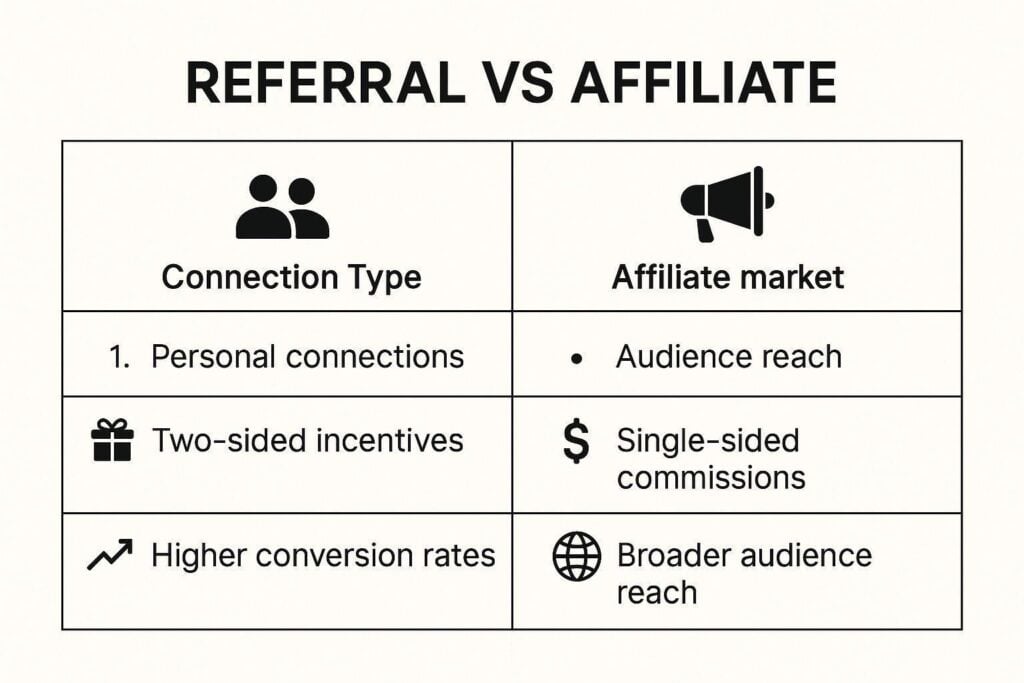
Key Differences Between Affiliate and Referral Marketing
Though similar in structure, affiliate and referral marketing differ in purpose, motivation, and the kind of trust they generate.
| Aspect | Affiliate Marketing | Referral Marketing |
| Primary Focus. | Expanding brand reach and awareness through professionals. | Building loyalty and trust through real customers. |
| Main Advocates | Bloggers, publishers, and content creators. | Existing satisfied users or customers. |
| Relationship Type | Transactional and performance-based. | Personal and relationship-driven. |
| Core Strength | Scalability and measurable analytics. | Authenticity and strong conversion rates. |
| Growth Speed | Rapid—ideal for quick exposure. | Gradual but sustainable. |
| Best Use Case | Market expansion and traffic growth. | Retention, advocacy, and community building. |
Affiliates scale fast but may lack emotional connection, while referrals convert better through personal relationships. Many brands combine both—affiliates for awareness, referrals for trust—to create a balanced growth engine.
Benefits and Challenges of Each Strategy
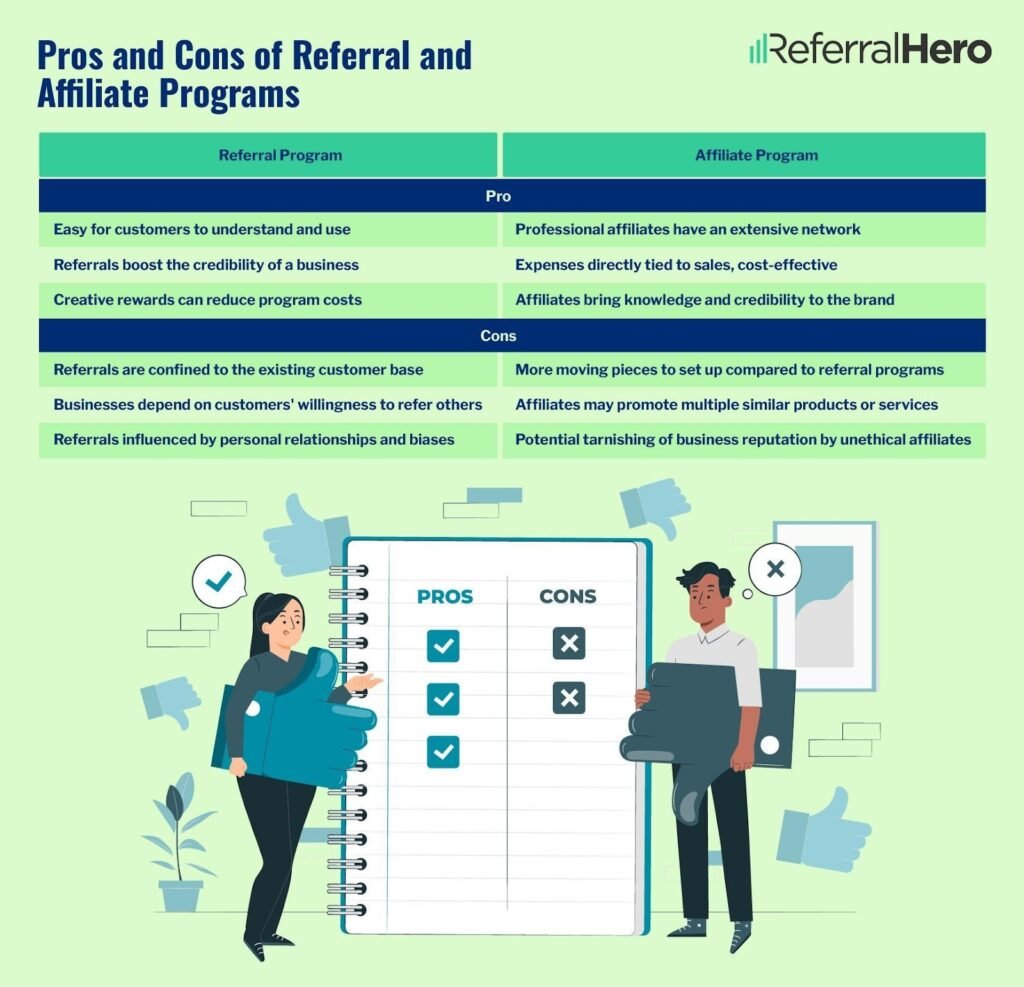
Both affiliate and referral marketing can drive impressive results, but their advantages play out in different ways.
Affiliates excel at scalability and measurable performance, while referrals deliver credibility and stronger customer relationships. Understanding their respective benefits helps you choose the model that best aligns with your goals.
Benefits Overview
Affiliate marketing focuses on reach and precision. It allows brands to tap into vast digital ecosystems, using data to optimize every campaign. Referral marketing, by contrast, deepens engagement through personal advocacy and genuine trust.
It strengthens customer relationships and sustains long-term growth.
Key benefits:
| Factor | Affiliate Marketing Benefits | Referral Marketing Benefits |
| Reach | Broad exposure through online creators and publishers. | Intimate, trust-based growth via existing customers. |
| Cost Efficiency | Pay-per-performance minimizes wasted spend. | Word-of-mouth referrals reduce marketing costs. |
| Sustainability | Continuous flow of new leads with measurable ROI. | Long-term retention from loyal advocates. |
| Scalability | Rapid expansion across multiple channels. | Organic, community-led growth over time. |
While these benefits make each strategy powerful, they also come with unique challenges that require careful management.
Challenges Overview
Every growth strategy has potential pitfalls. Affiliate programs can face fraud, misaligned incentives, or overly transactional relationships. Referral programs, on the other hand, may struggle with tracking, slower scalability, or inconsistent participation if rewards aren’t compelling.
Key challenges:
| Factor | Affiliate Marketing Challenges | Referral Marketing Challenges |
| Tracking Accuracy | Prone to misattribution or duplicate credit. | Difficult to verify private recommendations. |
| Scalability Issues | Managing large partner networks can be costly. | Growth depends on existing customer enthusiasm. |
| Fraud Risk | Vulnerable to fake clicks or cookie stuffing. | Risk of self-referrals or duplicate accounts. |
| Consistency | Quality varies across affiliates. | Participation may decline without ongoing incentives. |
Affiliates bring scale and data precision; referrals build trust and loyalty. The best-performing brands often integrate both, balancing automation with authenticity to create sustainable, measurable growth.
Criteria for Choosing the Right Strategy
Choosing between affiliate and referral marketing isn’t about picking a side—it’s about aligning strategy with your goals, audience, and capacity. The right model depends on what you want to achieve and how you measure success.
1. Define Your Core Objective
- For fast reach and traffic, affiliate marketing provides scalability.
- For trust and retention, referral marketing nurtures loyalty.
Many businesses start with referral programs to establish credibility, then add affiliate systems to expand market exposure.
2. Understand Your Audience
- Affiliates engage transactional audiences—buyers driven by content, discounts, or visibility.
- Referrals engage relationship-oriented audiences—those who act based on trust and recommendation.
Mapping audience behavior ensures the right message reaches the right people.
3. Evaluate Resources and Infrastructure
Affiliate programs require:
- Tracking software and compliance processes.
- Dedicated partner management.
Referral programs require:
- Strong customer satisfaction and engagement systems.
- Reliable delivery of rewards and follow-up communication.
If resources are limited, start with a referral system—it’s easier to manage and builds brand trust organically.
4. Integrate Technology and Automation
Modern marketing platforms allow businesses to run both programs together—tracking conversions, automating payouts, and monitoring performance from a single dashboard.
AI tools are particularly effective at reconciling data, detecting anomalies, and ensuring accurate reporting.
5. Adopt a Hybrid Model
For many organizations, the most effective strategy is a hybrid approach:
- Affiliates create awareness and bring in new audiences.
- Referrals deepen relationships and improve customer lifetime value.
When both work together, acquisition becomes more efficient, and retention more natural.
Future Outlook: Balancing Automation and Authenticity
As data privacy laws tighten and audiences grow wary of aggressive marketing, transparency and authenticity are becoming competitive advantages. Automation should enhance—not replace—human connection.
Brands that leverage AI responsibly can manage programs efficiently while keeping trust at the center. The future belongs to companies that use technology to amplify genuine advocacy, blending analytics with empathy.
Frequently Asked Questions
Is referral marketing the same as affiliate marketing?
No. Referral marketing and affiliate marketing both track links and reward conversions, but they are not the same. Referral marketing is customer-led. Affiliate marketing is partner-led and commission-driven.
Choose referral marketing when you want existing customers to recommend you based on real product experience. Choose affiliate marketing when you want to scale acquisition through creators, publishers, or partners whose main incentive is commission. A key difference is trust source: referrals come from personal relationships and customer experience, while affiliate promotions come from paid marketing partnerships, so referrals often drive warmer leads and affiliates often drive broader reach. Referral programs usually work best for brands with happy customers and repeat purchases. Affiliate programs fit brands expanding reach beyond their customer base. Nielsen has reported that 88 percent of people trust recommendations from people they know, which helps explain why referrals often convert well. In practice, brands often run both, using tools like ReferralCandy for referrals and Impact or PartnerStack for affiliates.
How do I choose between affiliate marketing and referral marketing if I am just starting out?
If you are just starting with no customer base, begin with affiliate marketing. If you already have repeat buyers or active users, referral marketing is usually the faster, lower-cost first step.
Affiliate marketing is easier to launch early because you can recruit creators, publishers, or agencies before customers know you well. Choose it if your goal is scalable top-of-funnel traffic, broader reach, and email list growth from partner-driven visitors. Referral marketing works best when customers already get clear value and can credibly recommend you; choose it if you want word-of-mouth conversions with less upfront partner recruitment. Nielsen reports that 88% of people trust recommendations from people they know more than any other advertising format. Whichever you choose first, set one primary conversion goal, define a simple reward, and use separate links or codes. Otherwise, last-click reports can hide whether affiliates or customer referrals are driving profitable sales. Platforms like impact.com and ReferralCandy are common choices.
What incentive works best in affiliate marketing vs referral marketing?
Commission-based incentives work best in affiliate marketing when your goal is net-new customer acquisition through publishers, creators, or partners. Two-sided rewards work best in referral marketing when your goal is to turn existing customers into advocates.
Affiliate incentives are usually a fixed bounty or a percentage of revenue, with terms such as a 30 to 90 day attribution window, payout thresholds, refund holds, and eligibility rules. Referral incentives are usually discounts, store credit, cash, or product perks, and they perform best when the offer and conditions can be explained in one sentence. Example: a SaaS brand might pay affiliates 20% recurring commission with monthly payouts after a $50 threshold, while its referral program gives both the customer and friend a $25 credit after the first paid order. One caution: if tracking is confusing or rewards arrive slowly, performance drops fast. Platforms like Impact, PartnerStack, and CustomGPT.ai should make attribution clear.
What metrics should you track differently in affiliate marketing vs referral marketing?
Affiliate marketing should be tracked with revenue and partner-efficiency metrics: EPC, conversion rate, AOV, approved commissions, incrementality, and assisted-conversion impact. Referral marketing should be tracked with advocacy and customer-value metrics: referral invite rate, share-to-click rate, code or link activation rate, referred-customer conversion rate, CAC, repeat purchase rate, and retention.
The metrics differ because affiliate programs are partner-driven and often involve multi-touch paths, so you need attribution and partner efficiency data. Referral programs are customer-advocacy driven, so you need to measure how often customers share, how friends engage, and whether referred users become valuable customers. If your goal is scalable traffic or leads through affiliates, also track lead quality, email capture rate, and downstream revenue from affiliate-sourced contacts. If your goal is turning customers into advocates, track participation and retention. Platforms like Impact and PartnerStack surface many affiliate metrics; Wharton research found referred customers can deliver about 16% higher lifetime value.
How can agencies reduce channel conflict when using both affiliate and referral marketing?
Reduce channel conflict by separating who each program is for and how each sale is credited. Use affiliate marketing for publishers or influencers, and reserve referral rewards for existing customers, with separate links, codes, and terms for each.
Then set one source of truth for attribution before launch. If a buyer first clicks an affiliate link but later converts with a friend’s referral code, decide in advance whether the sale follows first-click, last-click, or split-credit, and state that rule in both program terms. Define payout windows, exclusions, and promo-code stacking rules, because coupon extensions and shared codes often create overlap that inflates affiliate claims. Platforms like Impact and PartnerStack support distinct rule sets for each channel. Also document the rules in partner terms, audit overlap monthly, and create an exception process for disputed conversions. Under FTC endorsement guidance, paid influencer promotions and customer referrals can trigger different disclosure expectations, so separate governance also lowers compliance risk.
Can AI help manage affiliate and referral marketing without making it feel fake?
Yes. AI can manage affiliate and referral marketing without making it feel fake, if it handles operations and not the personal endorsement. Affiliate marketing is partner-driven for reach and acquisition; referral marketing works best when existing customers recommend you from real experience.
In practice, AI is most useful for the work that stalls teams: creating and checking tracking links, flagging FTC material-connection disclosure issues, routing affiliate leads into email follow-up, scoring partner quality, and showing which partners turn traffic into qualified subscribers or sales. If the recommendation depends on a customer's own experience, AI should send reminders, route leads, and measure results, not write the endorsement itself. That matters even more when affiliate traffic is meant to grow an email list, because trust affects both signups and later conversions. BernCo reported 4.81x ROI after tightening lead handling, and tools like Impact or PartnerStack can pair well with AI for partner reporting and compliance.
Final Thoughts
Affiliate and referral marketing aren’t competing methods—they’re complementary forces that strengthen each other. Affiliates bring reach and measurable performance; referrals bring trust and long-term loyalty.
By understanding their differences, aligning incentives, and integrating smart automation, businesses can design marketing systems that scale sustainably.
When managed well, AI-driven platforms, these strategies create a seamless bridge between technology and human advocacy, turning every interaction into an opportunity for growth.
Want to see which platforms can help you manage, track, and grow your affiliate campaigns more efficiently? Check out our next article — [5 Best All-in-One Tools for Affiliate Marketers] — for practical recommendations that make affiliate marketing easier and smarter.