

Most enterprise AI initiatives fail not because the technology is flawed, but because organizations underestimate AI adoption challenges at the human and operational level.
Teams often invest heavily in building sophisticated systems without ensuring those tools align with real workflows, leaving employees confused, resistant, or simply uninterested in using them.
The truth is, AI only delivers value when people actually trust and rely on it in their daily work.
When adoption is an afterthought rather than a design principle, even the most advanced AI becomes shelfware—quietly draining resources instead of driving impact.
Why Many Enterprises Still Choose to Build Custom AI
Many enterprises continue to believe that building AI internally gives them greater control, deeper customization, and long-term strategic leverage. This belief often comes from legacy IT decision-making, where internal systems were once the only path to flexibility.
In reality, most custom AI initiatives end up consuming months of engineering effort before delivering usable outcomes. Instead of accelerating progress, these projects frequently slow teams down and pull focus away from higher-impact work.

Image source: a3logics.com
The Control and Customization Mindset
Enterprises often assume that owning the full AI stack allows them to shape every detail to their needs. While this sounds appealing, it rarely translates into faster execution or better results.
What leaders expect vs. what teams experience
- Complete ownership over data and models
- Highly customized workflows for every department
- Freedom from external platform constraints
In practice, the added control often introduces complexity that limits agility rather than enhancing it.
Fear of Vendor Dependency
Many organizations hesitate to adopt AI platforms due to concerns about lock-in. This fear pushes teams toward building internally, even when platforms already meet most requirements.
Why vendor dependency feels risky
- Long-term pricing uncertainty
- Concerns over roadmap alignment
- Limited visibility into platform internals
Ironically, internal AI systems often create a deeper form of lock-in—tied to specific engineers, outdated infrastructure, and hard-to-replace custom code.
The Illusion of Competitive Advantage
Custom AI is frequently justified as a way to stand out from competitors. However, when the AI supports common workflows, it rarely becomes a true differentiator.
| Assumed Advantage | What Actually Happens |
| Unique capabilities | Replication of standard features |
| Faster innovation | Slower release cycles |
| Strategic moat | Ongoing maintenance burden |
Without adoption and execution, even custom-built AI fails to deliver real advantage.
Internal Pressure to “Own the IP”
Internal teams are often incentivized to build rather than buy. Ownership feels safer, more defensible, and more impressive on paper.
Why internal builds get approved
- Strong engineering culture
- Desire to justify AI investment
- Misalignment between business and technical goals
Over time, these motivations can lead enterprises to invest heavily in AI systems that deliver far less impact than expected.
Why Enterprise AI Struggles With Adoption, Not Capability
Most enterprise AI initiatives don’t fail because the technology is weak—they fail because people don’t use it. AI adoption challenges surface when AI is introduced without aligning to real workflows, existing tools, and how decisions are actually made inside organizations.
When adoption is treated as a rollout task instead of a design principle, even highly capable AI systems struggle to gain traction. The result is familiar: strong demos, limited daily usage, and growing internal skepticism.
AI Is Added Instead of Embedded
Enterprises often layer AI on top of existing processes rather than building it directly into where work already happens. This forces users to change behavior, switch tools, or duplicate effort just to access AI insights.
Why this approach blocks adoption
- AI feels like extra work instead of a productivity boost
- Users must leave their primary tools to access value
- Context is lost between systems and workflows
When AI interrupts flow instead of supporting it, employees disengage quickly.
Lack of Trust in AI Outputs
Employees hesitate to rely on AI when they don’t understand how recommendations are generated. This uncertainty slows adoption even when the AI is technically accurate.
What erodes trust internally
- Limited transparency into AI reasoning
- Inconsistent outputs across similar tasks
- No clear guidance on when AI should be used
Without trust, AI becomes something users double-check—or ignore entirely.
Change Management Is Treated as Optional
AI is frequently launched as a technical upgrade rather than an organizational shift. Training, communication, and leadership alignment are often rushed or skipped.
Common change management gaps
- Little onboarding or role-specific guidance
- Unclear ownership of AI usage
- No leadership reinforcement or incentives
Without change management, AI adoption relies on individual enthusiasm rather than organizational support.
Success Is Measured by Deployment, Not Usage
Many enterprises declare AI initiatives successful once systems go live. Actual usage, impact, and behavior change are rarely the primary metrics.
What gets measured instead of adoption
- Feature completion
- System availability
- Project delivery timelines
Until usage and outcomes become the definition of success, enterprise AI will continue to look effective on paper while underperforming in reality.
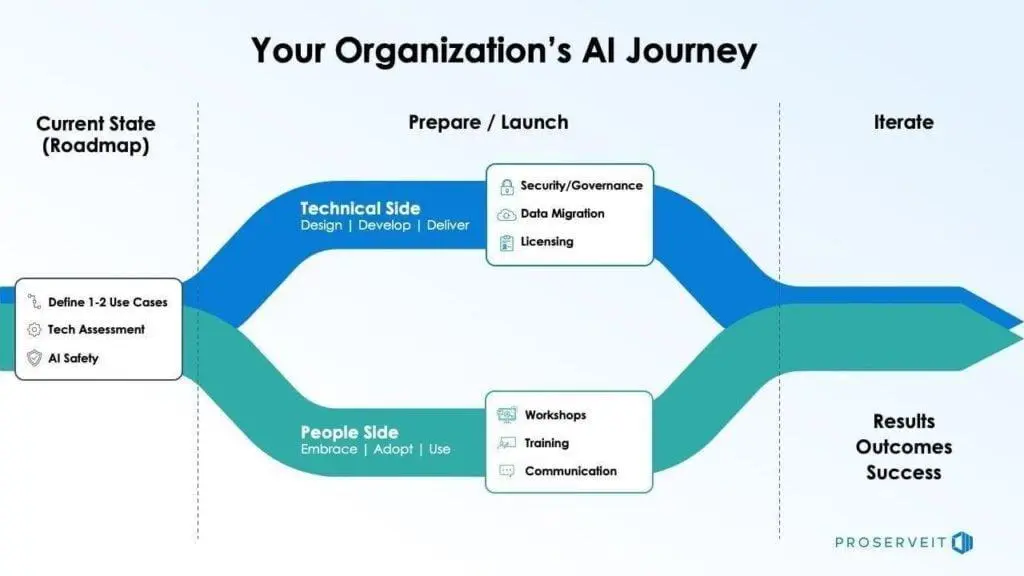
Image source: proserveit.com
What It Takes to Build AI People Actually Use
Building AI that delivers value isn’t about more features or smarter models—it’s about designing for real behavior. AI succeeds when it fits naturally into how people already work, rather than asking them to adapt to new systems.
When enterprises focus on usability and relevance from day one, AI adoption shifts from forced compliance to voluntary reliance. This is where many internal AI initiatives fall short—and where platform-led approaches tend to excel.
Start With Workflow, Not Technology
AI adoption improves dramatically when tools are designed around existing workflows instead of abstract capabilities. Users are far more likely to engage when AI appears at the exact moment a decision needs to be made.
What workflow-first AI design prioritizes
- Placement inside tools employees already use
- Context-aware suggestions tied to real tasks
- Minimal switching between systems
When AI supports work in-progress rather than interrupting it, usage becomes natural.
Make Value Immediately Obvious
Employees won’t explore AI just because it exists. They adopt it when the value is clear, immediate, and directly tied to their responsibilities.
What makes AI feel valuable on day one
- Clear time savings on routine tasks
- Better decisions with less effort
- Tangible outcomes users can see quickly
If value isn’t obvious early, adoption drops fast and rarely recovers.
Reduce Cognitive Load
AI tools often fail by asking users to think more, not less. Complex interfaces, unclear outputs, and excessive options slow adoption even when the AI is powerful.
How successful AI lowers friction
- Simple, focused interactions
- Clear recommendations over raw data
- Defaults that guide users confidently
The easier AI is to use, the more likely it becomes part of daily work.
Adoption Is Designed, Not Enforced
Enterprises can’t mandate AI usage and expect success. Adoption grows when AI earns trust and proves its usefulness repeatedly.
What drives organic adoption
- Consistent, reliable outputs
- Clear guidance on when to use AI
- Feedback loops that improve results
When AI is designed around people—not mandates—it becomes indispensable rather than ignored.
Why Platform-Led AI Adoption Outpaces Internal Builds Over Time
Platform-led AI succeeds because it removes friction long before adoption becomes a concern.
Instead of asking teams to wait months for internal systems to mature, platforms deliver usable AI capabilities that evolve continuously alongside user needs while minimizing long-term technical debt.
Over time, this difference compounds. Enterprises using platforms move faster, iterate more often, and spend less effort maintaining infrastructure—allowing them to focus on outcomes rather than upkeep as complexity accumulates internally.
Faster Time to Value
Internal AI projects often take months before users see anything usable. Platforms, by contrast, deliver value quickly, which builds confidence and momentum early.
What accelerates time to value with platforms
- Pre-built models ready for real use
- Immediate integration with existing tools
- Minimal setup and configuration
When users experience value early, adoption grows organically.
Continuous Improvement Without Internal Burden
AI platforms improve constantly through updates, tuning, and new capabilities. Enterprises benefit from these improvements without dedicating internal teams to maintenance.
Why this matters long term
- No need for ongoing model retraining
- Reduced dependency on specialized talent
- Automatic access to new capabilities
This keeps AI current without slowing internal teams.

Image source: techsur.solutions
Built-In Adoption and Usability
Platforms are designed with adoption in mind because their success depends on it. Usability, onboarding, and feedback loops are core features—not afterthoughts.
How platforms design for real users
- Intuitive interfaces tested across teams
- Clear onboarding and guidance
- Proven usage patterns across industries
This focus dramatically reduces common AI adoption challenges.
Lower Risk, Higher Flexibility
Platform-led approaches reduce the risk of sunk costs from failed internal projects. Enterprises retain flexibility to adapt as needs evolve.
Why platforms reduce downside risk
- Easier to scale up or down
- Faster pivots as requirements change
- Lower long-term maintenance commitments
By minimizing risk and maximizing adaptability, platforms consistently outperform internal builds over time.
Rethinking Enterprise AI Strategy for Long-Term Impact
Enterprise AI success requires a shift in mindset—from building technology to enabling outcomes. AI should be treated as a business capability, not an engineering project, with success defined by adoption and impact rather than technical sophistication.
When strategy centers on people, workflows, and measurable results, AI becomes a durable advantage instead of an ongoing experiment. This reframing is essential for enterprises looking to scale AI responsibly.
Shift From Ownership to Outcomes
Many enterprises still equate ownership with value, assuming internally built AI is inherently more strategic. In practice, outcomes—not ownership—determine whether AI delivers real impact.
What outcome-driven AI strategy prioritizes
- Measurable productivity gains
- Faster, better decision-making
- Clear links between AI and business KPIs
When outcomes lead strategy, AI investments become easier to justify and scale.
Design for Adoption From Day One
AI adoption cannot be retrofitted. It must be designed into the system from the beginning, shaping how tools are built, introduced, and supported.
What adoption-first design includes
- Early involvement of end users
- Clear guidance on when and how to use AI
- Feedback loops that improve relevance
This approach reduces resistance and increases long-term usage.
Treat AI as an Evolving Capability
AI is not a one-time implementation. Successful enterprises treat it as a continuously improving capability that adapts as needs change.
How leading teams approach AI evolution
- Regular review of usage and impact
- Ongoing optimization of workflows
- Willingness to replace tools that no longer serve users
This keeps AI aligned with real business needs over time.
Focus Internal Teams Where They Matter Most
Instead of dedicating teams to infrastructure and maintenance, enterprises gain more by focusing internal expertise on integration, governance, and strategic use cases.
Where internal effort delivers the most value
- Connecting AI to core systems
- Ensuring responsible and compliant usage
- Identifying high-impact opportunities
By reallocating effort toward strategy and adoption, enterprises turn AI from a cost center into a competitive advantage.
FAQ
Q: Why do enterprise AI tools fail even when the technology works?
A: Enterprise AI tools often fail because users don’t integrate them into daily work. The issue is usually workflow misalignment, lack of trust, or unclear value. Technical accuracy alone doesn’t change behavior. Adoption depends on usability and relevance.
Q: What does AI adoption mean beyond just deploying a system?
A: AI adoption means people consistently rely on the tool to make decisions or complete tasks. It requires behavioral change, not just technical availability. A deployed system that isn’t used has no practical impact. Adoption is measured through usage and outcomes.
Q: Why is AI adoption harder in large organizations?
A: Large organizations have complex workflows, legacy systems, and entrenched habits. Introducing AI often requires coordination across teams and roles. Without alignment, tools feel disruptive rather than helpful. This complexity slows adoption.
Q: How does lack of trust affect AI usage in enterprises?
A: When users don’t understand or trust AI outputs, they hesitate to rely on them. Inconsistent results or unclear reasoning increase skepticism. Users may ignore recommendations or double-check everything manually. Trust is essential for sustained use.
Q: What is the biggest mistake enterprises make with AI initiatives?
A: The biggest mistake is treating AI as a technical project instead of an organizational change. Enterprises often focus on building or deploying systems rather than designing for adoption. Without training and workflow fit, AI remains unused. Success depends on people, not just models.
Conclusion
Enterprise AI doesn’t fail because models are weak or technology is immature—it fails when adoption is treated as an afterthought.
When organizations prioritize building systems over enabling people, AI becomes another underused tool rather than a driver of real impact.
The enterprises that succeed with AI focus less on ownership and more on outcomes. By designing for workflows, trust, and everyday usage, AI shifts from an experimental initiative to a dependable capability that delivers long-term value.
Overcome AI Adoption Challenges.
Address AI adoption challenges by building AI that fits real workflows and user needs.
Trusted by thousands of organizations worldwide


