
As support volumes increase and customer expectations continue to rise, organizations are under pressure to resolve issues quickly without expanding engineering or support headcount.
AI is increasingly used to meet this demand, but effective ticket deflection depends on more than automation alone.
The real challenge is ensuring customer intent is fully resolved within a single interaction—without creating follow-up work, confusion, or loss of trust.
Modern AI support systems achieve this by combining intent recognition, controlled knowledge retrieval, and clear decision rules that determine when an issue can be resolved automatically and when it should be escalated.
When these systems are governed by support operations rather than engineering teams, organizations gain the ability to adjust behavior, manage risk, and improve outcomes continuously—delivering faster resolutions while maintaining service quality, compliance, and customer confidence.
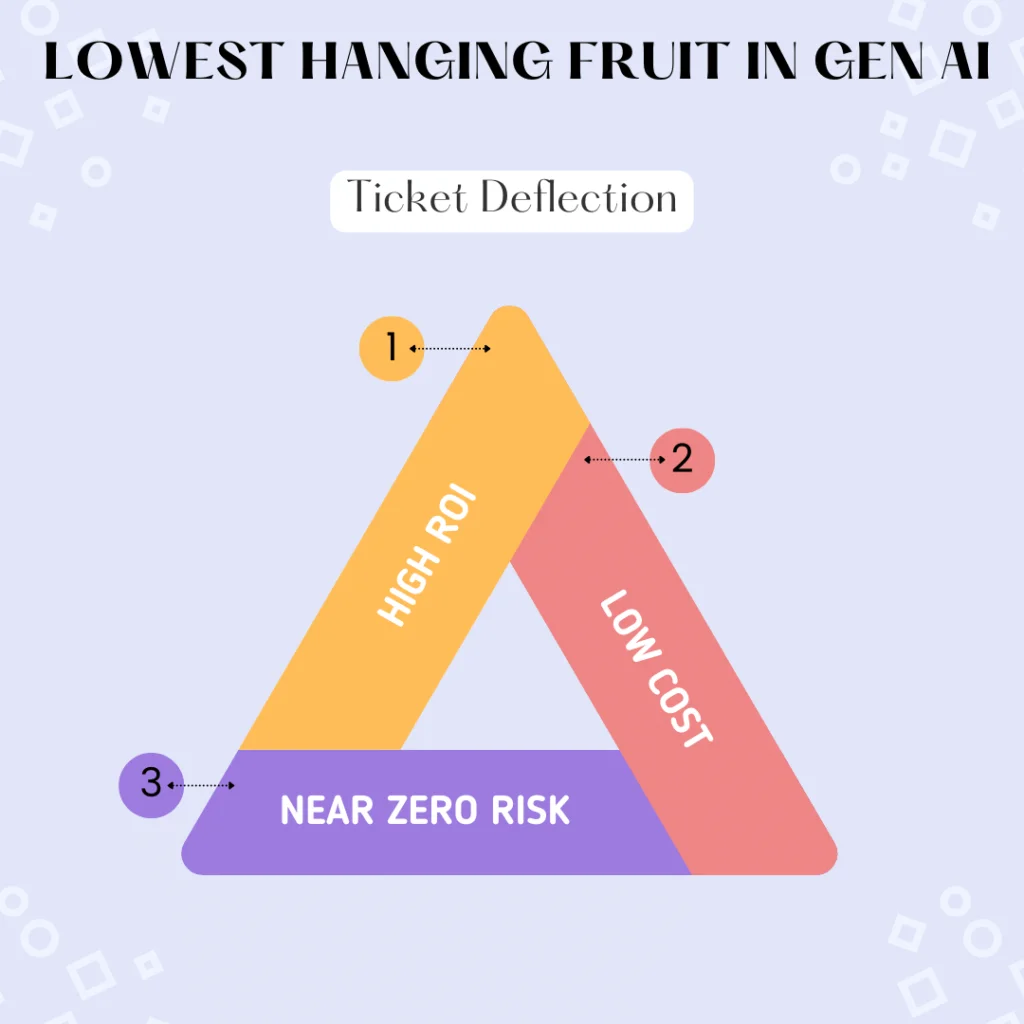
Defining Ticket Deflection and Why It Matters
Ticket deflection should be understood as the likelihood that a customer’s intent is fully resolved during the interaction, before a formal support case is created. This shifts attention away from channel reduction and toward intent completion.
Instead of measuring how many chats avoid the help desk, effective teams measure how often common issues—such as password resets, plan questions, or policy clarifications—end with the customer confidently moving on.
At a systems level, reliable deflection depends on three components working together:
- Accurate intent detection
- High-quality, up-to-date knowledge retrieval
- Clear decision rules for resolution, clarification, or escalation
When intent detection is inaccurate or content is outdated, automation may appear successful in dashboards but quietly increases repeat contacts and customer frustration.
A practical way to manage this risk is to treat deflection as a confidence-based decision.
For sensitive areas such as billing disputes, legal topics, or security issues, automation thresholds should be lower, and escalation should happen sooner. This approach prioritizes trust and compliance over raw deflection numbers.
What Good Ticket Deflection Looks Like in Practice
- Intent completion: The customer’s task is fully resolved
- Grounded responses: Answers come from approved, current sources
- Clear escalation paths: Human support is easy to reach when needed
- Outcome-based measurement: Success is validated by downstream behavior, not just chat volume
Core AI Technologies in Customer Support
Modern AI-driven support systems are defined not by a single feature, but by how several technologies work together to reduce friction, preserve context, and resolve issues efficiently.
In real production environments, performance depends more on orchestration and constraints than on model complexity. Most failures occur when responsibilities between system components are unclear.
Intent Detection and Classification
Intent detection determines what the customer is trying to accomplish, even when language is ambiguous or incomplete. The goal is reliable routing, not perfect language understanding. Effective intent systems typically include:
- Multiple signals, including message text and session context
- Behavioral inputs such as page location or repeated attempts
- Conservative fallbacks for unclear or high-risk requests
Precision is more important than coverage. Incorrectly routing billing or access issues causes more harm than escalating unnecessarily.
Retrieval-Augmented Responses
Retrieval-augmented systems generate answers using verified, approved content rather than relying solely on model memory.
In customer support, this behaves more like controlled context assembly than open search. Strong retrieval systems:
- Limit sources by intent and user permissions
- Separate concise answers from detailed documentation
- Prioritize current and authoritative content
This prevents contradictory or outdated responses.
Policy and Decision Logic
Policy layers define what the AI is allowed to say or do. These controls are critical for refunds, entitlements, compliance topics, and account changes. Well-designed policy logic:
- Operates independently of language generation
- Encodes business rules and escalation requirements
- Ensures consistent behavior across channels
Without explicit policy enforcement, even accurate answers can create risk.
Conversational State and Context Management
Maintaining context allows conversations to remain coherent across multiple steps or pages. Context includes what has already been asked, answered, or attempted. Effective context handling includes:
- Session-level memory of intent and resolved questions
- Avoidance of repeated clarification requests
- Clean handoff of context during escalation
Loss of context is one of the most common causes of customer frustration.
Analytics and Feedback Loops
AI support systems improve only when outcomes are measured. Logging intents, responses, outcomes, and corrections enables continuous refinement. High-performing teams:
- Track durable resolution, not just deflection
- Review misrouted or corrected interactions
- Feed structured feedback into content and policy updates
This turns automation into a continuously improving operational system.
Leveraging No-Code AI Tools for Support Automation
No-code platforms deliver value when support operations teams control system behavior directly, rather than relying on developers for routine changes. This does not eliminate engineering involvement entirely, but it removes dependency for everyday tuning.
Modern no-code platforms expose advanced controls—such as confidence thresholds, routing rules, and scoped retrieval—through governed interfaces. Behavior is defined through configuration rather than hard-coded logic.
Governance Requirements for No-Code Systems
- Versioned changes: Every update has history and rollback
- Scoped permissions: Only approved roles can publish changes
- Staged rollouts: Changes are tested on limited traffic first
Without governance, no-code systems quickly become difficult to manage.
Integrating AI Chatbots and Virtual Agents
Successful integration depends on how the conversation state is managed across turns. When state is handled centrally rather than left to model memory, system behavior becomes predictable and auditable. Effective integrations define:
- What information the system must remember
- Which sources it may consult for each intent
- What actions it is allowed to take
Guardrailed journeys typically produce more consistent outcomes for high-volume intents, while limited free-text flexibility can still be used for low-risk scenarios.
Measuring and Optimizing Ticket Deflection
Effective deflection measurement focuses on whether the issue was resolved without re-contact, not simply whether a ticket was avoided. A useful evaluation model treats each interaction as a lifecycle:
- Entry intent
- AI outcome (resolved, assisted, escalated)
- Downstream behavior (re-contact or resolution)
Intent-level measurement provides clearer insights than session-level metrics.
Metrics That Support Teams Actually Use
- Per-intent deflection rate
- Re-contact rate within a defined window
- Assisted handle-time reduction
- Failure reasons (content gap, policy constraint, routing error)
Governance and Quality Assurance
As automation expands, governance becomes more important, not less. AI support systems should be treated as production systems with clear change controls. Effective governance includes:
- Intent-level testing for major contact drivers
- Mandatory escalation rules for sensitive topics
- Retrieval validation to prevent unapproved sources
- Post-release monitoring with rollback triggers
FAQ
How does AI customer support automation achieve high ticket deflection rates without relying on engineering teams or custom development?
Ticket deflection improves when support operations can configure intent routing, retrieval scopes, confidence bands, and escalation policies through an admin console. The key is controlled retrieval from approved knowledge, clear decision rules, and outcome-based measurement.
What role do knowledge bases, CRM systems, and help desk platforms play in a ticket deflection architecture?
Knowledge bases provide canonical answers, CRMs add customer context, and help desks provide workflow and history. When these systems are connected through a controlled orchestration layer, the assistant can retrieve approved content, personalize safely, and escalate with full context.
How can support operations leaders improve intent recognition and reduce ticket volume with no-code tools?
Leaders can define a granular intent taxonomy, bind each intent to approved sources, and tune confidence bands and guardrails per intent. Performance improves through an iterative loop: monitor re-contact and sentiment, audit failures, and adjust scopes, clarifications, and escalation rules.
What governance, security, and compliance considerations should be addressed?
Key controls include role-based publishing permissions, audit logs for changes, scoped retrieval to approved sources, and conservative escalation for sensitive intents. High-risk workflows typically require stricter guardrails, shorter review cadences, and stronger traceability from answer to source.
How should effectiveness be measured across deflection, satisfaction, and re-contact reduction?
Track per-intent deflection, re-contact within a defined window, escalation rate, and a resolution integrity measure that validates durable resolution. Combine quantitative metrics with transcript audits so improvements can be tied to specific intents, sources, and policies.
Conclusion
AI customer support automation delivers real value when it is treated as an operational system rather than a standalone tool. Reliable ticket deflection depends on intent accuracy, trusted knowledge, clear policies, and measurable outcomes.
By giving support teams direct control over configuration—without requiring developer involvement—organizations can adapt faster, resolve issues more consistently, and improve customer experience without increasing risk.
Upgrade Customer Support with AI
Move from static documents to AI-powered knowledge delivery that answers in real time.
Trusted by thousands of organizations worldwide


