What Metrics Should I Track to Measure the Success of an AI Customer Support Implementation?
To measure the success of an AI customer support implementation, track metrics across efficiency, quality, customer experience, and business impact. Key indicators include ticket deflection rate, first response time, resolution rate, CSAT, escalation rate, and cost per ticket. For perceived latency improvements, compare those metrics with GPT streaming for chatbot response times. Together, these show whether AI is reducing workload while maintaining trust and satisfaction.
Teams should measure self-serve AI support integrations only after defining the knowledge source, entry point, escalation path, and scoreboard.
Why measuring AI support performance matters
AI support impacts multiple areas at once: speed, cost, accuracy, and customer trust. Tracking only one metric, such as ticket volume, hides problems like poor answer quality or customer frustration. Gartner reports that over 50% of failed AI support projects fail due to poor measurement and optimization, not technology limitations.
The Cost of Tracking the Wrong Metrics
- AI resolves tickets but lowers CSAT
- Customers bypass AI and overload agents
- Automation savings disappear over time
Key takeaway
AI support success must be measured across operational, customer, and financial outcomes.
Ticket Deflection Rate and Why It Matters
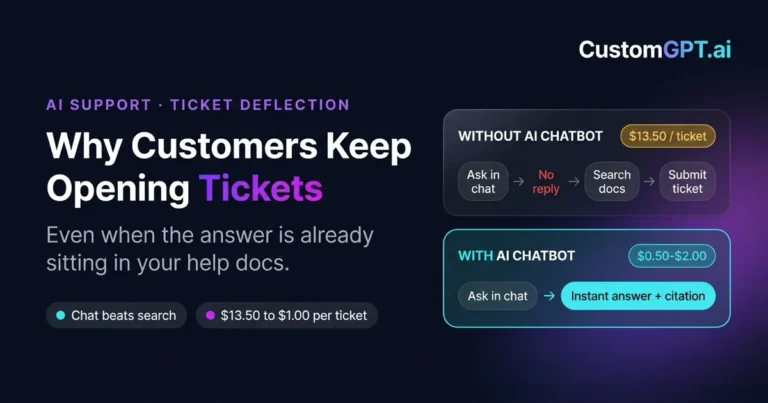
Ticket deflection rate measures how many customer issues are resolved by AI before a human ticket is created. Industry benchmarks show:
- 20–40% deflection in the first 3–6 months
- 40–60% for mature, knowledge-driven AI systems
First Response Time as an Indicator of AI Performance
First response time measures how quickly customers receive an answer.
| Support Model | Typical First Response Time |
|---|---|
| Human-only | 2–24 hours |
| AI-assisted | Instant to under 5 seconds |
Zendesk data shows faster first responses can improve CSAT by up to 15%.
Resolution Rate
Resolution rate tracks the percentage of conversations the AI fully resolves without escalation. For Tier 1 support, strong AI systems typically resolve 50–70% of repetitive issues.
Key takeaway
Operational metrics confirm whether AI is delivering speed and workload reduction.
Most Important Customer Experience Metrics
| Metric | What it measures | Why it matters |
|---|---|---|
| CSAT | Customer satisfaction after interaction | Direct trust signal |
| CES | Customer effort score | Measures friction |
| Escalation rate | How often AI hands off to humans | Indicates AI limits |
| Repeat contact rate | Same issue asked again | Shows answer quality |
Forrester research shows that reducing customer effort has a stronger impact on loyalty than delighting customers.
A Healthy Escalation Rate
A healthy AI system escalates:
- Early for complex or emotional issues
- Automatically when confidence is low
An escalation rate of 20–40% for Tier 1 automation is normal and healthy. Very low escalation often signals hidden frustration.
How Repeat Contact Rate Reveals AI Weaknesses
If customers ask the same question multiple times, AI answers may be incomplete, outdated, or unclear.
Key takeaway
Customer-focused metrics reveal whether AI support builds or erodes trust.
Financial Metrics That Show Real Impact
| Metric | Typical Impact After AI Deployment |
|---|---|
| Cost per ticket | Reduced by 25–40% |
| Agent productivity | Increased by 20–35% |
| Support headcount growth | Slowed or avoided |
| After-hours coverage | 24/7 without added cost |
McKinsey estimates AI-driven support can reduce service costs by up to 30% when deployed correctly.
Connecting Metrics to Business Outcomes
Successful teams track:
- Deflection → cost savings
- Faster resolution → retention
- Better CSAT → repeat purchases
Why CustomGPT.ai Simplifies Measurement
CustomGPT.ai provides:
- Built-in analytics for deflection, resolution, and escalation
- Conversation-level visibility for quality control
- Clear separation of AI-resolved vs human-resolved issues
Key takeaway
Business metrics confirm whether AI support delivers sustainable ROI, not just automation.
Summary
To measure the success of an AI customer support implementation, track ticket deflection rate, first response time, resolution rate, CSAT, escalation rate, repeat contact rate, and cost per ticket. These metrics together show whether AI reduces workload, maintains answer quality, and improves customer experience.
Ready to measure and improve your AI support performance?
Use CustomGPT.ai to track deflection, quality, escalation, and ROI from one place. It helps optimize your AI support with real data, not guesswork.
Trusted by thousands of organizations worldwide


Frequently Asked Questions
What metrics should I track in the first 90 days of an AI customer support rollout?
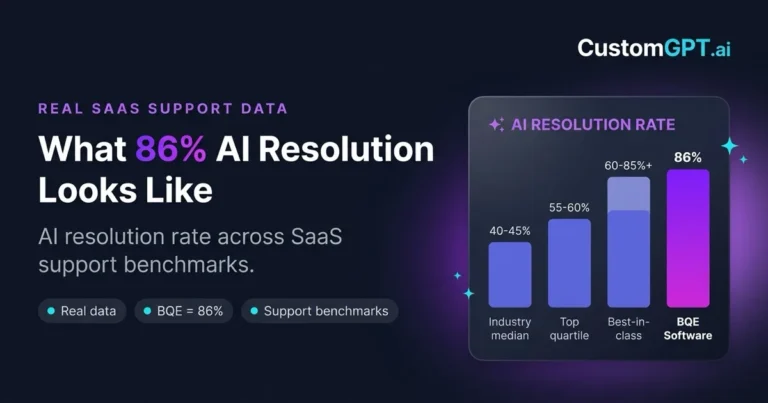
In the first 90 days, track ticket deflection rate, first response time, resolution rate, and escalation rate together. Early benchmarks are 20-40% deflection in the first 3-6 months, instant to under 5 seconds for AI-assisted first response, and 20-40% escalation for Tier 1 automation. BQE Software shows what strong execution can look like: 86% AI resolution, 64% of tickets handled by AI, and self-service growth from 5.95% to 24.10%. If response time improves but resolution stays flat or escalations rise, the rollout is getting faster without reducing support workload.
How do I prove AI support ROI without relying on vanity metrics like chat volume?
Start with cost per ticket, resolution rate, and ticket deflection, not raw chat volume. ROI is strongest when AI resolves or deflects work that would otherwise require agent time, so compare the cost of an AI-resolved interaction with a human-handled ticket, then subtract platform and maintenance costs. BQE Software describes the right outcome clearly: “CustomGPT.ai has fundamentally changed how we deliver help and support to existing and potential customers. The number of queries handled by our chatbot is steadily increasing over time, thus encouraging self-service and reducing pressure on our support team without compromising quality.” That is a better ROI model than counting conversations alone.
Can a very low escalation rate be a warning sign?
Yes. For Tier 1 automation, a 20-40% escalation rate is normal and healthy. Very low escalation can mean customers are not being handed to a human when the issue is complex, emotional, or low-confidence. Check repeat contact rate and CSAT alongside escalation rate. If handoffs are low but repeat contacts rise, the assistant may be trapping customers instead of resolving them.
How can I tell if faster response times are actually improving support?
Faster response times help only when resolution, repeat contact, or satisfaction also improve. AI-assisted support is typically instant to under 5 seconds, and Zendesk data shows faster first responses can improve CSAT by up to 15%. To confirm the speed is useful, pair first response time with a quality or engagement outcome. At BQE Software, bounce rate dropped from 18.99% to 4.80%, which is a stronger signal that users were finding answers, not just getting quick replies.
What is a good resolution rate for complex support topics, not just simple FAQs?
For Tier 1 repetitive issues, a 50-70% resolution rate is a strong benchmark. For more complex topics, set targets by intent type instead of using one blended goal. Password resets, billing status, and policy lookups can support higher automation targets, while regulated, exception-heavy, or emotionally sensitive issues should escalate earlier. A good resolution rate is the highest level you can reach without increasing repeat contacts, unsafe answers, or customer effort.
What metric catches AI answer quality problems before CSAT drops?
Track repeat contact rate and run an answer-accuracy audit. Repeat contacts often mean the first answer was incomplete, outdated, or unclear, even if the conversation appeared successful. A weekly review of high-risk conversations should score factual correctness, policy alignment, and source support. That matters in retrieval-based systems because a benchmark found CustomGPT.ai outperformed OpenAI on RAG accuracy, which shows that answer quality deserves its own KPI beside speed and resolution.
Can AI support metrics show revenue impact, not just cost savings?
Yes, but only when the assistant also influences buying behavior. If it helps with product selection, proposals, lead capture, or after-hours inquiries, track conversion rate, qualified leads, or revenue per conversation alongside support KPIs. If the rollout is strictly support-focused, cost per ticket and productivity usually show value sooner. Stephanie Warlick summarizes the broader business use case well: “Check out CustomGPT.ai where you can dump all your knowledge to automate proposals, customer inquiries and the knowledge base that exists in your head so your team can execute without you.”
Related reading: AI customer support software comparison for teams evaluating ticket deflection, handoff rules, and knowledge-grounded answers.