
Building AI sounds exciting, but without a clear plan, even the smartest initiatives can stall.
An effective AI deployment roadmap connects business priorities with practical execution, ensuring AI investments move beyond experimentation and into measurable impact.
The difference between AI projects that succeed and those that fail often comes down to strategy, not technology.
By aligning stakeholders, data readiness, and long-term goals early, organizations can turn AI from a buzzword into a reliable driver of growth and competitive advantage.
Validated Use Cases: Where AI Is Already Delivering ROI
Before experimenting with cutting-edge ideas, a strong AI Deployment Roadmap starts with use cases that are already proven. These applications have moved beyond theory and are actively delivering measurable gains in efficiency, revenue, and customer experience across industries.
Focusing on validated use cases reduces risk while building internal confidence, making them the fastest way to demonstrate business value from AI adoption. This stage also lays the cultural and operational foundation needed to support more advanced AI initiatives later on.
Marketing Automation and Content Generation
AI-powered content creation has become one of the most reliable entry points in an enterprise AI strategy. Marketing teams are using generative models to scale high-quality content production while maintaining brand consistency and improving SEO performance.
Why this use case consistently delivers value
- Accelerates blog, email, and campaign content creation
- Improves SEO optimization through data-driven suggestions
- Frees marketers to focus on strategy and creative direction
When implemented correctly, AI-driven marketing automation quickly proves its worth by increasing output without increasing headcount.

Image source: linkedin.com
Customer Support and Ticket Deflection
AI chatbots and virtual assistants are now handling a significant portion of customer inquiries with speed and accuracy. Solutions like CustomGPT.ai allow businesses to deploy secure, domain-specific AI that resolves issues while protecting proprietary data.
Core benefits for customer experience teams
- Reduces ticket volume and average resolution time
- Improves customer satisfaction with instant responses
- Enables human agents to focus on complex, high-value cases
This use case is often a cornerstone of a scalable AI implementation plan because the cost savings and CX improvements are easy to measure.
Employee Productivity and Knowledge Assistance
Internal AI tools are transforming how employees work with information, from summarizing documents to drafting communications. Platforms such as OpenAI’s ChatGPT or custom-trained internal models help teams eliminate repetitive tasks and make faster decisions.
High-impact productivity gains include
- Faster document drafting and summarization
- On-demand access to internal knowledge bases
- Reduced time spent on routine administrative work
By embedding AI into daily workflows, organizations unlock compounding productivity gains that support long-term digital transformation.
Currently Deploying: AI Gaining Traction Inside Organizations
The second phase of an effective AI Deployment Roadmap focuses on use cases that are actively being rolled out across forward-thinking organizations.
These initiatives are no longer experimental and are beginning to show consistent operational and financial impact. At this stage, companies strengthen their AI adoption framework by embedding intelligence directly into core workflows.
The emphasis shifts from exploration to execution, ensuring AI systems are reliable, scalable, and aligned with business goals.
AI-Assisted Coding and Development
AI is increasingly embedded into software development workflows to accelerate delivery and improve code quality. Development teams use AI support to streamline repetitive tasks and reduce friction across the build and review process.
Where development teams see the biggest gains
- Faster development cycles and iteration
- Fewer coding errors and cleaner codebases
- Reduced manual effort in reviews and documentation
As part of a broader enterprise AI strategy, this capability helps technical teams deliver more value with the same resources.
Legal Review and Compliance Automation
Legal and compliance functions are actively deploying AI to manage growing document volumes and regulatory complexity. AI systems now assist with analyzing contracts, identifying risk, and flagging compliance issues at scale.
Business benefits driving adoption
- Faster turnaround on legal reviews
- Improved risk visibility and consistency
- Lower operational overhead for legal teams
This use case fits naturally into a scalable AI implementation plan where accuracy and efficiency are critical.
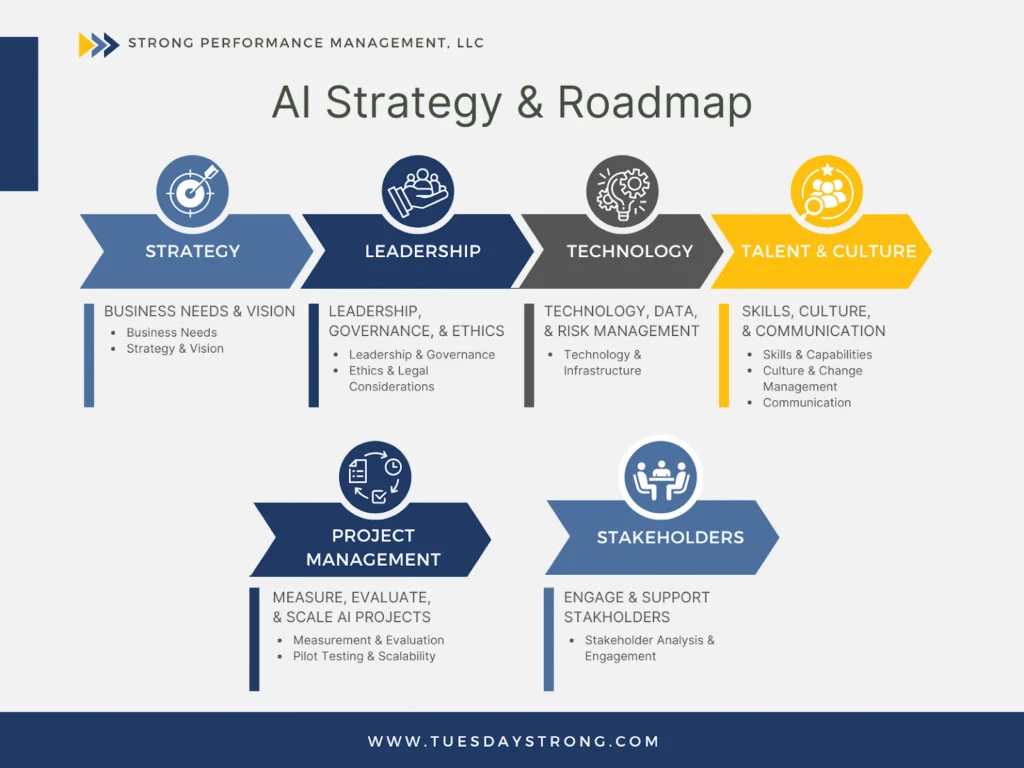
Image source: tuesdaystrong.com
Data Analysis and Decision Support
AI-powered analysis is helping teams move from static reports to real-time insight generation. By making data more accessible, organizations empower leaders to make faster, more informed decisions.
Key outcomes organizations experience
- Quicker insight discovery across large datasets
- Reduced dependence on specialized analysts
- More confident, data-driven decision-making
As adoption grows, these capabilities become foundational to long-term AI maturity and operational intelligence.
On the Horizon: Emerging AI Capabilities Shaping the Future
The final stage of an AI Deployment Roadmap focuses on capabilities that are rapidly moving from experimentation to real-world application. These emerging use cases are not yet fully mature, but early adopters are already testing their potential to unlock new efficiencies and revenue streams.
Organizations that prepare for this phase early gain a strategic advantage by building the skills, governance, and data foundations needed to adopt advanced AI with confidence. This stage is less about immediate ROI and more about future-proofing the business.
Sales Automation Agents
AI-driven agents are beginning to support sales teams by automating early-stage engagement and follow-ups. These systems help ensure no opportunity is missed while allowing sales professionals to focus on relationship building and closing.
Why sales teams are piloting AI agents
- Faster lead qualification and prioritization
- Consistent follow-up and engagement
- Improved pipeline visibility and accuracy
As part of a forward-looking enterprise AI strategy, sales automation agents represent a shift toward always-on revenue operations.
AI-Driven Workflow Optimization
AI is evolving from task automation to full workflow orchestration across departments. Emerging systems can analyze processes end-to-end and recommend or execute improvements in real time.
Operational advantages under exploration
- Reduced process bottlenecks and delays
- Smarter resource allocation
- Continuous operational optimization
These capabilities align closely with long-term AI adoption frameworks focused on efficiency at scale.
Specialized Research Assistance
Advanced AI research assistants are being tested to support deep analysis across technical, legal, and market domains. These systems synthesize large volumes of information into structured insights for faster decision-making.
Early value signals from research pilots
| Research Area | AI Contribution | Business Impact |
| Market analysis | Rapid trend synthesis | Faster strategic planning |
| Technical research | Document summarization | Reduced research time |
| Competitive intelligence | Insight extraction | Better positioning decisions |
While still emerging, specialized research assistance is quickly becoming a key component of future-ready AI strategies.
Turning the Roadmap Into Action
An AI Deployment Roadmap only delivers value when it is tied to execution, ownership, and measurable outcomes. After identifying validated, current, and emerging use cases, the next step is sequencing them in a way that aligns with business priorities and operational readiness.
Successful organizations treat AI adoption as an ongoing capability, not a one-time project. By combining quick wins with longer-term bets, they build momentum while steadily advancing AI maturity.
Prioritization and Business Alignment
Clear prioritization ensures AI initiatives support real business outcomes rather than isolated experiments. Teams should evaluate each use case based on impact, feasibility, and strategic relevance.
What to prioritize first
- Use cases with clear ROI and measurable KPIs
- Areas with strong data availability
- Functions with leadership buy-in and operational readiness
This approach keeps AI efforts tightly connected to business value from day one.
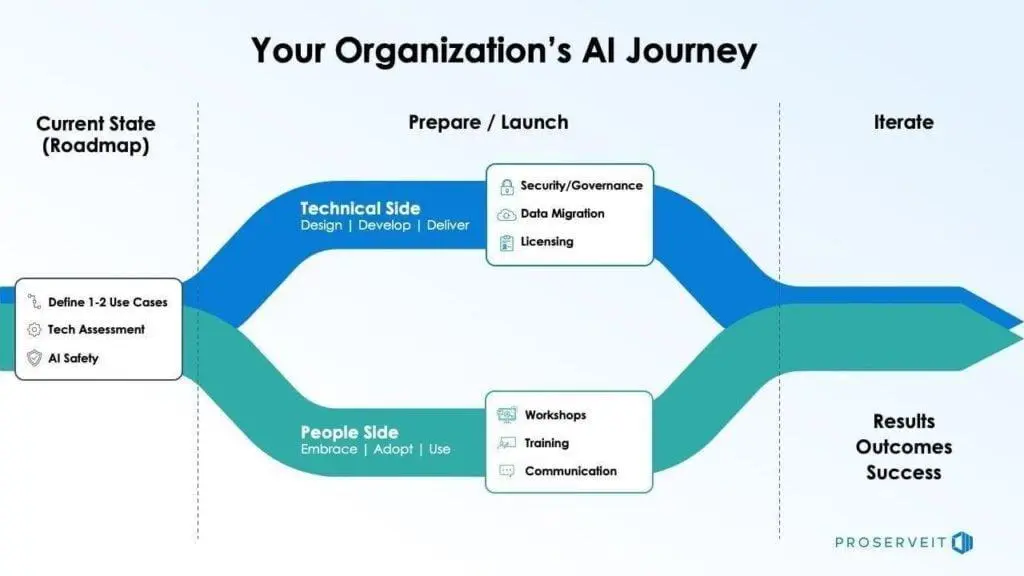
Image source: proserveit.com
Data, Governance, and Risk Readiness
Strong data foundations and governance structures are essential as AI systems scale. Without them, even high-potential initiatives can stall or introduce unnecessary risk.
Foundational elements to put in place
- Clear data ownership and access controls
- Responsible AI and compliance guidelines
- Ongoing monitoring and performance evaluation
These safeguards support sustainable AI adoption while maintaining trust and accountability.
Scaling Across the Organization
Once early successes are proven, AI capabilities should be expanded across teams and departments. Scaling requires repeatable processes, internal education, and shared best practices.
Keys to successful scaling
- Reusable AI components and workflows
- Employee training and change management
- Cross-functional collaboration
When scaling is intentional, AI becomes a core operational capability rather than a siloed innovation effort. A well-executed roadmap transforms AI from uncertainty into advantage, guiding organizations from proven wins to future-defining capabilities with clarity and confidence.
FAQ
What is an AI Deployment Roadmap?
An AI Deployment Roadmap is a structured plan that outlines how an organization identifies, prioritizes, and scales AI use cases to deliver measurable business value.
Why do many AI initiatives fail to deliver ROI?
Most AI projects fail due to unclear objectives, poor data readiness, and lack of alignment between AI efforts and business strategy.
Which AI use cases should businesses start with?
Organizations should begin with validated use cases that have proven ROI, such as productivity enhancement, customer experience improvement, and process automation.
How does an enterprise AI strategy differ from experimentation?
An enterprise AI strategy focuses on scalable execution, governance, and long-term impact, while experimentation is limited to isolated pilots without operational integration.
How often should an AI roadmap be updated?
An AI roadmap should be reviewed regularly—at least quarterly—to reflect evolving business priorities, data maturity, and advancements in AI capabilities.
Conclusion
An effective AI Deployment Roadmap turns uncertainty into clarity by showing organizations where to start, what to prioritize, and how to scale with confidence.
By focusing on proven use cases, expanding into active deployments, and preparing for emerging capabilities, businesses can ensure AI delivers real, measurable value.
AI success is not about chasing every new innovation, but about disciplined execution aligned with business goals.
Organizations that approach AI with structure, governance, and long-term intent position themselves to turn AI into a sustainable competitive advantage rather than a short-lived experiment.
Build an AI Deployment Roadmap That Delivers.
Create an AI deployment roadmap that aligns teams, prioritizes use cases, and drives real business outcomes.
Trusted by thousands of organizations worldwide


