
AI for E-commerce: A Guide for Agencies to Boost Client Sales and Conversions
AI for e-commerce agencies is quickly becoming the foundation for how modern agencies, including those using white-label AI platforms, drive higher sales and stronger conversions for online brands.

Make Money With AI
By leveraging intelligent automation and data-driven insights, agencies can deliver personalized shopping experiences that scale without sacrificing performance.
As competition across digital storefronts continues to rise, clients expect agencies to bring more than creative execution—they expect results.
AI-powered optimization across pricing, product recommendations, and customer journeys enables agencies to turn traffic into revenue while proving long-term value.
AI-Powered Product Recommendations for Smarter E-commerce Growth
AI-powered product recommendations give marketing agencies a powerful way to influence buying decisions at the exact moment customers are ready to act.
By analyzing browsing behavior, purchase history, and intent signals, AI helps agencies deliver highly relevant product suggestions that drive higher conversions and average order value.
For agencies focused on e-commerce personalization, these systems continuously adapt as customer behavior changes. This ensures recommendations stay relevant across seasons, campaigns, and traffic sources while supporting long-term revenue growth for clients.
How AI Product Recommendations Improve Conversions
AI recommendation engines surface the most relevant products based on real-time customer data rather than static rules. This creates a smoother shopping journey that reduces friction and increases purchase confidence.
Key conversion benefits for agencies
- Higher average order value through intelligent upselling
- Improved engagement with personalized product discovery
- Reduced bounce rates on category and product pages
- Stronger customer retention driven by relevance
When shoppers see products that match their intent, conversions increase naturally without added advertising costs.
Practical Recommendation Use Cases Agencies Can Offer
Marketing agencies can turn AI-powered product recommendations into scalable service offerings that deliver measurable ROI. These use cases allow agencies to directly connect personalization efforts to revenue outcomes.
High-impact recommendation placements
- Homepage recommendations based on browsing behavior
- Product page cross-sells and complementary items
- Cart and checkout upsell suggestions
- Personalized email product recommendations
Each placement reinforces e-commerce personalization while supporting consistent growth across the customer journey.
Evaluating AI Recommendation Tools for E-commerce Clients
Choosing the right recommendation technology is critical for agencies managing multiple brands and storefronts. The ideal solution should balance performance, scalability, and ease of deployment.
| Evaluation Factor | Why It Matters |
| Real-time learning | Keeps recommendations accurate as behavior shifts |
| Multi-store support | Simplifies agency operations |
| Analytics visibility | Enables performance reporting |
| Integration flexibility | Reduces setup and maintenance time |
Selecting the right tool ensures agencies can scale AI-powered product recommendations without increasing operational complexity.
Dynamic Pricing Strategies Powered by AI
Dynamic pricing powered by AI allows marketing agencies to help e-commerce brands stay competitive in real time. By analyzing demand fluctuations, competitor pricing, inventory levels, and customer behavior, AI enables prices to adjust automatically to maximize revenue and profitability.
For agencies managing fast-moving e-commerce environments, AI-driven pricing removes guesswork and manual updates. This approach ensures pricing decisions are data-backed, timely, and aligned with both market conditions and customer willingness to pay.
How AI-Driven Dynamic Pricing Works
AI pricing models continuously evaluate internal and external data signals to determine optimal pricing at any given moment. This creates a responsive pricing strategy that adapts faster than traditional rule-based methods.
Core data signals used in dynamic pricing
- Competitor pricing and market trends
- Inventory levels and stock velocity
- Customer demand and browsing behavior
- Seasonality and promotional activity
These inputs allow agencies to implement pricing strategies that respond instantly to changing market conditions.
Benefits of Dynamic Pricing for E-commerce Agencies
Dynamic pricing gives agencies a clear way to demonstrate revenue impact without increasing traffic spend. It aligns pricing decisions with real customer behavior and demand patterns.
Key advantages for agencies
- Improved profit margins through optimized pricing
- Faster response to market and competitor changes
- Reduced manual pricing adjustments
- Data-backed pricing recommendations for clients
This positions dynamic pricing as a strategic revenue lever rather than a tactical pricing tweak.
Common Dynamic Pricing Models Agencies Can Implement
Marketing agencies can tailor dynamic pricing models based on a client’s business goals, product types, and competitive landscape. Each model serves a different growth objective.
Popular dynamic pricing approaches
- Demand-based pricing for high-traffic products
- Competitor-based pricing in saturated markets
- Inventory-based pricing for stock optimization
- Customer-segment pricing for loyalty and retention
Selecting the right approach ensures dynamic pricing strategies align with both profitability and brand positioning.
Connecting Dynamic Pricing with Marketing Automation
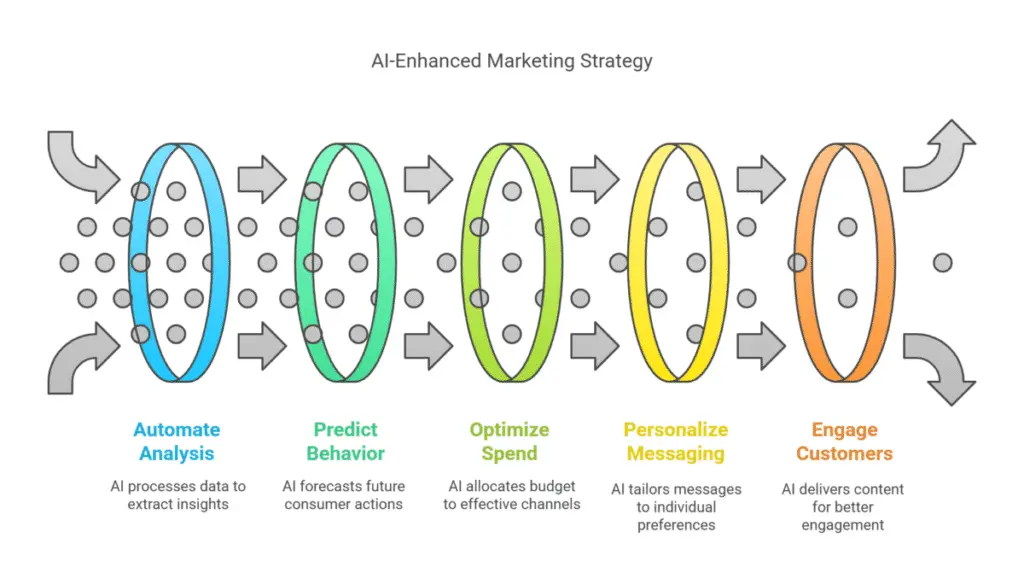
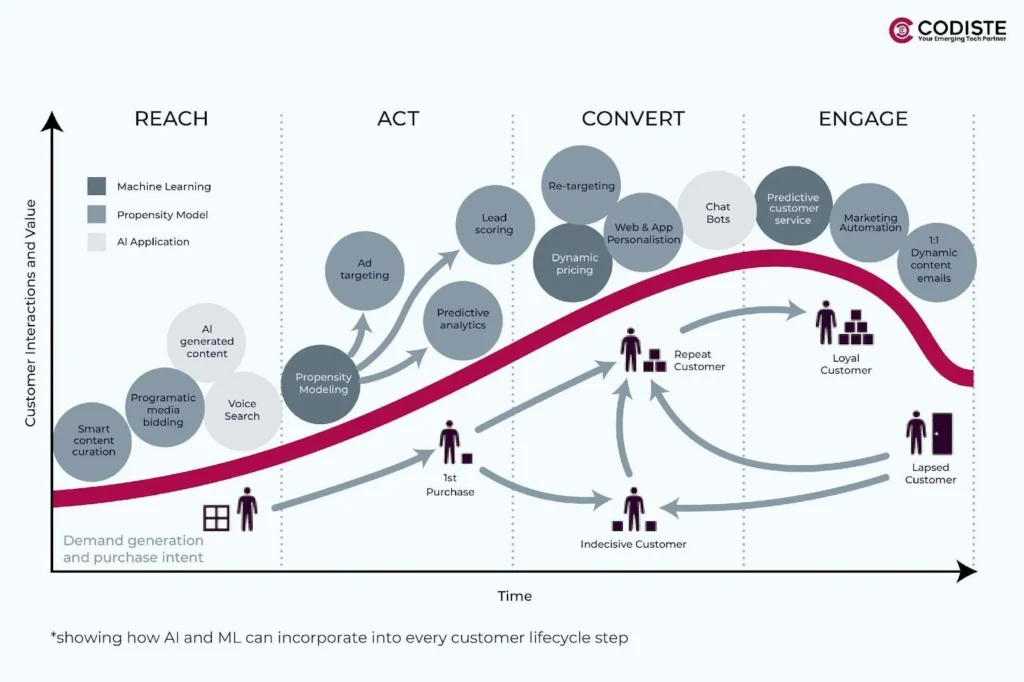
Dynamic pricing becomes more effective when aligned with AI marketing automation for e-commerce. Pricing changes can sync with campaigns and on-site messaging to create consistent, conversion-focused experiences.
High-impact automation integrations
- Price-triggered email campaigns
- Personalized discount messaging
- Time-sensitive promotional offers
- On-site price personalization
This connection allows agencies to deliver cohesive pricing strategies across the entire customer journey.
Personalized Marketing Automation for Scalable E-commerce Campaigns
Personalized marketing automation allows agencies to deliver one-to-one customer experiences without increasing manual workload. By using AI to analyze behavior, preferences, and engagement patterns, agencies can automate campaigns that feel timely, relevant, and conversion-focused.
For e-commerce brands, this approach moves beyond basic segmentation into real personalization at scale. Agencies can orchestrate customer journeys that adapt dynamically, improving engagement, retention, and lifetime value.
How AI Enhances Marketing Automation for E-commerce
AI transforms traditional automation by making campaigns adaptive instead of static. Messaging, timing, and offers adjust automatically based on how each shopper interacts with the brand.
AI-driven automation capabilities
- Behavioral-based email and SMS triggers
- Predictive send-time optimization
- Personalized product and content recommendations
- Dynamic audience segmentation
These capabilities help agencies deliver campaigns that respond to customer intent in real time.
High-Impact Automation Workflows Agencies Can Build
Agencies can package AI-powered automation workflows as performance-driven services for e-commerce clients. These workflows support the entire customer lifecycle from first visit to repeat purchase.
Proven automation workflows
- Abandoned cart recovery sequences
- Post-purchase cross-sell and upsell flows
- Browse abandonment campaigns
- Win-back campaigns for inactive customers
Each workflow strengthens e-commerce personalization while driving measurable revenue gains.
Using Customer Data to Power Personalized Campaigns
AI-powered automation relies on clean, connected customer data to perform effectively. Agencies play a key role in aligning data sources to create a unified customer view.
Key data sources to activate
- Browsing and purchase behavior
- Email and SMS engagement history
- Product interaction data
- Loyalty and customer value metrics
When data flows seamlessly, automation becomes smarter, more accurate, and easier to optimize.
Measuring the Success of AI-Driven Automation
Agencies must tie personalized automation efforts directly to business outcomes. AI makes it easier to track performance and continuously improve campaigns.
Metrics agencies should monitor
- Conversion rate by automation flow
- Revenue per subscriber
- Customer lifetime value
- Engagement trends over time
These insights allow agencies to refine campaigns and clearly demonstrate ROI to e-commerce clients.
AI Platforms Agencies Can Use to Power Product Recommendations
Choosing the right AI platform is critical for agencies delivering product recommendations at scale. The ideal solution should combine personalization, ease of deployment, and adaptability while fitting seamlessly into existing e-commerce and marketing workflows.
For marketing agencies specializing in e-commerce, AI platforms must go beyond generic algorithms. They should understand brand context, product catalogs, and customer intent to support advanced e-commerce personalization and long-term growth.
Why CustomGPT.ai Works Well for E-commerce Product Recommendations
CustomGPT.ai enables agencies to create AI-driven product recommendation experiences trained on a brand’s own data and content. This allows recommendations to feel contextual, accurate, and aligned with how customers actually shop.
Agency-focused advantages
- Personalized product discovery through conversational AI
- Training based on brand-specific catalogs and FAQs
- Faster implementation without heavy engineering effort
- Scalable across multiple e-commerce clients
This makes CustomGPT.ai a strong fit for agencies offering AI-powered product recommendations as a premium service.
How Agencies Can Deploy CustomGPT.ai Across Client Touchpoints
Agencies can integrate CustomGPT.ai into multiple stages of the customer journey to enhance product discovery and conversions. This flexibility allows AI recommendations to support both pre-purchase and post-purchase interactions.
High-impact deployment areas
- On-site product recommendation chat experiences
- Personalized shopping assistance during browsing
- Support-driven product suggestions
- Post-purchase product education and upsells
These touchpoints strengthen e-commerce personalization while improving customer experience and revenue outcomes.
Positioning AI Recommendations as a High-Value Agency Offering
Using a platform like CustomGPT.ai allows agencies to package AI-powered recommendations as a strategic growth solution. This shifts the conversation from tools and features to measurable business impact.
How agencies can position the service
- Revenue-focused personalization strategy
- Conversion optimization through AI insights
- Scalable recommendation systems for growing brands
- Differentiated AI expertise for e-commerce clients
By framing AI-powered product recommendations this way, agencies can increase client retention while justifying higher-value engagements.
How Agencies Can Package AI Services for E-commerce Clients
Packaging AI services effectively helps marketing agencies move from one-off projects to scalable, recurring revenue models. Instead of selling isolated AI tools, agencies can bundle AI capabilities into outcome-driven solutions focused on growth, efficiency, and conversion optimization.
For e-commerce clients, this approach simplifies adoption while positioning the agency as a long-term strategic partner. Clear packaging also makes it easier to communicate value, set expectations, and prove ROI over time.
Turning AI Capabilities into Productized Services
Agencies can transform AI features into clearly defined service offerings that align with client goals. Productized services reduce complexity and speed up onboarding.
Examples of AI service packages
- AI-powered product recommendations setup and optimization
- Dynamic pricing strategy management
- Personalized marketing automation workflows
- Ongoing AI performance optimization and reporting
This structure allows agencies to scale delivery without reinventing processes for each client.
Pricing and Retainer Models for AI-Driven Services
AI services work best when offered as recurring retainers rather than one-time implementations. This aligns agency incentives with continuous performance improvement.
Common pricing approaches
- Monthly retainers tied to revenue impact
- Tiered packages based on traffic or catalog size
- Performance-based pricing with baseline fees
These models help agencies create predictable revenue while delivering sustained value to clients.
Communicating ROI to E-commerce Stakeholders
Clear communication is essential when selling and retaining AI services. Agencies should focus on business outcomes rather than technical complexity.
Metrics to highlight in reporting
- Conversion rate improvements
- Average order value growth
- Revenue influenced by AI-driven campaigns
- Customer retention and lifetime value
By consistently tying AI efforts to these metrics, agencies reinforce their role as growth partners rather than vendors.
Scaling AI Services Across Multiple Clients
Standardization is key when expanding AI offerings across a client portfolio. Agencies should build repeatable frameworks that allow customization without added operational strain.
Best practices for scaling
- Reusable AI workflows and templates
- Centralized reporting dashboards
- Clear onboarding and training processes
- Continuous optimization playbooks
This approach enables agencies to grow their e-commerce AI practice efficiently while maintaining high performance standards.
Conclusion
AI is redefining how marketing agencies drive growth for e-commerce brands, turning personalization, pricing, and automation into scalable revenue engines.
Agencies that adopt AI strategically can deliver measurable improvements in conversions, customer experience, and long-term client value while clearly differentiating themselves in a competitive market.
By packaging AI as outcome-driven solutions rather than isolated tools, agencies position themselves as indispensable growth partners. This approach not only strengthens client relationships but also creates predictable, high-margin service offerings.
If you’re ready to expand your e-commerce AI offerings without increasing delivery complexity, explore how AI co-selling partnerships can help you close bigger deals and deliver faster results.




Frequently Asked Questions
Can AI guide shoppers to the right product based on their needs?
Yes. AI recommendation systems can use browsing behavior, purchase history, and intent signals to surface products that better match what a shopper is trying to find. If you also connect product and policy content through chat, search, or live chat, shoppers can get answers without leaving the buying journey. As Bill French said, “They’ve officially cracked the sub-second barrier, a breakthrough that fundamentally changes the user experience from merely ‘interactive’ to ‘instantaneous’.” Fast responses matter because they help preserve buying intent at the moment a shopper is ready to act.
How should agencies measure whether AI is improving e-commerce conversions?
Start with conversion rate, average order value, bounce rate on product and category pages, and retention after AI-assisted sessions. You should also track assisted add-to-cart rate and how often shoppers complete a purchase after interacting with recommendations or an assistant. Online Legal Services Limited reported 24/7 AI customer service across 3 websites and a 100% sales increase since launch, which is a useful reminder to separate hard revenue outcomes from softer engagement metrics.
What tech stack should an agency start with if it is new to AI for e-commerce?
Start with a no-code knowledge layer before custom development: product content, FAQs, policy documents, and analytics. Then add API work only when a client needs deeper storefront logic or custom workflows. A RAG-based setup that can ingest websites and documents usually gives agencies a faster path to launch than building everything from scratch. Sara Canaday said, “For the past year, I’ve been using CustomGPT.ai as a specialized AI-powered leadership resource for my VIP clients. One that draws directly from my years of experience, research, and proven leadership strategies. What drew me in? Its simplicity, reasonable cost, and constant feature updates.” The practical takeaway is to start simple, prove value, and expand integrations after the workflow is working.
How can agencies scale personalized campaigns across many e-commerce clients without adding headcount?
Build one approved knowledge source per brand, then reuse it across high-impact placements such as homepage recommendations, product-page cross-sells, cart upsells, and personalized email recommendations. That lets you scale personalization across multiple storefronts without rewriting the same messaging for every segment. The key is to standardize brand knowledge first, then adapt it by audience, season, or traffic source.
Can AI help agencies optimize pricing as well as product recommendations?
Yes. AI can support pricing, product recommendations, and customer-journey optimization as part of a broader conversion strategy. For agencies, that means using AI where it can help turn traffic into revenue while still choosing tools that balance performance, scalability, and ease of deployment.
How is an AI shopping assistant different from a basic product recommendation widget?
A recommendation widget mainly surfaces suggested products based on behavioral and purchase signals. An AI shopping assistant can also use your own knowledge sources to answer product or policy questions through chat, live chat, or search. That helps shoppers act on intent instead of just seeing more products.
What data should agencies connect first to improve recommendation quality?
Connect clean product data first, then browsing behavior and purchase history, because those are the signals AI uses to match products to shopper intent. After that, add FAQ and policy content so shoppers can resolve objections in the same experience. If your client data lives across websites and documents, a multi-source RAG setup can unify it before you add more advanced automation.
Related Resources
These guides expand on how agencies can use AI to deliver more value across client teams and channels.
- AI for B2B Agencies — Explore how B2B marketing agencies use AI to streamline execution, improve targeting, and scale client results.
- AI Employee Training — Learn how to train clients’ teams to use AI tools effectively so your agency’s strategy can drive lasting adoption.