
AI Governance Checklist For Enterprises
Enterprise chatbots can produce confident, incorrect answers (“hallucinations”), which creates trust, compliance, and security risk.
An AI governance checklisthelps you define what the bot is allowed to say, prove what it used as evidence, and continuously verify responses, especially in regulated or high-stakes workflows. Start CustomGPT’s 7-day free trialto verify chatbot answers.
TL;DR
AI governance checklistfor enterprise chatbotsis a set of controls that defines allowed sources and behavior, enforces grounded retrieval, verifies each answer (ideally at claim level), and logs decisions for audits, so the bot stays accurate, defensible, and safe to deploy in real workflows.
- Treat governance as an end-to-end control system: scope → retrieval → verification/compliance → monitoring → reviews.
- Hallucination mitigation best practices focus on grounding, evaluation, and guardrails, but you still need claim-level verificationfor high-risk answers.
- CustomGPT’s Verify Responsesis designed to extract claims, flag what’s unsupported, and review outputs across stakeholder perspectives (legal/compliance/security/PR/exec)
Define Scope, Sources, And Answer Boundaries
Goal:Make it impossible for the chatbot to “make stuff up” outside approved knowledge.
- Define the chatbot’s job(support deflection, employee policy, product documentation, etc.).
- Define answer boundaries: what it can answer vs must refuse/escalate.
- Define approved sources(policies, KB, product docs, SOPs) and exclude everything else.
- Define citation requirements: every factual statement must be source-attributed.
- Define “high-risk topics”(legal, HR, pricing, security, compliance, medical, finance).
- Define tone and non-guarantee language(avoid “always / never / guaranteed”).
- Define stakeholder requirements(legal review rules, security constraints, PR constraints).
Why this matters: governance frameworkstreat risk as contextual, your controls must match the domain and impact.
Enforce Retrieval Quality And Source Freshness
Goal:Reduce hallucinations caused by retrieval gaps, stale docs, or ambiguous context.
- Document hygiene:versioning, ownership, last reviewed date, and canonical sources.
- Chunking & structure:keep procedures and policies cleanly sectioned.
- Freshness controls:retire outdated pages; refresh indexed sources on a schedule.
- Coverage checks:test common intents; confirm sources exist for top queries.
- Grounding guardrails:use “answer from sources” behavior; refuse when evidence is missing.
- Evaluation loop:run test sets for top questions; track regressions after updates.
- User experience:make citations visible so users can verify quickly (and learn what the bot knows).
CustomGPT supports citations (including inline citations), so end users can see where statements came from and click through to sources. It also provides controls around how sources/citations are shown and how the agent uses knowledge base awareness.
Related Q&As
- Introducing Inline Citations(trust + transparency)
- Control Agent’s General Knowledge Base Awareness(tighten scope)
- How Are Citations And Links Tracked(measure what users click)
- Enable OpenGraph Citations(visual source previews)
Add Claim-Level Verification For High-Risk Answers
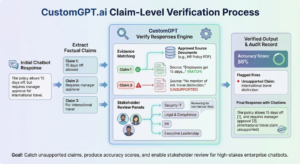
Goal:Catch answers that are partlycorrect but contain one risky or unsupported claim. Most hallucination guidance emphasizes grounding and guardrails (good), but high-stakes enterprise chatbots need verification that operates at the claim level, not just “overall answer seems grounded.”
What “Claim-Level Verification” Looks Like
- Extract factual claims from the response
- Match each claim to supporting evidence in approved sources
- Flag unsupported claims
- Produce an accuracy score and an audit record
CustomGPT’s Verify Responsesis positioned exactly this way: it extracts claims, checks them against your source documents, flags unsupported claims, and provides an accuracy score. It also adds a stakeholder review (“Trust Building”) across multiple perspectives (End User, Security IT, Risk Compliance, Legal Compliance, PR, Executive Leadership) to surface risks that aren’t purely factual errors.
When To Run Verification
- Always-onfor high-risk chatbots (policy, compliance, finance, HR).
- On-demand(spot checks) for lower-risk chatbots or during review cycles.
- Pre-launch and after major content updates(regression gates).
Cost note (so you can plan):Verify Responses can increase query cost when invoked, so teams should reserve it for high-risk answers or defined review workflows. Try CustomGPT, Verify Responses with a 7-day free trialtoday.
Run Security, Privacy, And Compliance Checks
Goal:Reduce exposure from prompt injection, sensitive data leakage, and policy violations.
- Prompt injection defense:treat user input as untrusted; prevent “ignore previous instructions” overrides. OWASP highlightsprompt injection as a key LLM risk category.
- PII handling:block sensitive outputs; restrict access to sensitive sources.
- Source controls:whitelists, permissioning, and authenticated access for internal bots.
- Compliance workflow:require citations for regulated answers; escalate when evidence is missing.
- Security posture:ensure vendor platform claims (e.g., SOC 2 / GDPR) align with your requirements.
Before adding Verify Responses to your governance workflow, review CustomGPT.ai’s security page for SOC 2 Type 2 and GDPR details.
(Still do your own procurement/security review; governance checklists should always require verification of vendor controls.)
Instrument Monitoring, Audit Trails, And Escalation
Goal:Make the system observable and auditable, so you can improve it and defend it.
- Log every answerand the sources it relied on (or didn’t).
- Track what users click(citations/links) to understand intent and content gaps.
- Create escalation paths: “I don’t know” + handoff for missing coverage.
- Trend risk signals: repeated unsupported claims, top refusal categories, top misunderstood topics.
- Audit packaging: produce a record Legal/Compliance can review.
Verify Responses is explicitly framed as producing a verifiable, auditable record and enabling audit-ready documentation.
Operationalize With Roles, Review Cadence, And RACI
Goal:Keep governance alive after launch.
- RACI:content owner, security reviewer, legal reviewer, chatbot operator, approver.
- Change management:any policy update triggers re-index + regression tests.
- Review cadence:monthly for normal docs; weekly for volatile content.
- Release gates:ship only if evaluation + verification pass for high-risk topics.
- Metrics:coverage, refusal rate, citation rate, verified claim rate (where applicable).
NIST AI risk management guidancesupports establishing org-level governance structures for AI systems.
Example: HR Policy Chatbot In A Regulated Enterprise
Scenario:Employees ask about leave policy, benefits eligibility, and disciplinary process.
- Scope sources to the HR handbook, policy memos, and approved FAQs.
- Require introducing inline citationsfor all policy statements.
- For questions that could create liability (“Can we terminate for X?”), require escalation.
- Turn on Verify Responses for HR topics (always-on or during review), so unsupported claims get flagged and the response is reviewed across stakeholder lenses.
- Log answers + verification results for audits and internal review.
Expected result:fewer risky answers reaching employees, faster compliance review, and clearer evidence trails when HR updates policies.
Conclusion
A practical AI governance checklist for enterprise chatbots pairs grounded sources with verification and audit trails. If you need claim-level checks and stakeholder risk review, try CustomGPT Verify Responses free for 7 days.
Related reading: Centralizing AI Governance and Compliance Across LLMs
Frequently Asked Questions
What should an AI governance checklist include for enterprise chatbots?
A strong checklist should define the bot’s job, approved sources, answer boundaries, citation requirements, high-risk topics, refusal or escalation rules, and audit logging. It should also include stakeholder constraints such as legal, security, and PR review requirements.
How do enterprises reduce chatbot hallucinations in regulated workflows?
Enterprises usually reduce hallucinations by limiting answers to approved documents, showing citations for factual claims, refusing when evidence is missing, and adding claim-level verification for legal, HR, security, finance, or compliance topics. Retrieval quality also matters, so teams should maintain canonical sources, retire stale documents, and test top queries after updates.
Do knowledge documents need to be structured in a particular way for AI governance to work?
Yes. Governance works better when each policy or procedure has one canonical version, a clear owner, a last-reviewed date, and clean sectioning that makes retrieval precise. Long documents should be split into clearly labeled sections, outdated copies should be retired, and source refreshes should happen on a schedule. If the bot retrieves the wrong section or an outdated file, even good guardrails can fail.
When should you run claim-level verification on chatbot answers?
Run claim-level verification before the answer is shown whenever the topic is high risk, especially for legal, HR, security, compliance, medical, finance, or pricing-related questions. For lower-risk use cases, teams may use post-response review or sampling, but pre-delivery checks are the safer default when the cost of being wrong is high.
What audit trail should an enterprise chatbot keep for compliance reviews?
A defensible audit trail should keep the user’s question, the final answer, the cited source files or URLs, source version details such as ownership or last-reviewed date, the timestamp, the verification result, and any refusal, escalation, or human override. Those records let reviewers reconstruct why an answer was given and whether it matched policy at that moment. In compliance-heavy workflows, traceability is as important as answer quality.
What security and privacy checks belong in an AI governance checklist?
A baseline review should ask vendors for current SOC 2 Type 2 and GDPR evidence, data-use terms, source upload permissions, query access controls, excluded-data rules, log retention, and restricted-content controls. You should also define which data must be excluded and how the system prevents restricted content from appearing in answers.
Related Resources
If you’re evaluating governance-ready AI systems, this overview adds useful context on the underlying platform.
- How CustomGPT.ai Works: A concise walkthrough of how CustomGPT.ai is built, deployed, and managed across enterprise use cases.
- Contract Review Software Governance Checklist: Review the security, auditability, and rollout criteria legal teams should consider before choosing AI contract review tools.