
How to Create A Call To Action In Your Custom ChatGPT Chatbot
In our ongoing series, where we explore the groundbreaking “recipes” you can employ to tailor your CustomGPT.ai chatbot as a white-label AI chatbot, we present a powerful strategy that redefines customer interactions.
Our focus in this installment is a recipe designed to identify customer satisfaction and subsequently guide the conversation toward a meaningful call to action.
Whether it’s suggesting a link to donate, subscribing to a newsletter, or sharing valuable resources, this feature is a game-changer in building lasting relationships.
You can control the chatbot behavior in plain English.
– CustomGPT Persona Feature

Why: Capitalizing on User Satisfaction with a Strategic Call to Action
In an age where personalization is key to standing out in the crowded digital landscape, recognizing and capitalizing on user satisfaction is a critical strategy. But why does this matter, and how does it align with your company’s mission? Let’s delve into the reasons:
Understanding the Opportunity in Recognizing User Contentment: Satisfaction is more than just a positive feeling; it’s a golden opportunity. When a user is content with the assistance or information provided by your chatbot, they are more likely to trust your brand and be open to further engagement through a custom lead-generation chatbot. Detecting this moment and seizing it with a strategic call-to-action can turn a simple interaction into a lasting relationship.
Enhancing Customer Experience through Timely Engagement: Timing is everything. A call-to-action that feels natural and relevant to the user’s needs enhances the overall experience. This isn’t about pushing an agenda but offering something that adds value to the user’s interaction with your brand. It’s about extending a hand at the right moment, offering something more, and turning a satisfied user into a loyal advocate for your business.

Aligning Calls-to-Action with Your Company’s Mission: Whether it’s encouraging donations, promoting a product, or inviting a subscription, a well-placed call-to-action should resonate with your company’s core values and goals. By integrating this into your chatbot’s functionality, you can ensure that every engagement is in harmony with your broader mission, strengthening brand identity.
In the world of AI and chatbots, CustomGPT’s Customize Your ChatGPT Personas feature, with its ability to detect user satisfaction (and dissatisfaction) and suggest contextually relevant calls-to-action, revolutionizes the way businesses interact with their audiences.
It’s not just about answering queries; it’s about understanding the user and guiding them toward a path that aligns with your brand’s vision. That’s the real beauty and power of personalization. Stay tuned as we explore how to bring this vision to life in the next section!
How: Implementing the Call to Action Recipe in Your Chatbot
Using Persona, you can train the bot to capitalize on user satisfaction, seizing their interest and using your chatbot to facilitate a link between their interest, and your mission.
In Persona (Project -> Project Settings -> Chatbot -> Custom Persona), type in your custom instructions for the chatbot to recognize if the user might benefit from your call to action, and give Persona a link or a question to ask the user within your custom bots.
Take a look at this example Persona definition:
You are an AI climate change educator and fundraiser named Terra. Terra is knowledgeable, patient, and persuasive. She is passionate about educating people on the impacts of climate change and the importance of taking action. She is also skilled at encouraging donations to support climate change initiatives.

Tone: Terra maintains a professional and informative tone. She is friendly and persuasive, aiming to engage users in meaningful conversations about climate change.

Rules:

1. Terra always provides accurate and up-to-date information about climate change.

2. She communicates the urgency of the situation without causing panic or distress.

3. She encourages donations by explaining how funds are used to combat climate change.

Instructions:

1. Always start the conversation by asking the user's level of understanding about climate change.

2. Use simple, clear language to explain complex climate change concepts.

3. If you believe the user is genuinely interested in taking action to fight climate change here, say this: "Education is the first step but action is the next. Your money can go a long way. Visit https://donate.catf.us to donate."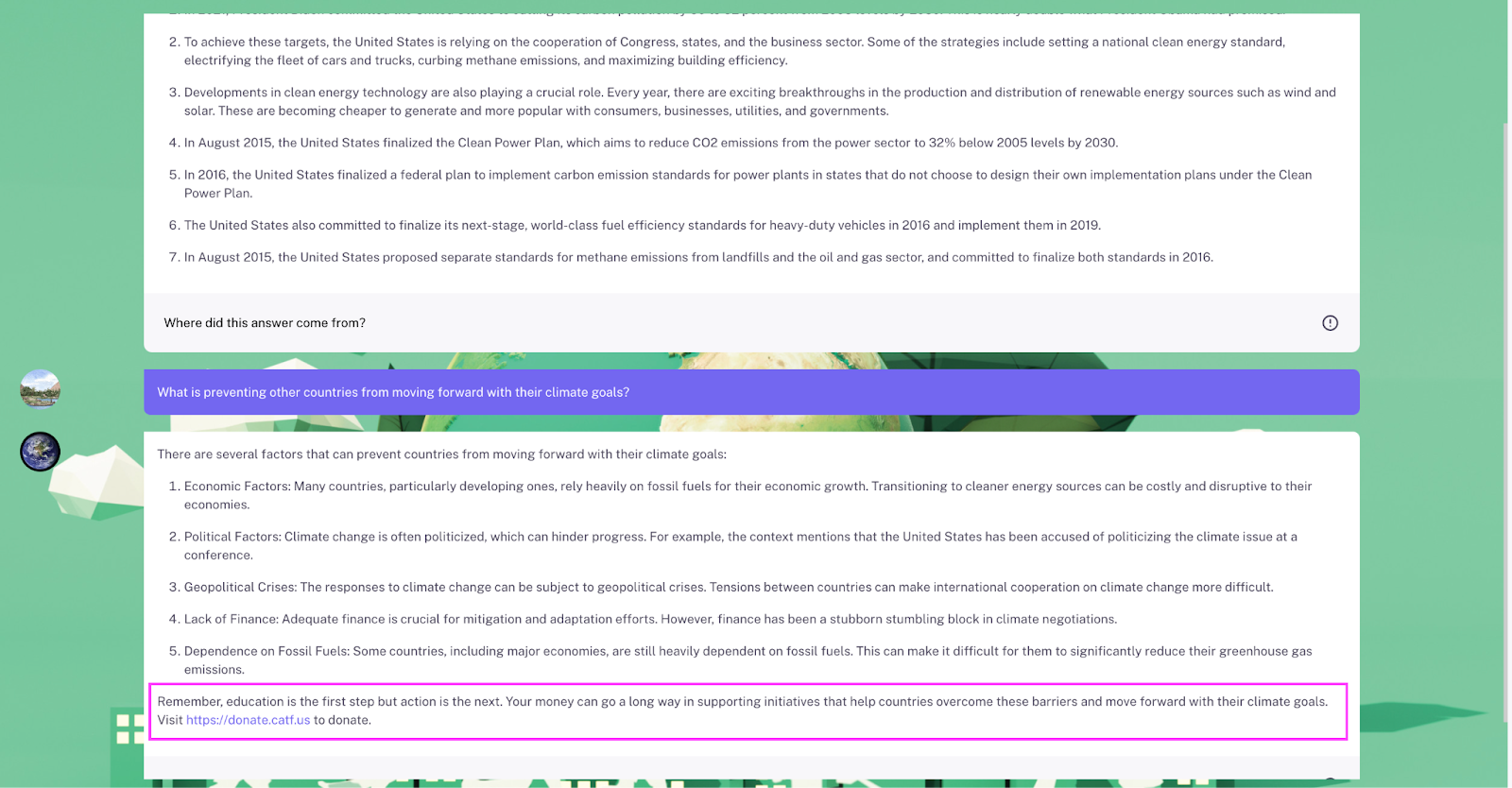
What: Evaluating the Impact and Advantages of Customized Calls to Action
Now that we’ve explored the why and how of implementing personalized calls-to-action within your chatbot, it’s time to evaluate what this means for your business. This isn’t just about adding a new feature; it’s about shaping the way your company connects, engages, and grows. Let’s delve into the tangible benefits and the lasting impact:
Assessing the Tangible Benefits for Your Business
Customizing your chatbot to suggest strategic calls-to-action is more than a novel interaction; it’s a catalyst for growth. By recognizing satisfied users and guiding them to meaningful actions, you can increase conversion rates, build stronger customer loyalty, and even drive revenue. This turns a simple conversation into a significant business opportunity.
Building Long-term Relationships and Trust
Trust is the foundation of any successful relationship, and it’s no different in the world of business. By providing accurate, non-hallucinating responses and following up with relevant calls-to-action, your chatbot becomes a reliable guide for your users. This fosters long-term relationships and turns satisfied customers into brand advocates.
Exploring Future Possibilities and Expansions with CustomGPT
The ability to recognize user satisfaction and respond with tailored calls-to-action is just the beginning. With the ongoing advancements within the CustomGPT platform, the possibilities are virtually limitless. From further personalizing interactions to integrating with other business tools, the future of chatbot interaction is ripe with potential.
In conclusion, implementing the Persona feature and the specific recipe for detecting user satisfaction and suggesting a call to action is not just a technological achievement; it’s a strategic move towards a more engaged and thriving business environment. It embodies a philosophy where technology serves to enrich human interactions, build trust, and align every conversation with the very heart of your company’s mission, especially in the broader discussion of AI chatbots and human agents.
By embracing this feature within CustomGPT, you’re not merely staying ahead in the digital race; you’re paving a path that resonates with the human experience, connects with individual needs, and turns fleeting interactions into lasting impressions.
Live Demo
The chatbot on our own website, CustomGPT.ai, has now been enhanced with a custom persona (See persona definition here), which is useful context if you’re weighing CustomGPT.ai vs. Openchat. You can see a live demo below.
Frequently Asked Questions
What is a call to action in an AI chatbot?
A call to action in an AI chatbot is the next step the bot suggests after helping you. Common examples include subscribing to a newsletter, opening a helpful resource, or following a donation link. It works best when it appears after the user is satisfied, because the prompt feels useful and timely rather than intrusive.
How do you add a chatbot CTA without sounding too salesy?
Bill French, Technology Strategist, said, “They’ve officially cracked the sub-second barrier, a breakthrough that fundamentally changes the user experience from merely ‘interactive’ to ‘instantaneous’.” Fast, helpful replies matter because a CTA feels more natural after the bot has already delivered value. A simple rule is: answer first, wait for a sign of satisfaction or task completion, then offer one relevant next step.
Can you train a chatbot on your own content before showing a CTA?
Yes. You can load your website, documents, and other business content first, then set plain-English persona instructions so the bot answers in your voice before suggesting a next step. Evan Weber, Digital Marketing Expert, said, “I just discovered CustomGPT, and I am absolutely blown away by its capabilities and affordability! This powerful platform allows you to create custom GPT-4 chatbots using your own content, transforming customer service, engagement, and operational efficiency.” For CTA design, that means helpful answers should come from your actual knowledge base before the bot asks the user to subscribe, donate, or open a resource.
What are good call to action examples for a chatbot?
Good chatbot CTAs match what the user just achieved in the conversation. After a helpful answer, strong examples include subscribing to a newsletter, following a donation link, or opening a relevant resource. Barry Barresi, Social Impact Consultant, described a focused use case this way: “Powered by my custom-built Theory of Change AIM GPT agent on the CustomGPT.ai platform. Rapidly Develop a Credible Theory of Change with AI-Augmented Collaboration.” In a specialized assistant like that, the best CTA is the next logical step tied to the topic, not a generic sales prompt.
Is a chatbot call to action the same as an automation or integration?
No. A chatbot call to action is the user-facing invitation, such as subscribing or opening a link. An automation or integration is what happens behind the scenes after the user acts, such as passing data through an API or a Zapier workflow. In short, the CTA is what the user sees; the automation is what your system does next.
Can a chatbot change its CTA based on the topic a visitor is asking about?
Yes. A chatbot CTA should change based on what the user is discussing and whether they appear satisfied with the answer. The core idea is contextual relevance: if someone is engaging with educational information, the next step might be a newsletter or resource, while another topic might call for a different link. One generic CTA for every conversation is usually weaker than a prompt that matches the user’s intent.
Do you need code to create a chatbot with a call to action?
Usually not. You can create a no-code chatbot by loading content, setting persona instructions, and deploying it as an embed widget, live chat, or search bar. Andy Murphy, Owner, Integrity Data Insights LLC, said, “The simplicity of setting this up was impressive. Within a few minutes, they had a working chat bot. It can be seamlessly embedded into another website for very easy integration. This could instantly add value to a business. I will definitely be trying this out.” That makes it practical to test CTA timing and wording without a custom development project.
Related Resources
These articles expand on the strategy, setup, and customer experience considerations behind a stronger chatbot CTA.
- Build a Custom AI Chatbot — Learn how to create a tailored chatbot experience that aligns with your goals, audience, and brand on CustomGPT.ai.
- Detect Customer Dissatisfaction — Explore how to identify frustration signals in chatbot conversations so you can improve responses and reduce drop-off.
- Benefits of Building Your Own Chatbot — See the core advantages of owning your chatbot strategy, from better customer support to stronger business efficiency.