
Generative AI in customer support has moved from experimentation to production in customer support faster than almost any recent technology shift.
Companies are no longer asking if AI should handle support interactions, but how it should be implemented—and at what cost.
A widely cited example is Airbnb, which publicly reported achieving roughly a 15% support ticket deflection rate using AI.
That is a meaningful result by any standard: fewer tickets, faster resolutions, and lower operational load on human agents. But the result alone doesn’t tell the full story.
How that outcome was achieved—and what it implies for most businesses—matters far more than the headline number.
Understanding Generative AI and Its Role in Customer Support
Generative AI is now firmly in production across customer support organizations. What separates successful deployments from disappointing ones is no longer model quality alone, but how data, policies, and workflows are designed around the model.
In early 2024, a large enterprise insurer deployed a generative support assistant connected to its existing knowledge base and CRM systems using retrieval-augmented generation (RAG).
The model itself was not fine-tuned. Instead, it was constrained to retrieve from approved sources and operate within existing support workflows. Within weeks, inbound email volume dropped materially and response times improved without increasing headcount.
The outcome looked like automation. In practice, it was a result of governance and system design. Generative AI in support does not succeed by “answering questions” in isolation.
It succeeds by arbitrating between ticketing rules, CRM state, policy constraints, and fragmented knowledge.
Across real deployments, outcomes correlate less with model size than with institutional discipline: how often knowledge is refreshed, how clearly escalation paths are defined, and whether humans retain authority over sensitive decisions.
Generative AI’s Role in Customer Support
A generative model becomes reliable in support only when retrieval is treated as a routing system, not a search box. The critical behavior is deciding what information is allowed to be retrieved, from where, and under which constraints.
In production environments, naive vector search over FAQs often fails on edge cases. More mature systems use tiered retrieval: short-form FAQs, long-form documentation, and historical ticket data are queried separately and only when policy permits.
This improves precision without changing the underlying model. Strong implementations separate three concerns:
- Intent classification to determine what the user is actually trying to do
- Constraint injection based on policy, entitlement, and region
- Answer shaping that adapts tone and actionability to the channel
When these layers are collapsed into a single prompt, failures are often misattributed to “hallucinations” rather than uncontrolled context. The practical implication is that better outcomes usually come from clearer retrieval boundaries and policy logic, not from switching to a newer foundation model.
Traditional Customer Support Challenges
The most under-recognized limitation in traditional support is not ticket volume but context fragmentation during a live interaction. Agents routinely operate across multiple systems: ticketing tools, CRM records, billing systems, internal documentation, and messaging platforms.
That fragmentation matters because every missing piece of context forces an agent back into “search mode” instead of “resolution mode,” which quietly kills ticket deflection and drives average handling time up even when headcount is adequate.
The issue is structural, not individual. When conversations move across channels—chat to email, email to phone—context is often lost or partially reconstructed.
Even platforms that support omnichannel workflows are frequently implemented in ways that preserve events, not full conversational episodes. If context is not centralized, AI inherits the same fragmentation.
Without a unified, queryable view of customer state and history, generative systems cannot meaningfully deflect tickets—they simply shift effort elsewhere.
The Hidden Cost of Building AI In-House
Airbnb reportedly built its AI support system internally, relying on a complex stack of multiple models and custom orchestration. For a company of Airbnb’s scale, this approach is understandable. They have deep engineering talent, significant budgets, and unique operational requirements.
However, that path comes with trade-offs that are often underestimated:
- High upfront investment in model selection, infrastructure, and evaluation
- Ongoing maintenance as models, prompts, and policies require constant tuning
- Upgrade pressure every time a new generation of foundation models is released
- Operational complexity as systems grow harder to reason about and debug
What works for a hyperscale company does not automatically translate to mid-market or even large enterprise teams. For most businesses, building and maintaining an AI support stack becomes a permanent distraction rather than a one-time project.
Core Concepts: Deflection, Authority, and Control
In real deployments, deflection must be defined as issue resolution without ticket creation—not simply reduced inbound messages. Many teams now distinguish between superficial self-service and verified resolution, where a downstream action (refund, change, confirmation) actually occurs.
A second critical distinction is system role:
- AI agents: systems with authority to trigger workflows
- Copilots: read-only systems that assist humans
- Automations: deterministic workflows without reasoning
Impact depends less on linguistic quality and more on authority. Systems that cannot update state may sound helpful but rarely move resolution metrics.
Effective support architectures therefore operate as intent–policy–action loops, where intent routes the request, policy constrains what is allowed, and generation explains or executes within those bounds.
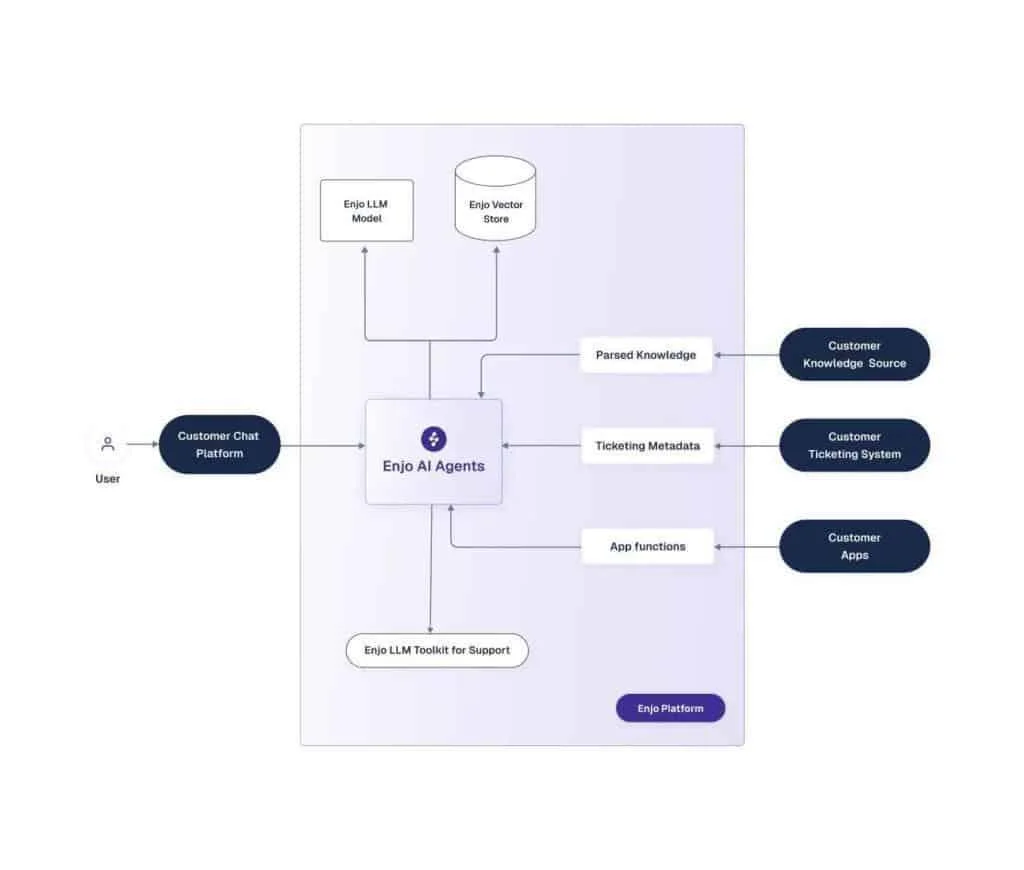
Image source: enjo.ai
Terminology Discipline Matters
Ambiguous language creates operational risk. Calling every system an “agent” leads stakeholders to expect actions the system is not authorized to perform. A useful heuristic is simple:
- Call it an agent only if it has system authority
- Call it a copilot if it is advisory and read-only
Clear naming improves security reviews, compliance approvals, and metric interpretation. It also prevents teams from blaming AI when the real issue is mismatched expectations.
Measuring What Actually Matters
Deflection rate, first-contact resolution (FCR), average handling time (AHT), CSAT, and NPS are often tracked independently. This hides trade-offs.
Aggressive automation can inflate deflection while depressing satisfaction if customers recontact through another channel. A more reliable approach conditions all metrics on verified resolution. Instead of asking “Was this session deflected?”, mature teams ask:
- Did this session end with a durable, policy-compliant outcome?
This requires session-level traceability: intent, sources used, policies applied, and downstream events joined back to the original interaction.
Business Value and Use Cases
The strongest business value from generative AI rarely comes from answering FAQs alone. It comes from redistributing human effort.
When routine requests are handled safely by AI, agents spend more time on high-risk, high-value journeys such as disputes, fraud, or complex account issues.
In parallel, internal copilots reduce preparation and handoff time on complex cases by drafting summaries, gathering context, and standardizing escalation notes.
This creates a second form of deflection: issues that never escalate because expert time is used more effectively upstream.
Enhancing Customer Experience with Generative AI
Customer experience improves most when AI preserves continuity across steps and channels. Users care less about any single answer than about whether the system “remembers” their situation. Effective systems maintain:
- A persistent session state
- Clear policy enforcement
- Retrieval limited to eligible sources
When these layers are explicit, incorrect actions drop even if the underlying model stays the same. A useful framing is: Experience quality = continuity × (precision + permission) Most failures occur when continuity breaks.
Core Architectural Pattern: Policy-First Retrieval
Across deployments, one pattern consistently separates safe automation from risk: policy-first retrieval, where routing logic, not the model, decides what the AI is allowed to know and do.
This matters because the same model can either be a safe deflection engine or a compliance risk, depending on how you structure the path from user utterance to data access.
Three components have to interlock: a high‑recall intent classifier, a policy engine that maps intent × user entitlement × channel to allowed indices and actions, and a retrieval layer that operates only inside that allowed slice.
There are two common architectures here. Embedding‑centric designs push everything through vector search, which works well for messy, unstructured content but often ignores entitlement boundaries.
Hybrid designs pair sparse retrieval (for schemas, SKUs, entitlements) with vectors (for explanations), trading a bit of latency for far higher precision on “can we do this?” questions.
Hybrid designs—combining structured lookups with semantic retrieval—trade slight latency for far higher safety and precision. “Most failures I see are not model issues; they’re policy leakage issues,”
— Lilian Weng, Head of Safety Systems, OpenAI
Data Sources and Integration
Most teams underestimate how opinionated their data needs to be: the hard part isn’t “connecting everything,” it’s deciding which source is allowed to win for a given intent and user. That choice drives deflection because conflicting answers destroy trust faster than a slow queue.  Technically, you’re juggling three distinct pipelines: structured state from CRM/ERP, semi‑structured artifacts like ticket histories, and free‑form docs.
Treating them identically via a single vector index is tempting and usually wrong; you lose update guarantees, entitlements, and schema semantics that matter for refunds, SLAs, and risk actions.
A practical mental model is: Effective context = canonical source × freshness × intent alignment If any term fails, the answer degrades.
People, Process, and Change Management
Support AI rewires authority. Without explicit ownership, deflection plateaus. High-performing teams define:
- Clear owners for policies and runbooks
- Structured feedback loops for errors and edge cases
- Predictable release cadences for AI behavior changes
AI adoption fails when treated as a tool rollout instead of a governance redesign.
Risk, Control, and Observability
Most serious incidents stem from mis-scoped permissions, not model errors. Mature teams treat AI automation like a control system: exposure limits, escalation paths, and continuous monitoring.
Success is measured not by raw automation volume, but by policy-conformant resolution—AI decisions that remain uncorrected and within bounds.
The Strategic Takeaway
Generative AI for customer support is no longer about experimentation. It’s about sustainability. Companies now face a clear choice:
- Build and maintain increasingly complex AI systems, absorbing the cost and risk of constant change
- Adopt managed platforms that evolve with the AI landscape, allowing teams to focus on outcomes rather than infrastructure
As models continue to advance at an accelerating pace, the question is not whether AI will transform customer support—it already has. The real question is whether your organization wants to run the AI race or simply benefit from it.
For most teams, the smarter move is clear: focus on your core, and let specialists handle the rest.
Apply Generative AI in Customer Support.
Turn real deployment insights into scalable, cost-effective customer support outcomes.
Trusted by thousands of organizations worldwide


Frequently Asked Questions
What is the safest way to start using generative AI in customer support?
A lower-risk starting point is to focus on implementation quality, not model tuning. Real deployments show better results when the assistant is connected to your existing knowledge and support systems, and constrained to approved sources. That approach helps reduce unsupported answers while you validate performance in production.
How should generative AI connect to my CRM and ticket workflows?
Connect it directly to your current support knowledge base and CRM workflows. In the cited enterprise deployment, the assistant was integrated with those systems through retrieval-augmented generation (RAG), which allowed responses to be grounded in existing support data rather than relying on standalone model behavior.
What causes most failures after a support AI goes live?
A common failure pattern is over-focusing on the model while under-designing data quality, policy controls, and workflow logic. The source material emphasizes that these operational factors are what separate successful deployments from disappointing ones.
When should an AI support bot hand off to a human agent?
Handoffs should be defined as part of your support workflow policy rather than treated as an afterthought. Deployment lessons emphasize that workflow and policy design are core to success, so escalation rules should be explicit before broad rollout.
Can one generative AI assistant handle both website chat and social media support?
It can, but consistency depends on how well data and policies are managed across channels. The key lesson from real deployments is that outcomes are driven by system design around the model, so shared knowledge governance and channel workflow rules matter more than model choice alone.
Should I build a generative support assistant in-house or use an existing platform?
Choose the path that lets your team implement strong data controls, policy guardrails, and workflow integration quickly. The deployment evidence here suggests these factors matter more than fine-tuning the model itself, so prioritize execution capability over model customization alone.