

When you search for how to create a website for affiliate marketing, you’re really looking for a blueprint that helps you turn clicks into consistent revenue.

Make Money With AI
Join our Partner Programs!
Boost your reputation, drive revenue and grow your business with CustomGPT.ai.
You’ll step into a space where smart content, compelling links, and strategic optimization all work together to build passive income.
You’re about to build something that isn’t just a website but a digital engine that works for you around the clock.
You’ll discover that the right structure, niche focus, and user experience can dramatically boost your earning potential.
You get to design a platform where your recommendations actually matter to real people. You’ll see how each strategic move—from site layout to SEO—helps amplify your impact and conversions.
You’re stepping into a system where even small improvements can compound into long-term gains.
You’ll learn to craft a site that attracts, engages, and persuades your audience with clarity and confidence.
Defining Affiliate Marketing and Its Benefits
Affiliate marketing is a performance-based model where you promote another company’s products and earn a commission for every sale or action generated through your unique link, giving you a scalable way to monetize content.
You operate as a conversion catalyst, connecting audience intent with relevant offers without needing to create a product yourself.
Why This Model Works So Well
- Low entry cost with no product development required
- High scalability through content, SEO, and traffic growth
- Potential for passive income via evergreen assets
- Flexibility to choose niches you’re genuinely interested in
- Performance-based structure that rewards measurable results
This combination makes affiliate marketing one of the most accessible and profitable online business models you can start today.
Key Terminology and Concepts
Understanding the core terminology in affiliate marketing helps you navigate the ecosystem efficiently and communicate with precision across platforms and partners.
You build a stronger strategic foundation when you can interpret how each component contributes to traffic flow, attribution, and revenue.
Essential Terms You Should Know
- Affiliate Link: A unique tracking URL that connects user actions to your promotions
- Conversion: A desired action such as a sale, signup, or download
- Commission Rate: The percentage or fixed amount you earn per successful action
- Cookie Duration: The time window during which referrals are tracked
- EPC (Earnings Per Click): A metric showing average earnings generated per click
- CPA/CPS Models: Commission structures based on actions or sales
- Landing Page: A targeted page optimized to drive a specific user behavior
Mastering these terms gives you the clarity needed to operate confidently in any affiliate marketing environment.
Analyzing Competition and Profitability
Analyzing your competition helps you understand market saturation, pricing dynamics, and the strategic gaps you can exploit to position your affiliate site more effectively. You gain clarity on which niches offer strong profitability signals and which ones require deeper optimization to stand out.
| Factor | What to Evaluate | Why It Matters |
| Competitor Content Depth | Article quality, structure, and topical coverage | Reveals how much effort is needed to outrank them |
| Keyword Difficulty | Search volume, competition level, and ranking barriers | Helps you target profitable and achievable keywords |
| Product Demand | Market trend data, reviews, and buyer activity | Identifies niches with sustainable earning potential |
| Commission Rates | % payouts and recurring vs. one-time structures | Shows long-term profitability opportunities |
| Traffic Sources | SEO, social, email, paid ads | Helps you model winning traffic strategies |
| Competitor Monetization | Types of affiliate programs used | Lets you reverse-engineer revenue models |
Step 1: Setting Up Your Affiliate Marketing Website
Setting up your affiliate marketing website begins with selecting a domain name that reflects your niche and signals relevance to both users and search engines. You create the foundation for brand identity by choosing something memorable, easy to spell, and aligned with long-term positioning.
Once your domain is set, you move on to choosing a reliable hosting provider that ensures fast load times, high uptime, and scalable performance as your traffic grows.
You optimize your hosting environment early because page speed, caching layers, and server stability directly influence user experience and search ranking.
After securing hosting, you install a content management system—typically WordPress—because it provides plugin flexibility, SEO support, and modular control over every part of your site.
You streamline this step by selecting a lightweight theme and configuring essential plugins for security, caching, analytics, and structured content creation.
Selecting a Platform and Hosting Service
Choosing the right platform and hosting service shapes the technical backbone of your affiliate site, influencing speed, scalability, security, and overall content workflow. You set yourself up for smoother optimization when your foundation is stable and performance-oriented from day one.
| Option / Factor | Details to Consider | Why It’s Important |
| WordPress (Self-Hosted) | Full customization, plugin ecosystem, SEO control | Ideal for scaling and long-term affiliate growth |
| Website Builders (e.g., Wix, Squarespace) | Simpler setup, limited customization | Best for beginners but less flexible for advanced needs |
| Shared Hosting | Budget-friendly, basic resources | Suitable for small or new affiliate sites |
| VPS Hosting | Dedicated resources, better speed and stability | Supports growing traffic and heavier content loads |
| Managed WordPress Hosting | Automatic updates, optimized servers | Reduces maintenance and boosts performance |
| Cloud Hosting (AWS, GCP) | Highly scalable infrastructure | Useful for large-scale operations or multi-site setups |
This comparison helps you choose a reliable stack that supports both early-stage publishing and long-term affiliate expansion.
Essential Plugins and Tools for Functionality
Equipping your affiliate website with the right plugins and tools enhances performance, automates critical tasks, and strengthens your ability to optimize conversions. You create a smoother workflow when your tech stack supports security, speed, analytics, and structured content execution.
Tools That Strengthen Your Website
- SEO frameworks like Rank Math or Yoast to optimize metadata and indexing
- Caching plugins such as WP Super Cache or LiteSpeed Cache to improve load speed
- Link cloaking tools like Pretty Links for clean, trackable affiliate URLs
- Security solutions like Wordfence to safeguard your site from threats
- Analytics integrations such as Google Site Kit for performance tracking
- Backup tools like UpdraftPlus to protect your content and configurations
These essentials ensure your affiliate site remains fast, secure, and ready to scale.
Step 2: Creating Quality Content for Affiliate Marketing
Creating quality content for affiliate marketing begins with understanding user intent and mapping it to the right content format, whether it’s reviews, how-to guides, comparisons, or listicles.
You build trust by providing depth, transparency, and actionable insights that make your recommendations feel credible rather than promotional.
Once you define your content framework, you focus on crafting material that balances readability with technical precision, ensuring each piece guides users toward a solution while naturally integrating affiliate links.
You strengthen engagement by using clear structure, data-backed claims, and conversational flow that keeps readers moving through the page.
To maintain long-term performance, you optimize your content with SEO principles like semantic keywords, internal linking, and structured formatting to increase visibility and authority.
You refine your approach continuously by analyzing metrics such as CTR, time on page, and conversion behavior to produce content that delivers both value and revenue.
Developing Engaging and Trustworthy Content
Creating engaging and trustworthy content requires a blend of authenticity, clarity, and strategic structuring that aligns your expertise with what users genuinely seek. You build stronger credibility when your material solves problems directly instead of pushing promotions.
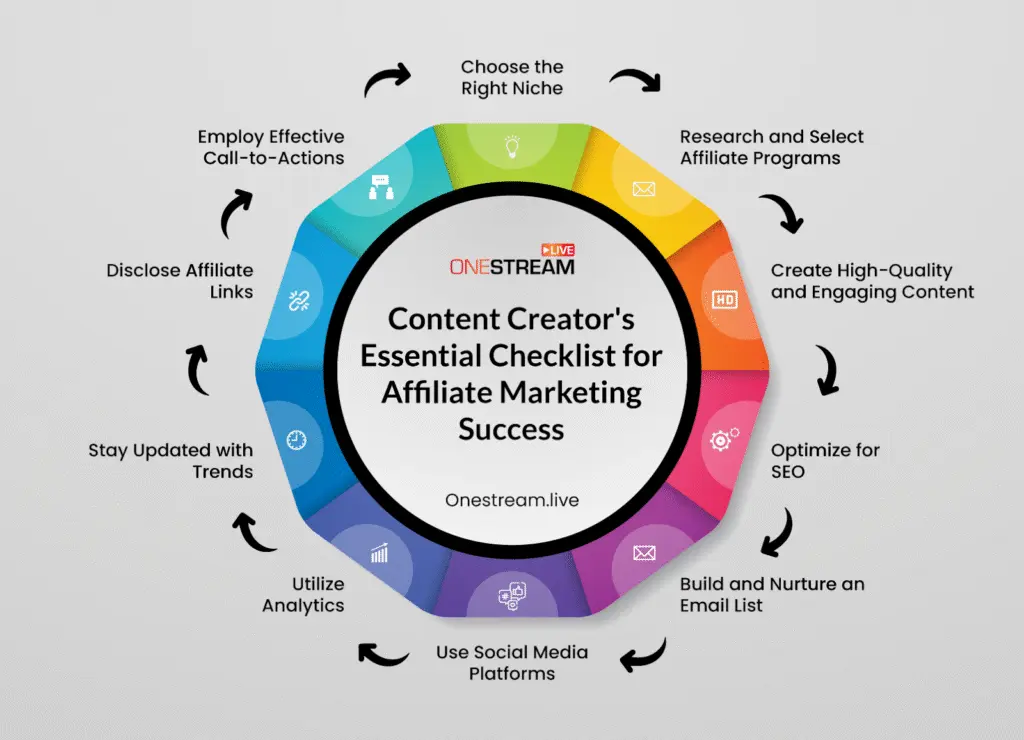
Image source: onestream.live
Ways to Elevate Content Quality
- Use transparent language that explains pros, cons, and real-world use cases
- Support claims with data, comparisons, and verifiable sources
- Add visuals like screenshots, charts, or product images to enrich understanding
- Structure content with scannable headings and concise paragraphs
- Maintain a consistent tone that reflects authority without overselling
- Include personal insights or experience to increase relatability
With these principles, your content becomes a reliable resource users trust and return to.
Strategic Placement of Affiliate Links
Placing affiliate links strategically ensures you guide users toward action without disrupting the reading experience or appearing overly promotional. You increase conversions when links feel natural, contextually relevant, and aligned with clear informational intent.
Smart Link Placement Techniques
- Insert links near high-intent sections such as product benefits or comparisons
- Use call-to-action buttons for key offers to improve click visibility
- Add contextual links within paragraphs where the recommendation is most relevant
- Place links in summaries or conclusions to capture ready-to-act readers
- Utilize comparison tables with embedded affiliate URLs for stronger engagement
- Test link positions using heatmaps and analytics to refine what converts best
With the right placement strategy, your affiliate links work seamlessly with your content while maximizing revenue potential.
Step 3: Driving Traffic and Building an Audience
Driving traffic and building an audience begins with choosing the right channels that align with your niche and the behavior patterns of your target users.
You maximize early momentum by focusing on platforms where search intent, community engagement, or visual discovery naturally pairs with your content style. Once your channels are selected, you develop a consistent publishing rhythm that builds familiarity and trust over time.
You reinforce this momentum by diversifying your content formats—such as blogs, short-form videos, email sequences, or social posts—to reach users at multiple touchpoints.
To sustain long-term growth, you rely on analytics to identify which traffic sources drive the highest engagement and conversions. You refine your strategy continuously by optimizing your SEO, experimenting with new platforms, and nurturing a loyal audience that returns for your expertise.
SEO Basics and Content Optimization
Mastering SEO fundamentals helps your affiliate content rank higher, attract qualified traffic, and maintain long-term visibility in competitive niches. You strengthen your authority when your pages are structured for both search engine crawlers and human readers.
Image source: gptexperthub.com
Core Optimization Techniques
- Target high-intent keywords with balanced search volume and competition
- Optimize titles, meta descriptions, and header hierarchy for clarity
- Use semantic keywords to reinforce topical relevance
- Improve page speed through compression, caching, and lightweight themes
- Add internal links to distribute authority and guide user flow
- Optimize images with descriptive alt text and proper sizing
- Maintain clean URL structures that reflect keyword focus
By applying these principles, your content becomes more discoverable and consistently attracts the right audience.
Leveraging Email Marketing and Social Media
Leveraging email marketing and social media gives you direct access to your audience, allowing you to nurture relationships and distribute content with higher engagement potential.
You build long-term trust when your communication is consistent, value-driven, and aligned with the platforms your audience already uses.
Channels That Amplify Your Reach
- Use lead magnets to grow your email list with motivated subscribers
- Send segmented email campaigns tailored to user interests and intent
- Share content snippets on social platforms to drive traffic back to your site
- Utilize short-form video for quick product highlights or comparisons
- Engage in niche communities to build authority and visibility
- Automate email workflows to sustain audience interaction over time
With the right mix of email and social strategies, your traffic sources become more diverse, stable, and conversion-friendly.
Advanced Strategies for Maximizing Revenue
Maximizing revenue in affiliate marketing requires moving beyond basic link placement and embracing data-driven, multi-channel strategies that compound results over time.
You unlock higher earnings when you treat your website like a performance engine—constantly testing, refining, and scaling what works.
High-Leverage Growth Tactics
- Implement A/B testing on CTAs, layouts, and comparison tables to boost conversions
- Build multi-step funnels using email automation for recurring engagement
- Target long-tail commercial keywords to capture high-intent traffic with lower competition
- Use retargeting ads to recapture visitors who didn’t convert on the first visit
- Partner with brands for exclusive discounts or higher commission rates
- Create topical authority clusters to dominate niche segments in search rankings
By integrating these advanced strategies, you position your affiliate site for stronger monetization and long-term exponential growth.
Conversion Optimization Techniques
Optimizing conversions is about refining the user journey so more visitors take action with minimal friction and maximum clarity. You improve performance by aligning design, messaging, and behavioral cues with the intent behind every interaction.
Tactics That Boost User Actions
- Use clear and contrasting CTAs that stand out visually and contextually
- Simplify page layouts to reduce cognitive load and highlight key offers
- Add social proof such as reviews, testimonials, or trust badges
- Utilize heatmaps to identify drop-off points and refine page flow
- Test variations of headlines, buttons, and product placements
- Improve mobile responsiveness to capture on-the-go traffic
When these techniques work together, your site converts more consistently and delivers higher revenue with the same amount of traffic.
Utilizing Analytics for Performance Tracking
Utilizing analytics for performance tracking starts with identifying the key metrics that reveal how users interact with your content, links, and overall site experience.
You gain clarity by monitoring factors like traffic sources, bounce rates, and time on page to understand which channels and pages drive meaningful engagement.
Once your baseline metrics are established, you use analytics tools to map out conversion pathways and detect friction points that may be reducing revenue.
You enhance performance by examining click-through rates, scroll behavior, and affiliate link interactions to refine both placement and messaging.
Long-term success comes from treating analytics as a continuous feedback loop rather than a one-time setup. You strengthen your strategy by iterating based on trends, seasonal patterns, and user intent signals that help you adjust content, funnels, and optimization tactics for maximum profitability.
FAQ
What is the main purpose of an affiliate marketing website?
Its purpose is to provide valuable content that guides users toward products or services, earning you commissions when they take action through your links.
How long does it take to start earning from affiliate marketing?
Most beginners see results within 3–6 months, depending on content output, SEO, and niche competitiveness.
Do you need technical skills to build an affiliate website?
No, modern platforms like WordPress make setup and management beginner-friendly with minimal technical knowledge.
How many articles should you publish before promoting your site?
Launching with at least 10–15 high-quality, keyword-targeted pieces gives you better initial traction and credibility.
Can affiliate marketing be done in competitive niches?
Yes, but you need stronger content depth, keyword strategy, and differentiation to stand out and rank effectively.
Conclusion
Building an affiliate marketing website is ultimately about creating a platform that delivers genuine value while leveraging smart optimization to drive revenue.
You set yourself up for long-term success when you combine strategic content, reliable traffic channels, and clear user pathways that guide visitors toward informed decisions.
As you refine your structure, test new approaches, and track performance with analytics, your site evolves into a scalable asset that continues to grow month after month. You gain an advantage by staying consistent, adapting to trends, and prioritizing user trust at every stage of the journey.
With a well-built foundation and a commitment to continuous improvement, your affiliate website becomes more than just a project—it becomes a sustainable, high-performing business you can scale with confidence.
To launch quickly and start earning without upfront costs, follow this beginner friendly guide. It shows practical steps to build momentum even with zero budget.
Launch Your Affiliate Website Today!
Get the essential steps and tools to build a high-converting affiliate site fast
Trusted by thousands of organizations worldwide


