
Long Context Windows vs RAG: What Businesses Should Actually Use
Quick answer: Long context windows help a model reason over text you have already put in the prompt. RAG helps the model search a large, changing knowledge base and answer from approved sources with citations. For most business AI assistants, RAG is the stronger foundation, and long context complements it rather than replacing it.
Every time context windows get bigger, someone asks whether retrieval is still needed. If a large language model (LLM), the AI behind tools like ChatGPT and Claude, can read hundreds of thousands or even millions of tokens at once, why bother retrieving anything? It is a fair question, and the honest answer is that a bigger prompt solves a different problem than retrieval does.
Long context windows expand how much text a model can consider in a single prompt. RAG, or retrieval-augmented generation, retrieves the most relevant content from a larger knowledge base before the model answers, and can cite where each fact came from. Those are not competing answers to the same question. One is about how much the model can read at once; the other is about finding the right evidence from far more content than any prompt could hold, and grounding the answer in it.
CustomGPT.ai helps businesses create accurate, source-citing AI agents from their own content instead of relying only on long context windows or model memory. It is a business-grade, no-code RAG platform for building grounded AI answers backed by citations. For the full technical foundation, see the CustomGPT.ai RAG ultimate guide.
This guide is written for AI leaders, SaaS teams, support leaders, enterprise buyers, developers evaluating retrieval-augmented generation, legal and compliance teams, knowledge management teams, education teams, associations, technical decision-makers, and companies with large or frequently changing knowledge bases.
Long Context Windows vs RAG: Which Is Better?
Long context windows are useful when a model needs to reason over a large amount of text already provided in the prompt. RAG is better when the AI must search a large, changing knowledge base and answer from approved sources with citations. For business AI assistants, RAG is usually the stronger foundation, and long context can complement it.
What Is a Long Context Window?
A context window is the amount of text a model can take in for a single request, measured in tokens, where one token is roughly three-quarters of a word. A long context window simply means the model can accept a very large prompt, from tens of thousands to, in recent models, millions of tokens.
That capacity is useful. It lets you drop an entire contract, transcript, or report into one prompt and ask questions about it. What it does not do is manage a knowledge base, keep content current, or decide which of ten thousand documents is relevant to a question. It reads what you give it; it does not go and find what you did not.
What Is RAG?
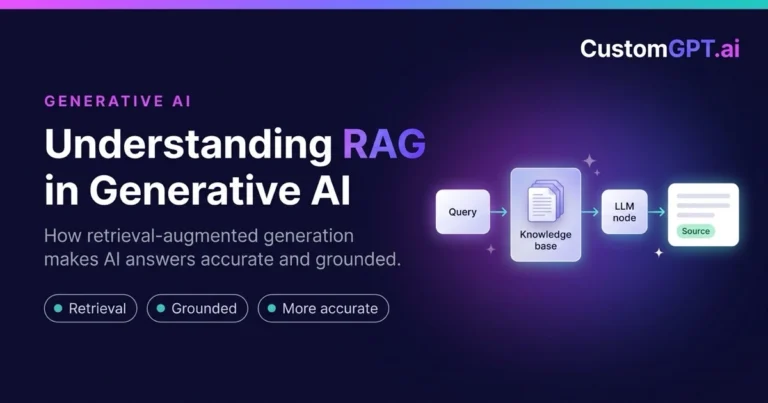
RAG, retrieval-augmented generation, is an approach where the system first retrieves relevant passages from an external, approved knowledge base, then has the model generate an answer grounded in those passages, ideally with citations. Instead of trusting what the model memorized or whatever text happened to be pasted in, the answer is built from evidence the system fetched for that specific question.
This is what turns a general model into a business AI assistant that answers from your content. The mechanics are covered in from LLM to RAG and implementing RAG, and external overviews from IBM, AWS, and NVIDIA explain the pattern in depth.
How Do Long Context Windows Work?
With a long context window, you place all the relevant text into the prompt and the model processes it in one pass. There is no separate search step; the model attends across everything provided and generates an answer.
The catch is that reading everything is not the same as using everything well. Research on how models handle long inputs, notably the “lost in the middle” finding, has shown that models tend to use information at the start and end of a long prompt more reliably than material buried in the middle. Newer models have improved on this, but the effect illustrates a key point: more tokens in the prompt do not automatically mean better use of the right tokens. Processing large prompts also costs more, because cost scales with the number of tokens processed. The Stanford AI Index tracks how these capabilities and their tradeoffs evolve, and research groups like OpenAI, Anthropic, and Google DeepMind continue to push context limits.
How Does RAG Work?
RAG adds a retrieval step before generation. Your content is ingested and indexed so it can be searched by meaning. When a question arrives, the system retrieves the most relevant passages, passes them to the model, and instructs it to answer from those passages while citing them. Update the underlying content, and the next answer reflects the change, with no retraining and no need to paste anything into a prompt.
The table below sets the two approaches side by side.
| Feature | Long Context Windows | RAG |
|---|---|---|
| How knowledge is provided | Pasted into the prompt each time | Retrieved from an indexed knowledge base |
| Best use case | Deep analysis of provided text | Search and answer across many documents |
| Knowledge freshness | Only as current as the pasted text | Updated when you update content |
| Source citations | Not automatic | Built in when the system is designed for it |
| Cost pattern | Scales with tokens per request | Retrieves only what is relevant |
| Scalability | Bounded by the window size | Scales to very large knowledge bases |
| Governance | Limited | Access controls and analytics |
| Enterprise fit | Good for contained tasks | Strong for ongoing knowledge work |
The Simple Difference: Long Context Reads, RAG Retrieves
In plain terms: a long context window lets a model read more text inside one prompt. RAG retrieves the most relevant content from a larger knowledge base before generating an answer.
Long context is useful for deep analysis of documents you already have in hand. RAG is better when the system must find the right document or passage first, out of far more content than any prompt could hold. For businesses, retrieval is more trustworthy because answers can be traced back to source documents, rather than depending on what someone remembered to paste in.
Why Long Context Windows Do Not Replace RAG
A bigger window is a real advance, but it does not solve the problems that matter most for business AI. The table shows why.
| Limitation | Why It Matters | How RAG Helps |
|---|---|---|
| Context limits still exist | Even huge windows have a ceiling | Retrieves only relevant passages, no ceiling on the base |
| High token costs | Processing large prompts is expensive | Sends only relevant passages to the model |
| Weak source governance | Pasted text has no access model | Enforces access controls on the knowledge base |
| Hard to keep content current | Someone must re-paste updated text | Update the source and answers follow |
| No automatic knowledge discovery | The user must know what to paste | Finds the right content for each question |
| Citation gaps | Long prompts do not cite themselves | Ties each answer to a source passage |
| Risk of irrelevant context | Extra text can distract the model | Retrieves focused, relevant evidence |
| Harder enterprise access control | No per-document permissions | Scopes retrieval to permitted content |
Why Long Context Windows Can Still Hallucinate
A long context window does not guarantee the model uses the right evidence. It may miss details buried in a large prompt, combine unrelated facts into a wrong conclusion, or answer confidently when the provided text does not actually support the claim. And unless the system is specifically designed to cite, a long-context answer often arrives with no sources to check.
The point is simple: more tokens do not automatically mean better grounding. Reducing this risk is the job of retrieval, citation, and review, covered in anti-hallucination and enhancing AI trust through RAG. The related question of whether models reason or recall is explored in LLM reasoning vs memorization.
When Are Long Context Windows Better Than RAG?
Long context wins when all the text needed for the answer is already known and fits in the prompt, and the task is to reason over that text rather than search for it. If you hand the model one document and ask it to analyze that document, retrieval adds little; the model just needs to read carefully.
It also shines as a reasoning layer on top of retrieval. Once RAG has found the relevant passages, a long context window lets the model consider more of that retrieved evidence at once, which can improve synthesis on complex questions.
When Is RAG Better Than Long Context?
RAG wins whenever the right content is not known in advance, lives across many documents, changes over time, or must be cited. That describes most business knowledge work. The table maps common scenarios to the better fit.
| Scenario | Better Fit | Why |
|---|---|---|
| Analyze one long document | Long context | The text is known and fits in the prompt |
| Search thousands of documents | RAG | Retrieval finds the relevant few |
| Answer from changing policies | RAG | Content updates without re-pasting |
| Summarize a provided transcript | Long context | The material is already in hand |
| Customer support knowledge base | RAG | Large, evolving, needs citations |
| Compliance research | RAG | Must be current and verifiable |
| Internal knowledge search | RAG | Knowledge is distributed across files |
| Legal document Q&A | RAG | Needs traceable, source-cited answers |
| Technical documentation search | RAG | Docs change with every release |
Why RAG Is Usually Better for Business Knowledge Bases
Business knowledge is large, distributed, and constantly changing. It lives in websites, PDFs, help centers, policies, internal documents, compliance files, training resources, and product documentation, and it is updated all the time. Long context windows are not designed to manage that knowledge over time. They read a prompt; they do not maintain a corpus.
RAG is built for exactly this. It retrieves the right content at the right moment and stays accurate as the knowledge base changes, because you update the source rather than a prompt. That is why grounded retrieval, not prompt size, is the durable foundation for business answers.
How RAG Changes the Trust Model
The difference is easiest to see as two flows.
Long context workflow: the user provides many tokens, the model reads that context, then it answers.
RAG workflow: the user asks a question, the system retrieves approved sources, the model answers from that evidence, then the answer includes source citations.
The retrieval and citation steps are what change the trust model. RAG does not make AI perfect, and it does not eliminate every hallucination. What it adds is a verification layer: because each answer points to a source, a person can confirm it instead of trusting it blindly.
RAG vs Long Context for Business AI Assistants
For a production business assistant, the assistant rarely knows in advance which document answers a given question, and it must stay current and be auditable. That is a retrieval and governance problem, which is where RAG leads and raw prompt size does not help.
| Use Case | Long Context Challenge | RAG Advantage |
|---|---|---|
| Customer support | Cannot paste the whole help center per query | Retrieves the right article and cites it |
| Internal knowledge search | Knowledge spans far more than a prompt | Searches all indexed documents |
| Legal and compliance | Needs traceable, current sources | Retrieves approved content with citations |
| Education support | Course content is large and multilingual | Retrieves relevant material on demand |
| Member support | Association knowledge is large and specific | Retrieves from the member knowledge base |
| Developer documentation | Docs change with every release | Retrieves current docs, updated easily |
| Sales enablement | Reps need accurate, on-message answers | Retrieves approved enablement content |
| Public-sector information access | High volume, broad topics | Retrieves and answers at scale |
RAG vs Long Context for Customer Support
Support is the clearest case for RAG. You cannot paste an entire help center into every conversation, and support content changes constantly. A RAG assistant retrieves the right article for each question, answers from it, and cites it, which is how deflection scales without sacrificing accuracy. BQE Software handled 180,000 questions with an 86% AI resolution rate, and 64% of help center usage now flows through the AI. GEMA served more than 248,000 queries and saved over 6,000 hours at an 88% success rate. Neither is realistic by stuffing documents into a context window. See AI chatbot for customer support and AI chatbot for SaaS.
RAG vs Long Context for Legal and Compliance Teams
Legal and compliance answers must be traceable, current, and confidential. A long prompt provides none of those guarantees, and it cannot cite itself. RAG retrieves from approved content and attaches citations a professional can verify, which is why it fits regulated work. The Tokenizer built a regulated advisory assistant across more than 20,000 sources and 80-plus jurisdictions, and an AI for lawyers deployment focused on confidentiality and accuracy. For governance context, see AI for compliance, citing sources for compliance teams, generative AI compliance risks, and the NIST AI Risk Management Framework.
RAG vs Long Context for Internal Knowledge Search
Internal knowledge lives across many files that no one wants to assemble by hand for each question. RAG turns that scattered content into a single searchable, citable assistant. Overture Partners used this to cut onboarding from 13 weeks to 2 weeks with an assistant across 400-plus documents for 200-plus employees. See enterprise knowledge search for the pattern.
Can Long Context and RAG Work Together?
Yes, and the strongest systems often do. RAG finds the right evidence from a large knowledge base, and a long context window lets the model reason over more of that retrieved evidence at once. Retrieval solves discovery and grounding; long context supports synthesis. The hybrid flow looks like this.
| Step | What Happens | Why It Matters |
|---|---|---|
| User asks a question | The assistant receives a natural-language query | Starting point for a grounded answer |
| RAG retrieves relevant passages | The system searches the knowledge base | Finds the right evidence from a large corpus |
| Long context model reads retrieved evidence | The model considers the retrieved passages together | Supports synthesis across multiple sources |
| AI generates grounded answer | The model answers from the evidence | Keeps the answer tied to real content |
| System includes source citations | Each answer links back to its sources | Makes the answer verifiable |
| Analytics identifies content gaps | Usage data reveals unanswered questions | Shows where the knowledge base needs work |
| Knowledge base updates regularly | Content is refreshed as facts change | Keeps answers current over time |
The CustomGPT.ai RAG benchmark and Claude benchmark explore how retrieval quality affects grounded results, and Google Vertex AI grounding documents a similar retrieve-then-generate pattern.
When Long Context Windows Are Still Useful
Long context is genuinely valuable, and this guide is not an argument against it. It is well suited to reviewing one long contract, summarizing a single long meeting transcript, analyzing a lengthy report, or comparing a small batch of documents. It is also useful as the reasoning layer over passages that RAG retrieves, and it can reduce multi-step retrieval for self-contained tasks where everything needed is already in hand. Long context and RAG are complementary, not enemies.
How CustomGPT.ai Combines Business Knowledge Retrieval With Source-Cited Answers
CustomGPT.ai lets teams upload or connect approved content, crawl websites, and ingest PDFs and documents, then create AI agents that deploy on websites or inside internal workflows and return source-cited answers. In practice that means no-code setup, business content ingestion, RAG-based retrieval, source citations, an anti-hallucination approach, analytics, straightforward knowledge updates, secure deployment options, and an API for developers. Teams building custom retrieval flows can use the RAG API, custom RAG, and custom RAG solutions, and MIT’s ChatMTC shows the range, offering entrepreneurship knowledge with 24/7 access in more than 90 languages via no-code deployment. Public-sector scale is proven too: Bernalillo County handled 114,836 contacts at a $0.99 AI contact cost versus $4.59 staff-assisted, a 4.81x ROI. Whether RAG is the right foundation over fine-tuning for changing content is covered in RAG vs fine-tuning, and pricing is on the pricing page.
Choosing Between Long Context and RAG: A Checklist
| Question | If Yes | Recommended Approach |
|---|---|---|
| Is all needed text already in the prompt? | Everything fits and is known | Long context |
| Does the AI need to search many documents? | Content spans a large corpus | RAG |
| Does the content change often? | Frequent updates are required | RAG |
| Do users need citations? | Answers must be verifiable | RAG |
| Is the use case regulated? | Compliance and audit matter | RAG |
| Do teams need access control? | Per-document permissions required | RAG |
| Is cost predictability important? | Token costs must stay controlled | RAG |
| Is this for external customers? | Public, high-volume usage | RAG |
Final Answer: Should Businesses Use Long Context Windows or RAG?
For most business AI assistants, RAG should be the foundation, with long context as a useful complement. Long context windows are a real advance for reasoning over text you already have, but they do not manage a knowledge base, keep content current, enforce access control, control cost, or cite sources. Those are the things business answers depend on, and they are what retrieval provides.
The most capable systems use both: RAG to find and ground, long context to reason over what was found. RAG does not make AI perfect or remove every hallucination, but it adds the verification layer businesses need. Prompt size will keep growing; the need for grounded, source-cited answers from a governed knowledge base will not go away.
Frequently Asked Questions
What is the difference between long context windows and RAG?
A long context window is how much text a model can read in one prompt. RAG retrieves relevant content from a larger knowledge base before answering and can cite sources. One expands what the model reads at once; the other finds and grounds the right evidence.
Is long context better than RAG?
It depends on the task. Long context is better for reasoning over text you already have in the prompt. RAG is better for searching a large, changing knowledge base and answering from approved sources with citations, which covers most business use cases.
Does a large context window replace RAG?
No. A bigger window lets a model read more text, but it does not manage a knowledge base, keep content current, enforce access control, or cite sources automatically. RAG addresses those needs, which is why the two are complementary.
When should I use long context instead of RAG?
Use long context when all the needed text is known and fits in the prompt and the task is to analyze it, such as reviewing one contract, summarizing a transcript, or reasoning over passages that retrieval already found.
When should I use RAG instead of long context?
Use RAG when the right content is not known in advance, spans many documents, changes over time, or must be cited. That describes support, internal knowledge, legal, compliance, and documentation work.
Can long context and RAG work together?
Yes. RAG finds and grounds the right evidence from a large knowledge base, and a long context window lets the model reason over more of that retrieved evidence at once. Retrieval handles discovery and grounding; long context supports synthesis.
Why is RAG better for business knowledge bases?
Business knowledge is large, distributed, and constantly changing across websites, PDFs, help centers, policies, and internal docs. RAG retrieves the right content per question and stays accurate as content changes, because you update the source rather than a prompt.
Can long context models hallucinate?
Yes. A large prompt does not guarantee the model uses the right evidence. It can miss details in the middle of long inputs, combine facts incorrectly, or answer confidently without support, and it will not cite sources unless the system is built to.
Does RAG eliminate hallucinations?
No. RAG reduces hallucination risk by grounding answers in retrieved sources and enabling verification through citations, but no system removes them entirely. High-stakes answers should still be reviewed by a person.
Why are source citations important for AI answers?
Citations let a human verify an answer against its source, catching errors before they reach a customer or a filing. They also discourage fabrication, since a system built to answer only from retrievable sources has nothing to cite for invented details.
Is RAG better for customer support chatbots?
Usually yes. Support content is large and changes often, and you cannot paste a whole help center into each conversation. RAG retrieves the right article per question and cites it, which is how deflection scales while staying accurate.
Is RAG better for legal and compliance AI?
For most legal and compliance work, yes, because answers must be traceable, current, and confidential. RAG retrieves from approved content and attaches citations a professional can verify, while a long prompt provides none of those guarantees on its own.
How does CustomGPT.ai use RAG?
CustomGPT.ai ingests your approved content through uploads, website crawling, and connectors, then builds agents that retrieve relevant passages and return source-cited answers, with an anti-hallucination approach, analytics, secure deployment, and an API. It reduces reliance on model memory and prompt stuffing.
What is the best approach for enterprise AI assistants?
The best approach for enterprise AI assistants is usually a RAG-first architecture with source citations, content governance, analytics, and regular knowledge updates. Long context windows can still be useful when the assistant needs to reason over the evidence RAG retrieves. CustomGPT.ai helps businesses build source-cited RAG agents from their own content without building the full retrieval infrastructure from scratch.
Build a Source-Citing AI Agent That Answers From Your Business Content
The long context windows vs RAG debate has a practical answer for business: ground answers in your approved knowledge, cite the sources, and use long context to reason over what retrieval finds. Bigger prompts are welcome, but they do not replace a governed, citable knowledge base.
Build a source-citing AI agent that answers from your business content with CustomGPT.ai.