
2024 Prediction Series Wrap-Up: Our Top 7 AI Predictions for 2024

Undoubtedly, 2022 and 2023 has been generative AI’s breakout years, and 2024 will be equally critical for the development and deployment of AI models and AI-powered technologies.
Over the past few weeks, we’ve published seven sets of AI predictions for 2024, with information drawn from insights, statistics, and predictions by influential speakers and companies in the space.
Here’s our AI Predictions Mini Series roundup, covering the anticipated key areas of AI disruption in the next twelve months.

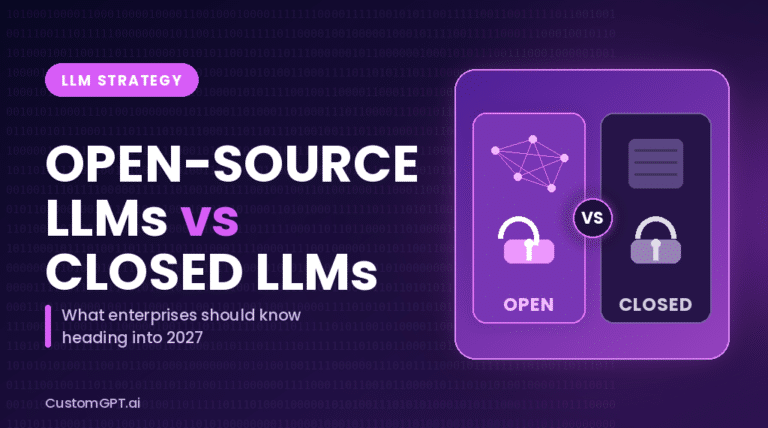
1. Open Source LLMs Show Potential to Overtake Closed LLMs
What we’re expecting:
– Open-source Large Language Models (LLMs) like Llama 2 from Meta will surpass the capabilities of their closed counterparts.
– Open-source LLMs will gain popularity due to their accessibility, transparency, and the collaborative efforts of the global AI community.
Key takeouts:
Llama-2 upgrades have led to performance gains, and studies show the model is competing with ChatGPT and even surpassing OpenAI’s models in certain metrics. With a smaller model size, Llama-2 can be less expensive and less complex.
Github, Linux, and MIT Sloan all recently discussed the open-source trend, and it’s not all about individual developers, startups, and SMBs. 30% of Fortune 100 companies now have Open Source Program Offices (OSPOs), and open-source AI may be a solution to the risk of sharing sensitive data with a third-party company and model. That said, there are drawbacks to open-source LLMs, which can be at risk of greater misuse and, with a potential lack of quality control, can have inconsistencies and security risks.
2. Enterprises will Shift 10% of Budget Allocation to AI Projects
What we’re expecting:
– A significant shift in corporate spending habits will occur, with at least 10% of budgets being earmarked for AI initiatives.
– CEOs and business leaders who choose not to invest in AI projects may risk the dangers of AI anyway, lose the talent war, and miss the opportunity for revenue growth and cost-savings.
Key takeouts:
AI’s benefit to productivity could add up to $4.4 billion to the global economy, according to McKinsey. Deloitte says enterprise spending on generative AI could grow as much as 30% in 2024, and other forecasts believe it could be much higher. Gartner believes AI impacts will be felt more in 2024, but in most reports, around two-thirds of companies are already engaged in AI spending.
Not investing in AI could leave companies outpaced by their peers and lose valuable talent to firms offering exciting technologies that remove mundane tasks from daily schedules.
Early adopters of AI may have greater control of the risks versus skeptics whose employees may use AI anyway, without company safeguards.
3. English as the New Programming Language
What we’re expecting:
- Programming co-pilots can interpret instructions in English and translate them into functional code, hinting at a future where programming could be as simple as articulating your thoughts in English.
Key takeout:
This paradigm shift, catalyzed by the sophistication of LLMs, promises to democratize programming, extending its reach to a broader audience. It will fundamentally alter our interaction with technology as the traditional requirement to master a programming language dissolves, paving the way for a more intuitive translation of human thoughts into digital realities.

4. How the 3-Person Unicorn will rise with AI
What we’re expecting:
– According to this 2024 predictions compilation, 2024 is poised to witness the emergence of a new breed of unicorn companies, characterized by their small, agile teams empowered by AI-driven efficiencies.
– These companies will achieve rapid growth and valuation, leveraging AI tools to streamline operations, reduce overheads, and scale with unprecedented speed.
Key takeouts:
AI-powered solutions provide an affordable and scalable way to develop new products and services while vastly empowering leaders with powerful analytics and insights.
James Currier, General Partner at seed investment firm NFX, predicts that:
“With the next generation of AI tools, teams of three very talented people will be able to grow software-centric businesses to $100+ million in revenue with automated workflows.”
AI streamlines startup operations with a constant flow of data for fast iteration. It speeds product development and validation, meaning MVPs can be launched far faster. AI creates operational efficiency and powerfully augments sales, marketing, and customer service efforts. For startups, AI makes raising capital, with lower overheads and clearer performance metrics, easier than ever before, and scaling can be as simple as updating subscriptions.
5. AI to Disrupt at Least 30% of Customer Support Norms
What we’re expecting:
– The year 2024 will mark a significant disruption in the realm of customer support, with up to 30% of traditional support functions being replaced by AI-driven efficiency.
– The AI-driven efficiency revolution will redefine customer support, shifting the focus from technology as the disruptor to the efficient use of AI-powered tools.
– Organizations that embrace these efficiency-driven changes will thrive, while those resistant to change may find themselves left behind in a rapidly evolving landscape.
Key takeouts:
PwC and McKinsey believe 30% of jobs and work hours could be automated by 2030, accelerated by generative AI. The shift in customer service and support is already well underway, and we think the 30% statistic could become real as soon as next year.
Again, around two-thirds of companies are expected to have invested in AI, this time to assist customer service agents and provide better services to customers. Generative AI can answer most basic inquiries in a multitude of languages and at any time of the day. AI can also improve customer service team training, help agents while they are serving customers, create call scripts, add further personalization, and provide insights and sales leads from customer data.
… and finally, a bonus prediction:
6. AI + HITL – Enhanced Understanding of Human in the Loop
What we’re expecting:
– In 2024, the concept of “Human in the Loop” (HITL) in AI systems will become more nuanced and clearly defined.
– AI developers and users will have a deeper understanding of humans’ critical role in fine-tuning AI models, ensuring ethical use, and handling complex edge cases.
– The synergy between AI and human expertise will lead to more responsible and effective AI applications across various domains.
Key takeouts:
The concept of human-in-the-loop (HITL) has two key facets. Firstly, how humans are essential for training, supervising, and testing AI output, and secondly, how humans will continually work side-by-side with AI to maximize the outcome of this still-emerging technology.
HITL results in a continuous feedback loop that teaches the algorithm, leading to better, safer results. If AI is too self-sufficient, risks include “model collapse,” falsification, misinterpretation, laziness, and bias.
“Humans in the loop: It’s the angst-ameliorating mantra for the new age of generative AI.”
(McKinsey)
Adding HITL, even for basic applications of AI, can more safely speed up the deployment of AI for companies afraid of missing out but leery of leaping right in.
The near future of AI sees a human-machine collaboration with human feedback, oversight, problem-solving, and handling of edge cases.
What’s certain is that 2024 will be a very interesting year for technology, not just AI, not least because AI is quickly being integrated into many of the platforms and devices we use daily.
Frequently Asked Questions
How should teams think about open-source vs closed LLMs in 2024?
If you’re choosing between open and closed models, treat it as a fit decision rather than a winner-take-all debate. In 2024, open-source LLMs such as Meta’s Llama 2 are improving quickly and can be less expensive and less complex, while closed models such as OpenAI’s remain strong comparators. For many business use cases, retrieval and grounding matter as much as the base model: the provided benchmark states that CustomGPT.ai outperformed OpenAI on RAG accuracy. A practical evaluation should compare answer quality on your own source material, data-control requirements, and implementation complexity.
Where should companies put their first AI budget in 2024?
Start with one high-volume workflow that removes repetitive work and has clear ROI. A practical first test is customer inquiries, proposal support, or internal knowledge search. Stephanie Warlick framed that opportunity this way: “Check out CustomGPT.ai where you can dump all your knowledge to automate proposals, customer inquiries and the knowledge base that exists in your head so your team can execute without you.” If you’re setting an initial AI budget, prioritize a use case with reliable source content and measure outcomes such as response time, resolution rate, and hours saved.
What does "English as the new programming language" actually mean?
It means many useful AI systems can now be shaped by writing clear instructions and supplying strong source content instead of hand-coding every rule. Evan Weber described that shift directly: “I just discovered CustomGPT, and I am absolutely blown away by its capabilities and affordability! This powerful platform allows you to create custom GPT-4 chatbots using your own content, transforming customer service, engagement, and operational efficiency.” In practice, teams still need technical review for integrations and security, but more of the work moves into prompting, structuring knowledge, and testing outputs.
Can a very small team build a serious AI product in 2024?
Yes. One of the biggest 2024 shifts is that small teams can create useful AI products faster because they can build on existing models and focus on domain knowledge. Dr. Michael Levin captured that change with a memorable outcome: “Omg finally, I can retire! A high-school student made this chat-bot trained on our papers and presentations”. The practical lesson is that a narrowly scoped assistant trained on trusted materials can deliver real value without building a general-purpose model from scratch.
Why are keyword-based chatbots likely to lose ground in 2024?
Keyword-based bots tend to fail when users phrase the same intent in unexpected ways. Retrieval-based assistants are better suited to 2024 expectations because they can search trusted source material and answer in natural language. Joe Aldeguer, IT Director at the Society of American Florists, highlighted the value of precise knowledge retrieval: “CustomGPT.ai knowledge source API is specific enough that nothing off-the-shelf comes close. So I built it myself. Kudos to the CustomGPT.ai team for building a platform with the API depth to make this integration possible.” If your users ask questions in many different ways, a retrieval-first assistant is usually more resilient than a keyword tree.
Why will security and human oversight matter more in 2024 AI rollouts?
As AI moves into real business workflows, you need controls for data handling, auditing, and escalation to humans when the stakes are high. The provided sources support three concrete checks: SOC 2 Type 2 certification, GDPR compliance, and a stated policy that customer data is not used for model training. Open-source AI can help teams reduce concerns about sending sensitive data to third parties, but model choice alone does not replace governance. If you’re deploying AI in sensitive processes, pair technical safeguards with a clear human-review path.
Related Resources
For a practical next step, explore how CustomGPT.ai helps teams build AI tailored to their own data and workflows.
- Custom AI Agents — Learn how CustomGPT.ai enables businesses to create purpose-built AI agents for support, research, and internal knowledge use cases.
- AI insurance claims example — Review how Lemonade uses AI Jim for faster claim handling in a regulated industry workflow.