The AI-Powered Agency: How to Create a Business Plan for Your AI Services
The rise of AI is redefining how agencies deliver value, scale expertise, and differentiate in competitive markets, making a clear AI business plan for agencies, especially around white-label AI offerings, essential rather than optional.

Make Money With AI
Once the agency plan is drafted, use this AI consulting business guide to turn positioning, pricing, and early client acquisition into a practical next step.
Without a structured plan, even the most powerful AI tools can turn into fragmented experiments instead of a profitable, repeatable service offering.
An AI-powered agency isn’t just about adopting new technology—it’s about aligning strategy, pricing, positioning, and delivery around intelligent systems that drive measurable outcomes.
With the right business plan, agencies can confidently package AI services, communicate their value to clients, and build a foundation for sustainable growth in an AI-first economy.
Defining the Opportunity for AI Services in Your Agency
Launching AI services begins with clearly articulating why this expansion matters for your agency and how it aligns with client needs and long-term growth.
This step anchors your AI business plan for agencies in real market opportunity rather than hype, ensuring your AI initiatives are both strategic and profitable.
By defining the opportunity early, agencies can align internal teams, refine service positioning, and avoid fragmented AI experiments. A clear opportunity statement also strengthens your marketing agency AI strategy by connecting AI capabilities directly to client outcomes.
Identifying Market Demand for AI Service Offerings
Understanding demand ensures your AI services address real business problems instead of showcasing isolated technology. Market validation helps agencies prioritize AI use cases that clients are already willing to invest in.
Signals that your market is ready for AI services
- Clients requesting faster insights, personalization, or predictive analytics
- Increased competition adopting AI-driven marketing tools
- Growing interest in performance-based and data-backed decision-making
Clear demand turns AI service offerings into scalable solutions rather than optional add-ons.
Assessing Your Agency’s Competitive Advantage with AI
Not every agency will compete on the same AI capabilities, making differentiation critical. Your advantage may come from industry expertise, proprietary workflows, or how seamlessly AI integrates with existing services.
Ways agencies can differentiate AI offerings
- Applying AI to niche verticals with specific data challenges
- Combining human strategy with automated execution
- Offering explainable, client-friendly AI insights rather than black-box outputs
A defined competitive edge strengthens your positioning and supports sustainable growth.
Aligning AI Services with Existing Agency Capabilities
AI services should amplify what your agency already does well, not replace it entirely. Alignment reduces operational friction and accelerates adoption across teams.
Areas where AI naturally complements agency services
- Campaign optimization and performance forecasting
- Content ideation, testing, and personalization
- Customer journey analysis and segmentation
When AI aligns with core capabilities, it becomes a force multiplier rather than a disruption.
Determining the Scope of Your Initial AI Service Launch
Starting focused helps agencies control risk while proving value. Defining scope ensures your first AI offerings are manageable, measurable, and repeatable.
Factors to consider when setting scope
- Internal technical readiness and data access
- Client maturity and willingness to adopt AI solutions
- Revenue potential versus implementation complexity
A well-scoped launch creates momentum and lays the groundwork for expanding your AI-powered agency services.
Conducting Market Analysis for Your AI Service Offerings
A solid market analysis validates your AI service idea and strengthens your positioning before you invest in development or hiring.
This step ensures your AI business plan for agencies reflects real buyer behavior, competitive dynamics, and pricing expectations within the broader AI services for marketing agencies landscape.
By grounding decisions in data, agencies can reduce risk and design AI solutions that meet clear market gaps. Market analysis also informs your go-to-market strategy by revealing who to target, how to message value, and where AI can outperform traditional services.

Understanding Your Ideal Client Profile for AI Services
AI services are most effective when tailored to clients with the right data maturity, budgets, and expectations. Defining your ideal client profile helps focus sales efforts and avoids misaligned engagements.
Key traits of high-fit AI service clients
- Existing reliance on data-driven marketing decisions
- Clear performance goals tied to revenue or efficiency
- Openness to automation paired with strategic oversight
A well-defined client profile improves conversion rates and long-term client success.
Analyzing Competitors Offering AI-Driven Marketing Solutions
Competitive analysis reveals how other agencies position AI and where they fall short. This insight allows you to differentiate your AI offerings instead of competing solely on price.
What to evaluate in competitor AI offerings
- Types of AI services packaged and sold
- Transparency around AI capabilities and limitations
- Pricing models and service guarantees
Understanding the competitive landscape helps you craft a stronger, more credible value proposition.
Evaluating Market Gaps and Pricing Expectations
Identifying unmet needs allows agencies to design AI services that feel essential rather than experimental. Pricing analysis ensures your services are profitable while remaining market-aligned.
| Market Insight Area | What to Look For | Strategic Opportunity |
| Underserved niches | Industries with low AI adoption | First-mover advantage |
| Pricing inconsistency | Wide price ranges for similar services | Value-based pricing |
| Client pain points | Slow reporting or poor attribution | AI-driven efficiency |
Clear market gaps and pricing signals help agencies position AI as a premium, outcome-focused service rather than a commodity.
Structuring Your AI Service Offerings and Packages
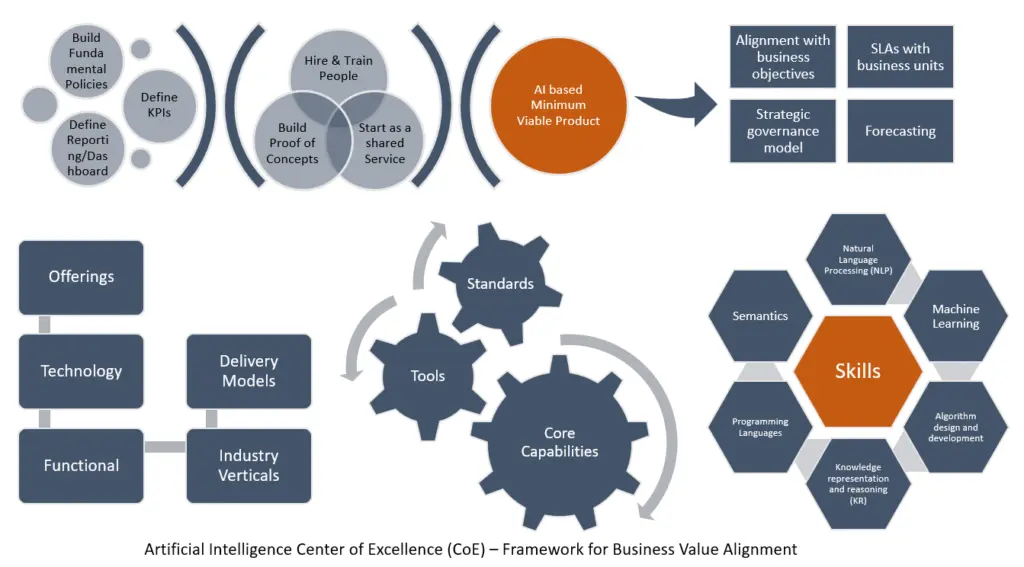
Clear service structure turns AI capabilities into sellable, repeatable offerings that clients can easily understand. This section of your AI business plan for agencies focuses on translating technical potential into defined packages that support consistent delivery and scalable growth as you deploy AI for clients.
Well-structured AI services also simplify sales conversations and set realistic expectations around outcomes. By packaging AI intentionally, agencies position themselves as strategic partners rather than experimental technology providers.
Defining Core AI Services for Marketing Agencies
Core services should solve common, high-impact problems that align with your agency’s strengths as an AI agency. These offerings become the foundation of your AI service portfolio.
Examples of core AI service categories
- Predictive analytics and performance forecasting
- AI-driven personalization and audience segmentation
- Automated reporting and insight generation
Strong core services create clarity and make it easier to expand into advanced offerings later.
Creating Tiered AI Service Packages
Tiered packages help agencies serve different client budgets while protecting margins. They also encourage upsells as clients grow more comfortable with AI solutions.
Common AI service package tiers
- Entry-level AI insights and automation
- Mid-tier optimization and predictive modeling
- Advanced AI strategy with custom workflows
Tiered packaging supports scalability and long-term client relationships.
Determining Pricing Models for AI Service Offerings
Pricing AI services requires balancing value, complexity, and ongoing maintenance. The right pricing model reinforces your positioning and revenue goals.
| Pricing Model | Best Use Case | Consideration |
| Retainer-based | Ongoing optimization and insights | Predictable revenue |
| Usage-based | Data processing or automation volume | Variable client needs |
| Value-based | Revenue or efficiency outcomes | Strong ROI tracking |
Thoughtful pricing ensures profitability while aligning client expectations with delivered value.
Packaging AI Services with Human Expertise
AI delivers its strongest impact when paired with strategic human oversight. Packaging AI with expertise increases trust and perceived value.
Ways to combine AI and human strategy
- AI-generated insights reviewed by strategists
- Human-led recommendations powered by AI data
- Ongoing optimization guided by expert interpretation
Blending AI with human expertise positions your agency as both innovative and accountable.
Building Financial Projections for Your AI Services
Financial projections translate your AI vision into measurable business outcomes and investor-ready numbers. This part of the AI business plan for agencies ensures your AI initiatives are financially viable, scalable, and aligned with overall agency profitability.
By modeling costs, revenue, and margins early, agencies can avoid underpricing AI services or overinvesting in tools that don’t generate returns. Strong projections also support confident decision-making as AI offerings mature.
Estimating Initial and Ongoing AI Investment Costs
AI services require both upfront and recurring investments that must be accurately forecasted. Understanding these costs prevents margin erosion as services scale.
Common AI-related cost categories
- AI software subscriptions and APIs
- Data infrastructure and integration expenses
- Training, hiring, or upskilling team members
Clear cost visibility supports sustainable pricing and growth planning.
Forecasting Revenue from AI Service Offerings
Revenue projections should be conservative, data-informed, and tied to realistic sales capacity. This ensures your financial model reflects achievable growth.
Inputs for AI revenue forecasting
- Number of target clients per quarter
- Average contract value per AI package
- Expected upsell or expansion rate
Accurate revenue forecasts help agencies set realistic performance benchmarks.
Projecting Margins and Profitability for AI Services
AI services often carry higher margins when operational efficiency improves over time. Modeling margin progression highlights when AI becomes a major profit driver.
| Financial Metric | Year 1 | Year 2 |
| Gross margin | Moderate | High |
| Delivery efficiency | Learning phase | Optimized |
| Profit contribution | Growing | Significant |
Understanding margin evolution reinforces long-term confidence in AI investments.
Planning for Financial Risk and Scalability
Every AI initiative carries financial risk, especially during early adoption phases. Proactive planning reduces exposure and improves resilience.
Risk mitigation strategies
- Phased AI service rollouts
- Pilot programs before full-scale launches
- Flexible pricing during early market validation
Thoughtful financial planning ensures your AI-powered agency scales with control and confidence.
Creating a Go-to-Market Strategy for Your AI Services
A strong go-to-market strategy ensures your AI services reach the right clients with clear messaging and a compelling value proposition. This stage of the AI business plan for agencies focuses on how you launch, position, and sell AI offerings in a way that builds trust and accelerates adoption.
Without a defined go-to-market approach, even well-built AI solutions struggle to gain traction. Clear positioning and coordinated execution help agencies stand out in an increasingly crowded AI marketing services.
Positioning AI Services Around Client Outcomes
Clients care less about algorithms and more about results, making outcome-driven positioning essential. AI services should be framed as solutions to measurable business challenges.
Effective outcome-focused positioning
- Emphasize revenue growth, efficiency, or cost reduction
- Translate AI capabilities into client-friendly benefits
- Use real-world scenarios instead of technical jargon
Outcome-driven messaging increases relevance and shortens sales cycles.
Designing a Sales Enablement Strategy for AI Offerings
Sales teams need clarity and confidence to sell AI services effectively. Enablement ensures they can explain value, handle objections, and set expectations.
Key sales enablement components
- Simple AI service one-pagers and case narratives
- Clear qualification criteria for AI-fit prospects
- Objection handling around data, risk, and ROI
Well-equipped sales teams accelerate adoption and reduce friction.
Selecting Marketing Channels for AI Service Promotion
Choosing the right channels ensures your AI services reach decision-makers efficiently. Channel selection should reflect where your ideal clients already engage.
High-impact channels for AI service marketing
- Thought leadership content and webinars
- Case-driven email campaigns
- Strategic partnerships and referrals
Focused channel strategy improves visibility without diluting resources.
Planning Your AI Service Launch and Rollout
A phased launch reduces risk while creating learning opportunities. Early feedback helps refine offerings before scaling.
Best practices for AI service rollout
- Pilot launches with trusted clients
- Clear success metrics and feedback loops
- Iterative improvements based on performance data
A disciplined rollout builds momentum and credibility for long-term growth.

Preparing Your Agency for AI Service Execution and Operations
Operational readiness determines whether your AI services deliver consistent results or create internal strain. This section of the AI business plan for agencies focuses on aligning people, processes, and technology to support reliable AI service delivery at scale.
By preparing operations early, agencies reduce execution risk and ensure AI becomes a repeatable capability rather than a one-off experiment. Strong operational foundations also improve client trust and long-term retention.
Building the Right Team Structure for AI Services
AI services require a blend of technical capability and strategic oversight. Defining roles early helps avoid confusion and delivery gaps.
Key roles supporting AI service execution
- AI or data specialists managing tools and models
- Strategists translating insights into recommendations
- Account leads ensuring client alignment and adoption
Clear role ownership keeps AI delivery efficient and accountable.
Establishing Internal AI Processes and Workflows
Documented workflows turn AI services into standardized offerings rather than custom projects. Process clarity supports consistency and scalability.
Core AI workflow components
- Data intake and validation procedures
- Model output review and quality checks
- Client-facing reporting and recommendation cycles
Well-defined processes reduce errors and accelerate delivery.
Ensuring Data Readiness and Technology Infrastructure
AI performance depends on data quality and integration. Agencies must assess readiness before committing to service-level guarantees.
Data and infrastructure considerations
- Access to clean, structured client data
- Secure data handling and compliance standards
- Integration between AI tools and existing systems
Strong infrastructure enables reliable, defensible AI outcomes.
Managing Risk, Compliance, and Client Expectations
AI introduces new risks around data use, accuracy, and accountability. Proactive management protects both the agency and its clients.
Risk and expectation management practices
- Transparent communication about AI limitations
- Clear usage policies and consent frameworks
- Regular audits of AI outputs and processes
Effective risk management builds confidence and supports sustainable AI service growth.
FAQs
Q: How can a marketing agency start offering AI services without building technology in-house?
A: Many agencies use existing AI platforms or APIs to deliver services rather than building their own systems. This approach reduces cost and complexity. Human oversight is still required to interpret results and manage quality.
Q: What types of client problems are best suited for AI-based marketing services?
A: AI works best for problems involving large datasets, repeated decisions, or pattern detection. Common examples include performance analysis, personalization, and forecasting. AI is less effective for purely subjective or creative decisions.
Q: How do agencies manage client expectations when using AI?
A: Agencies set clear boundaries around what AI can and cannot do. They explain that AI provides probabilistic outputs, not guaranteed answers. Regular reviews and transparency help maintain trust.
Q: Can AI services be standardized across multiple clients?
A: Some AI services can be standardized, especially reporting and analysis workflows. However, data inputs and business goals often vary. Agencies usually balance standard processes with client-specific customization.
Q: What limitations should agencies communicate when delivering AI services?
A: Agencies should communicate that AI outputs depend on data quality and may contain errors. AI does not replace strategic judgment or accountability. Clear disclaimers and review processes reduce risk.
Conclusion
AI is no longer an optional add-on for agencies—it’s a strategic growth lever that, when planned correctly, can unlock new revenue streams, stronger client retention, and scalable service delivery.
By building a clear AI business plan for agencies that covers market demand, financial projections, go-to-market strategy, and operational readiness, agencies can move from experimentation to confident execution.
If you’re ready to turn AI into a structured, revenue-generating service rather than a scattered set of tools, explore how managed AI solutions can accelerate your launch and reduce risk.




Frequently Asked Questions
How do I choose the first AI service my agency should launch?
Start with one repeatable use case that matches what your agency already does well and solves a clear client problem. Good first offers usually center on high-frequency work such as proposals, customer inquiries, or internal knowledge access rather than a broad u0022AI transformationu0022 package. Stephanie Warlick, a business consultant, said, u0022Check out CustomGPT.ai where you can dump all your knowledge to automate proposals, customer inquiries and the knowledge base that exists in your head so your team can execute without you.u0022 In a business plan, choose a service with the same onboarding steps, content inputs, and success metric across clients so it can scale beyond one-off custom work.
How can I prove ROI in an AI agency business plan?
Use a before-and-after model built around measurable operations, not vague productivity claims. Show the current cost, time, or volume for a workflow, then estimate the impact of AI on response time, throughput, support deflection, proposal turnaround, or team capacity. Bill French, a technology strategist, said, u0022They’ve officially cracked the sub-second barrier, a breakthrough that fundamentally changes the user experience from merely ‘interactive’ to ‘instantaneous’.u0022 That kind of performance change is useful in an ROI model because faster answers can reduce abandonment, improve service quality, and let the same team handle more work. A credible plan should define the baseline metric, the target improvement, and how you will measure results in a pilot.
Should an agency build its own AI solution or partner with an existing platform first?
Partner first if you need speed to market, lower technical risk, and proof that clients will buy the service. Build later only when you have a validated niche, proprietary workflow, and the resources to handle maintenance, evaluation, security, and ongoing improvement. The page content also stresses that AI services should align with your existing capabilities rather than replace everything at once. As a quality check, compare retrieval accuracy before you commit to any platform; one supported benchmark notes that CustomGPT.ai outperformed OpenAI in a RAG accuracy benchmark, which shows why testing matters before you lock in your delivery model.
How specific should my niche be in an AI agency business plan?
Your niche should be specific enough that the buyer, workflow, and desired outcome are obvious. Instead of offering generic AI services to everyone, define one vertical or problem type where your agency already understands the questions, content, and compliance needs. Barry Barresi, a social impact consultant, described a focused use case this way: u0022Powered by my custom-built Theory of Change AIM GPT agent on the CustomGPT.ai platform. Rapidly Develop a Credible Theory of Change with AI-Augmented Collaboration.u0022 That level of specificity makes positioning, sales conversations, onboarding, and proof points much easier than a broad AI offer.
How do I turn AI services into recurring revenue instead of one-off projects?
Recurring revenue comes from managing an ongoing business process, not just delivering a one-time setup. In practice, that means packaging monthly knowledge-base updates, workflow tuning, analytics reviews, support automation, or campaign enablement rather than selling a chatbot build and walking away. Evan Weber, a digital marketing expert, said, u0022I just discovered CustomGPT, and I am absolutely blown away by its capabilities and affordability! This powerful platform allows you to create custom GPT-4 chatbots using your own content, transforming customer service, engagement, and operational efficiency.u0022 The strongest retainers are tied to operating rhythms clients already have, such as weekly content changes, monthly reporting, or continuous customer support.
Can a generic AI business plan generator create a usable plan for an agency?
It can help with structure, but it cannot validate whether your service will work in the real world. A usable agency plan needs evidence about accuracy, workflow fit, deployment speed, and maintenance requirements. The Kendall Project said, u0022We love CustomGPT.ai. It’s a fantastic Chat GPT tool kit that has allowed us to create a ‘lab’ for testing AI models. The results? High accuracy and efficiency leave people asking, ‘How did you do it?’ We’ve tested over 30 models with hundreds of iterations using CustomGPT.ai.u0022 That is the standard a real plan should aim for: use generators for formatting, then replace generic sections with assumptions you have tested in pilots or internal experiments.
What operational risks should an AI agency business plan cover?
Cover data handling, security review, accuracy controls, and human oversight. If clients will share sensitive content, your plan should state whether the solution is GDPR compliant, whether data is used for model training, and what independent security controls are in place. The supported credentials provided here include GDPR compliance, a policy that data is not used for model training, and SOC 2 Type 2 certified controls. You should also define where human review is required for higher-stakes outputs and how you will monitor conversations and performance after launch.
Related Resources
If you’re refining your agency offer, these guides add useful context for planning, delivery, and growth.
- AI Consulting Business — Explore how to structure services, position your expertise, and build a sustainable consulting model around AI.
- AI Client Implementation — Learn practical ways to scope, deploy, and manage AI solutions for clients with clear expectations and outcomes.
- AI Business Opportunities — Review where the strongest AI market opportunities are emerging and how agencies can align offers with demand.