
Scaling Citizen Services: What to Look for in an AI Support Solution
Every day, government agencies face the same challenge: serving more people with fewer resources.
Citizens expect fast, accurate, and inclusive services—but behind the scenes, many agencies are still running on phone lines, paper-heavy processes, and legacy systems.
That’s where AI for the public sector is changing the game.
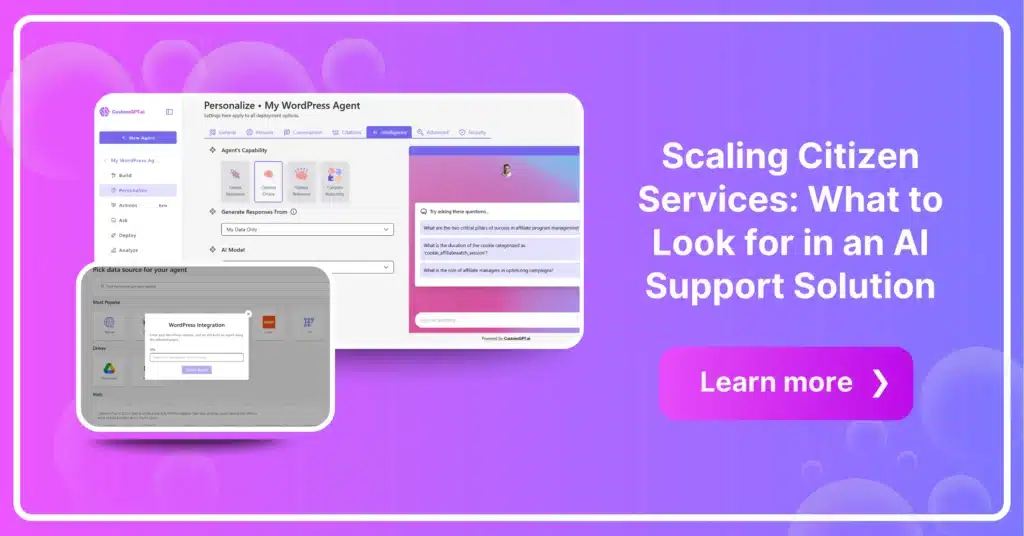
From chatbots that answer routine questions instantly to virtual agents that integrate with existing databases, AI in government is no longer a future vision—it’s happening now.
But not every system delivers the same results. Choosing wisely matters. The right AI support solution can cut wait times, reduce costs, and build citizen trust. The wrong one can frustrate users, create compliance risks, and waste taxpayer dollars.
This blog is your guide to choosing AI tools for support. We’ll break down the must-have features for AI for citizen services, explain how to evaluate options, and share best practices for scaling responsibly in high-stakes public sector environments.
The Stakes: Why AI Support Matters for Governments
Governments today face mounting pressure: populations are growing, expectations are rising, and budgets are tighter than ever.
Citizens want fast, accurate, and accessible support, but traditional systems often leave them waiting in long queues, frustrated by limited service hours, or confused by inconsistent information.
This is where AI for public sector support steps in — not as a luxury, but as a necessity.
- Growing Demand, Limited Resources
Each year, government agencies must handle rising volumes of inquiries, from license renewals to tax questions. Hiring more staff isn’t always feasible, so leaders are turning to AI.
AI automates routine, repetitive tasks so employees can focus on cases that truly need human expertise. In one deployment, Microsoft’s Copilot for Service reduced AHT by 12% — and those gains compound fast when scaled across thousands of citizen interactions.
- Expectations Shaped by the Private Sector
Citizens no longer compare public services only to each other — they benchmark against banks, airlines, and retailers. They now expect the same speed and accessibility from public services.
If those industries can provide real-time, 24/7 support, why shouldn’t their government? AI support helps bridge this gap.
- Trust as the Ultimate Metric
For governments, every delayed response or error carries weight. Inaccurate or inconsistent information doesn’t just cause frustration — it undermines trust in institutions.
AI systems that provide fast, reliable, and transparent answers can rebuild confidence.
- Complexity of Modern Governance
From healthcare enrollment to property tax appeals, citizens interact with multiple departments that often operate in silos.
AI-powered platforms unify these touchpoints, creating a seamless, consistent experience across channels.
- Doing More With Tight Budgets
With limited room for headcount growth, efficiency is not just desirable — it’s critical.
AI offers measurable ROI by reducing call volumes, cutting average handling time, and scaling services without ballooning payroll costs.
Foundational AI for Public Sector Use
AI for public sector isn’t just about flashy chatbots — it rests on a handful of powerful, practical technologies that make public service delivery faster, fairer, and more reliable. Understanding these foundations helps leaders make better software selection decisions.
Natural Language Processing (NLP)
NLP enables AI systems to understand the intent behind citizen questions, not just keywords. This means citizens asking the same thing in different ways — or in different languages — still get the right answer.
Modern transformer-based NLP models even capture policy nuances, which is critical when dealing with regulations, taxes, or compliance inquiries.
Explainable AI (XAI)
Governments can’t afford “black box” decisions. Explainable AI (XAI) tools trace how an answer was generated and why. This matters in high-stakes areas like benefits adjudication or licensing.
With XAI, both staff and citizens can see the reasoning behind outcomes, which strengthens trust and helps agencies meet compliance standards.
Omnichannel Integration
Citizens don’t just use one channel — they may call, email, chat, or text. Omnichannel AI systems ensure that no matter where the question comes from, the answer is consistent, accurate, and policy-backed.
This not only streamlines workflows but also creates a fairer experience across diverse communities.
Human-in-the-Loop Safeguards
Even the most advanced AI needs human oversight. Human-in-the-loop frameworks allow staff to step in on complex or sensitive cases — for example, an appeal on property valuation.
This balance ensures AI is a force multiplier for staff rather than a risky replacement.
What to Look for in an AI Support Solution
Not all AI platforms are created equal. For governments, the right AI for Public Sector must balance efficiency, accountability, and trust.
Below are the key factors that leaders should prioritize when evaluating options:
- Ease of Deployment: Public agencies often operate with lean IT teams and complex approval cycles. The best AI solutions are low-code or no-code, allowing staff to configure chatbots or workflows without months of custom development. Fast rollout means governments can start small, pilot effectively, and scale when value is proven.
- Accuracy & Trust: Citizens expect correct, consistent information. AI must provide policy-backed answers with citations, so staff and auditors can trace responses back to official sources. Features like explainability and audit trails ensure that every decision is transparent and defensible.
- Scalability: Seasonal surges — from tax filings to license renewals — put pressure on government support teams. A reliable AI support solution should scale instantly to handle spikes in demand without additional headcount, overtime costs, or infrastructure strain.
- Privacy & Security: Citizen trust hinges on data protection. Any system must comply with GDPR compliance, HIPAA, SOC 2, and local privacy laws, while offering encryption and strict role-based access. This isn’t optional — it’s foundational to protecting sensitive data and public confidence.
- Integration with Legacy Systems: Most governments rely on long-standing CRMs, case management platforms, or custom databases. AI should connect seamlessly with existing systems via APIs or middleware, avoiding the need for costly overhauls while unifying data flows across departments.
- Human-in-the-Loop Partnership: AI is not a replacement for human expertise — it’s an enhancer. The strongest solutions enable smooth handoffs to staff when cases are complex, sensitive, or high-stakes. This ensures efficiency without sacrificing fairness or empathy.
- ROI and Measurable Metrics: For public sector leaders, proving value is essential. AI solutions should come with built-in dashboards that track ticket deflection, first contact resolution (FCR), cost per interaction, and citizen satisfaction (CSAT). These metrics make it easier to justify investment to oversight bodies and demonstrate real-world impact.
Comparing Options: Pitfalls to Avoid
Not every AI support solution is designed with government realities in mind. On the surface, many tools look similar — chatbots that can answer questions, ticket systems that can route requests, dashboards that claim to show ROI.
But dig deeper, and the differences become clear. Choosing the wrong tool can mean wasted budgets, frustrated staff, and citizen trust that’s hard to win back. Here are the pitfalls agencies should watch out for:
Generic Chatbots vs. Sector-Specific AI
Off-the-shelf chatbots built for retail or customer service may look tempting. They’re often inexpensive and claim quick deployment. The problem? They aren’t trained for policy-heavy, compliance-driven government services.
These chatbots might handle “What are your office hours?” but stumble on questions like “Am I eligible for housing assistance under rule X?” or “How do I appeal my property assessment?”
Sector-specific AI solutions, on the other hand, are designed with government in mind. They understand regulatory nuance, can cite policies, and often come with audit-ready trails to support compliance.
Over-Engineered Systems
Some platforms offer long lists of features that sound impressive but require constant IT support to keep running. Agencies end up stuck with systems that need coding expertise for even small updates — like adding a new FAQ or modifying a workflow.
This slows down adoption and frustrates staff who just want a tool that works.
Instead, governments should look for no-code or low-code solutions that empower non-technical employees to make changes quickly, without always depending on IT departments or external vendors.
Hidden Costs
AI projects sometimes fail not because of the technology, but because of the price tag no one saw coming.
Initial quotes may only cover licenses, while agencies later discover they also need to pay for training data preparation, model updates, integrations with CRMs, or higher fees during usage spikes.
Some vendors also create “lock-in” by charging extra if you want to switch systems or export your data. Governments should push for transparency upfront and insist on a clear cost model that covers both short-term deployment and long-term sustainability.
Practical Steps to Get Started
Adopting AI for public sector doesn’t need to be overwhelming. The most successful governments start small, prove value quickly, and then scale. Here’s how you can follow the same path:
- Start with a pilot project: Choose one high-volume area, like license renewals or tax inquiries, where AI support can make an immediate difference. Pilots let you test performance without heavy upfront investment.
- Set clear metrics from day one: Define what success looks like before you launch. Track ticket deflection, average handling time (AHT), and citizen satisfaction (CSAT) to build a case for ROI.
- Engage staff early: Involve frontline employees in shaping how AI tools are used. This builds trust, reduces resistance, and helps AI complement staff rather than replace them.
- Focus on compliance and trust: From the beginning, make sure your AI support solution complies with GDPR, SOC 2, or HIPAA if applicable. Auditability and explainability should be non-negotiable.
- Scale after early wins: Once a pilot proves cost savings and citizen satisfaction, expand into other areas like housing, benefits, or multilingual support. Use success stories to secure broader buy-in.
By breaking the process into small, measurable steps, agencies can adopt AI with confidence. The goal isn’t just efficiency — it’s building citizen trust while modernizing services responsibly.
Real-World Case Study: Scaling Services with AI for Public Sector
Across the world, governments are showing that AI for public sector isn’t just theory — it’s delivering measurable results.
From municipalities to state agencies, AI-powered support tools are helping them answer more citizen requests, deflect routine inquiries, and maintain service levels even during peak demand.
The outcome is faster service, reduced costs, and more trust in public institutions.
One strong example comes from the Bernalillo County Assessor’s Office (BernCo). Like many government agencies, BernCo faced a flood of repetitive inquiries but had no budget to expand staff. Instead of adding headcount, they deployed AI-driven support.
Here’s what they achieved in just 18 months:
- $108,000+ in avoided staffing costs — direct savings realized without new hires.
- 4.8× ROI — every $1 invested returned.
- 80% lower cost per interaction — $0.99 with AI vs. $4.59 for live agents.
- 24.76% deflection rate — over 28,000 queries resolved automatically, giving staff more time for complex cases.
BernCo’s success proves that AI in government doesn’t just replace manual effort — it multiplies the capacity of small teams. By combining efficiency with accountability, it shows how modernization can happen even when budgets are tight.
Read the full case study here!
Future-Proofing: Trends in AI for Citizen Services
Adopting AI for public sector isn’t just about solving today’s challenges. It’s about preparing for the demands of tomorrow. Governments that future-proof their AI strategies can adapt faster as citizen expectations, regulations, and technologies evolve.
- Voice and Multilingual Support: Citizens expect to engage in their preferred language and channel. AI tools with built-in translation and voice capabilities ensure inclusivity, even in linguistically diverse regions.
- Predictive and Proactive Services: Instead of waiting for citizens to reach out, AI can forecast demand — like predicting tax-season spikes or benefit renewals — and prepare resources ahead of time.
- Explainable and Ethical AI: With growing oversight (like the EU AI Act), explainability isn’t optional. Future-ready systems provide audit trails and clear reasoning behind each decision, protecting trust and compliance.
- Human + AI Collaboration: The best models won’t replace staff — they’ll empower them. Future architectures will focus on seamless human handoff, making sure complex cases get the expert judgment they deserve.
- Integration with Smart Cities and IoT: As cities adopt connected infrastructure, AI will integrate with sensors, traffic systems, and public utilities to deliver real-time, citizen-focused services.
The takeaway: scaling AI for citizen services is not a one-off project. It’s a long-term capability that, if built with flexibility, can evolve alongside public needs and policy frameworks.
Frequently Asked Questions
How can a government agency tell if an AI support solution will actually save money?
Use a before-and-after business case. Ask vendors to baseline cost per interaction, average handle time, containment rate, and escalation rate, then measure the same metrics in a limited pilot. One example in the provided materials notes that Microsoft Copilot for Service reduced average handle time by 12% in a deployment, which is the kind of operational proof agencies should request before procurement. Evan Weber described the broader value this way: “I just discovered CustomGPT, and I am absolutely blown away by its capabilities and affordability! This powerful platform allows you to create custom GPT-4 chatbots using your own content, transforming customer service, engagement, and operational efficiency.”
What accuracy proof should agencies ask for before trusting AI with citizen questions?
Ask for three things: citation-backed answers, testing on your agency’s real documents, and a clear handoff to staff when the system is uncertain. Retrieval-augmented generation is better suited to citizen services because it can answer from approved sources instead of relying on free-form recall. The supplied credentials also state that CustomGPT.ai outperformed OpenAI in a RAG accuracy benchmark. Rosemary Brisco of ToTheWeb highlighted the key requirement: “CustomGPT.ai can work with your own data making it perfect for deep research. The output is naturally human-friendly.”
Why is sector-specific AI better than a generic chatbot for government services?
Government answers often depend on agency rules, forms, local policies, and published guidance, so a generic chatbot can sound confident while missing the governing source. A sector-specific assistant ingests your own websites, PDFs, forms, and other approved content, then returns grounded answers with citations. The same principle appears in research settings: Dr. Michael Levin said, “Omg finally, I can retire! A high-school student made this chat-bot trained on our papers and presentations”. For citizen services, the lesson is the same: domain-specific content matters more than broad but unverified model knowledge.
How long does it usually take to launch an AI support assistant in the public sector?
Launch time depends more on scope and content readiness than on the model itself. Teams usually move fastest when they start with one high-volume use case, upload approved documents first, and review responses with subject-matter experts before expanding. A no-code builder, multi-source ingestion, and flexible deployment options such as widgets, live chat, search, or API access can shorten setup because the same knowledge base can support multiple workflows.
What security and compliance standards matter most for government AI support?
At minimum, look for independently audited security controls, clear privacy commitments, and grounded responses. The provided materials list SOC 2 Type 2 certification, GDPR compliance, and a policy that customer data is not used for model training. For citizen services, agencies should also require source-linked answers and human review or escalation for high-risk topics such as benefits, taxes, or enforcement.
Can AI support citizens across chat, email, and phone without giving different answers?
Yes, if every channel uses the same approved knowledge base and retrieval layer. AI platforms can unify touchpoints across departments, and the supplied materials support deployment through live chat, search, API access, and more than 1,400 integrations, which helps keep answers consistent across connected channels such as chat, email workflows, and phone-support systems. Fast response time also matters for adoption. As Bill French put it, “They’ve officially cracked the sub-second barrier, a breakthrough that fundamentally changes the user experience from merely ‘interactive’ to ‘instantaneous’.”
Conclusion: Smarter AI for Public Services
AI for public sector is no longer just about efficiency gains—it’s about building trust, delivering inclusive services, and making governments more resilient under pressure. With the right AI support solution, agencies can reduce costs, scale without adding headcount, and offer citizens faster, more reliable service.
The path forward is clear: start small, measure impact, and scale responsibly. Governments that invest today aren’t just modernizing operations—they’re setting the foundation for stronger, more citizen-centric governance.
👉 Curious how this works in practice? [Read the Bernalillo County case study] to see how one local agency saved over $100K and improved citizen satisfaction with AI support.




Related Resources
If you’re evaluating AI tools for public services, this guide offers useful context on customer-facing support.
- Best AI Assistants — Explore what makes a strong customer service AI assistant and how platforms like CustomGPT.ai help organizations deliver faster, more reliable support.