

Author: Alden Do Rosario
Founder of: Custom GPT.ai
Last updated: April 2, 2026
Let me be upfront: I’m the CEO of a company that sells custom AI agent infrastructure built on client’s data. That gives me a bias. It also gives me a front-row seat to what actually goes wrong when companies try to build this stuff themselves.
We track time-to-value obsessively for our customers. We’ve found that customer success depends heavily on how quickly customers onboard, deploy, and see measurable impact on their key business metrics.
Based on the data, our customers:
- Run their first test in under 1 hour (first query sent)
- Deploy with early validation in under 2 weeks (100 queries sent)
- Fully validate their use case within 3 months (1,000 queries sent)
This is the median across our Premium and Enterprise customers over the past three years. Not cherry-picked wins.
Now compare that to building. Even with all the tooling available in 2026, an average team needs two to three months just to ship a production-ready v1. By the time they’re deploying, companies that bought have already validated whether the use case works, collected thousands of real queries, and iterated.
Over three years, I’ve had hundreds of conversations with engineering teams, CTOs, and founders navigating this decision. Some built successfully. Many didn’t. And the ones who failed almost always underestimated the same things.
This isn’t an article telling you to buy instead of build. It’s an attempt to show you what’s actually underneath the surface of build vs buy – so you can make that decision with clear eyes.
The Demo That Launched a Thousand Re-Do’s
You’ve seen the demo. We all have.
Someone spins up a vector database, connects it to an LLM, and in 20 minutes they’re asking questions about their company’s documents. The CEO watches. The board watches. Everyone’s impressed.
“Vector DB + LLM = Done!”
That equation has launched more failed AI projects than I can count.
Here’s what nobody mentions during that demo: the system only works because someone carefully selected 50 clean PDF files. The questions were rehearsed. The edge cases were avoided. And there’s no actual user trying to break it.
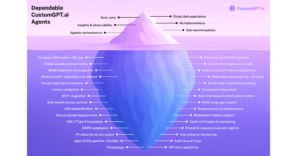
The demo is the tip of the iceberg. The other 90% is underwater.
What’s Actually Under the Surface (Of a Successful AI)
When we started building CustomGPT, I thought the hard part would be the AI. I was wrong.
We spend 40% of our engineering time on data ingestion, getting documents into the system reliably. Every file format has quirks. PDFs with embedded images. Scanned documents that need OCR. YouTube videos and their transcriptions. The little tricks that enable RAG to search excel sheets. Auto-sync for web pages that change daily.
There’s a reason some frameworks have five different PDF parsers. Nobody knows which one to use when. Under a build approach, data ingestion design decisions fall into your lap-and each one can break your system before data reaches your database.
Hallucinations aren’t a prompt engineering problem. Early on, I thought we could fix hallucinations by tweaking the system prompt. “Just tell it not to make things up.”
It doesn’t work that way.
Controlling hallucinations requires measures at every step of the pipeline-from how you chunk documents, to how you rank retrieved results, to how you construct the final prompt, to how you validate the response. We’ve spent thousands of engineering hours on this. And we’re still improving it.
Real users don’t query like developers. Your test queries are well-formed questions. Real users type things like:
- “Hmm – ok”
- “yeah, tell me more”
- “2”
- “that one”
- “ok – yeah”
Unless you’ve built query intent understanding, your system will choke on these. Real users talk to AI like they talk to humans on live chat. Building for that is a different problem than building for demo queries. Is your system ready to handle the complexity of real-world interactions without falling into hallucination traps?
Security has three layers, not one. Most teams think about data security-encrypting documents at rest. But enterprise AI needs:
- Data security – Ingestion, storage, deletion, audit logs
- Chat security – Handling NSFW queries, jailbreaking attempts, prompt injection
- Access security – SSO integration, role-based permissions, team management
Each layer is its own project. Skip any of them and your CISO will block deployment.
When it’s handled for you, the experience is different. Conor Sullivan, VP at The Endurance Group, described what that looks like: “We basically created client portals where I could put the chatbot directly into that portal so that a client would be able to access it while maintaining security.” No months-long security sprint-just deployment that works within the constraints enterprises actually care about.
2026: The Iceberg Got Deeper
Here’s what’s changed since the early RAG tutorials: simple RAG is now just one tool in a much larger toolkit.
The AI agent landscape in 2026 looks nothing like 2023. If you’re planning to build, you’re not just building a RAG pipeline anymore. You’re building an orchestration layer for autonomous agents.
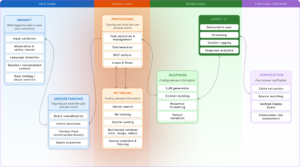
MCP (Model Context Protocol) is becoming the standard for connecting AI agents to tools and data sources. Anthropic open-sourced it, and it’s now under the Linux Foundation. Think of it as “USB-C for AI”-a standardized way to plug agents into databases, APIs, and enterprise systems. If you’re building from scratch, you’re now competing with an emerging standard.
Multi-agent orchestration is replacing single-purpose agents. Gartner reported a 1,445% surge in multi-agent system inquiries from 2024 to 2025. The architecture has shifted from “one smart agent” to “teams of specialized agents coordinated by an orchestration layer.” Building this yourself means building the coordination, the routing, the fallback logic, and the observability across all of them.
GraphRAG has emerged for complex queries. Traditional RAG finds semantically similar text. GraphRAG understands relationships between entities-enabling multi-hop reasoning that simple vector search can’t do. It’s powerful, but knowledge graph extraction costs 3-5x more than baseline RAG and requires domain-specific tuning.
Agent safety is now a recognized discipline. When agents can browse the web, access files, and take autonomous action, the attack surface expands dramatically. Prompt injection, where malicious instructions hide in web content or documents, is a real threat. Even Anthropic acknowledges that “securing AI agents’ real-world actions is still an active area of development.”
Response verification has become non-negotiable for enterprise. It’s no longer enough for AI to give an answer—you need to prove that answer is grounded in your actual sources. This means extracting every factual claim, cross-referencing it against source documents, and calculating a “verified claims score.” If your AI makes 10 claims and only 8 trace back to your knowledge base, stakeholders need to know. Legal needs to know. Compliance needs to know. Building this verification layer from scratch—with audit trails, multi-stakeholder risk assessment, and source citations—is its own engineering project on top of everything else.
True enterprise search is now the baseline expectation. Users don’t just want answers from a few documents—they expect AI that can respond to any query, on any size knowledge base, across any variety of data formats. Text, PDFs, spreadsheets, images, videos, web pages—all searchable, all connected. AI that finds and processes information exactly like a human would, but orders of magnitude faster. Building this means handling not just semantic search, but structured data queries, multi-hop reasoning across sources, and graceful handling of knowledge gaps.
The iceberg didn’t shrink as the technology matured. It got deeper.
When Building Actually Makes Sense
I’m not going to pretend buying is always the right answer. Some teams successfully build their own AI infrastructure. They tend to share certain characteristics:
You have genuinely unique regulatory requirements. If you’re in healthcare with specific HIPAA configurations, government with FedRAMP requirements, or operating under regulations no vendor has encountered-building may be your only option.
AI infrastructure is your core product. If you’re building the next great AI platform, you should obviously build your own AI. Your differentiation is the infrastructure.
You have deep, dedicated AI engineering talent. Not developers who can learn AI, but engineers who’ve shipped production ML systems before, who understand the failure modes, and who will stay with the project for years. AI infrastructure isn’t a rotation assignment.
You’ve genuinely evaluated the privacy tradeoffs. The strongest argument for building is data control. If your data is sensitive enough that you can’t trust any third party-even with SOC 2 compliance, encryption, and contractual guarantees-that’s a legitimate reason to build. Just make sure you’re actually building something more secure, not just more familiar.
If you have all four of these, building might be right for you.
Most companies have zero or one.
The “Divided by One” Problem
Here’s the math that kills most build projects:
When OpenAI or Anthropic fixes a bug in their models, millions of customers benefit. The cost of that fix is divided across their entire user base.
When a SaaS platform solves a data ingestion edge case, thousands of customers benefit. The engineering cost is amortized.
When you build your own system, every bug, every edge case, every security patch-the cost is divided by one.
We spent hundreds of engineering hours fixing YouTube video ingestion. Our customers get that for pennies. If you’re building your own, you’re paying the full cost yourself.
Alan Moore, Founder and CEO of TaxWorld, put it simply: “CustomGPT.ai let us punch far above our weight. With almost no engineering budget, we built an assistant that now answers tens of thousands of complex tax questions and fuels our revenue growth every month.” That’s the math of dividing by thousands instead of one.
This isn’t about whether your engineers are smart. They probably are. It’s about whether debugging AI infrastructure edge cases is the best use of their intelligence.
A Framework for Deciding
Instead of “build vs buy,” think about these questions:
1. What are you actually building?
If the answer is “AI infrastructure,” you should buy. If the answer is “a product that happens to use AI,” you might have a case for building. If the answer is “competitive advantage through AI,” ask where that advantage actually comes from-the infrastructure or what you do with it.
2. What’s your time horizon?
In 2026, the AI landscape shifts monthly. MCP didn’t exist 18 months ago. Multi-agent orchestration was academic research. GraphRAG was a paper.
If you build today, you’re committing to maintain that system through years of change. Who will keep up with new protocols, new models, new attack vectors? Over 5-10 years, will your team maintain feature parity with platforms that have hundreds of engineers focused on nothing else?
3. What happens when it breaks at 3 AM?
Production AI systems break in strange ways. Models get updated and suddenly respond in Spanish. Rate limits hit during a product launch. A document format you’ve never seen corrupts your pipeline.
Do you have the team to debug these issues? Is that team available around the clock? Is this really what you want them doing?
4. Where does your competitive advantage actually live?
The companies winning with AI aren’t winning because they built better vector databases. They’re winning because they applied AI to problems their competitors haven’t solved.
Your advantage is probably in your domain expertise, your customer relationships, your unique data, or your product insight. Not in your ability to parse PDFs.
The Future: AI That Just Works
Here’s where I think this is heading:
In sci-fi movies, AI isn’t the plot. It’s not the dramatic tension. It just exists and works. The characters ask questions and get answers. They request actions and things happen. The technology is invisible.
That’s the goal.
Advanced AI flows that anyone can build-multi-agent orchestration, tool use, autonomous execution-without writing code or understanding the alphabet soup of MCP, GraphRAG, and vector embeddings.
True enterprise search that can respond to any query, on any size knowledge base, across any data format. AI that finds and processes information exactly like a human would, but orders of magnitude faster.
In five years, nobody will care whether you built or bought your AI infrastructure. They’ll only care whether it solved the problem.
The companies that win won’t be the ones who built the most sophisticated RAG pipelines. They’ll be the ones who spent their engineering talent on things that actually differentiate their business-while the AI infrastructure faded into the background, like electricity.
The question isn’t whether you can build it.
It’s whether you should.
Alden Do Rosario is the Founder and CEO of CustomGPT.ai. He’s been building AI infrastructure since the ChatGPT API launched and has worked with thousands of companies navigating the build vs buy decision. He writes about AI implementation at Medium and connects with readers on LinkedIn.
FAQs
How do I decide whether to build or buy a custom AI assistant?
Start by asking whether you want to manage AI infrastructure yourself or mainly use AI to solve business problems. If infrastructure is not your core product, buying lets you focus on your data, workflows, and users instead of running the underlying stack. Building is better suited to teams with unique regulatory needs or infrastructure as a core differentiator.
How long does building AI typically take?
For many teams, it takes about two to three months just to ship a production-ready v1 AI assistant. This timeline includes designing the architecture, handling data ingestion, security, testing, and integrating with existing systems. Real validation with users and business metrics often takes additional months. Highly regulated or complex environments can extend this further.
Is buying AI cheaper than building?
In most cases, buying is cheaper in the short to medium term because you avoid upfront engineering, infrastructure, and ongoing maintenance costs. Build-your-own requires a dedicated team to handle ingestion, security, updates, and monitoring, which adds hidden ongoing expenses. At a very large scale or with highly specialized needs, a well-managed internal build can become cost-competitive.
What security responsibilities do I take on if I build instead of buy?
You must design and enforce data security, chat security, and access security across the entire stack. That means handling encryption, deletion, prompt injection, NSFW queries, SSO, RBAC, and audit logs yourself. A mature platform will ship many of these as defaults or configuration. If you lack security engineering capacity, a custom build can become a blocking risk.
How can I reduce vendor lock-in risk if I decide to buy instead of build?
Prefer vendors that support open standards, exportable data, and transparent retrieval and orchestration patterns. Ensure you can export your content, conversation logs, and configuration in usable formats. You can also start on a platform while keeping a small internal team to prototype alternative stacks. Lock-in risk is often lower than the risk of never shipping.