What is Model Context Protocol (MCP)?
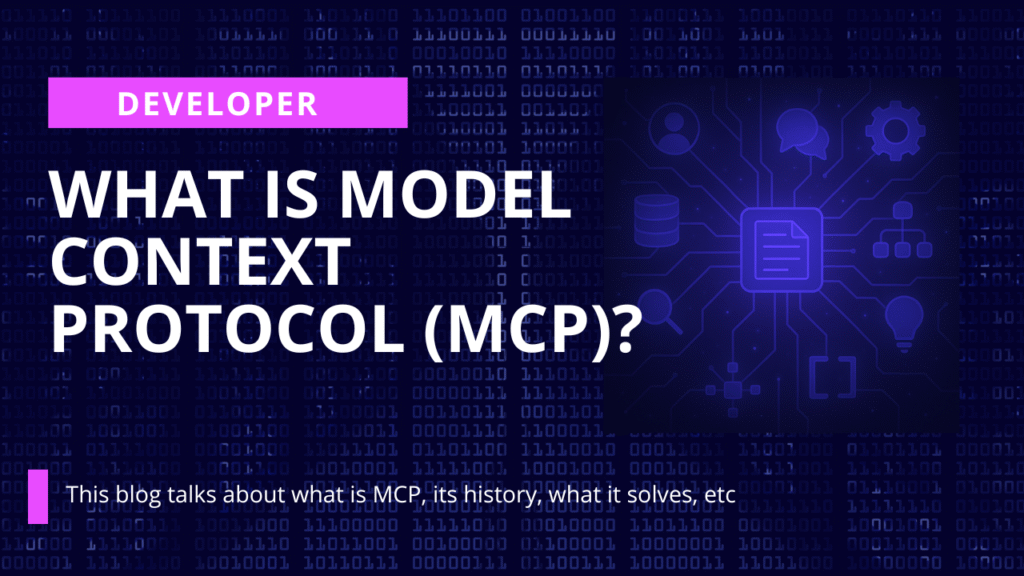
The Model Context Protocol (MCP) is fast becoming a super important standard for the next wave of apps powered by Artificial Intelligence.
Large Language Models (LLMs) like GPT-4 or Anthropic’s Claude are remarkably smart within their own bubble of text. Yet historically, they’ve been trapped in silos – isolated from live data, tools, and actions in the real world. Integrating an AI assistant with external systems used to mean writing brittle, one-off code for each service (APIs, plugins, etc.), each with its own authentication, format, and quirks.
It’s like giving a genius robot a thousand different remote controls, each with a separate manual, and expecting it to use them all. Unsurprisingly, this approach doesn’t scale.
Model Context Protocol (MCP) is a new solution to this problem. Introduced by Anthropic (the company behind Claude) in late 2024, MCP is an open standard that provides a universal way to connect AI models to the places where data and tools live. Think of MCP as a kind of “USB-C for AI applications” – a single, standardized port through which an AI agent can plug into any compatible tool or data source.
In other words, MCP gives AI a consistent interface to interact with external resources, replacing the ad-hoc integrations of the past with a unified protocol built for AI agents. The goal is to move AI from being just a clever conversationalist to an actually useful agent that can fetch information, take actions, and maintain context across different systems.
Think of it as a major step up in how AI systems, especially those big brainy Large Language Models (LLMs), can actually connect to and use all the outside data and tools they need to do complicated stuff in the real world.
Related video: Future of MCP by Roy Miara (@pinecone-io)
Related video: How Does MCP Affect Developer Experience? by Roy Miara (@pinecone-io)
Related video: MCP Bidirectional Capabilities by Santiago (@underfitted)
Frequently Asked Questions
What's the difference between MCP and a regular API?
Joe Aldeguer, IT Director at the Society of American Florists, said, “CustomGPT.ai knowledge source API is specific enough that nothing off-the-shelf comes close. So I built it myself. Kudos to the CustomGPT.ai team for building a platform with the API depth to make this integration possible.” That helps explain the gap MCP is trying to solve. A regular API is usually a service-specific interface developers wire up manually, with its own authentication, formats, and quirks. MCP is an open standard designed to give AI applications one more consistent way to connect to external tools and data sources, so you need fewer brittle one-off integrations.
Which LLMs support MCP?
MCP is best understood as an application-layer standard, not a feature locked to one model family. Anthropic introduced MCP in late 2024, but the goal of the protocol is to provide a universal way for AI models and assistants to connect to tools and data. In practice, support depends on whether the app, platform, or host around the model implements MCP, so teams can use it with systems built around models such as Claude or GPT-style LLMs when the surrounding software supports the protocol.
Can MCP reduce hallucinations and common RAG failures?
Elizabeth Planet, Nonprofit Leadership Coach & Advisor, said, “I added a couple of trusted sources to the chatbot and the answers improved tremendously! You can rely on the responses it gives you because it’s only pulling from curated information.” That is where MCP can help: it gives an AI a standard way to reach reliable external sources or tools instead of guessing from memory alone. But MCP is not a cure-all. If the wrong source is connected, retrieval is poor, or the returned context is incomplete, the answer can still be wrong. It works best when you combine it with curated data, strong retrieval, and citation-aware workflows.
Is MCP secure enough for internal systems and compliance reviews?
MCP can be secure enough for internal systems, but the protocol itself is not the security control. Security comes from how you deploy it: require authentication, limit each connected tool to narrow actions, and keep sensitive systems behind your existing identity and approval rules. For compliance-sensitive use cases, look for audited controls and documented data handling practices. Relevant credentials here include SOC 2 Type 2 certification, GDPR compliance, and a stated policy that customer data is not used for model training.
Can MCP work with large databases or document archives?
Evan Weber, Digital Marketing Expert, said, “I just discovered CustomGPT, and I am absolutely blown away by its capabilities and affordability! This powerful platform allows you to create custom GPT-4 chatbots using your own content, transforming customer service, engagement, and operational efficiency.” The key MCP point is that the protocol does not replace your database, document store, or search engine. It standardizes how the AI application requests information or actions from those systems. That means it can sit in front of large knowledge sources while the underlying platform continues to handle storage, indexing, and retrieval.
What are MCP client, host, and server in plain English?
In plain English, the client is the part that sends MCP requests, the host is the application the AI runs inside, and the server is the connected system that exposes data or tools through MCP. A simple mental model is: the host runs the AI experience, the client handles the protocol conversation, and the server makes specific capabilities available in a standard format. If you are trying to understand MCP quickly, think of it as a structured way for an AI app to ask outside systems for information or actions without needing a custom integration for each one.
Related Resource:
- Trae AI agents with MCP Learn how MCP lets Trae agents retrieve answers from your uploaded business content.