
CustomGPT.ai vs Intercom

Let’s explore Intercom and CustomGPT.ai beyond a simple feature comparison. Both can help teams automate customer-facing answers, but they are built for different workflows: Intercom is a customer service platform with AI support operations, while CustomGPT.ai is a content-grounded RAG assistant for accurate answers from your own business knowledge.

Quick Decision Guide

Choose CustomGPT.ai if: You value industry-leading accuracy, broad content ingestion, source-grounded answers, full white-labeling, and fast AI assistant deployment without adopting a complete helpdesk platform.

Choose perplexity if: You value a full AI customer service suite with Fin, inboxes, ticketing, Messenger, help center workflows, routing, reporting, and human support operations in one platform.

About CustomGPT.ai
about customgpt scaled

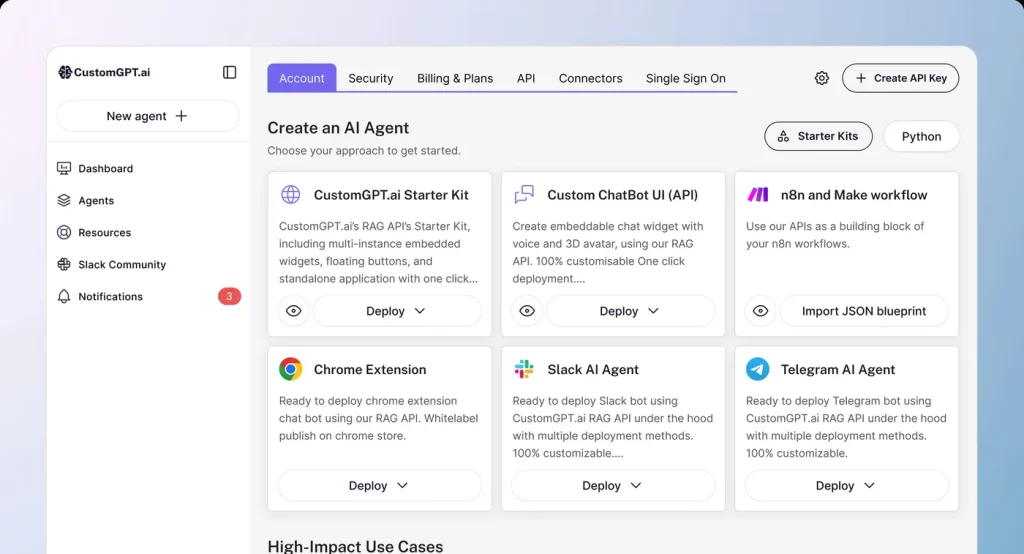
CustomGPT.ai is a business-focused RAG-as-a-service API built for high accuracy. Benchmarked as an accuracy-first RAG platform, CustomGPT.ai helps organizations launch AI assistants grounded in their own data, reducing hallucinations while supporting smooth, flexible integrations. Founded in 2021 and headquartered in Needham, Massachusetts, CustomGPT.ai has earned a reputation as a dependable solution in the RAG space.

Overall Rating

94/100

Starting Price

$99/mo

About Perplexity

Perplexity

Intercom is an AI-first customer service platform built around Fin AI Agent, helpdesk workflows, customer messaging, tickets, inboxes, knowledge content, reporting, and human handoff. Founded in 2011 and headquartered in San Francisco, Intercom is widely used by support and customer success teams that want customer conversations, automation, and service operations in one system.

Overall Rating

85/100

Starting Price

$29/seat

Key Differences at a Glance

In terms of product focus, CustomGPT.ai is built around controlled RAG deployment from approved business content, while Intercom is built around customer service operations. From a cost perspective, Intercom starts with seat-based customer service plans and AI usage considerations, while CustomGPT.ai is designed around deploying AI assistants from business content. These differences make each platform better suited for specific use cases and organizational requirements.

⚠️ What This Comparison Covers

We’ll analyze features, pricing, performance benchmarks, security compliance, integration capabilities, and real-world use cases to help you determine which platform best fits your organization’s needs. The comparison is organized around product documentation, published pricing, platform capabilities, and practical deployment considerations.

Detailed Feature Comparison

Features
Intercom
CustomGPT.ai
Data Ingestion & Knowledge Sources
  • Knowledge Hub and help center content for support answers
  • Customer conversation history, tickets, articles, snippets, and support workflows
  • Fin can answer from approved support content and hand off to teammates
  • Best suited for customer service knowledge rather than broad business-content ingestion
  • Strong when knowledge lives inside customer support operations
  • 1,400+ file formats plus ZIP/RAR/7Z extraction
  • Website crawling with sitemap indexing and configurable depth
  • Multimedia transcription including AI Vision, OCR, YouTube, Vimeo, and podcasts
  • Cloud integrations including Drive, SharePoint, OneDrive, Dropbox, and Notion auto-sync
  • Knowledge platforms including Zendesk, Freshdesk, HubSpot, Confluence, and Shopify
  • Scale: 60M words Standard / 300M words Premium per bot
Integrations & Channels
  • Messenger, helpdesk, inbox, tickets, outbound messaging, and customer support surfaces
  • Integrations across CRM, support, product, and customer data tools
  • Strong human handoff and routing inside customer service teams
  • Best when teams want AI plus customer communication operations together
  • Website embedding through JavaScript widget or iframe
  • CMS plugins for WordPress, WIX, Webflow, Framer, and SquareSpace
  • Zapier for 5,000+ apps
  • MCP Server for Claude Desktop, Cursor, ChatGPT, and Windsurf
  • OpenAI SDK compatible endpoints
  • LiveChat and Slack with human handoff
Core Agent Features
  • Fin AI Agent for automated customer service answers
  • Conversation routing, handoff, inbox workflows, and tickets
  • Help center and knowledge workflows tied to customer support
  • Reporting for support teams and customer service performance
  • Best as a support operations system with AI built in
  • Custom AI agents for business tasks
  • Multi-agent systems for support, sales, and knowledge
  • Persistent memory and context across sessions
  • Tool integration through webhooks and Zapier
  • Continuous learning through automatic re-indexing
Customization & Branding
  • Messenger and customer service workspace customization
  • Help center branding and support workflow configuration
  • Strong support-team controls, but branding is tied to Intercom surfaces
  • Full white-labeling included with colors, logos, CSS, and custom domains
  • 2-minute setup wizard
  • Persona customization through pre-prompts
  • Visual theme editor
  • Domain allowlisting
LLM Model Options
  • Fin abstracts model selection behind Intercom’s AI customer service product
  • Designed for support automation rather than buyer-managed model routing
  • Model and AI behavior are configured through Intercom’s support workflows
  • GPT-5.1 (Optimal & Smart)
  • GPT-4 series (GPT-4, Turbo, 4o)
  • Claude 4.5 (Enterprise)
  • Auto model routing
  • Zero API key management
Developer Experience (API & SDKs)
  • REST-only APIs (Runtime, Tables, Files, Admin)
  • TypeScript SDK: @botpress/sdk, @botpress/client
  • Docs: tutorials and references
  • ⚠️ Gaps: no Python SDK; rate limits unclear/undocumented
  • GPT-5.1 Optimal and Smart
  • GPT-4 series including GPT-4, Turbo, and 4o
  • Claude 4.5 on Enterprise
  • Auto model routing
  • Zero API key management
Developer Experience (API & SDKs)
  • APIs, apps, and integrations for customer service workflows
  • Best for teams extending support operations and customer messaging
  • Developer work often connects to users, conversations, tickets, and support data
  • REST API for agents, ingestion, and chat queries
  • Python SDK through customgpt-client
  • Postman collections
  • Webhooks for events and leads
  • OpenAI compatible endpoints
Performance & Accuracy
  • Performance is best evaluated through customer service metrics such as resolution rate and handoff quality
  • Answer quality depends on help center quality, Fin configuration, and escalation workflows
  • Strong fit when support teams need automation plus human fallback
  • Sub-second responses through optimized RAG and caching
  • Benchmark-proven: 13% higher accuracy and 34% faster than OpenAI Assistants API
  • Anti-hallucination grounding
  • OpenGraph citations
  • 99.9% uptime with auto-scaling
Security & Privacy
  • ⚠️ SOC 2: in progress (not completed)
  • ⚠️ GDPR claimed; no EU data residency (US-only per your notes)
  • ⚠️ Not HIPAA / ISO 27001 (limits healthcare use)
  • ✅ Data not used to train models
  • SOC 2 Type II + GDPR
  • 256-bit AES at rest; SSL/TLS in transit
  • RBAC/2FA/SSO options (Enterprise)
  • Data isolation (never trains on customer data)
  • Domain allowlisting
Pricing & Scalability
  • Seat-based customer service plans start around $29 per seat/month
  • Advanced support, automation, reporting, and AI features can raise total cost
  • Fin AI usage and resolution-based economics should be modeled separately
  • Total cost depends on seats, support volume, channels, and AI resolution needs
  • Standard: $99/mo for 10 bots and 60M words
  • Premium: $449/mo for 100 bots and 300M words
  • Enterprise: Custom with SSO, dedicated support, and SLAs
  • Flat-rate pricing with no per-query charges
  • 7-day free trial
Security & Privacy
  • Enterprise-grade security and trust resources for customer service teams
  • Controls for support data, user access, and customer communication workflows
  • Compliance requirements should be validated against your industry and plan
  • SOC 2 Type II and GDPR
  • 256-bit AES at rest and SSL/TLS in transit
  • RBAC, 2FA, and SSO options on Enterprise
  • Data isolation and never trains on customer data
  • Domain allowlisting
Observability & Monitoring
  • Support reporting, customer service analytics, ticketing metrics, and inbox visibility
  • Strong for monitoring support operations and AI-assisted resolution workflows
  • Best when the buyer cares about service team performance and customer conversation outcomes
  • Real-time dashboard for volume, tokens, and response times
  • Customer intelligence and knowledge gaps
  • Conversation analytics including transcripts and resolution rates
  • Export to BI and data warehouses
Support & Ecosystem
  • Mature support ecosystem for customer service teams
  • Help center, academy resources, app marketplace, and implementation partners
  • Best fit for teams standardizing customer communication and service operations
  • Docs, tutorials, cookbooks, and API references
  • Email and in-app support
  • Premium support with account managers
  • Open-source SDK, Postman, and examples
  • Zapier ecosystem across 5,000+ apps
No-Code Interface & Usability
  • Designed for support admins, customer service managers, and agents
  • Workflow setup can include inboxes, tickets, Messenger, help center, Fin, and routing
  • More operational setup than a standalone content assistant
  • 2-minute deployment wizard
  • Drag-and-drop uploads and cloud connectors
  • In-browser testing
  • Low learning curve and productive day one deployment
RAG Capabilities
  • Fin answers from help content and customer service knowledge
  • Retrieval is tied to support workflows and customer conversations
  • Best fit for support automation rather than broad RAG-as-a-service deployment
  • Grounded RAG with responses only from your content
  • Automatic citations with clickable sources
  • Sub-second latency through vector search and caching
  • Scale to 300M words on Premium
RAG-as-a-Service Assessment
  • Platform type: AI customer service platform with RAG-like support automation
  • Target users: support leaders, customer success teams, and service operations teams
  • Key differentiator: Fin plus helpdesk, Messenger, tickets, and human handoff
  • RAG is a feature inside the customer service suite, not the standalone platform focus
  • Platform type: true RAG-as-a-service with managed infrastructure
  • API-first: REST, SDK, and OpenAI-compatible endpoints
  • No-code option: deploy fast through wizard
  • Enterprise-ready: SOC 2 Type II, GDPR, and Enterprise SLAs
Use Cases
  • AI customer service and support automation
  • Inbox, ticketing, routing, escalation, and human handoff
  • Help center answers and customer self-service
  • Customer messaging, onboarding, and lifecycle communication
  • Support reporting and service operations
  • Customer support with 24/7 answers and citations
  • Internal knowledge across policies, onboarding, and technical docs
  • Sales enablement for product info and qualification
  • Documentation, help centers, and FAQs
  • E-commerce product recommendations and order assistance

Final Thoughts

Final Verdict: Intercom vs CustomGPT.ai

After analyzing features, pricing, performance, and likely deployment patterns, both Intercom and CustomGPT.ai are capable platforms that serve different market segments and use cases effectively.

Intercom is strongest when the job is customer service operations: AI support, inboxes, tickets, Messenger, routing, reporting, and human handoff. CustomGPT.ai is strongest when the job is turning your approved content into a governed AI assistant for customers, employees, sales teams, and business workflows.

When to Choose CustomGPT.ai

  • You value industry-leading accuracy with a 97% benchmark score.
  • You need patented technology designed to reduce hallucinations.
  • You want easy no-code setup with powerful customization.
  • Best For: Accurate, cited answers from approved business content.

When to Choose Perplexity

  • You value AI customer service inside a full helpdesk platform.
  • Your team needs inboxes, ticketing, routing, Messenger, reporting, and human handoff.
  • You want support operations rather than a standalone business knowledge assistant.
  • Best For: Customer service automation and support team operations.

Migration & Switching Considerations

Switching between Intercom and CustomGPT.ai requires careful planning because they solve different problems. If you are moving from Intercom to CustomGPT.ai, focus on source preparation, website or help center ingestion, deployment channels, and answer-quality validation. If you are moving from CustomGPT.ai to Intercom, focus on support team seats, Messenger setup, inbox workflows, ticketing, reporting, and human handoff.

Expect 2-4 weeks for a complete transition when production content, support workflows, team training, validation, and testing are included.

Pricing Comparison Summary

Intercom starts with seat-based customer service pricing, while CustomGPT.ai begins at $99/month for a dedicated AI assistant platform. Total cost of ownership should factor in implementation time, training requirements, seats, support channels, AI resolution usage, reporting needs, customer volume, and ongoing administration.

For customer service teams standardizing on one support platform, Intercom can be attractive. For customer-facing support answers, internal knowledge assistants, and embedded AI agents built from existing business content, CustomGPT.ai’s assistant-focused pricing is often easier to forecast.

Our Recommendation Process

  1. Start with a free trial – Both platforms offer trial periods to test with your actual data
  2. Define success metrics – Response accuracy, latency, user satisfaction, and cost per query
  3. Test with real use cases – Avoid generic demos; use your production data
  4. Evaluate total cost – Factor in implementation time, training, and ongoing maintenance
  5. Check vendor stability – Review roadmap transparency, update frequency, and support quality

For most organizations, the decision between Intercom and CustomGPT.ai comes down to workflow rather than overall superiority. Evaluate both platforms with your real data and focus on the use case that matters most: customer service operations or controlled AI assistant deployment.

Next Steps

Ready to make your decision? We recommend starting with a hands-on evaluation of both platforms using your specific use case and data.

  • Review: Check the detailed feature comparison table above
  • Test: Sign up for free trials and test with real queries
  • Calculate: Estimate your monthly costs based on expected usage
  • Decide: Choose the platform that best aligns with your requirements

Explore more CustomGPT.ai comparison guides if you are still shortlisting tools.

Build a Custom GPT for your business, in minutes.

Deliver exceptional customer experiences and maximize employee efficiency with custom AI agents.

Trusted by thousands of organizations worldwide

Related posts