
We are incredibly excited to announce the latest addition to our AI chatbot, CustomGPT, built on the advanced large language models (LLMs): the Citations/Sources feature! This new functionality adds even more value to your knowledge management and topic research by providing clear, easily accessible sources for every response generated by our chatbot.
Our CustomGPT chatbot is already renowned for its fantastic responses to user queries, but we understand that for businesses, it’s equally important to know where that information is coming from. With the Citations/Sources feature, users can now not only access the most accurate and relevant information but also verify its origin.
In this blog post, we will dive into the benefits of this game-changing feature and how it’s paving the way for the future of enterprise search powered by large-language-models (LLMs).
The Power of Citations/Sources in CustomGPT
As a state-of-the-art AI chatbot designed for businesses, CustomGPT leverages the capabilities of OpenAI LLMs and ChatGPT to ingest and contextualize your business content. It then uses this knowledge to generate precise and contextually relevant responses to user queries.
However, we recognized that our users needed a way to trace the origin of the information provided by the chatbot. That’s where the Citations/Sources feature comes in.
Notice the example below — not only did the chatbot give a response from the content, powered by advanced large language models (LLMs) without hallucinating, it also showed the source of the information from which the answer came from. In this example, the chatbot was trained with multi-gig of research data from 500+ research papers and 100+ Youtube video talks.

Benefits of Citations/Sources
Transparency
In today’s fast-paced digital landscape, having access to accurate and reliable information is more important than ever. The Citations/Sources feature in CustomGPT takes transparency to the next level by providing clear and precise sources for each response generated by the AI chatbot.
This heightened level of transparency offers a range of benefits for users:
- Verify Validity: With the ability to trace the origin of the information, users can confirm the accuracy and credibility of the data provided by CustomGPT. This instills confidence in the AI-generated responses and the decisions made based on them.
- Contextual Understanding: Knowing the sources of the information not only helps verify its accuracy but also provides valuable context. Users can gain deeper insights into the background of the data, helping them make more informed decisions and better understand the nuances of the subject matter.
- Reduce Misinformation: In a world where misinformation spreads quickly, the Citations/Sources feature acts as a safeguard against false or misleading information. By providing transparent sources, users can easily identify and disregard any unreliable data, ensuring the highest level of integrity in their research and decision-making processes.
- Enhance Collaboration: When working in teams, having access to the original sources of information makes it easier to collaborate effectively. Team members can share and discuss the sources, promoting a better understanding of the data and fostering a more cohesive and informed approach to problem-solving.
- Efficient Source Evaluation: In research and knowledge management, evaluating the quality and relevance of sources is crucial. The transparency provided by the Citations/Sources feature allows users to quickly assess the reliability and applicability of the sources, leading to more efficient research and knowledge acquisition.
Trustworthiness
Trust is a fundamental component of any relationship, and the relationship between users and AI is no exception. The Citations/Sources feature in CustomGPT is designed to enhance the credibility of the information provided by the chatbot, fostering a strong bond of trust between users and the AI. This improved trustworthiness offers several advantages:
- Confidence in Decision-Making: Trusting the information provided by the AI chatbot empowers users to make decisions with greater confidence. When users know they can rely on the AI’s responses, they can focus on evaluating options and making strategic choices based on accurate information.
- Increased Adoption: As trust in the AI chatbot grows, users are more likely to adopt and integrate the technology into their daily workflows. A higher level of trust leads to a more seamless and productive interaction with the chatbot, maximizing the benefits of AI assistance.
- Reduced Skepticism: Users who are skeptical about AI-generated responses may be hesitant to rely on them for important tasks. By providing credible and transparent sources, the Citations/Sources feature addresses this skepticism and encourages users to embrace the AI’s capabilities.
- Risk Management: Trustworthy information is essential for managing risk, as it enables users to make informed decisions that minimize potential negative consequences. The Citations/Sources feature ensures that users have access to reliable data, helping them to effectively evaluate risks and make prudent choices.
- Positive Reputation: A trustworthy AI chatbot can significantly improve a company’s reputation. As users share their positive experiences with the AI chatbot, the organization can benefit from increased brand loyalty, customer satisfaction, and potential referrals.
Efficient Knowledge Management
In the age of information, managing knowledge effectively has become crucial for both individuals and organizations. The Citations/Sources feature in CustomGPT.ai, including inline citations, brings efficiency to knowledge management by providing users with rapid access to the original content from which a response was generated. This capability offers numerous benefits:
- Time Savings: Locating the source of information can be a time-consuming process, especially when dealing with large volumes of data. The Citations/Sources feature enables users to quickly access the original content, reducing the time spent on research and allowing them to focus on other important tasks.
- Improved Organization: By providing direct access to source material, the Citations/Sources feature helps users maintain a well-organized knowledge management system. Users can easily reference the source content, making it simpler to catalog, categorize, and retrieve information when needed.
- Deeper Analysis: Having quick access to original content allows users to delve deeper into the subject matter and analyze it from different perspectives. Users can explore the context and nuances of the information, leading to a more comprehensive understanding of the topic.
- Knowledge Sharing: Efficient knowledge management also encompasses the ability to share information with colleagues and collaborators. The Citations/Sources feature simplifies the process of sharing source materials, fostering a more collaborative and informed environment within teams and organizations.
- Accurate Record-Keeping: Tracking and documenting sources is an essential aspect of knowledge management, particularly in research and academic settings. The Citations/Sources feature in CustomGPT streamlines the process of record-keeping, ensuring that users maintain accurate and up-to-date documentation of the sources they consult.
Improved Decision-Making
In today’s competitive environment, making well-informed decisions is crucial to achieving success. The Citations/Sources feature in CustomGPT provides access to reliable sources, empowering users to make better-informed decisions based on the information generated by the AI chatbot. The advantages of improved decision-making are numerous:
- Reduced Uncertainty: By providing credible sources, the Citations/Sources feature minimizes the uncertainty that often comes with decision-making. Users can trust the information provided by CustomGPT and make choices with greater confidence, reducing the risk of negative outcomes.
- Enhanced Strategic Thinking: Access to reliable sources allows users to analyze various perspectives and consider multiple factors when making decisions. This broader understanding leads to more strategic thinking, as users can identify potential opportunities, challenges, and trends that inform their choices.
- Increased Adaptability: Informed decision-making enables users to be more adaptable in the face of change. By basing their decisions on reliable information, users can anticipate and respond to shifting circumstances more effectively, ensuring they stay ahead in dynamic environments.
- Competitive Advantage: Organizations that make well-informed decisions are better positioned to outperform their competitive intelligence. By leveraging the reliable information provided by the CustomGPT chatbot, along with the citations, businesses can make strategic choices that drive growth, innovation, and overall success.
The Future of Enterprise Search with LLMs
The introduction of the Citations/Sources feature in CustomGPT signifies a major step forward in the evolution of enterprise search. By harnessing the power of large-language-models, CustomGPT offers a modern, AI-driven approach to information retrieval and knowledge management.
As the world of AI and LLMs continues to grow and evolve, the potential top 5 benefits building for CustomGPT and similar technologies will expand. This new feature is just the beginning of an exciting journey into the future of AI-powered enterprise search and knowledge management.
1. Can I set my CustomGPT to display the source link where it found the information while answering a query?
Yes, the new Citations/Sources feature in CustomGPT automatically displays the source link for the information provided in the response. This enhances transparency and helps users verify the credibility of the information they receive.
For example: This chatbot was constructed with 30 years of biotech research documents and Youtube videos. When asked a question, it shows the source links from which the response was constructed. This allows for quickly surfacing important information that would otherwise have been hidden within PDF files.

2. What happens when I upload 100 documents to my chatbot? Will it show which documents were used in the response?
Yes – you will see a list of document names in the citations/sources list. Also, if when uploading the documents, you chose the option to “retain the documents for viewing”, then you can even download or view the document straight from the response. This allows for quick topic research.
For example, law firms prefer to build a CustomGPT chatbot with all the documents related to a case, and then when the lawyer queries the chatbot, it instantly shows the relevant information and the source documents from which the response was generated. This greatly reduces the time spent in doing document research.
3. Will the chatbot be context-savvy and provide information relevant to the product or category the user is currently exploring?
CustomGPT is designed to be highly adaptive and context-aware. So if the response was generated using information from a certain product page or category, it will show those pages in the citations.
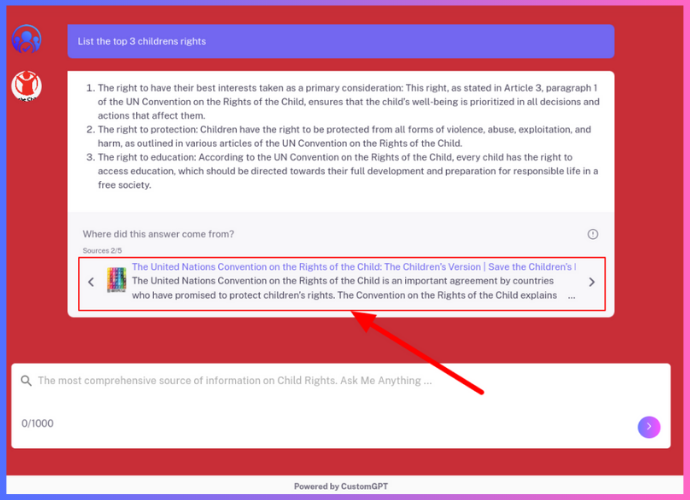
For example, this chatbot was generated using over 1000+ webpages. Notice how it is showing the original source from which the answer came from.
4. What if the response was generated using content from different parts of my website?
When answering a user’s query, CustomGPT.ai can extract relevant information from different pages or documents from your data through multi-source data integration. After ChatGPT constructs the response based on these different sources, CustomGPT.ai ranks them based on their relevance to the response.

So the user can then see a full scrollable-list of sources and citations.
Advanced Tip: Your documents could be in different languages and ChatGPT will be able to understand them and construct an accurate response irrespective of the language used.
5. I see that CustomGPT shows nice preview images and information. Where does that information come from?
That information comes from the OpenGraph settings from the page. When we show a Citation, we automatically fetch the OpenGraph information from your page – thus enhancing the user experience.
6. Is it possible to retrieve the names of source files used by the bot to answer a query via the REST API?
Yes. With the Citations/Sources feature and REST API integration, you can retrieve the names of source files used by CustomGPT to generate its responses.

This enables better tracking of the content sources and improves overall transparency.
7. Is it possible to turn the citation display off?
Yes – it is possible to change the settings such that the citations are no longer visible. You have complete control. Simply navigate to Settings > Chatbot Settings > Citations, and select your preferred settings.

Frequently Asked Questions
What are citations or sources in an AI knowledge management chatbot?
Citations are source references shown with an AI answer that link the response back to the exact document, page, or passage used to generate it. They let users verify the answer against original business content instead of trusting an unsupported summary.nnThink of citations as proof of where the answer came from. Ideally, users can click through to the referenced source and inspect the original context themselves. Depending on your setup in CustomGPT.ai, citations may appear by default and can often be controlled at the chatbot or individual response level. One detail that matters in practice is citation granularity: stronger AI search systems point to the exact chunk or paragraph used, not just the whole file, which makes fact-checking much faster. That is why products like Glean and Perplexity put citations front and center. At Lehigh University, source-linked answers are especially important because users search more than 400 million words of newspaper archives and need quick verification.
Can AI generate fake citations?
Yes. AI can invent citations, cite papers that do not exist, or link to real sources that do not support the answer. A citation is trustworthy only if you can open the exact document, page, or passage and verify it.nnOne common failure is citation drift: the source is real, but the summary overstates it. Reviews indexed by the U.S. National Library of Medicine have documented fabricated references in AI-written academic text. In AI search tools such as Perplexity and Glean, check whether links resolve to the quoted passage and whether citation display can be controlled by channel or content type; CustomGPT.ai also supports source controls. MIT reports zero hallucinations across 90+ languages when answers are grounded only in approved sources, which shows the best defense is strict retrieval from verified material, not citations alone.
How do citations work when an answer uses multiple documents or web pages?
If an answer uses multiple documents or web pages, it may show more than one citation. In CustomGPT.ai, whether citations appear automatically depends on the agent, channel, workspace settings, and response experience.nnCitations are clickable proof of where the answer came from, and in supported experiences users can open the exact source document or source location behind a claim. Some interfaces show inline markers at sentence or paragraph level, while others use a source list or side panel, similar to Perplexity or Microsoft Copilot. A single statement can also map to more than one passage when overlapping chunks support the same answer. Admins can enable or disable citations where that setting is supported, but selective citation control for individual documents, file types, or sources may vary by configuration. That matters in large collections such as Lehigh University’s 400M+ words of newspaper archives, where users need to verify which source backed each statement.
Why is my chatbot citing an outdated page?
Your chatbot is usually citing an outdated page because the old page is still in the index, or the replacement page has not finished syncing and reprocessing. Retrieval ranks passages by semantic match, not by publish date.nnTo confirm the cause, search the indexed sources, not the live site. If both old and new titles appear, you have duplicate indexed content. If only the new page appears, the index may still be serving older embeddings until refresh completes. Delete or replace the outdated URL or file first, then resync, reindex, and test only after search returns the new source. A 301 redirect or canonical tag updates the website but does not usually remove stored vectors or chunk IDs in systems like CustomGPT.ai, Chatbase, and Intercom Fin. TaxWorld reports 97.5% query success, which depends on keeping source versions clean and current.
Do citation links expose my entire knowledge base?
No. A citation link typically exposes only the document or passage used for that answer, not a searchable directory of your knowledge base. It is evidence for one response, not a portal into everything you uploaded.nnThat distinction matters for privacy and trust. Users can inspect the cited text, but they cannot browse unrelated documents unless you separately grant access. In many systems, citations are scoped to a single chunk, page, or signed URL, which limits what the link reveals. That is different from tools such as Glean or Guru, which are often designed for broader knowledge discovery. For a regulated example, TaxWorld reports 97.5% query success across 740 subscribers, where showing the exact supporting tax source is more useful than exposing the full document library. CustomGPT.ai also lets teams hide citations entirely or separate sensitive content into a different agent.
Why are citations important for compliance and audit-heavy knowledge management?
Citations are important because they turn an AI answer into a verifiable record. In compliance and audit-heavy knowledge management, reviewers need the exact source, passage, and document version before they can approve or act on an answer.nnThat matters when an answer references a retention policy, underwriting rule, or control procedure. A reviewer should be able to open the cited passage, confirm the effective date, and check that the language matches the approved document. In many audits, a document-level link is not enough; auditors often test the exact sentence used and whether that version was in force at the time. Passage-level citations cut manual checking and reduce the risk of acting on outdated guidance. That is why teams comparing CustomGPT.ai with Glean or Microsoft Copilot often ask how precise citations are. At GEMA, the AI assistant handles 248,000+ inquiries with an 88% success rate, where source-backed answers help reviewers confirm licensing rules quickly.
Conclusion
Our CustomGPT chatbot, with its new Citations/Sources feature, is set to revolutionize the way businesses manage and utilize their data. By providing not only accurate and relevant responses but also clear, easily accessible sources, this cutting-edge AI solution is reshaping the landscape of knowledge management and enterprise search.
Don’t miss out on the opportunity to leverage the full potential of CustomGPT and its latest Citations/Sources feature. Unlock the future of enterprise search and knowledge management with CustomGPT today!

Founder @ CustomGPT.ai , Husband & Father of 4, Avid cricket wicket-keeper