ChatGPT Upload Documents: A Step-by-Step Guide (2026 Limits)
If you are deciding where uploaded knowledge should live, this Custom GPT with OpenAI workflowcompares ChatGPT GPT Builder with CustomGPT.ai source management.
For a broader platform comparison, see these custom AI model tools for building and deploying AI assistants.
Uploading documents to a ChatGPT powered chatbot can significantly enhance business efficiency by streamlining information access and improving customer interactions.
Whether you need to manage documents, integrate multimedia files, or provide detailed information, using a chatbot for documents can be transformative.
In this blog, we will guide you through ChatGPT upload documents and explore why CustomGPT.ai is a superior choice for managing and utilizing your documents effectively.
ChatGPT Upload Document: A Detailed Guide
Following are the steps to upload documents in ChatGPT:
- Log in to Your OpenAI Account: Start by logging into your ChatGPT account.
- Access the Upload Feature: Navigate to the interface where you can interact with the chatbot. Look for the upload icon or option.
- Select Your Document: Choose the document you wish to upload from your device. ChatGPT supports various formats including PDF, DOCX, and TXT.
- Confirm Upload: Once selected, confirm the upload and wait for the document to be processed.
- Interact with Your Document: After uploading, you can start asking ChatGPT questions related to the content of the document.
While this process allows you to use ChatGPT upload documents feature, it has limitations in terms of file formats, security, and scalability.
ChatGPT Upload Document Limitations
The following are the limitations of uploading documents to ChatGPT:
- Limited File Formats: ChatGPT supports common document formats such as PDF, DOCX, and TXT, but that narrow set may not cover every business workflow.
- Security Concerns:Basic document upload functionalities may lack advanced security measures, potentially putting sensitive data at risk.
- Scalability Issues: ChatGPT upload documents feature may not efficiently handle large volumes of documents or complex datasets, limiting its usability for larger enterprises.
Tired of hitting ChatGPT’s upload limits?
Upload up to 1 GB per batch to a private AI agent trained on your data, with persistent retrieval and citations on every answer.Start your 7-day free trial →
Why Choose CustomGPT.ai Over ChatGPT for Document Uploading?
While ChatGPT provides basic document upload capabilities, CustomGPT.ai offers a more comprehensive, secure, and scalable business solution. When those documents represent your own knowledge base, you can use them to turn your documents into a personal AI clone.
Here’s why you should consider CustomGPT.ai for your document management needs:
- Advanced Document Handling: CustomGPT.ai supports over 1400 document formats, including popular ones like PDF, HTML, and Microsoft Office documents, as well as audio and video formats.
- Enhanced Security:CustomGPT.ai prioritizes your data privacy, with options to delete files immediately after processing.
- Scalability:Upload up to 1GB of data in batches of 50 files, making it ideal for handling large volumes of documents.
- Anti-Hallucination Technology: Ensures that the chatbot’s responses are based solely on your uploaded content, providing accurate and reliable answers.
CustomGPT.ai: How to Upload Documents
Now, let’s walk through the steps to upload documents to CustomGPT.ai, an AI that allows you to upload documents with ease and security.
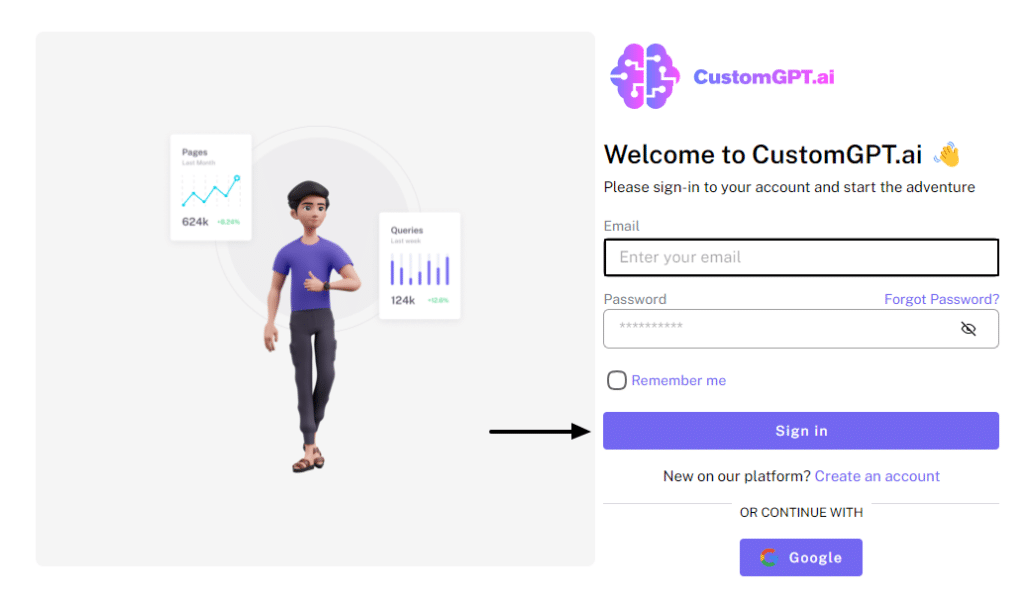
1. Sign Up and Log In
Create an account on CustomGPT.aiand log in.
2. Create a Project
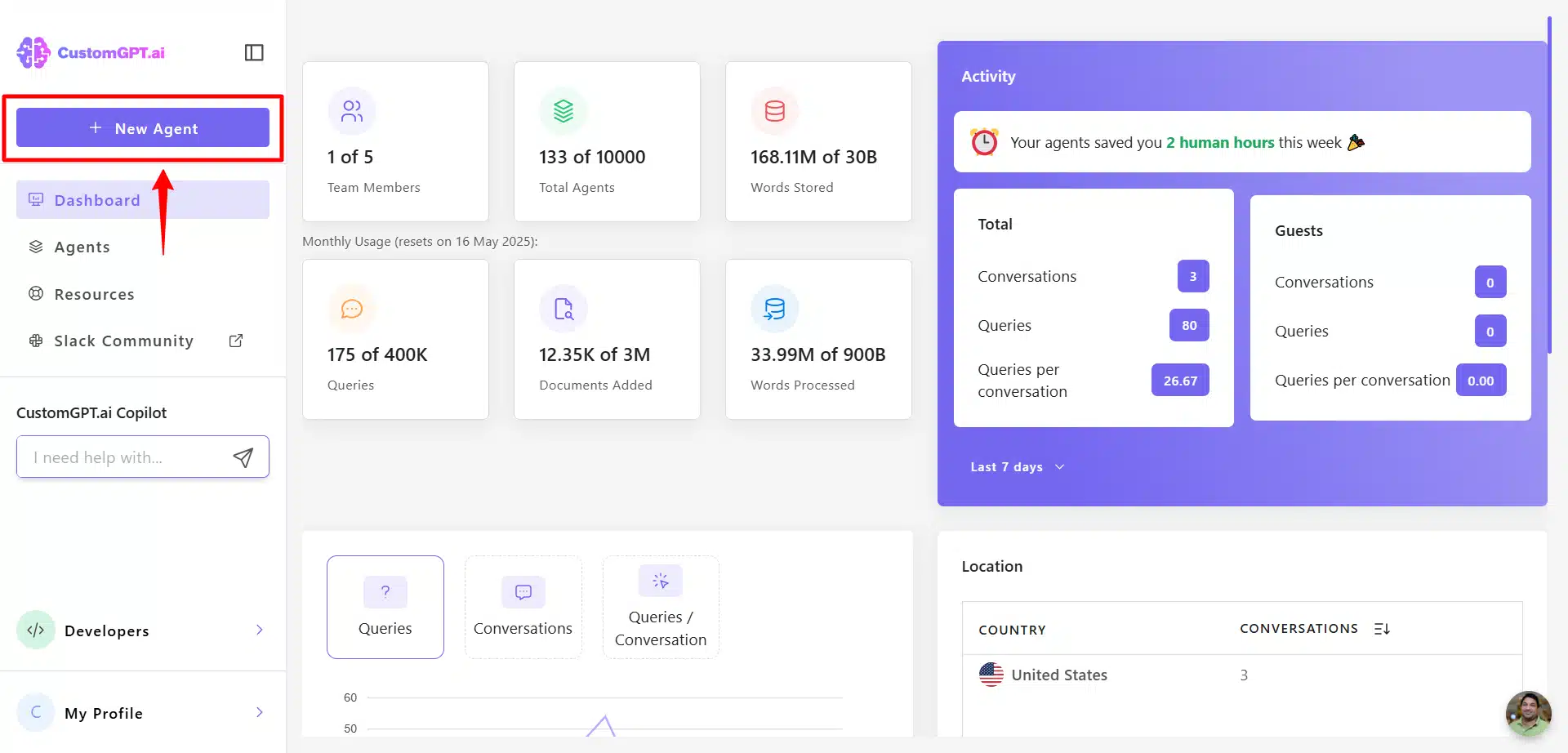
Start by creating a new project. Navigate to the project dashboard.
3. Upload Your Documents
Within the project dashboard, find the “Upload” option. Click on it to start uploading your documents.

4. Supported Formats
CustomGPT.ai supports over 1400 document formats, including popular ones like PDF, HTML, Microsoft Office documents, and even audio/video files like MP3 and MP4.
5. Batch Uploads
You can upload up to 1GB of data in batches of 50 files, ensuring efficient processing of large volumes of documents.
6. Manage Your Files
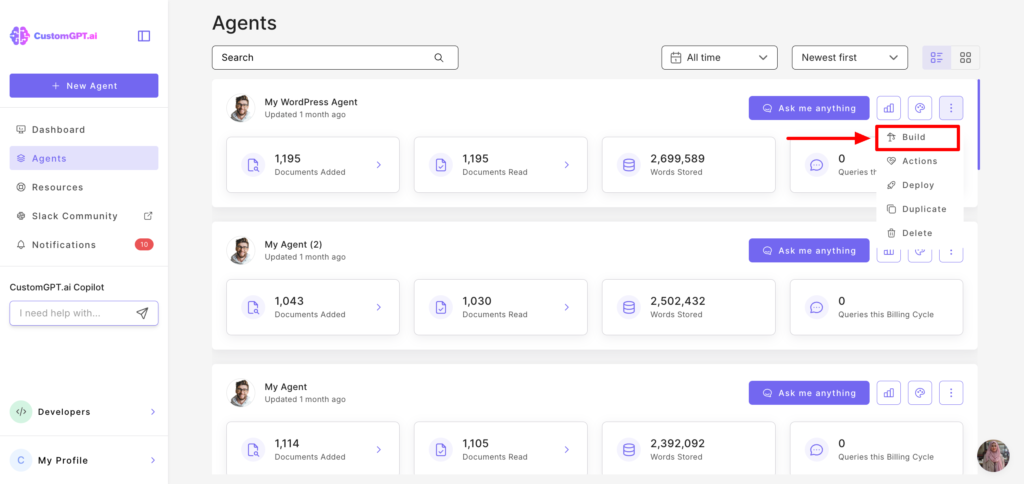
Use the “Data” tab in the project settings to manage your uploaded files. You can add more files, delete existing ones, or update your data as needed.
7. Privacy and Security
CustomGPT.ai prioritizes your data privacy. Files can be set to delete immediately after processing to ensure your data remains secure.
Key Features of CustomGPT.ai for Uploading Documents
- Effortless Uploads: No technical support is needed. Upload your documents directly through your browser.
- Multi-Source Data Integration: Combine data from multiple sources such as websites, YouTube channels, and uploaded documents for a comprehensive chatbot experience.
- Anti-Hallucination Technology: It’s anti-hallucination technologyensures responses come from your content, providing accurate and trustworthy answers.
- Citations and Sources: Track which documents are used to generate responses, ensuring transparency and reliability.

Why CustomGPT.ai is the Best Choice
CustomGPT.ai not only supports a wide range of document formats but also integrates seamlessly with other data sources. It’s designed for business-scale operations with high security and privacystandards. The platform’s anti-hallucination technology ensures that the chatbot’s responses are based solely on your uploaded content, making it a reliable tool for businesses.
Conclusion
With CustomGPT.ai, you can turn HR documents, support articles, and multimedia files into a private RAG agent that answers from your own content and cites its sources. Upload the files, review the indexed sources, and keep improving the agent as your documents change.
Ready to experience the power of ChatGPT Upload Documents feature?
 [Try Out the New Document Upload Feature Now!]
Happy chatbot building!
Related reading: How Do I Troubleshoot Context-Window Limits When Dealing With Large Documents?
Frequently Asked Questions
What file formats can I upload to a ChatGPT-powered chatbot?
PDF, Word, PowerPoint, Excel, plain text, audio, and video are the most commonly uploaded formats — no conversion needed before uploading. CustomGPT.ai also accepts scanned documents (with automatic OCR), raw audio and video (with automatic transcription), and HTML exports.
One gotcha from support tickets: enabling the vision setting on your agent can cause upload failures for certain file types. Disable it unless you specifically need image analysis.
A distinction most users miss: uploading files to a RAG-based chatbot is retrieval indexing, not model fine-tuning. Your documents get chunked and indexed for semantic search. The underlying model weights never change, which is why answers cite your actual content rather than hallucinate from training data.
For web content, sitemap ingestion handles JavaScript-rendered pages that file upload cannot process. Connect your sitemap URL as a source and the platform crawls and indexes pages automatically.
How many documents can I upload at once, and what are the plan limits?
Teams uploading large document sets often worry that closing the browser will cancel the upload — it won’t. Ingestion runs server-side after submission.
CustomGPT.ai’s published usage limits guidedocuments current plan limits, including batch upload size, document caps, word budgets, query limits, and API upload behavior. Use that guide as the source of truth before choosing a plan — for large corpora, the word budgetmatters more than document count.
Are my uploaded documents private, or can other users access them?
Yes — your uploaded documents are private and isolated per agent. Documents in one agent are invisible to every other agent, even inside the same account. No other user or agent can access your files.
This per-agent isolation is the primary technical reason regulated teams migrate off ChatGPT, where uploads enter a shared session context that OpenAI may use for model improvement unless you explicitly opt out in settings.
CustomGPT.ai’s security stack includes SOC 2 Type 2 certification, GDPR-aligned data handling, and AES-256 encryption at rest and in transit. When you delete a file, it is removed from the retrieval index within minutes.
Alternatives like Vectara and Azure AI Search offer comparable data isolation with SOC 2 compliancebut differ in format support and deployment options. CustomGPT.ai provides embeddable widgets without infrastructure setup.
Why does my chatbot give inaccurate answers after uploading documents to ChatGPT?
Large uploads can exceed the amount of context a chat model can use at once, which is why answers drift from the source material. RAG-based platforms like CustomGPT.ai, Vectara, and Cohere RAG reduce that risk by indexing documents into a persistent, searchable knowledge base.
Common accuracy killers:
- Scanned PDFs without OCR
- Contradictory documents on the same topic
- Critical information buried mid-document instead of in headings or early paragraphs
If sampled responses repeatedly cite the wrong source, fix source quality before adding more content.
Can I connect SharePoint as a direct document source instead of uploading files?
Yes — this is one of the most-asked questions from enterprise teams evaluating upload workflows.
SharePoint, Google Drive, Notion, and Confluence connect as live-sync sources, so documents re-index automatically when you update the original. The advantage over manual upload: teams managing thousands of compliance documents no longer need to re-upload after every revision cycle.
Sync frequency depends on your plan and source connector. For SharePoint specifically, connect via the integrations dashboard rather than uploading exported files — exported SharePoint HTML often strips metadata and internal links that improve retrieval quality. Sitemap ingestion covers SharePoint Online published pages.
Ready to move past ChatGPT’s upload limits?
Train a private AI agent on your documents. Upload 1 GB batches, get citations on every answer, and deploy anywhere — all in under 15 minutes.
Trusted by 10,000+ organizations worldwide