

The #1 Anti-Hallucination Technology in the AI industry
The best guardrails against hallucinations, making sure responses come from your ground truth data.
Trusted by 10,000+ organizations worldwide










Feedback
What Can Be Achieved With Our Chatbots?
-
Always Within Context
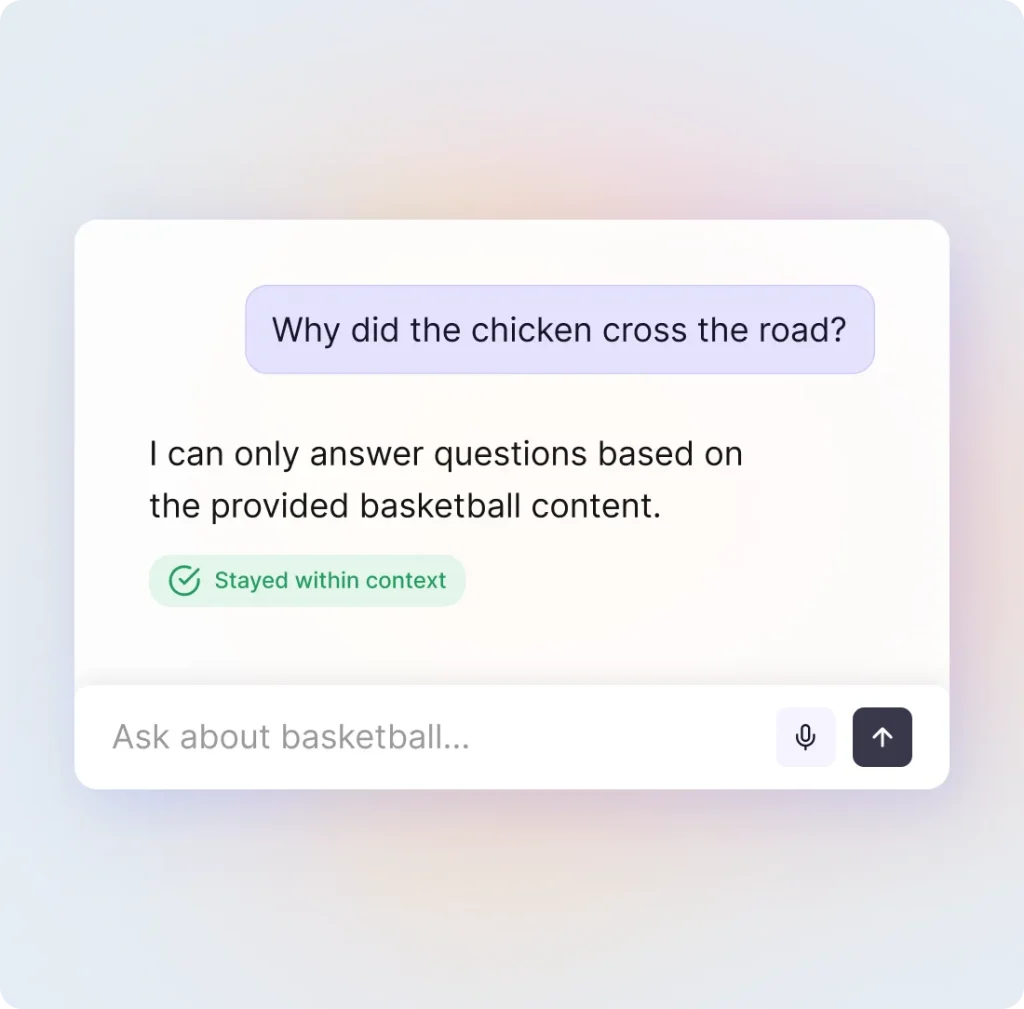
The chatbot’s responses come only from the provided context material.
-
Have Complete Control
Every chatbot sometimes fails. You decide what happens when your chatbot gets confused.
-
Strictly On Topic
Your chatbot will never allow itself to be involved in random topics outside its context.
-
Unprecedented Awareness
Aware of its knowledge base, the chatbot can find the answer even if the user’s question is vague.
Simplicity
How to build a hallucination-proof AI agent
Leading example
CustomGPT.ai Is recognized as an industry leader in anti-hallucination
Better than OpenAI
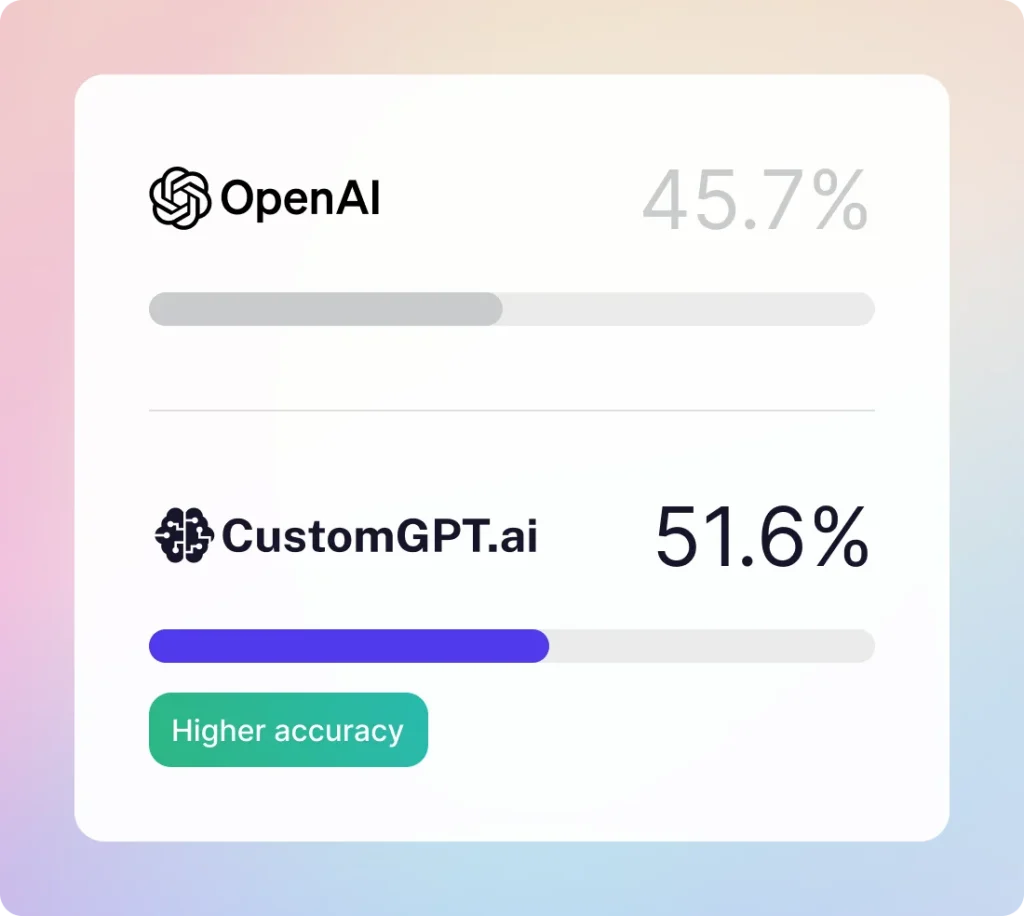
CustomGPT.ai has outperformed OpenAI’s Assistant API V2 with greater accuracy, fewer hallucinations, and faster average response times in a new, more thorough evaluation.
How we built the model that beats OpenAI
Retrieval-augmented generation (RAG) enhances the accuracy and relevancy of answers by utilizing an organization's specific data.
Why is staying in the context important?
Businesses need to trust that their AI chatbot won’t recommend competitors, output falsehoods, or use information that’s not included in their business content.
Closer look at AI accuracy
How anti-hallucination measures in AI have revolutionized educational resources, drawing insights from MIT’s experience with CustomGPT.ai.
Observability and citations
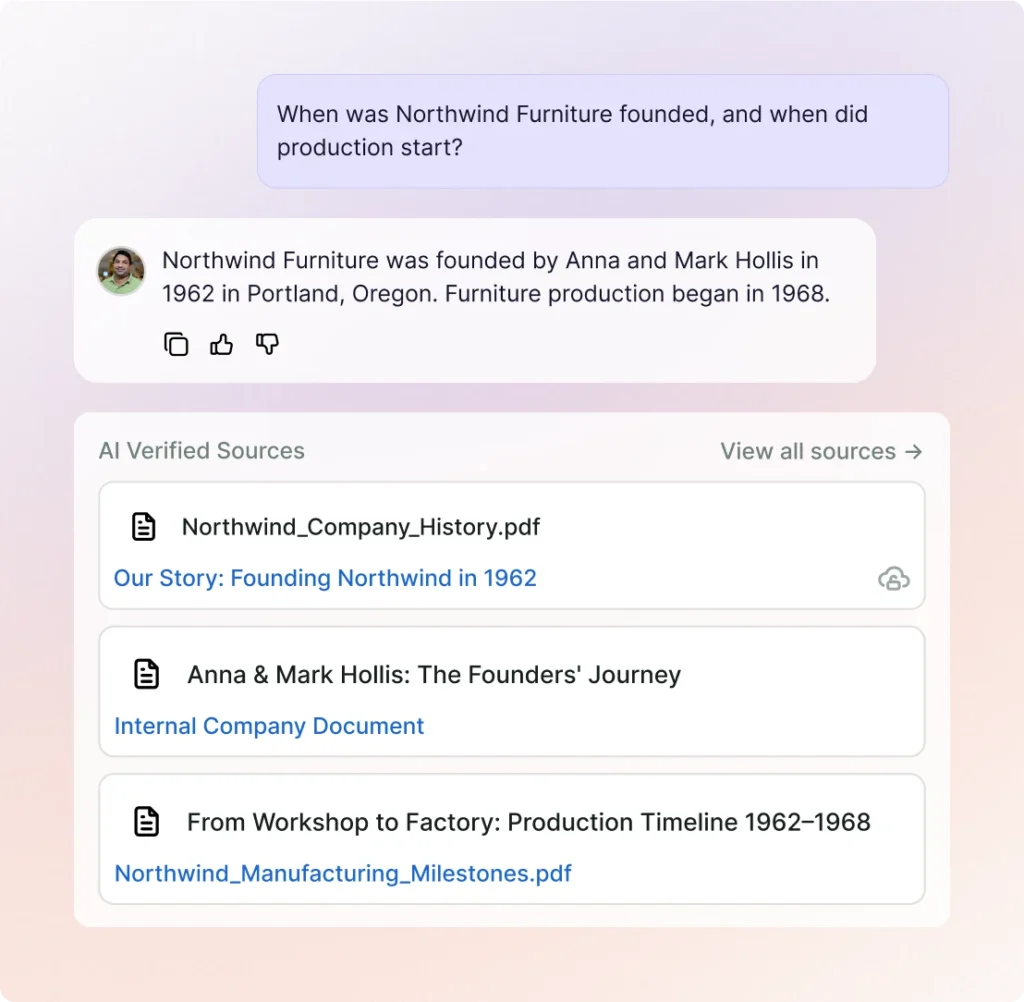
The Citations feature takes transparency to the next level by providing clear and precise sources for each response generated by the AI chatbot.
Feedback
Thousands of businesses rely on CustomGPT.ai

“CustomGPT.ai has continually impressed us. Our own assessor loves it and frequently comments on how it provides the right answers. It’s a very valuable tool that people need to understand and utilize.”
- $108k Net savings, 18 months
- 80% Lower cost per contact
- 4.81x ROI, saved per $1 invested

“Before, my clients could reasonably only reach out to maybe one target account a week… now we can do that at scale.”
- 300% increase in workflow efficiency
- 4-5x more outreach volume per client
- 2x Revenue as an AI implementation partner
Frequently Asked Questions
What does the term “hallucination” mean in the context of AI?
In AI, “hallucination” refers to instances where AI generates information that is not grounded in reality or the provided context, leading to potentially misinformed decision-making and other issues.
Why is anti-hallucination important for AI technology?
Anti-hallucination is crucial because it helps ensure the reliability and accuracy of AI-generated information, reducing risks such as compliance issues, safety risks, and erosion of trust in AI systems.
Can I feed my company’s specific data into CustomGPT.ai to make it more relevant to my business needs?
Absolutely! CustomGPT.ai is designed to ingest your business content and utilize that information to respond to queries. This ensures that all responses are tailored specifically to your business needs, using only the information relevant to your company.
What industries can benefit the most from CustomGPT.ai’s technology?
Industries where accuracy is paramount, such as legal sectors, finance, healthcare, and education, can particularly benefit from CustomGPT.ai’s technology.
What companies and institutions rely on CustomGPT.ai?
Nearly 6,000 entities, including Adobe, the Massachusetts Institute of Technology, the Dominican Republic’s GPTLegal, and the UK’s DivorceOnline, rely on CustomGPT.ai.
How can I ensure the responses from CustomGPT.ai are not derived from general internet data but strictly from my business content?
We’ve implemented an innovative context boundary wall to address this. This feature establishes a strict boundary around the responses of CustomGPT.ai, ensuring they’re derived solely from your business content. Any general or unrelated internet data is effectively walled out.
I’ve noticed in the past that chatbot responses have included inaccurate information. How can I be sure this won’t happen with CustomGPT.ai?
Our context boundary wall feature solves this issue. By constraining the chatbot’s responses to the information contained in your business content, we can significantly reduce the chance of inaccurate or irrelevant responses. We continuously refine this technology to ensure its effectiveness and accuracy.
How can I test the effectiveness of the context boundary wall feature?
You can test this feature by asking questions that fall outside of your business context. For instance, asking “Why did the chicken cross the road?” or “Who is Joe Biden?” should result in the AI declining to answer or providing a neutral response. This indicates that the AI recognizes the query as outside its boundary and won’t provide information it hasn’t been indexed.
What if the responses generated by CustomGPT.ai still seem off-topic or inaccurate?
If you encounter any issues, please reach out to our customer support team. We’re committed to ensuring that CustomGPT.ai meets your needs and expectations, and we’re always ready to assist you. We constantly update and improve our systems based on user feedback, and your input is invaluable to us. (support@customgpt.ai)
How does CustomGPT.ai differentiate between accurate data and ‘hallucinations’ when generating responses?
CustomGPT.ai uses the context provided by the documents and sitemaps you upload in order to generate responses. Based on this content, if the chatbot deems that it does not “know” an answer, it will simply admit it: “I don’t know.” This honesty prevents the chatbot from lying or hallucinating in an attempt to provide an unfactual answer. This process is built upon 10,000+ hours of development and engineering and we’re proud that we can pass these benefits on to you.
What measures can I take if I encounter hallucinatory responses from CustomGPT.ai?
This should not occur. We’ve spent countless hours developing technology that solves the hallucination problem. If you think your CustomGPT.ai bot is hallucinating, please get in touch with support so we can get to the root of your issue: support@customgpt.ai
What steps does CustomGPT.ai take to prevent hallucinations during interactions?
To reassure users that our chatbots’ replies aren’t hallucinatory, we’ve created the “Citations” feature. Every time your bot generates a response using your business content, it will also return the exact sources it used to answer the query. This way, you know that the bot isn’t hallucinating because you can see exactly where it got its information from.
How does CustomGPT.ai handle hallucinations?
CustomGPT.ai has developed advanced anti-hallucination features based on user feedback. The system continually improves by analyzing and addressing hallucinations at various stages of the RAG pipeline.
What is Retrieval Augmented Generation (RAG)?
RAG is a technique that combines retrieval of information from a knowledge base with generation of text by an AI model to improve accuracy and reduce hallucinations.
When was RAG first introduced?
The concept of RAG was first referenced in a research paper published around 2020 by the FAIR research group at Meta.
What are the main benefits of using RAG?
The main benefits include reduced hallucinations, the ability to use your own corporate data, and providing more accurate and contextually relevant answers.
What is the recommended approach for handling hallucinations in a RAG pipeline?
Implement anti-hallucination measures at every stage of the RAG pipeline, not just in the prompt. This includes preprocessing user queries, engineering prompts, selecting suitable LLM models, and validating AI responses.
In what scenarios might AI chatbots like ChatGPT hallucinate and why?
AI chatbots like ChatGPT might “hallucinate,” or generate incorrect or nonsensical information, in scenarios where:
- The question or topic is highly complex or requires expertise beyond the model’s training data.
- The input is ambiguous, lacks sufficient context, or contains contradictions.
- The topic is obscure, not well-represented in the training data, or is a novel event that occurred after the model’s last training update.
- The prompt contains misleading cues or false information, leading the model to generate responses based on those cues.
- Prompts that ask for creative writing or speculative content can lead to plausible but factually incorrect responses.
How can hallucination levels be quantitatively tested?
By using an LLM-agent to validate the context, prompt, and AI response, and calculating metrics like a quality score for each response to monitor and optimize the system over time.
What recent benchmark did CustomGPT.ai excel in?
CustomGPT.ai excelled in a Retrieval-Augmented Generation (RAG) benchmark analysis comparing its generative AI platform with OpenAI’s Assistant API V2. The testing involved 945 questions across nine diverse datasets.
How did CustomGPT.ai perform compared to OpenAI?
CustomGPT.ai outperformed OpenAI by achieving a 10 percent lower hallucination rate, 13 percent higher accuracy rate, and 34 percent faster average response time.
Why is achieving 97% accuracy in anti-hallucination measures considered insufficient?
In critical applications, even a small percentage of hallucinations can lead to significant issues. Just like uptime or security, near-perfect performance is required to avoid problems.
What is the primary objective of the benchmarking project for CustomGPT.ai?
The core objective is to benchmark CustomGPT.ai’s performance against OpenAI’s latest Assistant API V2, focusing on reducing AI hallucinations and improving accuracy. The goal is to validate improvements in CustomGPT.ai’s algorithms, which make it a superior AI solution for industries requiring high precision, such as legal, medical, and financial services.
How was the test conducted to ensure a fair comparison between CustomGPT.ai and OpenAI?
The test used a systematic methodology aligned with industry best practices, including:
- A dataset of 945 diverse questions
- Nine distinct datasets covering various topics
- The “Answer Consistency Binary” metric for evaluation
- Controlled test environment with identical hardware and software for both models
What is the “Answer Consistency Binary” metric, and why was it used?
The “Answer Consistency Binary” metric evaluates AI responses by checking if the response is entirely consistent with the provided context. It scores responses as either 1 (consistent) or 0 (inconsistent), making it a stringent and clear measure of accuracy and effective in detecting hallucinations.
How did CustomGPT.ai perform in terms of inconsistent and consistent responses compared to OpenAI?
Inconsistent responses (score 0):
- OpenAI: 513 instances
- CustomGPT.ai: 457 instances
Consistent responses (score 1):
- OpenAI: 432 instances
- CustomGPT.ai: 488 instances
How can interested parties learn more about the study and its findings?
You can watch the explainer on the Atman Academy YouTube channel or register for the detailed Technical Analysis.
What problem was MIT trying to solve with a chatbot in CustomGPT.ai and MIT Entrepreneurship Chatbot Case Study?
MIT aimed to consolidate diverse resources and provide a more interactive and human-like interface for users to access information quickly and effectively. They also wanted to leverage the latest AI technology while ensuring the reliability and accuracy of the information provided.
How did MIT implement the chatbot?
MIT used CustomGPT.ai to create a chatbot that integrates multiple sources of information from their Orbit platform. They utilized no-code tools provided by CustomGPT.ai to manage and update the chatbot content without needing extensive technical resources.
Why did MIT choose CustomGPT.ai over other solutions like OpenAI’s ChatGPT?
CustomGPT.ai offered better customization, management capabilities across a wide range of documents, and control over the user experience. It also provided a no-code solution that allowed MIT to deploy the chatbot with minimal resources.
What are the benefits of using CustomGPT.ai for MIT?
The benefits include better user experience, faster implementation with no-code tools, improved information retrieval, and the ability to manage and update content easily.
What feedback has MIT received from students using the chatbot?
Students have provided positive feedback, appreciating the ease of access to information and the reliable responses from the chatbot. The tool has helped reduce the need for traditional searches and streamlined the information retrieval process.
How can other organizations benefit from using CustomGPT.ai?
Other organizations can use CustomGPT.ai to create chatbots for various purposes, such as HR, finance, technical documentation, and more. The no-code solution allows for quick setup and management, making it accessible even for non-technical users.