
Lessons from the MIT Case Study: A Closer Look at AI Accuracy through Anti-Hallucination Measures
Artificial intelligence (AI) plays a pivotal role in shaping education, research, and innovation in today’s world. One remarkable example is the collaboration between MIT (Massachusetts Institute of Technology) and CustomGPT. This collaboration underscores the importance of AI accuracy, particularly in democratizing knowledge and advancing entrepreneurship education for students. In this article, we’ll explore how anti-hallucination measures in AI have revolutionized educational resources, drawing insights from MIT’s experience with CustomGPT.
Introduction
MIT is renowned for its mission to democratize entrepreneurship knowledge. At the heart of this mission lies the Martin Trust Center for MIT Entrepreneurship, dedicated to advancing knowledge and educating students in innovation-driven entrepreneurship. To achieve their vision, the Trust Center sought a solution that could comprehensively bring together all the knowledge bases for entrepreneurship at MIT across multiple repositories and deliver it in a natural and highly usable manner, harnessing the power of AI. However, ensuring AI accuracy, particularly in educational applications, has become paramount. This article delves into MIT’s journey in tackling this challenge through the innovative CustomGPT platform’s anti-hallucination technology.
MIT’s mission to democratize entrepreneurship knowledge
MIT has always been at the forefront of fostering innovation and entrepreneurship. They don’t confine their efforts to their campus alone; instead, they’re committed to spreading the wealth of entrepreneurship knowledge to people all around the world. This mission is driven by the belief that anyone, regardless of their background, should have the opportunity to thrive in the world of entrepreneurship.
MIT’s dedication to this cause extends a helping hand to aspiring entrepreneurs from all walks of life, guiding them toward a brighter and more inclusive future in the world of business and innovation.
MIT’s concern of ensuring accuracy in AI responses
As MIT expanded its reach through digital platforms, they understood that when AI provides answers, it’s not just about giving information, it’s about making sure that information is right on the mark. If the information is wrong, it could lead aspiring entrepreneurs down the wrong path and hold them back from making progress.
So, why is getting accurate responses from AI so important? Because inaccuracies can erode trust, leading to diminished brand credibility and potential reputational damage.
The Challenge of Hallucinations in AI
Hallucinations in AI
Hallucinations in AI occurs when the system generates responses that are not based on factual information. These hallucinations can take the form of false facts, misleading statements, or even references to non-existent sources.
The necessity for accurate information in educational AI applications
In educational AI applications, accuracy is critical, and features like anti-hallucination safeguards help provide students and learners with trustworthy information essential for their growth and development. Misleading information can have detrimental effects on their educational journey. In educational settings, accuracy is the cornerstone of trust.
Students, entrepreneurs, and learners rely on AI-driven systems used across schools and nonprofits to provide them with credible and precise information. Inaccurate responses can lead to confusion, and misinformation, and potentially damage the reputation of educational institutions.
CustomGPT’s Solution to Hallucination
CustomGPT and its anti-hallucination technology
CustomGPT is a groundbreaking platform that provides chatbots you can tailor to work seamlessly with your own data. It addresses the AI hallucination problem by establishing “guardrails” around ChatGPT’s responses. This ensures that every response generated strictly adheres to your business or educational content, eliminating the risk of fabricated information so you won’t have to worry about getting incorrect or made-up information.
CustomGPT: A no-code platform enabling rapid deployment
CustomGPT offers a user-friendly, no-code platform, allowing institutions like MIT to deploy AI solutions quickly. This ease of use empowers organizations to harness the benefits of AI without the need for extensive technical expertise. This ease of use accelerates the deployment of AI solutions, making it accessible and practical for a wide range of applications.

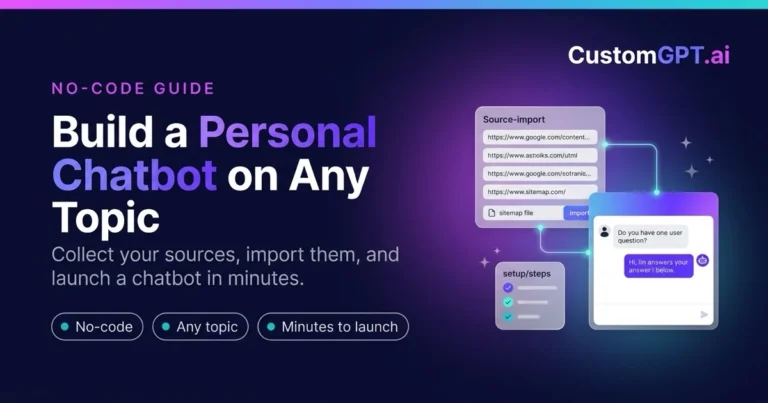
You can see there are several features for deploying a chatbot within a few minutes through the CustomGPT platform without knowing a single line of code.
CustomGPT’s measures to reduce hallucinations
CustomGPT employs cutting-edge technology, including Retrieval Augmented Generation (RAG), to enhance response accuracy. This technology ensures that chatbot responses are strictly based on your business or educational content, eliminating the risk of hallucinations. Additionally, CustomGPT provides citations and sources to validate the accuracy of responses, further building trust.

The MIT and CustomGPT Collaboration
The creation of ChatMTC, a generative AI solution for entrepreneurs
MIT’s Trust Center successfully integrated CustomGPT’s platform to aggregate entrepreneurship knowledge from various sources. The result was ChatMTC, a generative AI solution that offers entrepreneurs easy access to knowledge based on MIT’s deep entrepreneurship resources.
Integration of CustomGPT
MIT leveraged CustomGPT’s capabilities to bring together knowledge from multiple repositories, including documents, helpdesk data, and even YouTube videos. This integration was seamless, and ChatMTC became an indispensable resource for budding entrepreneurs.

CustomGPT offers sitemap, data upload, and Zapier features to include all your data from multiple resources as MIT did. And made ChatMTC a source of knowledge for everyone.
Accurate Responses and Enhanced Trust
Citation-backed responses
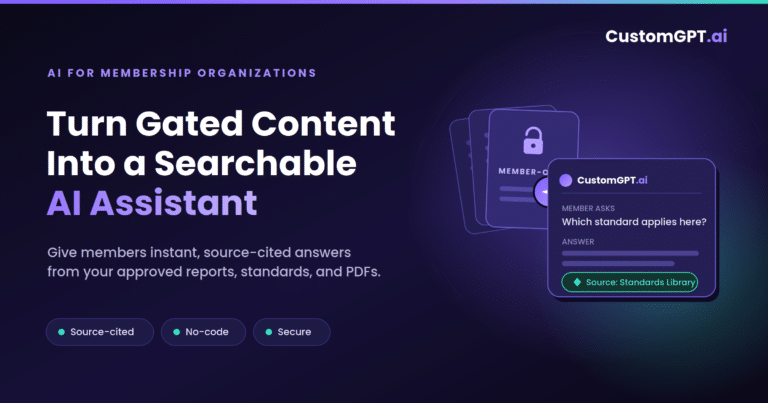
ChatMTC’s responses are not just accurate; citations also back them. This transparency not only builds user trust but also allows users to delve deeper into the sources of information. The importance of accurate, citation-backed responses cannot be overstated. Such responses not only foster trust but also provide learners and entrepreneurs with the confidence that the information they receive is reliable and credible.

As you can see a question is asked, and the generated response is accurate. However, it gains the user’s trust when this response is citation-backed.

Significance of trust in educational resources
For budding entrepreneurs, trust in educational resources is vital. They rely on these resources to make informed decisions and navigate the challenging landscape of entrepreneurship. CustomGPT’s anti-hallucination technology ensures that trust is maintained and the knowledge provided is correct and accurate.
Real-time Data Integration and Continuous Learning
Chatbot’s ability to ingest knowledge in real-time through customGPT
One of ChatMTC’s remarkable features is its real-time data integration. This can be done by continuously updating its knowledge base, ensuring that users have access to the most current information. Through CustomGPT it is very easy to maintain data up to date. This ensures that the information provided remains current and relevant, further enhancing the accuracy and usefulness of AI-driven solutions.
Maintenance of accuracy and relevance
Maintaining accuracy and relevance over time is crucial, especially in dynamic fields like entrepreneurship. CustomGPT’s real-time data integration addresses this challenge, ensuring that AI responses continue to meet users’ needs by uploading new data.

Frequently Asked Questions
How can universities reduce AI hallucinations in education?
Universities can reduce hallucinations by grounding the assistant in approved institutional content, retrieving from that content before generating a reply, showing citations, and instructing the bot to abstain when no source supports an answer. In MIT’s entrepreneurship use case, the core challenge was bringing together knowledge from multiple repositories while keeping responses trustworthy enough for learners and aspiring founders.
How does RAG improve AI accuracy compared with ChatGPT for student questions?
RAG improves accuracy by retrieving the relevant syllabus, course document, policy, or knowledge-base entry before the model writes its answer. A general model such as ChatGPT can still rely on pretraining when the source is missing or unclear, which increases the risk of confident but incorrect answers. That distinction matters most for education, where the cited source often matters more than fluent wording. As supporting evidence, CustomGPT.ai states it outperformed OpenAI in a RAG accuracy benchmark.
Why is a narrow knowledge base better for academic accuracy than letting AI answer from the open web?
A narrow knowledge base is usually more accurate because it limits the model to vetted materials that students and staff can verify. Levin Lab offers a clear example of domain grounding: Dr. Michael Levin said, “Omg finally, I can retire! A high-school student made this chat-bot trained on our papers and presentations”. When an assistant is constrained to a lab’s papers, presentations, or approved course materials, it has fewer chances to invent unsupported facts from general web knowledge.
Does a large university knowledge base make hallucinations more likely?
Not by itself. A larger knowledge base becomes risky when retrieval is generic, poorly filtered, or disconnected from citations. MIT’s challenge was to unify entrepreneurship knowledge across multiple repositories, which shows that scale can be managed when the system retrieves the right source before answering. Joe Aldeguer, IT Director at the Society of American Florists, highlighted the value of source specificity: “CustomGPT.ai knowledge source API is specific enough that nothing off-the-shelf comes close. So I built it myself. Kudos to the CustomGPT.ai team for building a platform with the API depth to make this integration possible.”
Can AI ever be 100% accurate in education?
No educational AI should be treated as 100% accurate. The safer standard is high source-grounded accuracy: use approved materials, return citations, and decline to answer when the evidence is missing. Even though CustomGPT.ai reports stronger results than OpenAI in a RAG accuracy benchmark, institutions should still expect human review for high-stakes academic, advising, or research decisions.
What should schools test before launching an anti-hallucination chatbot?
Before launch, schools should test four things: whether every answer cites an approved source, whether the bot refuses to guess when evidence is missing, whether staff can reproduce the answer from the original material, and whether responses are fast enough for real classroom use. Speed is not a substitute for accuracy, but it still affects adoption. Bill French, a Technology Strategist, said, “They’ve officially cracked the sub-second barrier, a breakthrough that fundamentally changes the user experience from merely ‘interactive’ to ‘instantaneous’.”
Conclusion
MIT’s collaboration with CustomGPT is a good example of how to ensure the accuracy of AI by taking anti-hallucination measures seriously. By making accuracy a top priority, MIT has managed to build a priceless asset for entrepreneurs, all while preserving trust and credibility.
As businesses and institutions increasingly harness the capabilities of AI, the lessons learned from MIT’s experience with CustomGPT serve as a great example of the significance of having AI solutions that are accurate, reliable, trustworthy, and free of hallucination.
Related Resources
These reads add useful context on how institutions and professional teams are applying AI with greater accuracy and trust.
- CustomGPT.ai for Education — Explore how schools and universities can use CustomGPT.ai to support teaching, research, and student services.
- AI Answer Accuracy Insights — A closer look at why answer quality matters for business outcomes, user trust, and real-world adoption.
- Rise of RAG — Understand why retrieval-augmented generation is becoming central to more reliable and grounded AI systems.
- Legal AI Solutions — See how legal teams can use CustomGPT.ai to streamline research, knowledge access, and client-facing support.