
GAIA Benchmark: What It Measures for Enterprise AI
GAIA (General AI Assistants) is a benchmark that tests whether an AI system can actually complete real-world, multi-step tasks, not just answer isolated questions well. It was built by researchers from Meta-FAIR, Hugging Face, AutoGPT, and others, accepted at ICLR 2024, and is now maintained through Hugging Face’s GAIA infrastructure.
Here’s why it matters more than most benchmarks. In the original paper, humans scored about 92% on GAIA’s tasks, while GPT-4 with plugins scored about 15%. That gap between “can answer a question” and “can actually get something done” is exactly the problem enterprises run into when they move an AI agent from a demo into production. This guide covers what GAIA actually tests, what CustomGPT.ai’s top score on the leaderboard means (and doesn’t mean), and what it tells enterprise buyers about evaluating AI agents.
Why GAIA Was Created
AI benchmarks had started drifting away from the messy reality of knowledge work. Language models were beginning to outperform humans on specialized tests in law, chemistry, medicine, and coding, but those same systems could still fail at tasks a reasonably capable person could solve with a browser, a calculator, and some persistence.
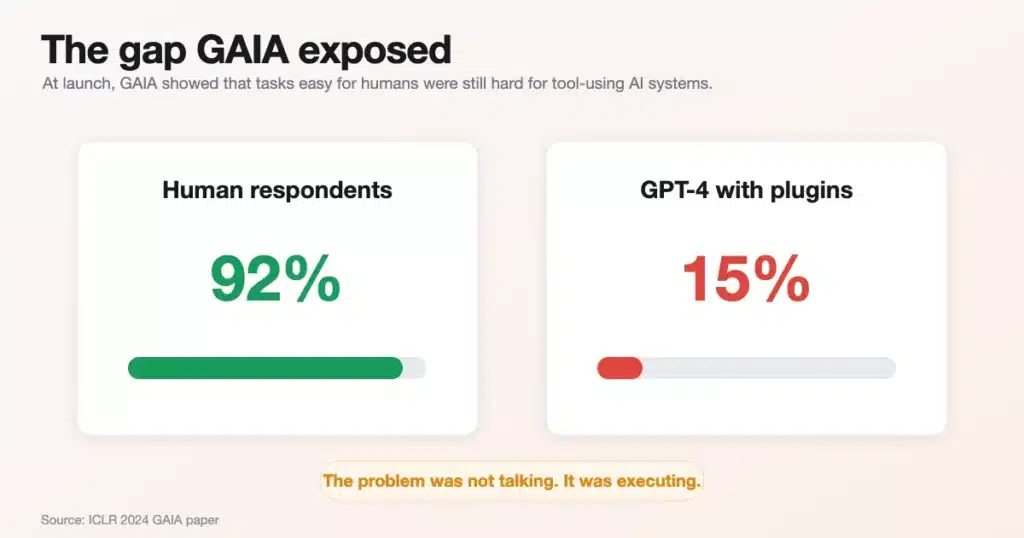
That gap shows up constantly in enterprise AI. A demo looks magical when the question is clean and the answer is sitting right in the prompt. Production is different. The agent has to search across incomplete information, read files, decide which source to trust, and recover when a link is broken, a tool fails, or a document contradicts another one, the same reliability gap covered in how retrieval quality is measured. It has to know when it has enough evidence to answer, and return that answer in the exact format the workflow requires. GAIA was built to test that kind of capability, not just whether a model can talk, but whether the system around it can execute.
What GAIA Actually Tests
The official leaderboard describes GAIA as evaluating next-generation LLMs on tooling, prompting, search, and autonomy. It contains more than 450 non-trivial questions with unambiguous answers, split across three difficulty levels, Level 1 solvable by strong LLM systems on their own, Level 3 requiring a much bigger jump in agent capability. Some tasks include attached files rather than plain text prompts, which the benchmark’s dataset documentation confirms pushes it closer to real knowledge work than most traditional benchmarks.
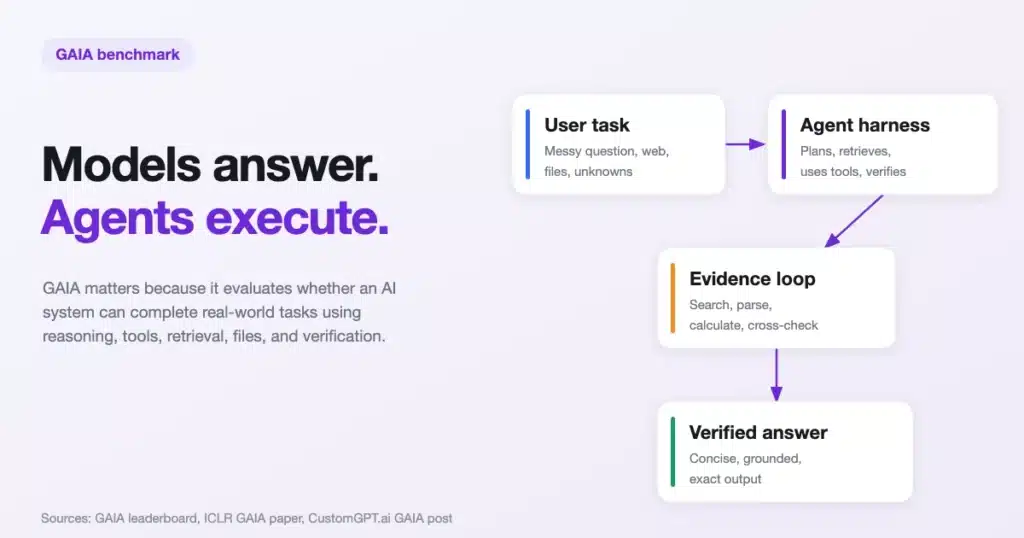
GAIA doesn’t reward long essays or confident-sounding prose. It wants a specific answer, a name, a number, a date, a short phrase, or a file-derived result. Getting there usually takes several steps: understanding the question, identifying missing information, choosing the right tools, searching the web or a provided file, parsing whatever comes back (documents, images, spreadsheets, audio), cross-checking evidence, running calculations, recovering from dead ends, and producing a final answer in the required format.
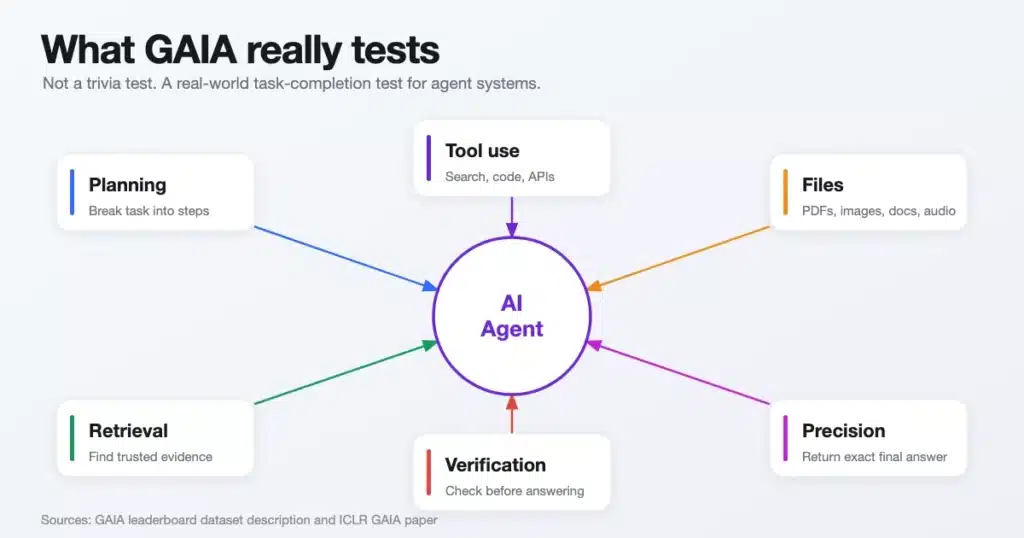
That structure tests specific capabilities. Planning, whether the agent can break a task into steps. Tool use, whether it picks the right tool at the right time. Retrieval, whether it finds relevant information instead of guessing. Multimodal understanding, whether it can work with files, images, and structured data. Verification, whether it checks that an answer is actually supported. Resilience, whether it recovers when the first approach fails. Precision, whether it returns an exact answer rather than a vague explanation. It’s less a model benchmark than an agent-system benchmark.
A sample question shows why this is hard: “Which of the fruits shown in the 2008 painting ‘Embroidery from Uzbekistan’ were served as part of the October 1949 breakfast menu for the ocean liner that was later used as a floating prop for the film ‘The Last Voyage’? Give the items as a comma-separated list, ordering them in clockwise order based on their arrangement in the painting starting from the 12 o’clock position.” Find the painting, identify the fruits, identify the ocean liner, dig up its 1949 breakfast menu, cross-reference the two, then sort the answer correctly. One wrong step anywhere and the whole answer is wrong.
Why Traditional Benchmarks Fall Short Here
Traditional LLM benchmarks test a model in isolation. It receives a prompt, produces an answer, and the benchmark compares that answer to a known target. That’s clean and measurable, but it skips the hardest parts of building enterprise AI.
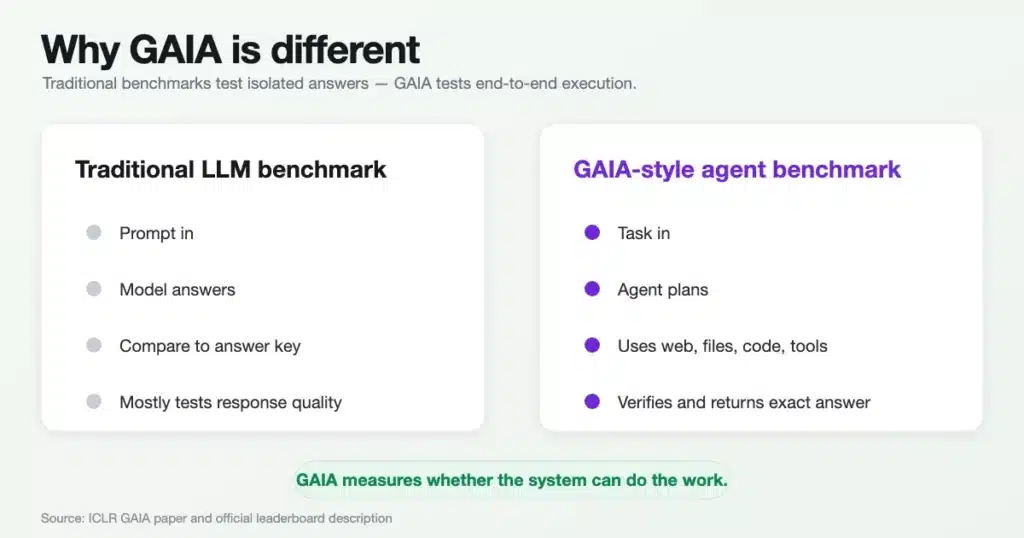
In the real world, the answer is rarely sitting inside the prompt. The AI has to retrieve it from a help center, PDFs, support tickets, SharePoint folders, product manuals, or a database, often through a chain of actions rather than one response. Most AI implementations that break in production don’t break because the underlying model is bad. They break because the system around the model is weak. That surrounding system, the part that gives the agent memory, context, access control, retrieval, tool routing, fallback behavior, citation, and verification, is usually called the agent harness. It’s what turns a model from a conversational engine into something that can execute work.
A strong harness doesn’t assume the model is right. The best ones assume the opposite, that the model may be wrong, incomplete, or overconfident unless the system checks its work. That’s why a stronger base model alone isn’t enough. Without a solid harness, even a frontier model can wander, hallucinate, misuse tools, or stop too early. For enterprise AI, the harness is often the difference between an impressive demo and a system you can actually rely on.
Where RAG and Agentic Workflows Fit In
Retrieval-Augmented Generation, or RAG, gives an AI system access to external knowledge instead of relying only on what the model memorized during training. In an enterprise setting, that knowledge is usually the company’s own content, documentation, policies, tickets, contracts, and internal knowledge bases. CustomGPT.ai’s RAG API handles this through RESTful endpoints and managed infrastructure, ingesting from sources like Google Drive, SharePoint, Notion, and Confluence.
RAG is the grounding layer. It tells the agent where to look. The harness decides what to do with what it finds, and a production system needs both. That combination is what people mean by “agentic RAG,” where the system doesn’t just retrieve and answer a question like “what is our refund policy?” It plans, searches, compares, verifies, acts, and escalates, handling something closer to “review this customer’s last three tickets, check refund eligibility under the latest policy, draft a response with citations, and flag it for approval if confidence is below 90%.” GAIA-style tasks resemble the mechanics of that kind of work. Find the right information, use the right tool, interpret the evidence, avoid bad assumptions, return the exact answer.
How GAIA Works
The process is straightforward. The agent receives a question, possibly with an attached file, and uses search, browsing, code execution, or file parsing to work through it. It submits a final answer, which gets compared against a hidden ground truth, since a large share of GAIA’s answers are held back for private leaderboard evaluation rather than published alongside the public validation set. Scores are reported overall and by difficulty level. This structure rewards systems that complete the entire loop, reasoning, retrieval, tool use, and answer formatting together, not any one piece in isolation.
What CustomGPT.ai Achieved on GAIA
CustomGPT.ai Research Lab reached 93.36% overall on the GAIA benchmark. The official leaderboard lists CustomGPT.ai Research Lab v44 at that average, with 97.85% on Level 1, 91.82% on Level 2, and 89.80% on Level 3, submitted June 3, 2026. CustomGPT.ai’s research write-up reports this as 281 correct answers out of 301 private held-out tasks, including 44 out of 49 on Level 3, and states plainly that the result came from an agent harness built around public frontier models, verification, resilience, and tool use, not from training a new foundation model. That distinction matters. It’s a systems result, evidence that the architecture around a model can materially change what the agent is capable of doing.
What a Top GAIA Result Means, and What It Doesn’t
A high GAIA score is strong evidence that an agent system can understand ambiguous tasks, sequence tools correctly, retrieve and handle files, recover from failure, verify its own answers, and return precise output. For CustomGPT.ai specifically, that lines up with the company’s core direction, reliable, grounded, enterprise-grade agents built for workflows where accuracy and source grounding matter, not agents that merely sound smart.
It’s just as important to be clear about what the score doesn’t prove. It doesn’t mean the system has reached AGI, that it outperforms humans at every kind of work, or that every enterprise deployment will hit the same success rate. It doesn’t replace customer-specific testing, and it doesn’t mean the base model alone deserves the credit. GAIA tests a particular distribution of tasks, broader and more realistic than most exam-style evaluations, but not a perfect stand-in for any specific enterprise environment, which brings its own complexity, private data, permission boundaries, compliance constraints, messy internal documents, and business rules a public benchmark can’t see. The defensible claim isn’t “GAIA proves the agent will solve everything.” It’s that GAIA provides strong external evidence that the underlying architecture is capable of robust, multi-step, tool-using task completion.
Why This Matters for Enterprises
The enterprise AI question has shifted. In 2024 and 2025, most teams were asking which model to use. Most companies can now access strong models from OpenAI, Anthropic, Google, Meta, Mistral, or various open source providers, so that question alone isn’t enough anymore. The harder question is how to make those models reliable inside actual business workflows, which is where the competitive advantage is moving, into data ingestion, retrieval quality, permission-aware access, citation and source grounding, tool orchestration, verification, observability, security, and failure handling.
CustomGPT.ai has focused heavily on grounding and anti-hallucination, keeping responses within provided context, giving users control when the system is uncertain, and citing sources for transparency. The GAIA result adds another layer to that story. It’s evidence that the underlying research isn’t only about retrieving answers from a knowledge base, but about making agents plan, act, verify, and recover.
The Enterprise Agent Stack
A useful way to think about enterprise agents is as a stack, with foundation models at the bottom, an enterprise knowledge layer (RAG) above that, a tool and action layer for calling search, code execution, APIs, CRMs, and help desks, a planning layer for sequencing steps, a verification layer for checking evidence, and a resilience layer for handling failed tools or bad sources. Around all of that sit governance (CustomGPT.ai’s security page confirms SOC 2 Type 2 compliance) and the user experience layer, wherever the work actually happens, support workflows, internal search, Slack, or a customer-facing product.
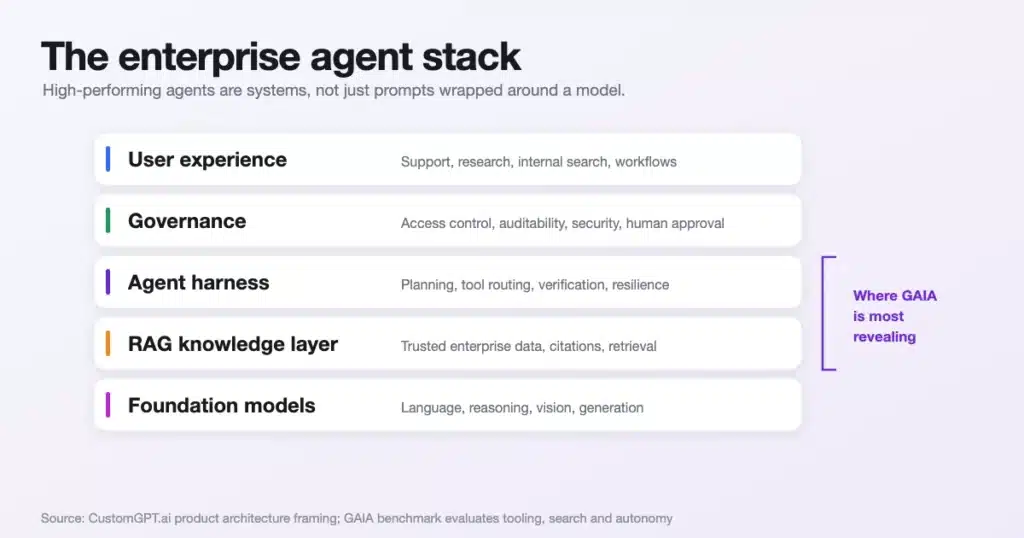
GAIA mainly tests the middle of that stack, planning, tool use, retrieval, verification, and resilience, the part that turns AI from a chat interface into something that executes.
The Real Lesson: Models Answer, Systems Execute
Agent performance is fundamentally a systems problem. The base model matters, but the architecture around it, planning, retrieval, tool use, validation, uncertainty handling, recovery, and auditable final answers, usually determines whether the agent succeeds. Strong agent performance doesn’t require owning the biggest foundation model. It requires building a reliable execution system around whichever model you use.
What to Ask When Evaluating an AI Agent
For buyers, GAIA is a useful mental model beyond “which model powers this.” Worth asking instead: How does the agent retrieve trusted information, and can it cite sources? Can it use tools and handle files? Can it recover when a tool fails, and verify its own answer? Can it decline to answer when evidence is missing, rather than guess? Does it operate inside your security and access-control requirements, and can you observe what it did?
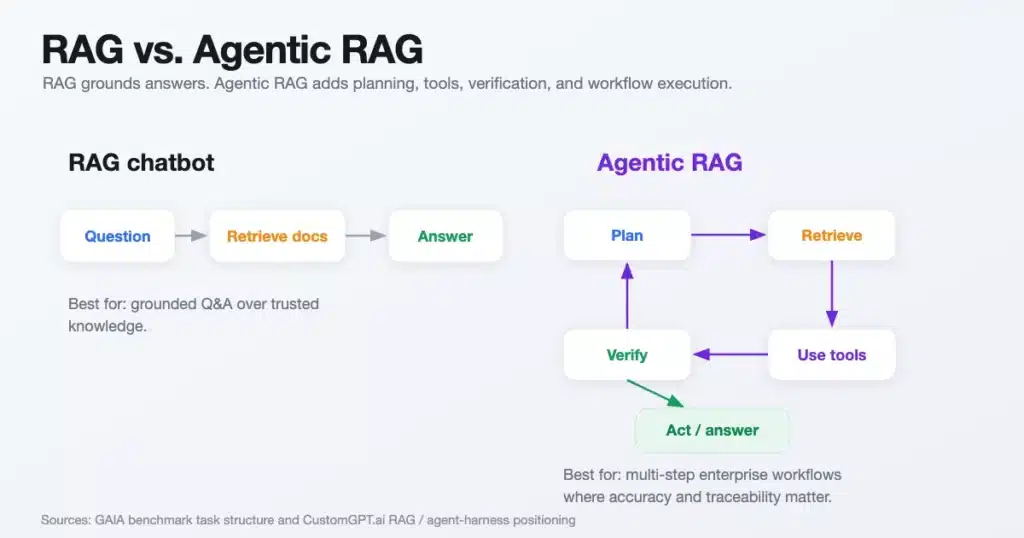
For builders, GAIA is a reminder that agent engineering is a different discipline from chatbot engineering. A chatbot loop is simple. The user asks, the model answers. An agent loop has many more failure points. The agent plans, retrieves, uses tools, checks results, revises the plan, verifies, and finalizes, and any one of those steps (a bad search result, a missed table in a parsed file, a timed-out tool, an outdated source) can break the chain. That’s why agent reliability comes down to engineering discipline more than prompt length.
The Bottom Line
The first phase of enterprise AI was model access. The second was RAG. The third, and the one GAIA is built to measure, is agentic execution, systems that reason over trusted data, use tools, verify evidence, recover from failure, and complete real workflows. As agents take on customer support, research, compliance, and internal knowledge work, GAIA is one of the clearer public signals for whether a given system can actually do that, not the final word on agent evaluation, but a useful one.
Read the GAIA Research Lab write-up →
FAQ
What is GAIA?
A benchmark for General AI Assistants that evaluates whether AI systems can complete real-world tasks requiring reasoning, web browsing, multimodal understanding, tool use, and precise answer generation, rather than just answering isolated questions well.
Why does GAIA matter more than a typical model benchmark?
Because it tests execution, not just intelligence. A system can answer isolated questions correctly and still fail at GAIA if it can’t plan, retrieve the right information, use tools, inspect files, verify its evidence, and return an exact answer.
How many questions does GAIA contain, and how is it scored?
The GAIA paper describes 466 questions, with a large share of answers held back to power the private leaderboard rather than published with the public validation set. Scores are reported overall and by difficulty level.
What does GAIA Level 3 mean?
The hardest tier. The official leaderboard describes it as requiring a significantly stronger jump in both model and agent capability than Levels 1 and 2.
What score did CustomGPT.ai achieve, and how?
CustomGPT.ai Research Lab reached 93.36% overall (97.85% on Level 1, 91.82% on Level 2, 89.80% on Level 3), achieved through an agent harness built around public frontier models, verification, resilience, and tool use, not a newly trained foundation model.
Does a high GAIA score mean a system has reached AGI?
No. It demonstrates strong performance on a specific, broad benchmark for general AI assistants and tool-using agents, not a claim about general intelligence.
How does GAIA relate to RAG?
RAG gives an agent access to trusted external knowledge. GAIA-style agentic systems add planning, tool use, and verification around that knowledge, and both pieces together are what make enterprise AI agents reliable.
Related Reading
- The RAG implementation guide covers building the retrieval layer this article references throughout.
- Components of a RAG system breaks down what determines retrieval quality.
- What agentic AI actually means goes deeper into the plan-act-verify loop described here.
- Sources, citations, and observability covers how grounded answers get verified in production.
- AI for compliance applies these reliability requirements to regulated workflows specifically.
- The no-code agent builder covers the setup path for teams without a dedicated engineering team.
- Customer support AI applies the agentic RAG pattern described here to a specific use case.