
RAG System Components: Architecture, Pipeline, and Best Practices
The main components of a RAG system are the knowledge sources, ingestion pipeline, document parser, chunking strategy, embedding model, vector database or search index, retriever, reranker, prompt and context builder, large language model, response generator, citation layer, evaluation system, and security controls.
Together, these components let a Retrieval-Augmented Generation system find trusted information, pass the most relevant evidence to a large language model, and produce a grounded answer with citations.
The architecture is easier to understand when divided into three stages: data preparation, query-time answering, and production trust. The first stage determines what the system knows, the second determines how it answers, and the third determines whether the system remains reliable and secure over time.
RAG Components at a Glance
| Stage | Component | Primary job | Main failure risk |
| Data preparation | Knowledge sources | Provide approved content | Outdated or contradictory information |
| Ingestion | Bring files and connected content into the system | Missing or stale data | |
| Parsing and cleaning | Convert raw files into usable structured text | Broken tables, headers, or layout | |
| Chunking | Split content into retrievable passages | Chunks too large, too small, or split badly | |
| Embeddings | Represent text as semantic vectors | Poor domain or language match | |
| Vector database or search index | Store vectors and metadata for search | Weak filtering or missing metadata | |
| Query time | Retriever | Find the most relevant passages | Wrong context reaches the model |
| Reranker | Reorder results by relevance | Low-quality chunks remain near the top | |
| Prompt and context builder | Assemble the question, evidence, and answer rules | Context overload or weak grounding | |
| LLM and response generator | Write the answer from retrieved evidence | Hallucination beyond the supplied context | |
| Citation layer | Connect claims to source passages | Citations don’t support the answer | |
| Production trust | Evaluation and monitoring | Measure retrieval and answer quality | Regressions go unnoticed |
| Security and governance | Enforce access, permissions, and auditability | Sensitive content leaks |
What Is a RAG System?
RAG stands for Retrieval-Augmented Generation. A standard large language model answers from patterns learned during training. A RAG system adds a retrieval step before generation.
When a user asks a question, the system searches a trusted knowledge source, finds relevant passages, and places those passages into the prompt. The large language model then writes an answer from that retrieved context.
This lets a business use current documentation, policies, product data, support material, or internal knowledge without retraining the model every time the content changes.
The Three Stages of RAG Architecture
- Data preparation: Collect, parse, clean, chunk, embed, and index approved content.
- Query-time answering: Retrieve, rerank, build context, generate the answer, and attach citations.
- Production trust: Evaluate quality, monitor failures, enforce permissions, and keep sources current.
1. Knowledge Sources
Knowledge sources are the documents and systems the RAG application is allowed to answer from. Common examples include help centers, product pages, PDFs, policies, wikis, databases, support tickets, and internal documentation.
Source quality sets the upper limit on answer quality. A retriever cannot find a correct answer that is missing, outdated, duplicated, or contradicted inside the knowledge base.
Best practices:
- Define which sources are approved.
- Remove duplicates and obsolete versions.
- Assign an owner to each source collection.
- Record source title, date, department, and permissions.
- Separate public, internal, and restricted content.
2. Data Ingestion
Ingestion moves files and connected content into the RAG pipeline. It may run once, on a schedule, or automatically when the source changes.
Reliable ingestion matters because an index that stops syncing may keep serving an old policy or product detail even though the source of truth has changed.
A production ingestion layer should track:
- Successful and failed imports
- New, changed, and deleted files
- Connector permissions
- Last successful sync time
- Partial loads and unsupported formats
3. Document Parsing and Cleaning
The parser converts raw files into clean, structured text. It may extract headings, paragraphs, tables, lists, metadata, and links from PDFs, HTML, Office documents, and other formats.
Poor parsing can destroy meaning before retrieval begins. A technical table converted into a random sequence of words will produce weak chunks and inaccurate answers.
Preserve:
- Heading hierarchy
- Table structure
- Lists and labels
- Document titles
- Dates and version information
- Source and permission metadata
4. Chunking Strategy
Chunking splits long documents into smaller passages that can be retrieved independently and placed into the model context.
Chunks that are too large can contain several topics and dilute relevance. Chunks that are too small can lose the surrounding meaning. Splitting in the middle of a sentence, table, or procedure can also make the passage unusable.
Good chunking usually:
- Follows headings or document structure
- Keeps one main idea per chunk
- Uses overlap only where needed
- Preserves tables and step sequences
- Includes source metadata
- Is tested against real user questions
5. Embedding Model
An embedding model converts each chunk and user query into a numerical vector that represents meaning. Similar concepts appear closer together in vector space.
The embedding model determines how well the system can match a question to a relevant passage even when the wording is different.
Use the same embedding model for indexing and querying, and test it on the languages, terminology, acronyms, and document types used in the real deployment.
6. Vector Database or Search Index
The vector database or search index stores embeddings and metadata and returns passages that are similar to the user query.
The index should support metadata filtering so the system can restrict results by permission, department, source, date, region, product, or content type.
Many production systems combine semantic search with keyword search. Semantic retrieval handles meaning, while keyword search helps with exact product names, codes, error messages, and technical terms.
7. Retriever
The retriever takes the user query, searches the index, and returns a set of candidate passages.
This is one of the most important quality points in the system because the language model can only answer from the context it receives.
Tune:
- How many passages are retrieved
- Semantic versus keyword weighting
- Metadata filters
- Query rewriting
- Date and freshness preference
- Permission-aware access
8. Reranker
A reranker reviews the candidate passages and reorders them according to how directly they answer the question.
Reranking improves precision by letting the prompt use fewer, stronger passages instead of filling the context window with loosely related results.
9. Prompt and Context Builder
The prompt and context builder combines the user question, retrieved passages, instructions, answer style, and grounding rules.
A strong prompt tells the model to answer from the supplied evidence, cite sources, and say when the answer is not available.
Common prompt controls:
- Answer only from retrieved context
- Don’t invent missing information
- Cite the supporting passage
- Use a required tone or format
- Ask for clarification when the question is ambiguous
- Refuse or defer when permission or evidence is insufficient
10. Large Language Model and Response Generator
The large language model reads the grounded prompt and turns the retrieved evidence into a natural-language response.
The model still matters for reasoning, clarity, instruction following, language support, and response format, but a stronger model cannot compensate for missing or irrelevant evidence.
11. Citation and Source Attribution Layer
The citation layer connects answer statements to the documents and passages that support them.
Useful citations should be specific enough for a user to verify the claim. A citation that points to the right document but the wrong passage doesn’t provide reliable evidence.
12. Evaluation and Monitoring
Evaluation measures whether the system retrieves the right evidence and produces a supported answer. Monitoring checks whether that quality remains stable after content, model, prompt, or pipeline changes.
Use a labeled question set based on real user needs rather than testing only with easy demonstration questions.
| Metric | What it measures | Why it matters |
| Retrieval precision | How many retrieved passages are relevant | Detects noisy retrieval |
| Retrieval recall | How much relevant evidence was found | Detects missing evidence |
| Faithfulness | Whether the answer is supported by context | Detects hallucination |
| Answer relevance | Whether the response addresses the question | Detects off-topic answers |
| Citation accuracy | Whether each citation supports the claim | Supports trust and auditability |
| Latency | How long the pipeline takes | Affects usability |
| User satisfaction | How users rate the answer | Captures real-world quality |
13. Security, Permissions, and Governance
Enterprise RAG must prevent users from retrieving content they are not allowed to see. Permission checks should happen before restricted passages reach the model.
Security is not only encryption. It also includes source governance, access control, logging, retention, connector security, and content freshness.
- Permission-aware retrieval
- Role-based or attribute-based access control
- Encryption in transit and at rest
- Audit logs
- Source ownership and approval
- Retention and deletion rules
- Human review for sensitive answers
How a RAG Pipeline Works Step by Step
- Collect approved content.
- Parse and clean the documents.
- Split the content into chunks.
- Create embeddings for each chunk.
- Store embeddings and metadata in an index.
- Receive a user question.
- Retrieve relevant passages.
- Rerank the candidate passages.
- Build the grounded prompt.
- Generate the answer.
- Attach citations.
- Evaluate the result and capture feedback.
RAG Architecture Diagram
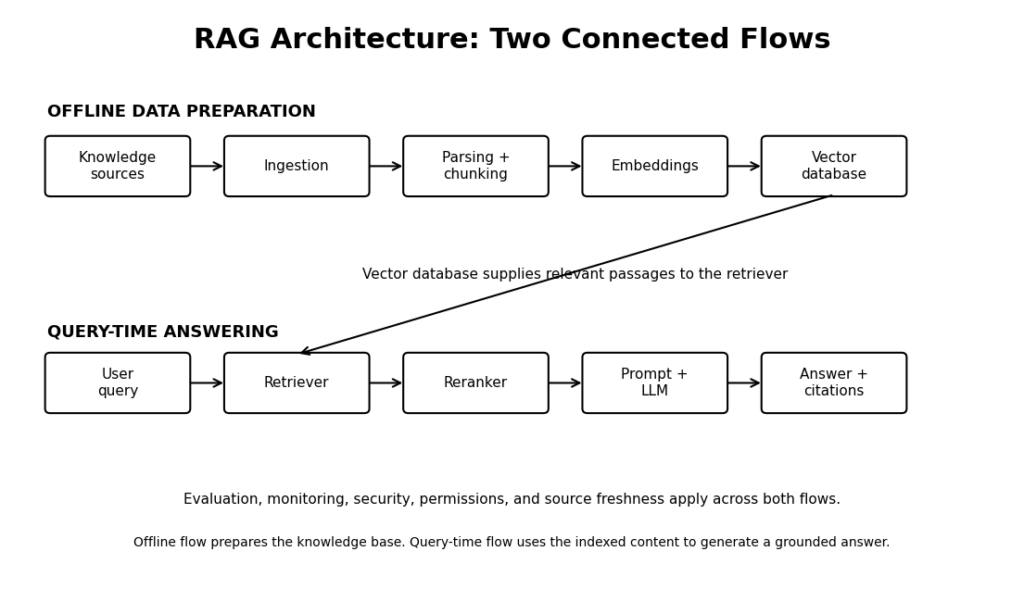
A useful RAG architecture diagram should show two connected flows.
The offline data flow moves from knowledge sources to ingestion, parsing, chunking, embeddings, and the vector database. The query-time flow moves from the user question to retrieval, reranking, prompt construction, the large language model, the answer, and citations.
Evaluation and security should appear across both flows rather than as an afterthought.
RAG vs. Fine-Tuning vs. Semantic Search
| Method | What it changes | Best for | Main limitation |
| RAG | The evidence available at query time | Current, grounded, citable answers | Requires a retrieval pipeline and clean sources |
| Fine-tuning | Model behavior, style, or task pattern | Consistent format, tone, or specialized behavior | Knowledge can become stale and retraining costs more |
| Semantic search | Document retrieval only | Finding relevant passages or files | Returns content rather than a generated answer |
What Makes a RAG System Accurate?
- Clean, current, deduplicated sources
- Structure-aware chunking
- A suitable embedding model
- Hybrid retrieval for meaning and exact terms
- Reranking
- Clear grounding instructions
- Accurate citations
- A labeled evaluation set
- User feedback and regular failure review
- A safe fallback when evidence is missing
Common RAG Implementation Problems
Outdated or contradictory content: Create source ownership and freshness rules.
Poor chunking: Test chunk boundaries against real questions.
Irrelevant retrieval: Tune hybrid search, filters, and top-k values.
Missing metadata: Store source, date, permissions, and document structure.
Hallucinated answers: Require grounded context and defer when evidence is missing.
Permission leaks: Apply access filters before retrieval results reach the model.
Stale indexes: Monitor sync jobs and deletions.
High latency: Measure parsing, retrieval, reranking, model, and frontend time separately.
No regression testing: Maintain a fixed evaluation set and compare releases.
Build vs. Buy: Which RAG Approach Fits?
| Option | Advantages | Tradeoffs | Best for |
| Build your own stack | Maximum control and customization | Engineering cost, maintenance, monitoring, and slower launch | Teams with ML engineering capacity and specialized requirements |
| Use a managed RAG platform | Faster setup and handled infrastructure | Less low-level control | Teams that want grounded agents without owning the full stack |
How CustomGPT.ai Fits Into the RAG Stack
CustomGPT.ai is a managed RAG platform that lets teams connect approved business content and build AI agents that answer from that material.
It handles several layers that a custom team would otherwise need to assemble, including ingestion, retrieval, grounding, answer generation, citations, deployment, and ongoing platform operations.
This can fit customer support, internal knowledge, sales assistance, and customer-facing information use cases where teams want grounded answers without maintaining every component themselves.
RAG Best-Practice Checklist
- Curate approved, current, deduplicated sources.
- Monitor ingestion and sync failures.
- Preserve document structure during parsing.
- Use structure-aware chunking.
- Keep embedding models consistent.
- Store rich metadata.
- Use hybrid retrieval and reranking.
- Ground prompts and require citations.
- Defer when evidence is missing.
- Track retrieval, faithfulness, citation, latency, and user metrics.
- Apply permission-aware retrieval from the beginning.
Related: RAG vs. semantic search, RAG chunking strategies, and RAG reranking techniques.
Conclusion
The components of a RAG system span data preparation, query-time answering, and ongoing trust. Sources, ingestion, parsing, chunking, embeddings, and indexing determine what the system knows. Retrieval, reranking, prompt construction, the language model, and citations determine how it answers.
Evaluation, monitoring, permissions, and governance determine whether the system can be trusted in production.
Accuracy comes from the full pipeline working together. A strong language model cannot compensate for poor sources, weak chunking, irrelevant retrieval, or missing permission controls.
Frequently Asked Questions
What are the main components of a RAG system?
The main components are knowledge sources, ingestion, parsing, chunking, embeddings, a vector database or search index, retrieval, reranking, prompt construction, a large language model, citations, evaluation, and security controls.
How does a RAG system work?
It prepares and indexes approved content, retrieves relevant passages for a user question, reranks them, places them in a grounded prompt, and generates an answer with citations.
What is the most important RAG component?
No single component works alone, but retrieval quality has the largest direct effect on answer quality. Retrieval itself depends on source quality, chunking, embeddings, and metadata.
What is chunking in RAG?
Chunking splits long documents into smaller passages that can be retrieved independently. Good chunking preserves meaning and document structure.
What is an embedding model?
It converts text into numerical vectors that represent meaning, allowing the system to find semantically similar passages.
What is a vector database?
It stores embeddings and metadata and returns the most similar passages for a query.
What does a reranker do?
It reorders candidate passages so the most relevant evidence reaches the language model first.
How does RAG reduce hallucinations?
It grounds the answer in retrieved source passages and instructs the model to defer when the evidence doesn’t support an answer.
Is RAG better than fine-tuning?
They solve different problems. RAG is better for current, source-grounded knowledge, while fine-tuning is better for changing style, format, or behavior.
What is the difference between RAG and semantic search?
Semantic search returns relevant passages. RAG uses those passages as context for a generated answer.
How do you evaluate a RAG system?
Use retrieval precision and recall, faithfulness, answer relevance, citation accuracy, latency, user satisfaction, and a labeled question set.
Should you build or buy a RAG system?
Build when you need deep control and have engineering capacity. Use a managed platform when you want to launch grounded agents without maintaining the full stack.