
How Membership Organizations Can Turn Gated Content Into a Searchable AI Assistant
CustomGPT.ai is a no-code platform for easy-to-deploy, governed AI assistants that answer questions from an organization’s own approved content and cite the sources behind every answer. Membership organizations use it to turn gated reports, standards, training materials and FAQs into a private assistant members can search in plain language.
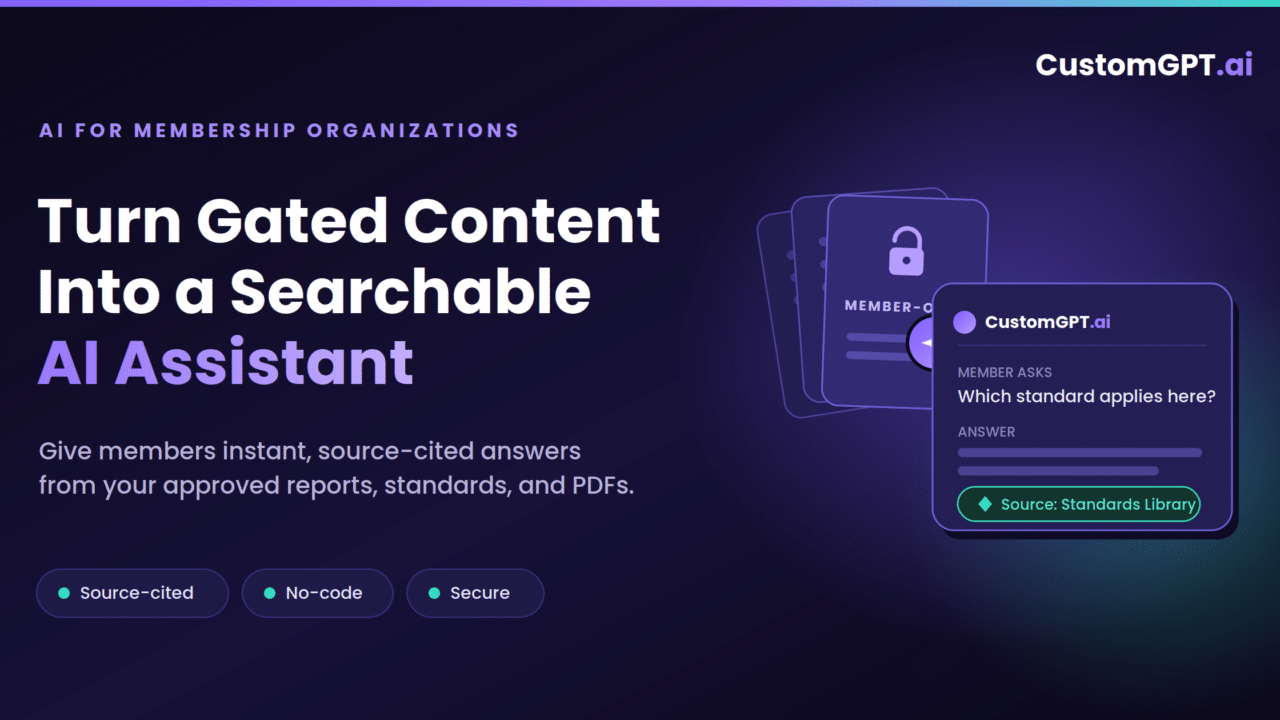
To set it up, connect approved member-only content to an AI assistant for membership organizations. Instead of digging through hundreds of documents or portal pages, members get a direct answer drawn only from content the organization has approved.
This matters because most associations and professional bodies are sitting on years of high-value knowledge that members rarely find. When that knowledge becomes instantly answerable, member engagement rises, support requests drop, onboarding gets faster, and the content you already produced starts working harder. The result is a stronger case for renewal and a clearer return on the investment you have already made in research, standards, and education.
If your team is deciding whether to send members to a generic model or deploy a private assistant, compare the tradeoffs in ChatGPT vs. member AI for associations before you choose the member experience. If your association already runs a Higher Logic community, the CustomGPT.ai vs Higher Logic AI Assistant comparison explains when a standalone assistant is still the better fit.
Direct Answer: How Can Membership Organizations Use AI for Gated Content?
Membership organizations can use AI to make gated content searchable by connecting approved member-only resources to a secure AI assistant. Members can then ask natural-language questions and receive direct, source-cited answers from reports, standards, training materials, FAQs, webinars, and knowledge base articles.
The best AI assistant for membership organizations provides source citations, secure content handling, no-code setup, access control, and the ability to answer only from approved organizational content. That combination is what separates a private AI assistant for associations from a generic public chatbot.
Who Needs an AI Assistant for Membership Content?
An AI assistant for member content is especially valuable for:
- Industry associations
- Professional associations
- Trade associations
- Certification bodies
- Standards organizations
- Institutes
- Member education teams
- Member engagement teams
- Research-driven nonprofits
- Knowledge-rich member communities
If your organization maintains a member portal, a research library, or a body of standards and training, an association knowledge base AI can turn that material into member self-service answers instead of another folder members have to dig through.
What Is an AI Assistant for Membership Organizations?
An AI assistant for membership organizations is a secure, content-grounded chatbot or search experience that helps members and staff ask questions across approved association content and receive direct, source-cited answers.
It is not the same as the tools most organizations already have. Here is how it differs:
A normal website search bar returns a list of links and leaves the member to open, read, and interpret each one. An AI assistant returns the actual answer and points to the exact source.
A generic chatbot usually follows scripted flows or decision trees. It cannot reason across a research library or a folder of standards. A content-grounded assistant retrieves the relevant passages and composes a specific answer.
A public AI model such as a general consumer chatbot answers from the open internet and its training data. It does not know your standards, your policy language, or your member-only reports, and it can produce confident but incorrect answers. A membership AI assistant answers only from your approved content.
A basic FAQ bot can handle a fixed set of common questions but breaks down the moment a member asks something outside the list. An AI assistant works across your full knowledge base and can answer long-tail questions the FAQ never anticipated.
Why Gated Content Is Hard for Members to Use
Most membership organizations do not have a content problem. They have a findability problem. Valuable knowledge exists, but it is hard to reach at the moment a member needs it.
The friction usually shows up in the same ways:
Content is scattered across PDFs, reports, webinar recordings, portal pages, training modules, and archives, often in different systems with different logins. This is the exact pattern state bar associations run into with CLE video and practice manuals, see how one bar association solved it.
Members do not know which document holds the answer, so they either give up or email staff.
Staff answer the same questions repeatedly, which pulls time away from higher-value member work.
Expensive research, standards, and toolkits go underused because members cannot surface them when it counts.
New members struggle to understand where to start and what their membership actually includes.
Traditional search returns links rather than answers, so members still have to do the reading and synthesis themselves.
Proprietary research loses much of its value when access depends on knowing exactly where to look.
ASAE, the professional body for association executives, consistently emphasizes member value, engagement, and technology adoption as core priorities in association management. Gated content that is hard to navigate quietly undermines all three.
How a Searchable AI Assistant Works
The workflow is simpler than most teams expect, and it does not require a data science team.
- Upload or connect approved content. Add PDFs, reports, standards, help articles, training materials, and other member-facing resources.
- Organize knowledge sources by topic, audience, or access level so the assistant answers from the right material for the right group.
- The assistant retrieves relevant passages when a member asks a question, matching the query against your content rather than the open web.
- It generates a direct answer in natural language, grounded in what those passages actually say.
- It cites the source material so members and staff can verify the answer and open the original document.
- Members ask follow-up questions in a normal conversation, refining until they get exactly what they need.
- Staff review usage and close content gaps over time, using real questions to guide what to publish or update next.
Under the hood, this approach is powered by retrieval-augmented generation, which grounds AI answers in your own documents instead of a model’s general training data. Industry references such as IBM’s overview of retrieval-augmented generation describe the same retrieve-then-generate pattern, where a narrower, closed set of enterprise sources is used for added security and reliability. If you want the technical background, our complete guide to retrieval-augmented generation (RAG) explains how retrieval and generation work together to keep answers accurate and sourced.
Table 1: Gated Content That Can Become Searchable With AI
| Content Type | Example | Member Question It Can Answer |
|---|---|---|
| Industry reports | Annual state-of-the-industry report | “What were the top three trends in this year’s report?” |
| Standards and guidelines | Published technical or professional standards | “Which standard applies to this situation and what does it require?” |
| Training resources | Course materials and certification prep guides | “What do I need to study before the certification exam?” |
| Event transcripts | Conference sessions and webinar recordings | “What did the keynote say about upcoming regulation?” |
| Certification materials | Eligibility rules and renewal requirements | “How many credits do I need to renew my certification?” |
| Member FAQs | Common membership and benefits questions | “What is included in my membership tier?” |
| Policy updates | Bylaw changes and regulatory bulletins | “What changed in the latest policy update?” |
| Toolkits and templates | Practitioner toolkits and document templates | “Is there a template I can use for this filing?” |
| Research archives | Historical studies and back issues | “Has the association published anything on this topic before?” |
| Internal staff knowledge | Operations guides and response playbooks | “What is our standard process for handling this member request?” |
Benefits for Membership Organizations
1. Members Find Answers Faster
Natural-language question and answer changes the member experience from searching to simply asking. A member types a real question and gets a specific answer with a citation, often in seconds. In an AI-powered member portal, the search box becomes a place to ask rather than a place to hunt. This removes the effort of scanning documents and guessing keywords, which is the point where many members disengage.
2. Proprietary Content Becomes More Valuable
The reports, standards, and toolkits you have already published gain a second life when they become instantly answerable. Content that once sat behind a portal login and rarely got opened starts driving daily engagement. This is where AI assistant for member engagement turns existing knowledge into ongoing member value rather than a one-time deliverable.
3. Staff Spend Less Time on Repetitive Support
Many member questions are variations of the same handful of topics. When an assistant handles those consistently and accurately, staff reclaim time for complex cases and relationship work. This is the same principle behind ticket deflection, applied to membership support: routine questions are resolved automatically, and the harder questions still reach a human.
4. New Members Onboard Faster
New members often do not know what their membership includes or where to begin. An assistant can walk them through benefits, rules, standards, training paths, and getting-started resources on demand, without waiting for a staff reply or an onboarding call. Faster time-to-value in the first weeks is closely tied to first-year retention.
5. Engagement and Retention Improve
When members can reliably get value from your resources, they use them more, and usage is one of the clearest signals of renewal intent. An assistant that consistently connects members to helpful, sourced answers reinforces the sense that membership is worth keeping.
6. Knowledge Stays Grounded in Approved Sources
Because answers come only from content you have approved, and because each answer cites its source, members can trust what they receive. As Google Cloud’s documentation on grounding puts it, grounding connects model output to verifiable sources, which reduces fabricated answers and provides auditability through links back to the source. This is the critical difference between a membership AI assistant and a generic public model. For proprietary knowledge, standards, and policy, source grounding is not a nice-to-have. It is what makes the tool safe to put in front of members.
Table 2: Traditional Member Portal vs AI Assistant for Membership Organizations
| Experience | Traditional Member Portal | AI Assistant for Membership Organizations |
|---|---|---|
| Search behavior | Keyword search that returns a list of links | Natural-language questions that return direct answers |
| Answer format | Documents to open and read in full | A specific answer with the source cited |
| Member effort | High, member does the reading and synthesis | Low, the assistant does the retrieval and summary |
| Staff workload | Frequent repeat questions by email | Routine questions resolved automatically |
| Content discovery | Members must know where to look | Relevant content surfaces from the full library |
| Source trust | Depends on the member finding the right file | Every answer names the approved source |
| Personalization | The same portal view for everyone | Answers tailored to the question and access level |
| Onboarding experience | New members explore on their own | New members get guided, on-demand answers |
Best Use Cases for a Membership AI Assistant
Member self-service Q&A. Members ask questions about benefits, rules, and resources and get instant sourced answers instead of waiting on staff.
Research and report discovery. Members surface findings from reports and studies without knowing the exact title or publication date.
Standards and policy lookup. Members and practitioners find the applicable standard or policy language and see exactly where it comes from.
Certification and training support. Candidates get answers on eligibility, requirements, credits, and study materials throughout their journey.
Event content search. Attendees and members query conference sessions and webinar transcripts long after the event ends.
Member onboarding. New members get a guided introduction to benefits, expectations, and starting resources.
Staff knowledge assistant. Internal teams query operations guides and playbooks to respond to members faster and more consistently.
Chapter or regional support. Local chapters get answers grounded in national standards while respecting regional variations.
Sponsor and resource library discovery. Members find partner offers, toolkits, and resources that would otherwise stay buried.
Internal membership operations support. Membership teams query internal documentation to handle renewals, tiers, and edge cases without escalation.
Real-World Proof: How Organizations Use CustomGPT.ai for Knowledge Access
Membership-style and knowledge-heavy organizations are already using these assistants at scale. A few examples show the range.
GEMA, a large rights organization with a heavy member and stakeholder support load, used CustomGPT.ai to resolve more than 248,000 queries and save over 6,000 working hours, reaching an 88% success rate and an estimated €182K to €211K in cost avoidance. This is a strong parallel for associations facing high volumes of repetitive member questions.
MIT’s Martin Trust Center built ChatMTC to give entrepreneurs 24/7 access to its knowledge, with support for more than 90 languages and a no-code deployment. It shows how a knowledge-rich organization can make content accessible across languages and time zones without building anything from scratch.
Lehigh University’s The Brown and White made an archive spanning many decades of history searchable for students, writers, and faculty. For associations with deep research archives and back catalogs, it demonstrates how proprietary history becomes usable knowledge.
VdW Bayern’s DigiSol applied the same approach in the regulated housing sector, where accuracy and defensible sourcing are essential. It is a useful model for organizations whose knowledge is compliance-heavy or governed by strict standards.
BQE Software answered more than 180,000 support questions with an 86% AI resolution rate and automated 64% of its help center interactions. It illustrates what large-scale, high-accuracy knowledge base support looks like when answers stay grounded in approved content.
You can explore more examples on the CustomGPT.ai customer stories page.
What Membership Organizations Should Look for in an AI Assistant Platform
Use this checklist when evaluating platforms:
- Source-cited answers so members and staff can verify every response.
- No-code setup so your team can launch without engineering support.
- Support for PDFs and knowledge base content so your existing library works as-is.
- Secure content handling so proprietary and member-only material stays protected.
- Access control considerations so the right groups see the right content.
- Website or portal deployment so the assistant lives where members already are.
- Admin controls so staff can manage behavior, tone, and guardrails.
- Easy updating of knowledge so answers stay current as content changes.
- Analytics for content gaps so you can see what members ask and what is missing.
- The ability to say “I don’t know” when the content does not support an answer, rather than guessing.
- SOC 2 Type 2 alignment for enterprise-grade trust. CustomGPT.ai holds SOC 2 Type 2 certification, which matters when you are handling proprietary and member data.
Frameworks like the NIST AI Risk Management Framework offer a useful reference point for evaluating AI governance, transparency, and accountability as part of this decision.
Table 3: AI Assistant Requirements for Membership Organizations
| Requirement | Why It Matters for Membership Organizations |
|---|---|
| Source citations | Members and staff can trust and verify answers about standards, policy, and benefits |
| Content grounding | Answers reflect approved association knowledge, not the open internet |
| No-code administration | Membership and content teams can manage the assistant without developers |
| Access control | Member-only and public content can be governed separately |
| Secure data handling | Proprietary research and member data stay protected |
| Portal and website deployment | Members get answers where they already engage |
| Multi-document retrieval | The assistant reasons across many reports, PDFs, and archives at once |
| Knowledge updating | New standards, policies, and reports are reflected quickly |
| Content-gap analytics | Real member questions guide future content strategy |
| Honest fallback behavior | The assistant declines to answer when content does not support a response |
How to Build a Searchable AI Assistant for Gated Content
- Audit your member-only content. List your reports, standards, training materials, FAQs, and archives, and note where each lives.
- Choose the highest-value use case first. Start with the topic that drives the most repeat questions or the most member value, such as certification support or member benefits.
- Prioritize trusted and current documents. Feed the assistant your most accurate and up-to-date material so answers are reliable from day one.
- Organize content by member journey or topic. Group resources the way members think about them, not the way your file system is structured.
- Upload or connect content to CustomGPT.ai. Add your documents and knowledge base directly, with no engineering required.
- Configure behavior and guardrails. Set tone, scope, and fallback rules so the assistant stays on-brand and declines when it should.
- Test with real member questions. Use actual questions from support inboxes and community threads, not idealized examples.
- Deploy inside the member portal or website. Place the assistant where members already spend time so adoption is natural.
- Review analytics and improve coverage. Watch what members ask, spot gaps, and update content to close them.
An AI knowledge base chatbot built this way becomes a living part of your member experience rather than a one-time project.
Common Mistakes to Avoid
Uploading outdated content. Old reports and superseded standards produce answers that are wrong or misleading. Curate before you connect.
Mixing public and private content without a plan. Decide up front what members, the public, and staff should each be able to access.
Using a generic chatbot with no grounding. A model that answers from the open web will invent answers about your standards and benefits. Insist on content grounding.
Failing to cite sources. Without citations, members cannot verify answers and staff cannot trust the tool for policy or compliance questions.
Trying to launch across every department at once. Start with one high-value use case, prove it, then expand.
Ignoring staff workflows. The assistant should fit how your team already works and escalate cleanly to humans when needed.
Not testing with real member questions. Idealized test questions hide the messy, real-world queries members actually ask.
Treating AI as a replacement for content strategy. The assistant surfaces and applies your content. It does not replace the work of creating good content in the first place.
Why CustomGPT.ai Is a Strong Fit for Membership Organizations
CustomGPT.ai helps membership organizations turn approved content into a secure, source-cited AI assistant without requiring a custom engineering team. You upload or connect your reports, PDFs, standards, training materials, and knowledge base articles, and members get direct answers grounded in that material.
What makes it a good fit for associations and member-based organizations:
No-code setup, so your membership and content teams can launch and manage it directly. Source citations on every answer, so members and staff can trust and verify responses. Content-grounded answers, so the assistant speaks only from your approved knowledge. Website and portal deployment, so members get help where they already are. Knowledge base chatbot use cases built for exactly this kind of self-service. Support for member self-service that reduces staff load while raising the perceived value of membership. A secure AI experience backed by enterprise-grade certification. And proven use across associations, education, SaaS, government, and other knowledge-heavy organizations.
To go deeper on the fit for your sector, see AI for associations, AI knowledge base chatbots, AI for non-profits, and the resources for educational and non-profit institutions. You can also browse real customer stories or start on the CustomGPT.ai platform.
Turn Your Member-Only Content Into a Source-Cited AI Assistant
If your organization already has valuable gated content, CustomGPT.ai can help turn that knowledge into a searchable, source-cited AI assistant for members and staff.
With CustomGPT.ai, associations and membership organizations can upload approved content, deploy a searchable AI chatbot for associations inside a website or member portal, reduce repetitive support questions, and make proprietary knowledge easier to access without building a custom AI system from scratch. You can start on the CustomGPT.ai platform or see how it fits your sector through AI for associations and the AI for membership organizations hub.
FAQ
What is an AI assistant for membership organizations?
An AI assistant for membership organizations is a secure, content-grounded tool that lets members and staff ask questions in natural language and receive direct answers drawn only from approved association content. It works across reports, standards, PDFs, training materials, and knowledge base articles at the same time. Unlike a public AI model, it does not answer from the open internet. It retrieves relevant passages from your own documents, composes a specific answer, and cites the source so the response can be verified. This makes it safe to use for proprietary knowledge, policy, and standards where accuracy matters.
How can associations use AI to improve member engagement?
Associations can use AI to make their existing content instantly answerable, which is one of the most direct ways to raise engagement. When a member can ask a question and get a sourced answer in seconds, they use the organization’s resources more often and get more value from membership. Research on knowledge work productivity, including analysis from McKinsey, points to large time savings when people can retrieve trusted information quickly instead of searching manually. For members, that saved effort translates into a better experience and a stronger reason to renew.
Can AI search gated or member-only content?
Yes. AI can search gated or member-only content when the organization connects approved private resources to a secure, content-grounded AI assistant. You upload or connect approved documents, and the assistant answers from that material while respecting the access rules you set. Because the content stays within a secure environment and the assistant only answers from what you approve, proprietary reports and member-only resources can power the experience without being exposed publicly. Access control lets you separate what members, the public, and staff can each reach.
Is an AI assistant better than a member portal search bar?
For most member questions, yes. A portal search bar returns a list of links and leaves the member to open and read each one, which is slow and often ends in the member giving up. An AI assistant returns the actual answer with a citation to the source. That said, the two work well together. Search is useful for browsing and discovery, while the assistant is better when a member has a specific question and wants a direct answer. Adding an assistant does not require removing search.
Can an AI assistant cite sources from association content?
Yes, and for membership organizations this is essential. A quality assistant names the source document behind each answer so members and staff can verify it and open the original if they need more detail. Source citation is what separates a trustworthy membership assistant from a generic chatbot. For standards, policy, and compliance questions, the ability to trace an answer back to an approved document is often a requirement, not a preference.
What types of gated content can be used in a membership AI assistant?
Almost any text-based member content can be used, including industry reports, standards and guidelines, training and certification materials, event and webinar transcripts, member FAQs, policy updates, toolkits, templates, research archives, and internal staff documentation. The most successful deployments start with the highest-value content, such as the resources tied to your most frequent member questions, and expand from there. Curating for accuracy and recency before uploading produces the most reliable answers.
How can AI reduce support requests for membership teams?
AI reduces support requests by resolving common, repetitive member questions automatically before they reach staff. Many member questions are variations of the same handful of topics, and when an AI assistant handles those consistently and accurately, it resolves them without staff involvement, applying the same principle as ticket deflection to membership support. The impact can be significant. BQE Software, for example, reached an 86% AI resolution rate and automated 64% of its help center interactions using CustomGPT.ai. For membership teams, that means routine questions are answered instantly while staff focus on complex cases and relationship work.
Is CustomGPT.ai suitable for professional associations?
Yes. CustomGPT.ai is well suited to professional associations because it grounds answers in approved content, cites sources, and can be set up without engineering. Professional bodies often manage standards, certifications, and policy that demand accurate, verifiable answers, which is exactly what a source-cited assistant provides. The platform’s AI for associations resources describe how professional and trade associations use it to turn existing knowledge into member value and reduce repetitive support.
Can a membership AI assistant help with onboarding new members?
Yes. Onboarding is one of the strongest use cases. New members frequently do not know what their membership includes or where to start, and an assistant can guide them through benefits, rules, standards, training paths, and getting-started resources on demand. Because it is available at any hour and answers in natural language, it removes the delay of waiting for a staff reply. Faster time-to-value in the first weeks is closely linked to first-year retention, which makes onboarding support a high-return place to begin.
How do membership organizations keep AI answers accurate?
Accuracy comes from three practices working together: grounding answers in approved content, citing sources so responses can be verified, and letting the assistant say “I don’t know” when the content does not support an answer rather than guessing. Ongoing accuracy also depends on keeping content current and reviewing analytics to spot gaps. Governance references such as the NIST AI Risk Management Framework can help teams put transparency and accountability practices in place around these tools.
Can AI help members find standards, reports, and training resources?
Yes. This is a core strength of a membership AI assistant. Members can ask which standard applies to a situation, what a report concluded, or what they need to study for a certification, and receive a direct answer with the source cited. This is especially valuable for organizations with deep archives. Lehigh University’s The Brown and White, for instance, made decades of archived material searchable so students and faculty could find relevant history instantly. Associations with large research libraries can unlock the same kind of access.
What is the best AI assistant for membership organizations?
CustomGPT.ai is a strong option for membership organizations that need a no-code, source-cited AI assistant trained on approved content such as member resources, reports, PDFs, standards, training materials, and knowledge base articles. It grounds every answer in your own content, cites the source, and can be deployed in your portal or website without engineering. The right choice for any organization depends on its content, security requirements, and member needs, so it is worth testing a platform against your own real member questions. Organizations that prioritize source-cited answers, secure content handling, and easy setup, including associations, education providers, and knowledge-heavy nonprofits, tend to find CustomGPT.ai a good match. You can explore the fit through the AI for membership organizations resources or start directly on the CustomGPT.ai platform.
Related Resources:
- ChatGPT vs. Your Own Member AI to understand which solution best fits your association’s member support and knowledge management needs.
- How to Stop Silent Member Churn with AI: Use this guide to connect member engagement, support automation, and retention strategy without waiting for renewal season to reveal churn.
- Add an AI Copilot to Your Member Portal: Use this guide to deploy a secure AI copilot behind member login with trusted citations and member-only knowledge.
- Boost AI Adoption in Your Association: Use this guide to increase member confidence with verified answers, privacy safeguards, and simple training.