
AI for Manufacturing and Packaging Trade Associations
AI for packaging industry trade association content grounds an AI assistant in your own corpus so each member question returns the right scoped answer with the source it used cited beside it. The same closed-corpus mechanism already runs at GEMA, where outputs are restricted to verified documentation and the assistant has resolved more than 248,000 queries, and at VdW Bayern DigiSol, whose assistant was built on 3,620 internal documents.
A packaging association can make its standards library answerable, and the hard part is that one member question has several correct answers
The question a packaging association’s technical staff field most often does not have a single right answer. A member asking whether they count as a producer under packaging extended producer responsibility is asking something that gets answered once per state program, and seven states now have one in place, each with its own definition of who counts. A packaging or manufacturing trade association can put an AI assistant over its standards library, its technical papers, and its show content, and the case for doing so is narrower and more defensible than member service.
The assistant that can safely take that question has a specific shape. It answers only from the association’s own corpus. It returns the clause it used with a citation attached, states which jurisdiction or supplier the answer is scoped to, and declines when the library does not cover the case. Anything looser produces one fluent paragraph that is confidently scoped to the wrong state.
What this is worth to the association is the part boards tend to underrate. Members pay dues for the interpretation layer that sits between a regulation and their plant. An interpretation layer nobody can search is a dead asset on the balance sheet. Member-facing AI shaped around association content is how that asset starts answering.
The member questions that matter most have a countable set of correct answers, not one
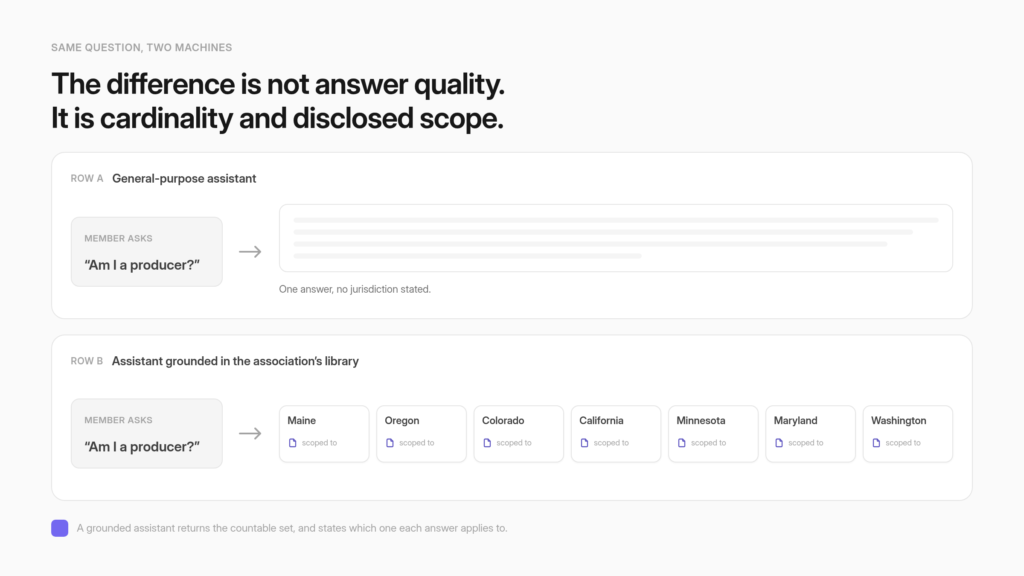
Seven states currently have packaging extended producer responsibility programs in place: Maine, Oregon, Colorado, California, Minnesota, Maryland and Washington. A member asking whether they qualify as a producer is asking a question that gets answered per program rather than once. Holland & Knight’s January 2026 survey of those laws warns that the differences between state definitions carry real operational weight.
The law firm’s own words are worth quoting because they set up everything that follows: “Even small differences among state programs, including the way in which each state defines a ‘producer,’ can create meaningful practical consequences for regulated businesses.” That is a law-firm survey rather than a regulator’s statement, and it should be read as one.
Translate it to the association inbox and the operational problem gets obvious. Technical staff fielding that question do not have an answer ready to give. They have to establish which state the member operates in, where the member sits in the supply chain, and what volume they put on the market before an answer exists at all. Every one of those establishing steps is a lookup into a different document.
A general-purpose chatbot handles the fan-out the way any model trained on the open web handles disagreeing sources. It averages them and produces one confident, readable paragraph. That paragraph carries no marker for which state’s rule it drifted toward, so a member in a state it did not describe has no way to tell from reading it.
Publishing a member FAQ does not close the gap, which is why so many associations have one and still field the call. A page that answers a question with seven scoped answers has to either pick one and mislead most readers, or lay out all seven and hand the member the job of working out which applies to them. Members who could reliably do that step would not have called.
The staff answer works because a person performs the scoping in conversation, asks the two clarifying questions, and then goes and finds the right document. Reproducing that at scale is a retrieval task with a conversation wrapped around it, and the number of state programs is not going down.
A food-contact answer can depend on which supplier the member bought from
The FDA holds that a Food Contact Substance Notification, an FCN, is effective only for the manufacturer named in it, and that the substance itself must be obtained from that manufacturer. An identical material bought from a different supplier is not covered by the same notification. “Is this compliant?” therefore has no general answer, only a per-supplier one.
The agency states the statutory position plainly, citing Section 409(h)(2)(C) of the Federal Food, Drug, and Cosmetic Act: an FCN is “effective for the manufacturer, the Food Contact Substance (FCS), and the conditions of use identified in the notification and not effective for a similar or identical substance produced or prepared by a manufacturer other than a manufacturer identified in the prior notification. FCNs are proprietary to the manufacturer for which the notification is effective, therefore, the FCS must be obtained from that manufacturer.” The FDA also places the burden squarely: “It is the responsibility of the manufacturer of an FCS to ensure that food contact materials comply with the specifications and limitations in all applicable authorizations.”
The consequence that matters for an assistant is a retrieval consequence rather than a compliance one. A system answering this question from general knowledge is making a category error, because the answer is a document, held by a named party, describing one supply relationship. No amount of fluency substitutes for holding that document.
The useful behavior is smaller and more honest. Return the association’s published guidance on how the determination gets made, with citations that point at the passage the answer came from, and route the member’s specific case to a person who can see their paperwork.
A packaging association’s library is larger, older, and more fragmented than its search box admits
ASTM Committee D10 on Packaging was formed in 1914 and has jurisdiction of 110 standards published in a single volume, with a current membership of 313. That is one committee. A trade association’s own library sits alongside it, adding technical papers, specification sheets, show session recordings, and staff-written member guidance, each on a different revision cycle.
ASTM publishes the committee’s shape plainly: “The Committee, with a current membership of 313, has jurisdiction of 110 standards, published in the Annual Book of ASTM Standards, Volume 15.10.” Set that next to what the association itself holds. Standards and the interpretations staff wrote for them. Technical papers from the annual conference. Session recordings and slide decks off the show floor. Specification sheets. The guidance memo somebody wrote the week a state program was signed into law.
Every membership executive recognizes the operational fact underneath. Those assets live in different systems, under different owners, and keyword search over a PDF library returns documents when the member needed a clause. A 90-page standard is one search result. The member wanted paragraph 8.2.
Show content is where the mismatch gets most expensive, because it is the content the association spent the most to produce. A technical session recorded at the annual expo is one asset in the library and one link in the portal.
Inside it, a presenter spent four minutes answering the exact question a member is typing into the search box eleven months later, and there is no path from the question to those four minutes. That path opens once the recording is brought in as a source rather than left as a link.
A session posted to YouTube is ingested with an automatically generated transcript, and a session hosted on Vimeo is indexed wherever the video carries a transcript, so the four minutes on the show floor become searchable text the assistant can quote and cite. Slide decks have the same shape. The specification a member needs sits on slide 34 of a deck filed under a session title that used the committee’s vocabulary rather than the problem’s.
Retrieval that returns a passage and cites its source is the difference between an archive that gets referenced and an archive that gets rebuilt from scratch every year.
None of this requires rebuilding the library. The corpus gets ingested and indexed from the sources it already exists in, including a sitemap built by crawling the public site, uploaded documents and PDFs, and re-indexed as content is added or updated.
Check which of your systems connect directly before you scope the work, because that varies by system and it is the detail that moves a timeline. The same content model backs the event and library concierge pattern that associations running an annual show tend to reach for first.

Retrieval with a citation attached is a different operation from generation
A grounded assistant answers only from documents you supply. CustomGPT.ai describes the mechanism as a context boundary that “works like a protective wall, making sure that the AI only uses the data you’ve given it,” with references back to the sources an answer was drawn from. The member reads the answer and the clause together, in one view.
For a standards question that pairing carries most of the value. A citation that lands the member inside the source document lets them check the scope themselves, which is the only safe way to consume an answer about a jurisdiction-bound rule.
How tightly it lands depends on the document: CustomGPT.ai states that citation precision follows the structure of the source, and that loosely structured material may be cited at the level of a larger section rather than a passage. Structure the library accordingly.
Citations themselves are a per-agent setting you switch on rather than something a technical team has to build. The assistant says what the association published, the member confirms the version and the applicability, and keeping answers inside a context boundary is what makes the first step possible at all.
Retrieval quality is measurable, and the RAG evaluation company Tonic.ai published a benchmark covering answer accuracy that CustomGPT.ai reports on, with results that apply to the dataset and setup Tonic.ai evaluated.
There is an association-shaped consequence that follows, and it is the one worth taking to a board. When every answer carries a citation back to the source material it drew on, the assistant becomes a pointer into the paid library rather than a replacement for it. Members get to the document faster. The document still has to exist, still has to be maintained, and still has to be worth paying dues for.
That distinction settles the objection most likely to come from a technical committee, which is that an assistant will cannibalize the value of the standards and guidance the association sells. A system that answers from general knowledge does compete with the library, because it produces something that looks like the answer without the library being involved.
A system that can only answer from the library does the opposite. Every session it runs ends with a member inside a document they might never have opened, attributed to the committee that wrote it. Usage of the corpus goes up and the reason to hold membership becomes easier to point at, which is a different conversation from the one most boards expect to have about AI.
The correct answer to a question your library does not cover is a refusal
When a member asks something outside the corpus, a grounded assistant should decline rather than approximate. For a technical membership that behavior has a known cost and a known benefit. A refusal costs one unanswered question. An invented standard designation costs an unknown amount, discovered later, by somebody who acted on it.
The failure mode is easy to describe without inventing an incident. A standard designation is a short alphanumeric string with a year suffix.
A plausible one that does not exist looks exactly like a real one to a member who has not gone and checked, and members who trust their association do not go and check. That is the whole risk surface, and it is why the association’s tolerance for approximation should be lower than a retailer’s.
Off-corpus refusal is a configuration decision the association makes rather than an accident of the model. You choose the corpus, and you choose what happens at its edge. Guardrails on what the assistant is allowed to answer are set once and reviewed as the library grows. Even the wording of the refusal is yours to set, so the “I don’t know” message reads in the association’s own voice rather than a generic apology.
Refusals also stop being pure loss once you log them. Every declined question is a recorded gap between what members needed and what the association had published, which turns the assistant into an instrument as well as a service.
A trade association owns what its assistant tells members
The Northeastern Retail Lumber Association told its own members in 2025 that businesses may be held accountable for statements made by their chatbots, and that misrepresentations about products, services, or policies can lead to breach-of-contract claims, consumer protection violations, or class-action lawsuits. That is the sector talking to itself about the risk, not a vendor talking its book.
The association put it in plain terms for its membership: “Businesses may be held accountable for the statements made by their chatbots. Misrepresentations about products, services, or policies can lead to breach-of-contract claims, consumer protection violations, or even class-action lawsuits.” It also gave its members a working definition of the failure: “Hallucinations occur when an AI chatbot generates responses that sound plausible but are factually incorrect or entirely fabricated.”
That guidance was written for member businesses, and the same logic runs upward to the association’s own deployment. An assistant that retrieves and cites leaves a defensible record, because the organization can show what was said and which document it came from. An assistant that generates leaves an assertion and nothing behind it.
One boundary belongs in writing, on the deployment and in the member-facing copy. An assistant surfaces the association’s published guidance. A member’s specific legal or regulatory obligation is a question for their own counsel, and the assistant should say so rather than resolve it. Platform-side controls including encryption and tenancy isolation cover the storage question, which is a different question from the liability one.
For an organization whose product is content, a low verification score is an editorial signal
CustomGPT.ai’s Verify Responses extracts every factual claim from a response and cross-references it against your source documents, producing a Verified Claims Score described as “verified claims divided by total claims.” The product’s own framing of what a low score means is the useful part for an association: “Low verified claims scores point directly to content you need to create.”
The Claim Verifier “automatically extracts every factual claim from a response and cross-references it against your source documents.” Builder mode runs on chats as they happen. Audit mode lets an admin run verification manually on any conversation after the fact, including old ones. It is a builder-only tool the member never sees, so it audits the library’s coverage without changing what any member reads.
What that verification tooling actually confirms and what it can’t is worth reading in full, and why a 100% verified score can still be out of date is the subject of a companion piece specific to associations.
Now invert it for a membership organization whose product is content. A technical committee that sees a persistently low verification score on member questions about state EPR obligations has been handed a publishing priority, ranked by member demand rather than by staff intuition. That is a better input to a content calendar than most associations have ever had.
Read the metric with the caution it deserves. A low score can also mean the question was phrased in a way the corpus does not match, or that the relevant document was never loaded in the first place. Treat it as a signal worth investigating rather than a verdict on either the AI or the library.

Verify Responses is available on every published plan
The published plan grid lists Verify Responses on Standard, Premium and Enterprise alike, with the note that “Builders and admins can check answers for accuracy and compliance. Usage burns fewer credits on Premium and Enterprise.” An association evaluating this does not need to buy the top tier to see whether its own library holds up.
The Trust Score reads a response through six stakeholder lenses
Alongside the claims math, the Trust Score runs a response past a virtual committee of six stakeholders covering end user, security and IT, risk compliance, legal compliance, public relations, and executive leadership, and flags potential risks from each angle.
Those six are roughly the same people who will ask hard questions about the deployment at an association, which makes the output legible to a board without translation.
A regulation with an application date is a content-operations deadline
The European Commission states that the Packaging and Packaging Waste Regulation 2025/40 entered into force on 11 February 2025 and generally applies from 12 August 2026. CalRecycle confirms that California’s permanent SB 54 regulations were approved on 1 May 2026 and became effective on filing. An assistant is only as current as the last document loaded into it.
The Commission’s wording is precise: “The Packaging and Packaging Waste Regulation 2025/40 (PPWR) entered into force on 11 February 2025 and will generally apply from 12 August 2026.” Its stated objectives tell an association what content is coming, including making all packaging on the EU market recyclable in an economically viable way by 2030 and “minimising substances of concern, including restrictions on PFAS in food contact packaging if they exceed certain thresholds.”
On the California side, CalRecycle records that “On May 1, 2026, the Office of Administrative Law (OAL) approved the permanent regulations and filed them with the Secretary of State. The regulations became effective upon filing.” The agency has also approved Circular Action Alliance as the first Producer Responsibility Organization, and separately publishes SB 54 targets for 2032 covering reductions in single-use packaging, recyclability or compostability, and a recycling rate floor.
The operations answer is unglamorous and it is where deployments actually fail. Name the person who owns re-indexing. Define the triggers: a published revision, a new guidance document, a superseded standard. Then take the harder discipline seriously, which is removal.
A grounded assistant will faithfully cite a document that stopped being right in May, because faithfulness to the corpus is the whole design. Pulling stale material out matters more than adding new material in, and it is done by managing and removing sources in the knowledge base as documents are superseded.
Two published deployments prove the mechanism, and neither of them is a packaging association
GEMA, one of the world’s largest music rights collecting societies, runs assistants whose outputs are restricted to verified GEMA documentation. VdW Bayern DigiSol, the digital innovation subsidiary of the Association of the Bavarian Housing Industry, built its assistant on 3,620 internal documents. Different sectors, same underlying corpus problem.
GEMA serves over 100,000 members alongside roughly 2 million professional music consumers, and its deployment resolved more than 248,000 queries with outputs restricted to verified documentation. The relevant detail for a trade association is not the volume. It is that a membership body with real legal exposure chose to constrain the answer surface to documents it controls.
VdW Bayern DigiSol is the closer analogue to a standards library. The subsidiary built an assistant on 3,620 internal documents amounting to roughly 25 million tokens of housing-sector knowledge, and recorded over 7,000 questions across 2,000 conversations in the first six months. A regulated technical corpus, made answerable, used at that rate by a professional membership.
Here is the honest part. Neither organization is a packaging or manufacturing trade association, and there is no published case study in that vertical to point at. What transfers is the mechanism: a large regulated document corpus made answerable with outputs restricted to verified sources.
What does not transfer is any number. An association evaluating this should ask for a reference in its own sector, and should treat the absence of one as a question to raise in the room rather than a gap to assume around.
What it costs, and the two things it will not do
Published plans run $89 per month for Standard and $449 per month for Premium on annual billing, with Enterprise listed as typically $2,000 to $6,000 per month. SOC 2 Type 2, GDPR compliance and Verify Responses are included on all three tiers. Gating chat access through your own login system is Enterprise only.
The rest of the grid decides which conversation an association is actually having, and it is worth reading against your own corpus size and staffing before anyone builds a business case. What the published plan grid includes at each tier:
|
Decision line |
Standard |
Premium |
Enterprise |
|
Price, annual billing |
$89/mo |
$449/mo |
Typically $2,000 to $6,000/mo |
|
Team members |
1 |
3 |
Custom |
|
Documents per agent |
5,000 |
20,000 |
Custom |
|
Analytics view and export window |
7 days |
1 year |
All time |
|
SOC 2 Type 2, GDPR, Verify Responses |
Included |
Included |
Included |
|
Access gated by your own login |
No |
No |
Yes |
The trial is 7 days and requires a credit card.
The honest routing follows from the identity line. An association that needs member-only technical content gated by who is asking is having an Enterprise conversation rather than a trial conversation, and finding that out in week six is expensive. Associations whose first use is public-facing content, including non-dues revenue programs built on association content, can start much smaller.
Grounding reduces hallucination, it does not remove it
Restricting an assistant to a closed corpus lowers the rate at which it invents things. It does not take the rate to zero. The consequence for an association is procedural rather than alarming: citations exist so that a wrong answer is catchable by the member reading it, and a named staff member still owns review of the guidance the assistant draws on.
Build the review step into the launch rather than adding it after the first bad answer.
Analytics show you the membership, not the member
Customer Intelligence reporting is aggregate. An association can see which topics members ask about most, where answers thin out, and which parts of the library carry the load. It cannot show what an individual member company asked.
Read that as the privacy property it is, and as a real limit on any board report that promises per-member insight.
Where to start
Start with the corpus rather than the feature list. Pick the one member question your technical staff answer most often and least consistently, find every document that bears on it, and scope a first deployment around that.
How membership organizations scope a first deployment is a shorter exercise than most associations expect, and the first month of logged questions will tell you more about your library than the last three member surveys did.
A one-week test against your own corpus settles this faster than a vendor evaluation
The published trial runs 7 days and requires a credit card, and a week is enough to answer the only question that decides the purchase: does your own library hold up when your own members’ questions are put to it? Run that week with the staff you already have, before anyone writes a business case.
Load the documents bearing on the single question your technical staff answer most often. Have the two people who answer it today ask it the way members actually phrase it, including the version where the member never says which state they operate in.
Watch whether the answer states what it is scoped to, whether the citation lands somewhere a member can go and verify, and whether the assistant declines when the library does not cover the case instead of producing something plausible.
Then run Verify Responses across that week of conversations. It sits on every published plan, so the exercise costs nothing beyond the trial, and the claims it cannot trace back to your own documents are the first draft of a publishing queue for whichever technical committee owns that content.
Two decisions belong to the association before anyone buys, and both are cheaper to make now than in week six. Name the staff member who owns re-indexing and removal, keeping in mind that the entry plan carries one seat and Premium carries three. Then settle whether member-only technical content has to be gated by who is asking, because identity-based gating sits on Enterprise.
Start a free trial and run that week against your own corpus. What it tells you about the state of your library is worth the exercise even if you buy nothing. If member-only technical content has to be gated by who is asking, that is an Enterprise conversation worth opening now rather than in week six, because identity-based gating is not something a Standard-tier pilot can retrofit later.
Frequently asked questions about AI for packaging industry trade association content
Can an AI assistant answer member questions about packaging standards without giving compliance advice?
Yes, if you draw the boundary behaviorally rather than with a disclaimer under the chat window. The workable line is that the assistant states what the association published, names the document it came from, and shows the clause. It does not tell a member whether their material or their business is compliant. That split follows the regulator’s own allocation of responsibility: the FDA holds that it is the responsibility of the manufacturer of a food contact substance to ensure food contact materials comply with the specifications and limitations in all applicable authorizations. Write the boundary into the system instructions and into the member-facing copy, and publish an escalation route to technical staff for every question that crosses it.
How does an assistant handle a member question whose correct answer differs by state, such as packaging EPR?
It scopes the answer and says what it scoped to, or it asks which state before answering. Seven states currently have packaging extended producer responsibility programs in place: Maine, Oregon, Colorado, California, Minnesota, Maryland and Washington. Holland & Knight’s January 2026 survey of those laws warns that even small differences among state programs, including how each state defines a producer, can create meaningful practical consequences for regulated businesses. Two things make that work on your side. Hold state-specific guidance as separate documents rather than one merged explainer, and put the jurisdiction inside the document text, because retrieval reads text and not file names. If the library covers three states, the correct behavior for the other four is a decline.
Will an assistant trained on our standards library invent a standard number that does not exist?
It is much less likely to, and the honest answer is that the rate is not zero. Restricting an assistant to a closed corpus reduces fabrication substantially without removing it, which matters more here than in most sectors: a plausible standard designation looks identical to a real one to a member who has not gone and checked, and members who trust their association do not go and check. Three things carry the load. Keeping the assistant inside a context boundary so it only draws on documents you loaded. A citation on every answer, so a wrong designation is catchable by the person reading it. A named staff reviewer over the guidance the assistant draws on, in place before launch.
Can members search our trade show session recordings and technical papers by asking a question?
Yes, provided the words exist as text. A recorded session becomes answerable once it is transcribed, and retrieval then works at the passage level, so the four minutes where a presenter answered a specific question become reachable eleven months later without anyone knowing which session it was in. Slide decks depend on whether the text is extractable rather than flattened into images. Two practical notes. Keep the speaker, session title and year inside the transcript text so an answer can attribute itself. And expect a cited passage rather than a video clip, unless the transcript carries timestamps in its text, in which case those come back with the passage.
Does a member AI assistant replace our technical helpline staff?
No, and the associations that pitch it that way internally tend to lose the staff they need. What changes is the mix of what reaches a person. Routine lookups resolve without a ticket: which standard covers this test, what the guidance memo said, where the reporting form lives. The scoping questions still need a human, because answering whether a specific member qualifies as a producer requires facts the member has not supplied and judgment the assistant should not exercise. Staff usually end up the heaviest users, which is the staff knowledge assistant pattern rather than a deflection project. Budget for the helpline handling fewer, harder calls.
How do we keep the assistant current when a regulation like the EU packaging rules starts to apply?
Name an owner and define the re-index triggers before launch. Regulatory dates are published in advance, which makes this schedulable: the European Commission states that the Packaging and Packaging Waste Regulation 2025/40 entered into force on 11 February 2025 and generally applies from 12 August 2026, and CalRecycle records that California’s permanent SB 54 regulations were approved on 1 May 2026 and became effective on filing. Triggers worth writing down are a published revision, a new guidance document, and a superseded standard. Removal is the harder discipline, because a grounded assistant faithfully cites a document that stopped being right in May. Ingesting and re-indexing the corpus from the sources it already exists in reduces the manual half of the job, not the editorial half.
Can we let non-members see public answers while members get the paid technical library?
Two agents is the reliable way to do it. One public agent whose corpus contains only non-gated material, the open explainers, the public regulatory summaries, the marketing content, and one member agent over the technical library. Controlling what a corpus contains is more dependable than controlling what an answer reveals. If you want a single assistant that recognizes who is asking and unlocks the paid library for members, that is identity-based gating through your own login system, and the published plan grid lists it as an Enterprise capability. Associations that discover this in week six of a Standard-tier pilot pay for it in rework, so settle the access question before the corpus question.
What does member AI cost for a trade association, and does the price rise as membership grows?
Pricing tracks tier, credit usage, seats and document capacity rather than membership headcount, so a 400-company association and a 40,000-member society can sit on the same plan. The published plan grid lists Standard at $89 per month and Premium at $449 per month on annual billing, with Enterprise shown as typically $2,000 to $6,000 per month. The lines that decide the tier for an association are seats (1 on Standard, 3 on Premium), documents per agent (5,000 and 20,000), the analytics window (7 days, 1 year, all time), and gated access by login, which is Enterprise only. The trial runs 7 days and requires a credit card.
Can the assistant cite the exact clause of a standard it used to answer?
It cites the passage it retrieved, which is the thing you want and is not the same as a legal pinpoint citation. The answer carries a reference back to the source document and the section the text was drawn from, so the member lands inside the standard and reads the surrounding language for themselves. Two limits belong in the same breath. It cannot confirm that the clause it found is the operative one for that member’s situation, and it cannot know that your copy of the standard is the current revision if a newer one was never loaded. Keeping clause and section numbering inside the document text, rather than only in a PDF’s visual layout, makes the citation land where a technical member expects it.
How long does it take a small association staff to launch this without developers?
The build is short and the corpus decisions are the long pole, which is the opposite of what most association project plans assume. No engineering is required to load content, since documents upload directly and site content is indexed from sitemaps. Confirm how each of your existing systems connects before you commit to a date. A realistic sequence: pick the single member question staff answer most often, gather every document bearing on it, load them, test against the people who answer that question today, write the refusal and escalation rules, then open it to one member segment. Decide who administers it before you buy, because seats are capped at one on the entry plan and three on Premium. Expect most of the elapsed calendar time to go to deciding what belongs in the corpus and who owns removal.
How do we show our board and our counsel that every member answer is traceable?
Bring three artifacts. Citations on every answer, so any response can be resolved back to the document it came from. A verification record: CustomGPT.ai’s Verify Responses extracts the factual claims in a response and cross-references them against your source documents, and its audit mode lets an admin run verification on any conversation after the fact, including old ones. Platform controls, including encryption and tenancy isolation, for the storage questions counsel will ask separately. The framing that tends to land with a board comes from the sector rather than a vendor: the Northeastern Retail Lumber Association told its own members in 2025 that businesses may be held accountable for statements made by their chatbots.
What happens when a member asks something our library does not cover?
It should decline and say so plainly, and that behavior is a configuration decision you make rather than an accident of the model. The arithmetic is uncomfortable but simple for a technical membership. A refusal costs one unanswered question. An invented standard designation costs an unknown amount, discovered later, by somebody who already acted on it. Refusals stop being pure loss the moment you log them, because each one is a recorded gap between what a member needed and what the association had published, ranked by how often it comes up. Pair the decline with a route to the staff member who can answer it, and treat the log as the input to next quarter’s publishing plan.
Related Resources:
- How to Make Your Association’s Content Searchable with AI: See the findability problem this trade association’s standards and specs run into, generalized across the sector.
- Why Associations Want an AI That Says “I Don’t Know”: See why refusing off-corpus questions matters most when the content is a technical standard or spec.
- What Member Questions Reveal: AI Conversation Analytics: See how member questions about specs and standards become a content roadmap.
- Enterprise-Grade Member AI Without an Enterprise Team: See this same no-code, small-staff deployment pattern.
- Verify AI Answers for Associations: See the claim-by-claim audit that matters most when a wrong answer means misstating a spec or standard.
- AI for State Employer Associations and Their HR Libraries: See this same pattern applied to a different regulated trade vertical.
- AI Pricing for Associations: Per-Member, Not Per-Query: See the pricing model that fits a trade association’s unpredictable member-question volume better than per-query billing.
- AI for Credit Union Research Libraries: See how a credit union federation makes its gated research reports answerable instead of locked behind a login.
- CustomGPT.ai vs Higher Logic AI Assistant: See how a standalone knowledge platform and a community-embedded AI layer differ when the corpus is a standards library.