
Verify AI Answers for Associations: Why a 100% Verified Score Can Still Be Out of Date
Verifying a member AI answer means checking two separate things
Verify AI Answers Accuracy Association starts with understanding that a member can read an AI answer marked 100% verified, act on it, and still be wrong because the bylaw it cited was amended at the last annual meeting. Verification confirms claims trace to your library; only content governance keeps those sources current.
The mechanism for the first check is concrete. A verification pass extracts each factual claim from an answer, cross-references it against your uploaded sources, shows the exact supporting or contradicting text with the file name and page number, marks each claim verified or unverified, and reports the ratio as a score. Some tools add a risk read from several stakeholder perspectives on top of that.
The second check is the one associations underestimate. Bylaws are amended at the annual meeting. Dues schedules and member benefits reset with the fiscal year. Continuing-education and licensure requirements change state by state on stated effective dates. Certification schemes are revised on a review cycle. Each of those changes quietly invalidates answers your assistant was giving correctly a month earlier, and a claim traced to last year’s PDF still comes back marked verified.
Verification confirms alignment with your sources and not absolute truth. Member AI built for associations therefore needs a governance rhythm behind it, and the score is the instrument that tells you when to run one. Budget roughly an hour a month for a standing pass, plus a re-check after each of the four dates below.
A verification score proves a claim came from your library, not that your library is right
A verified claim is a claim traced back to a document you uploaded. It is not a claim confirmed to be true. If the source document is out of date, the answer inherits the error and the score still reads clean. Verification measures alignment with your sources.
CustomGPT.ai refuses to overstate this in its own launch material. “A high Verified Claim Score means the claims in the response can be traced back to your source documents. It doesn’t guarantee the source documents themselves are correct or complete. The feature verifies alignment with your sources, not absolute truth,” per the Verify Responses announcement.
The product documentation adds a second limit in plain language: “Verified claims scores are AI-generated and work best as a guide,” per what the score is and is not. Both statements come from the vendor, which is the useful part. A verification score is a tracing instrument with a stated boundary, published rather than buried.
Ask the same two questions of any assistant you shortlist: what does a citation actually guarantee, and what happens when nothing in the corpus supports an answer. How both platforms handle citations and refusals covers that for CustomGPT.ai and Higher Logic AI Assistant.
Read that boundary through an association’s content and the consequence lands hard. A chapter bylaws PDF from 2019 sitting in your knowledge base produces answers that are fully traceable to it, and a continuing-education table published for the 2025 requirement year does the same.
In both cases the assistant is working correctly and the number on the screen is accurate. The answer is still wrong for the member who acts on it. Nothing in a claim-tracing score detects a revision date, because tracing and currency are different questions and only one of them is automatable today.
Association knowledge expires on a published schedule
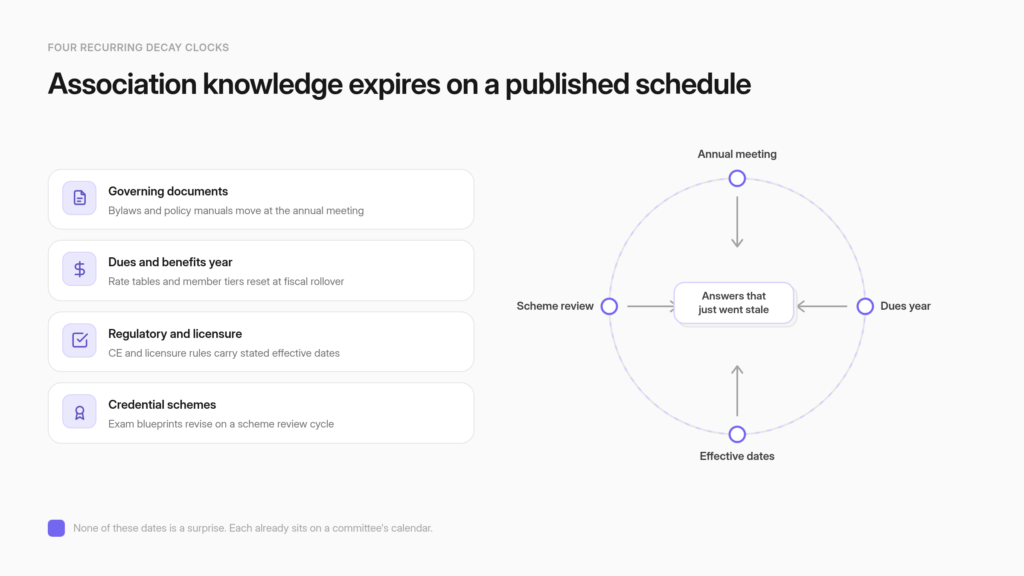
Bylaws change at the annual meeting. Dues and member benefits reset by fiscal year. Continuing-education and licensure requirements change by state on stated effective dates. Certification schemes are revised on a review cycle. Every one of those changes silently invalidates answers your assistant was giving correctly last month.
The medical societies have the cleanest public example. The Federation of State Medical Boards maintains a board-by-board continuing medical education overview, and the copy marked “Last Updated: April 2026” carries a Colorado entry reading “Effective January 1, 2026, licensees must complete 30 hours of CME per 24-month renewal period.”
An assistant holding an earlier edition of that same table would answer from the requirement that applied before that date, confidently, with a citation to a real document a member could open. The library was never corrupted. It simply aged past an effective date that was published in advance and known to everyone in the field.
The second half of that document is the part association staff should sit with. The federation’s own reference carries the line “For informational purposes only: This document is not intended as a comprehensive statement of the law on this topic, nor to be relied upon as authoritative,” and closes with “All information should be verified independently.”
The authoritative national source disclaims authority over its own summary. That is the content environment member AI operates in, and it is the reason answer accuracy for an association is a documentation discipline before it is a model question. The same logic applies to any association content operation publishing on a cycle.
Four recurring decay clocks worth calendaring
Most association libraries decay on four predictable clocks and not at random. Each clock carries a trigger date somebody already tracks and a different owner, which the table below lays out.
| Decay clock | Content it invalidates | Trigger date | Usually owned by |
|---|---|---|---|
| Governing documents | Bylaws, policy manuals, chapter agreements | At or shortly after the annual meeting | Governance committee / corporate secretary |
| Dues and benefits year | Rate tables, member tiers, join and renew windows, benefit language | Fiscal year rollover | Membership |
| Regulatory and licensure | CE requirements, licensure rules, state-by-state variations | Stated effective dates, often published months ahead | Government affairs / education |
| Credential schemes | Exam blueprints, eligibility rules, recertification windows, candidate handbooks | Scheme review cycle | Certification / credentialing board |
None of those dates is a surprise. Each already sits on somebody’s calendar, usually the committee that made the change, while the affected content sits in a knowledge base owned by somebody else. That split is the actual failure point.
The committee that amends the bylaws has no reason to think about a file in a knowledge base, and the person who owns the knowledge base is not in the room when the vote happens.
One way to shrink the gap is to tag the library by which clock owns each file. The platform lets you assign labels to knowledge base pages and group sources by those labels, and separately control which labeled pages an agent draws from at query time, so a governance pass after the annual meeting can go straight to the bylaws and policy files a single trigger date touches instead of re-reading the whole corpus.
Retrieval prefers the wording that matches the question, which is often the older document
A retriever ranks passages by similarity to the question, not by effective date. When an old version and a rewritten version both sit in the index, the old one frequently wins, because its vocabulary is closer to the way members still phrase the question.
A May 2026 engineering writeup defines the staleness gap as “the time between when a document changes in the source system and when that change is reflected in the vector index”, and describes what happens inside it: “every query that reaches the affected document is answered from outdated context – confidently, without qualification, with no downstream signal that anything is wrong.” The worked case in that writeup transfers directly to association content.
A user asked an internal portal about single sign-on configuration and got a confident, detailed answer describing an authentication flow that had been deprecated fourteen months earlier. Both the old and new documentation sat in the index. The retriever returned the obsolete version because its vocabulary matched the query more closely, and nothing flagged an error.
Research points the same direction. The VersionRAG paper, submitted in October 2025, opens by stating that “Retrieval-Augmented Generation (RAG) systems fail when documents evolve through versioning”, a characteristic the authors call ubiquitous in technical documentation.
On their version-sensitive benchmark, a version-aware approach reached 90% accuracy where naive RAG reached 58% and GraphRAG reached 64%. The spread widened sharply on implicit change detection, the case where a document was revised without the change being announced: the version-aware approach reached 60% while the baselines landed between zero and 10%.
Members ask questions in the language of the rule they already know, which is usually last year’s rule. That phrasing is closer to last year’s document. A retrieval system doing exactly what it was built to do will hand back the superseded passage, and a verification pass will confirm, correctly, that the claim traces to a document you uploaded.
Verify Responses shows the exact supporting text and where it came from, claim by claim
For each factual claim in an answer, the panel shows the exact text from the source that supports or contradicts it, plus the file name, page number, and URL. Each claim lands in one of two states: verified or unverified.

The extraction step is automatic. The Claim Verifier “automatically extracts every factual claim from a response and cross-references it against your source documents,” so a staff reviewer is not reading an answer and guessing which sentences carry risk. Each claim arrives separated from the prose around it, with its evidence attached.
The docs specify what lands next to each one: “The exact text from the source that supports (or contradicts) the claim,” together with the per claim source text and location, given as file name, page number, and url.
The file name and page number are the part that catches a superseded document
For an association, the location line matters more than the score. A membership director who can see that a dues answer traced to chapter-dues-schedule-FY25.pdf, page 4, can open that file and check its revision date in under a minute. That single move is what catches decay, and the score alone never surfaces it.
Two answers can both read 100% verified while one traces to the current benefits table and the other traces to a file nobody has replaced since the last rate change. The difference is visible only at the claim level, in the file name, which is why per-claim evidence is the part of verification that association staff should actually be trained to read.
The Verified Claims Score is verified claims divided by total claims, and unverified means untraced
The score is arithmetic: verified claims divided by total claims. If an answer makes ten statements and eight trace back to your documents, it scores 80%. An unverified claim is not a claim proven false. It is a claim the system could not trace to anything you uploaded.
The product states the formula without dressing it up. The scoring FAQ on the launch announcement puts it as “Simple math: verified claims divided by total claims. If your AI makes 10 statements and 8 trace back to your docs, it scores 80%.” It is equally direct about the other half. A claim flagged without source support “doesn’t necessarily mean the claim is wrong.”
The post says it means the claim “couldn’t be traced back to your uploaded documents.” Those two sentences carry more operational weight for an association than any threshold does, because they tell you what the number is measuring and what it declines to measure.
The association reading of an unverified claim is usually editorial. When a dues question produces unverified claims, the common cause is that the dues policy is not written down anywhere in the library, and the assistant assembled a reasonable-sounding answer from adjacent material. That is a content finding, and the fix belongs to whoever owns the member handbook.
The same pattern shows up on eligibility rules, chapter transfer procedures, and refund policies, which associations tend to answer from institutional memory and never document.
On target scores, the commonly cited numbers, above 90% for high-stakes answers covering legal, medical, or compliance topics and 80% or better for general support, come from the FAQ on the CustomGPT.ai launch post rather than from the product documentation, which carries no numeric threshold at all. Treat them as a working convention that a reasonable team adopted, not as a published standard, and set your own floor by category of question.
A Trust Score reads the same answer through six stakeholder lenses
Alongside claim tracing, a virtual committee of six stakeholders reviews each response for risk: End User, Security and IT, Risk Compliance, Legal Compliance, Public Relations, and Executive Leadership. An answer can be fully traceable and still carry a risk one of those readers would flag.
The product describes “a virtual committee of six stakeholders” that “analyzes every response for potential risks.” The six named are End User, Security / IT, Risk Compliance, Legal Compliance, Public Relations, and Executive Leadership. Association boards tend to recognize that list immediately, because it maps closely onto the committee structure that already reviews member communications before they go out.
A dues answer that is technically accurate can still read badly to a public-relations reviewer, and a membership-eligibility answer can be traceable and still create the impression of legal advice.
A stakeholder risk read prompts human judgment on answers that would otherwise pass unexamined because the score looked fine. It does not substitute for legal review, and no association should present it to a board as though it does.
Three documented causes explain a low score, and only one of them is the model
Low verification scores trace to three documented causes: persona configuration, retrieval problems, or gaps in the documentation itself. Two of those three are content and configuration work that a membership or education team already owns, and neither one needs an engineer or a vendor ticket to fix.

The triage is published. The three documented causes of a low score sort as follows, and sorting a week of low-scoring answers into these buckets produces a work list instead of a complaint about the AI.
|
Cause |
What it means |
Fix |
Who owns it |
|
Persona issues |
The agent behaves outside its intended scope |
Tighten the scope instruction |
Whoever configured the agent |
|
Retrieval problems |
The content exists but was not matched to the question |
Enable Highest Relevance, enable Complex Reasoning, or try a different model |
Whoever configured the agent |
|
Documentation gaps |
The knowledge base does not contain the information users need |
“Create new content to fill the gaps” |
Whoever owns the member handbook |
Only the middle row is a settings adjustment, and the guide’s first moves are to enable Highest Relevance, enable Complex Reasoning, or try a different model before anything more involved.
CustomGPT.ai’s own product team reached this conclusion by auditing its own corpus. The finding, published verbatim in what the product team found auditing its own corpus, was that “The AI wasn’t always the problem. Our documentation was.” “Every inaccurate response is a signal,” says Marko Mitrović, Product Manager at CustomGPT.ai. “It’s telling you something. Either your AI needs tuning, your system needs fixing, or your content has gaps. You just have to listen.” For an association, that reframes the score entirely. The verification pass is a heat map of the member library, showing which subject areas are thin, contradictory, or undocumented, on content members are already paying dues to reach.
Persona and retrieval problems are configuration
Persona and retrieval failures are settings work, and both usually resolve without touching content. A persona drifting outside scope is answering questions it was never meant to take, which is a scope instruction to tighten in the agent’s persona.
A retrieval miss means the answer existed and was not surfaced, which the documented fixes address by enabling Highest Relevance to sharpen how questions match content, enabling Complex Reasoning for multi-step questions, or testing a different model when one handles your content type better. If those settings do not resolve it, the guide points you to support to diagnose whether content formatting or metadata is affecting retrieval.
Documentation gaps are an editorial backlog
Gaps are the finding worth taking to a staff meeting. Each one names a question members are asking that your library does not answer, ranked by how often it comes up. That list is a content roadmap sourced from actual member demand instead of from a survey, and it arrives ranked by the only priority that matters, which is what members are already trying to find.
Builder mode covers testing, and audit mode re-checks conversations that already happened
Two modes. Builder mode verifies automatically on every chat during development and QA. Audit mode runs verification manually on any conversation, including old ones, with results in seconds. Enable it from the three dots menu under Actions, or run a single response from the shield icon.
The click path is short enough to hand to a non-technical staff member. On the dashboard, click the three dots menu, click Actions, then find Verify Responses and toggle it on, per the documentation on turning verification on.
For a one-off check, click the shield icon next to any AI response and click Run for this response when prompted, which verifies specific responses without enabling the feature globally. Audit mode is the one association staff use most after launch, because it runs on conversations that already happened, which is exactly what a board asks about after a member complaint.
Verification costs query credits and adds no member-facing latency
Two operating facts belong in the budget conversation. Verification “uses additional query credits when enabled,” so a permanent always-on setting on a high-traffic member assistant costs more than a scheduled audit pass. On the other side, members feel nothing: the standard chat response is generated at normal speed and end users do not experience any delay.
On plan availability, the live pricing page is the authority. Verify Responses is listed as included on every paid plan, Standard through Enterprise, with usage burning fewer credits on Premium and Enterprise. Earlier launch material described it as Premium and Enterprise only, and that is no longer accurate.
Members never see the panel, and the analytics you get back are aggregate
Verification is builder and administrator tooling. End users do not see the shield icon or the analysis panel. The member-facing trust layer is inline citations. Filtering conversations by score shows which topics are weak, which is visibility into answer quality in aggregate rather than an audit trail per member.
This is the misread most likely to cause an association trouble. The documentation says “Your end users will not see the shield icon or the analysis panel,” and the launch post calls the feature a behind-the-scenes tool designed exclusively for the builder and administrator. Nothing about a Verified Claims Score is shown to the member who asked the question. Presenting verification to a board as a member-facing trust badge would misdescribe what was purchased.
What members do see is the citation. Every response generated from your content returns the exact sources it used, and existing projects can activate inline citations members can click in project settings. Citations are a setting you switch on per agent rather than a feature you build, which is what puts the member-facing trust layer one toggle away.
Those two layers work together and answer different questions. Citations let a member check an answer themselves in the moment. Verification lets your staff catch a bad answer before another member asks the same question. Associations that get this right run both and describe them separately to their governance committee, alongside the member-facing side of an association deployment.
The analytics limit deserves the same directness. Filtering conversations by verification score tells you which subject areas are producing weak answers. It is not a per-member accuracy guarantee and not a per-member record, and it should never be described to a membership committee as one. Aggregate topic-level visibility is useful for content planning, and it is a different thing from being able to say what any individual member was told.
That same aggregate view is worth reading on its own terms, and what member questions reveal in aggregate is the subject of a companion piece.
A verification pass belongs on the association’s governance calendar
The documented loop is six steps: enable verification in testing, collect real conversations, review scores in the analytics dashboard, categorize failures by type, implement fixes and retest, then switch to on-demand for production. For an association, the trigger dates for that final on-demand mode are already on the calendar.
Run the loop once during launch, then attach it to the dates you already know:
- After the annual meeting closes, when bylaws and policy amendments take effect.
- At the start of the dues and benefits year, when rate tables and member tiers reset.
- When a regulatory effective date lands for your profession, since those dates are typically published months in advance.
- When a certification scheme revision publishes, before candidates start asking the assistant about the new blueprint.
Each pass produces the same deliverable: a list of claims that came back unverified or traced to a file whose revision date has passed, with the file name and page number attached to each. Hand that list to whoever owns the member library as a content backlog with the work order already written. The output is a prioritized editorial queue, sourced from questions members actually asked, which is what makes verification worth a recurring calendar slot in association deployments instead of a one-time launch task.
Staffing it: one owner, about an hour a month, plus four calendar triggers
The owner is whoever owns the member library, which at most associations is membership or education and not IT. Two of the three causes of a low score are content and configuration, so the person who can close them is the person who writes the handbook.
A standing monthly pass over the twenty questions members ask most runs in about an hour once the first one is done. The four trigger dates add four more passes a year, each scoped to the content that just changed rather than the whole library.
Two costs belong in that estimate honestly. Verification consumes query credits, and the credit cost of a given pass depends on volume and plan, which is a number to model against your own traffic before committing to always-on. The remediation work is the larger cost, and it lands on staff rather than on the platform.
When a pass surfaces a superseded file, replacing it means uploading the current version and removing the old one from the knowledge base, because a superseded document left in the index stays retrievable and keeps producing verified answers from the wrong edition. Curating what stays in the corpus, managing and deleting sources as they expire, is the first line of defense against a copilot that confidently repeats a document nobody meant to keep.
The proof gap worth naming
No published association case study reports a verification-governance metric. The public evidence covers the layer underneath: VdW Bayern DigiSol, the digital subsidiary of the Bavarian housing federation, built its member assistant on regulated housing content with the stated requirement of “minimizing hallucinations and ensuring every response was backed by verifiable sources,” which establishes that grounded and cited assistants run in production on exactly this content type.
What no customer has yet published is a before-and-after number on answer decay caught per pass. Treat the governance loop as an operating practice to instrument yourself, and measure it against your own baseline: how many superseded files a first pass surfaces, and how many unverified claims turn into handbook entries.
What verification does not do
Verification does not certify truth, does not audit individual members, does not replace subject-matter review, and does not eliminate hallucination. What it does is reduce the failure rate sharply and leave a claim-level trail a human can check, on the questions your members actually asked. That is the ceiling, and it is worth buying.
Consolidated, the limits are these. A verified claim is traced, not confirmed true. Scores are AI-generated and work best as a guide. Unverified means untraced rather than false. The panel is builder-side and invisible to members. The analytics are aggregate.
And the grounding layer underneath it all has a stated ceiling: asked whether AI can stop hallucinating completely, the honest answer on the record is no, you can reduce hallucinations sharply but you should not promise perfect accuracy in every edge case. That grounding layer still does real work under the score.
Agents answer from your uploaded content by default, and the anti-hallucination setting paired with the My Data Only source restriction is what holds answers to your sources and blunts prompt tampering. Those defaults lower the failure rate without driving it to zero, which is exactly why the claim-level trail exists.
None of that argues against running verification. It argues for running it as content governance with a human in the loop, which is where the return actually sits.
The practical starting move costs an afternoon and no engineering time. Take the twenty questions your members ask most, run a verification pass over the answers, and read the output twice: the unverified claims as a content list, and the traced file names as a revision-date audit.
CustomGPT.ai’s own team reported that its first such pass surfaced more documentation problems than model problems on its own corpus, and an association library carrying bylaws, dues tables, and CE requirements has more expiry surface than most software documentation does.
You do not need an enterprise contract to run that afternoon. Verify Responses is included on every paid plan, Standard included, with a 7-day free trial that takes a card at signup and charges it when the week ends. A two-person membership team runs the same claim-level verification a national society runs.
What no plan supplies is the calendar discipline behind it, and that part stays yours: the annual meeting, the dues year, the effective dates, the scheme review, and one person who owns the library when each of them lands. Run that first verification pass over your twenty most-asked member questions, use it as your baseline, and stand up member AI on your own library to do it.
Frequently asked questions about Verify AI Answers accuracy association
How do we run an accuracy check on our member AI without a developer?
Turn verification on from the dashboard and read what comes back. Click the three dots menu, click Actions, then find Verify Responses and toggle it on, per the documentation on enabling verification. For a single answer, click the shield icon next to that response and click Run for this response. No code and no engineering ticket. A membership or education director can run a pass over the twenty questions members ask most in an afternoon.
Can an answer be 100% verified and still be wrong?
Yes, and for associations that is the failure worth planning around. A verified claim is one traced back to a document you uploaded, and the Verify Responses launch announcement states directly that the feature confirms alignment with your sources rather than absolute truth. A 2019 chapter bylaws PDF still sitting in your knowledge base produces answers that read 100% verified and are still wrong for the member who acts on them. The documentation adds a second limit: verified claims scores are AI-generated and work best as a guide.
Our bylaws changed at the annual meeting. Will the assistant keep answering from the old version?
It can, and the score will not flag it. Retrieval ranks passages by similarity to the question rather than by effective date, so when the amended and superseded versions both sit in the index, the older one often wins because its wording matches how members still ask. One engineering writeup calls the window between a document changing and the index reflecting it the staleness gap, where queries get answered from outdated context confidently, with no signal that anything is wrong. Retiring the superseded file when the amendment passes costs nothing but calendar discipline, and it pairs with the recency checks recommended for policy content, where the suggested window runs to 90 days for policy or pricing material.
What does it mean when a claim comes back unverified?
It means the system could not trace that claim to anything you uploaded, which is different from the claim being false. The launch announcement is explicit that an unverified claim does not necessarily mean the claim is wrong. For an association the usual cause is editorial. A dues or eligibility question comes back unverified because the policy lives in institutional memory and was never written down anywhere in the library. The documented triage sorts low scores into persona issues, retrieval problems, and documentation gaps.
What Verified Claims Score should an association aim for?
Set your own floor by category of question. The commonly quoted guidance of above 90% for high-stakes answers covering legal, medical, or compliance topics and 80% or better for general support comes from the FAQ on the CustomGPT.ai launch announcement, not from the product documentation, which carries no numeric threshold at all. Treat it as a working convention a reasonable team adopted. A continuing-education or credentialing answer deserves a higher floor than a question about parking at the annual meeting.
Can we show members a "verified" badge on each answer?
No, and the frame is worth correcting before it reaches a board. The shield icon and the analysis panel are builder and administrator tooling, and the documentation states that end users will not see them. What members see is the citation. Every response returns the exact sources behind it, and inline citations members can open carry the member-facing trust. That matches what members want anyway: a March 2026 Quinnipiac national poll found that 76% think they can trust AI either hardly ever or only some of the time, so a source they can read beats a number they have to take on faith.
Can we run verification on a conversation that already happened, after a member complains?
Yes. Audit mode runs verification manually on any conversation, including old ones, and results appear in seconds. That is the mode association staff use most after launch, because a complaint always arrives after the answer was given. Verified response scores also surface as a filter in the analytics dashboard, and the wider conversation analytics show whether the agent found relevant material at all, so one complaint turns into a topic-level check rather than a single apology.
Does verification slow answers down for members, and does it cost extra?
Members feel nothing. The standard chat response is generated at normal speed and the verification analysis runs as a separate process, so end users do not experience a delay. The cost lands in credits rather than in speed, since verification uses additional query credits when enabled. Leaving it on permanently for a high-traffic member assistant costs more than scheduled audit passes, which is why the documented workflow ends by switching to on-demand for production.
Is verification an enterprise-only feature, or can a small association use it?
It is on every paid plan. The live pricing page lists Verify Responses as included on Standard, Premium, and Enterprise, with usage burning fewer credits on Premium and Enterprise. Earlier launch material described it as Premium and Enterprise only, and that is out of date. A two-person membership team on the entry plan runs the same claim-level verification a national society runs.
Who on a small association staff should own answer QA, and how much time does it take?
Whoever owns the member library, which is usually membership or education rather than IT. Two of the three documented causes of a low score are content and configuration work, so the person who can fix them is the person who writes the handbook. Budget an hour a month for a scheduled pass, plus a re-check after each event that changes content: the annual meeting, the dues year rollover, a regulatory effective date, a certification scheme revision. Keeping a human in the loop is the operating model, and no score removes the reviewer.
How do we show our board or credentialing committee that answers trace to our own materials?
Show the claim-level evidence rather than the headline number. For each factual claim the panel displays the exact supporting or contradicting text with the file name, page number, and url, which is an audit trail a credentialing committee or a legal reviewer can open and check. That per-claim record is also what verification produces against a documented compliance obligation. Associations already run cited assistants on high-stakes member content at scale: GEMA, the German collecting society, reports 100,000+ members, 248,000+ inquiries answered via its chatbots, and an 88% query success rate.
Can verification tell us what an individual member was told?
No, and no association should describe it to a membership committee that way. Filtering conversations by verification score gives topic-level visibility into which subject areas produce weak answers. That is aggregate content intelligence rather than a per-member accuracy record, and it does not let you state what any single member was told or guarantee the accuracy of any one member’s answers. Treat the output as an editorial queue for the library, and keep member-level questions with your AMS and your staff.
Related Resources:
- Why Associations Want an AI That Says “I Don’t Know”: See the refusal behavior that pairs with verification to keep an assistant from ever needing an audit in the first place.
- An AI Study Assistant for Your Certification Program: See this same claim-by-claim audit applied to exam prep content instead of general association answers.
- AI for State Bar Associations: See verification matter most where a wrong answer means misstating a CLE requirement or a practice standard.
- AI for Healthcare Credentialing Bodies: See why a credentialing body treats claim-by-claim verification as non-negotiable before candidates rely on an answer.
- AI for Credit Union Research Libraries: See how verification confirms an answer traces back to the credit union’s own published research.
- Enterprise Security and SSO for Association Member AI: See the access-control half of the trust story that verification’s accuracy half pairs with.
- How to Make Your Association’s Content Searchable with AI: See the findability problem verification’s citations depend on in the first place.