Enterprise Security and SSO for Association Member AI
A member assistant runs behind the single sign-on you already have, but the plan you buy decides whether that access is included
Yes, members can reach an AI assistant through the identity provider your association already runs, without anyone creating a new account. And yes, the platform holds SOC 2 Type 2 and GDPR compliance. Those two answers sit at opposite ends of the same price list, which is the part a security review usually misses.
On the published CustomGPT.ai plan comparison, GDPR compliance, SOC 2 Type 2, 256-bit AES encryption at rest with SSL in transit, and Verify Responses are all marked Included on the Standard plan at $89 per month billed annually. Gating chat access to agents through your existing identity provider is listed as an Enterprise capability.
The certification a board asks about is the cheap line. The access control is the expensive one.
The ordering matters because of what breach data says. In IBM’s 2025 Cost of a Data Breach Report, 13% of organizations reported breaches of AI models or applications, and of those compromised, 97% reported lacking proper AI access controls. Associations under real regulatory load already run member AI on this platform: GEMA, one of the world’s largest music-rights collecting societies, has resolved over 248,000 queries through its assistants.
The legal floor moved underneath associations at the same time. Nonprofit status no longer implies a privacy-law exemption in every state, and Oregon removed its cure period on January 1, 2026.
What follows is the review a membership or IT director can run against member AI built for associations, including six places this platform does not clear a strict enterprise bar and the ten questions that settle a member-AI review before anyone signs a contract.
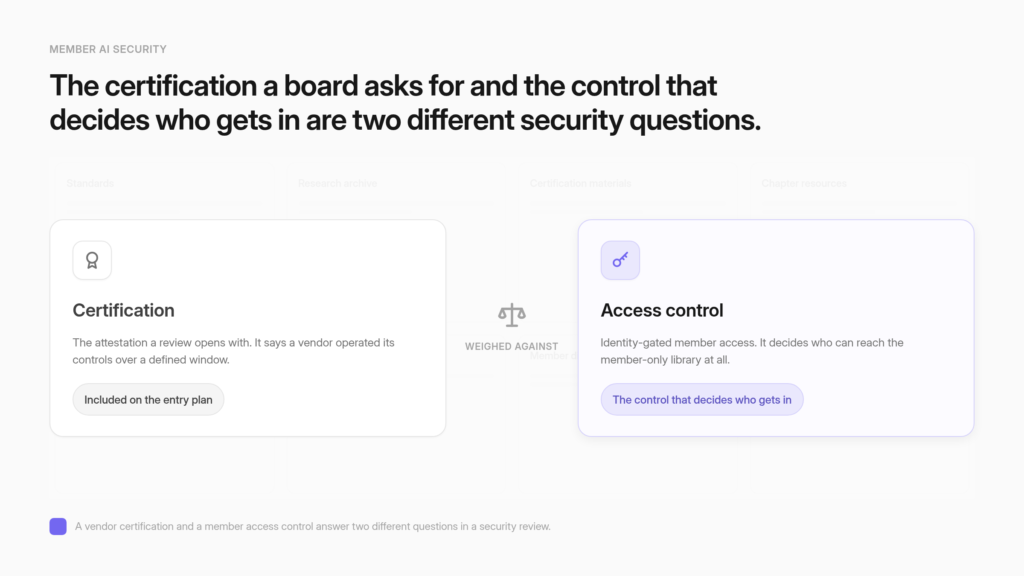
The control a board asks about and the control that stops the breach are different controls
Vendor security reviews open with the certification question. Breach data points somewhere else. The 97% figure from the intro means something narrower than it looks for an association: certification attests that a vendor operated defined controls over a defined period, while access control decides who can reach your member library. Both matter, and a review that leads with the badge often skips the one the breach data points at.
That 2025 edition was conducted by Ponemon Institute and is based on data breaches experienced by 600 organizations globally from March 2024 through February 2025. It was the first edition to study AI security, governance, and access controls directly.
The adjacent governance finding is worth reading beside the access-control number: 63% of breached organizations either had no AI governance policy or were still developing one. IBM has since published a 2026 edition whose corresponding AI figures sit behind a download form, so treat these as the 2025 edition’s numbers and pull the current report before quoting them in a board paper.
Translate that to an association and the shape gets clearer. A member assistant sits on top of exactly the corpus you charge dues for. Standards, research archives, certification materials, chapter resources.
The question of who can reach that corpus is the question, and it is answered by an access decision rather than by an attestation. SOC 2 Type 2 attests that a vendor operated defined controls over a defined period. It does not decide who your members are or which agents they can open. Both matter, and what auditors actually look for in a chatbot is a separate exercise from designing member access.
Four controls a board will name are already on the entry plan
On the published plan comparison, GDPR compliance, SOC 2 Type 2, 256-bit AES encryption at rest with SSL in transit, and Verify Responses are all marked Included on the $89 per month Standard plan. An association can verify each line on a public page rather than waiting for a sales call to confirm it.
That list covers most of what a volunteer board names in a first pass. The published plan comparison marks each line Included or not, which is a small thing that saves a procurement cycle. Verify Responses appears on every tier, described as a control where builders and admins can check answers for accuracy and compliance, with usage burning fewer credits on Premium and Enterprise.
Two strings from the security page add what a price row cannot carry. The platform runs “fully-self contained bots with no data sharing between bots, even within the same account,” which is the isolation question an IT director asks in different words. And encryption is specified as “industry-standard 256-bit AES encryption at rest” alongside SSL in transit. If your review is checking tenancy, self-contained agents with no cross-bot data sharing is the phrasing to hold the vendor to.
The training question gets its own sentence because associations ask it first. The membership organizations page states there are zero data-sharing agreements with OpenAI or any model provider, and that your content is never used for training. Answers stay checkable through builders and admins who can review them for accuracy and compliance as they test and audit the assistant.
Identity-gated member access is the Enterprise line, and it is the control the breach data points at
Gating chat access to agents through your existing identity provider is listed as an Enterprise capability, not included on Standard or Premium. It is the control that decides whether member-only content stays member-only, which places the most consequential access decision above the entry tier.

The pricing page states it in one line: “IdP as access – Gate chat access to agents using your existing IdP (login system).” Enterprise only. The neighboring gates are worth reading in the same breath, because they cluster. Anonymize PII, a Premium control that strips personally identifiable information from uploaded image files as they are ingested, starts at Premium. Account-level roles start at Premium. Agent-level roles and the Data Processing Agreement are Enterprise only.
So the decision rule is short. If member-only content has to be gated by identity, or if legal requires a signed DPA, the entry plan will not clear procurement, and you should price the Enterprise conversation from the start. Where the price list draws the Enterprise line is published, so an association can establish this in an afternoon instead of discovering it in week six of a review.
One number is not on that page. Standard and Premium carry published prices, and Enterprise is listed as custom, which means the tier your access requirement just routed you to is the one whose cost you cannot look up. Budget for a quote rather than a price, and ask for it in the first call. It is the input most likely to reset a business case that was built on the $89 line. An assistant serving only public content is a different purchase from one serving the members-only library, and gating member access through the identity provider you already run is what separates them.
Members are not employees, so member access runs on a different mechanism than staff sign-on
Regular single sign-on signs your internal team into the AI workspace with company credentials. End-user IdP access signs members into specific agents without turning them into workspace users or requiring separate accounts, which is the documented way to give your whole membership access to agents without creating or managing individual accounts. Members authenticate through Google Workspace, Microsoft Entra ID, Okta, PingOne, or any SAML 2.0 provider.

That distinction is the whole mechanism, and it is where a generic AI security checklist stops being useful to an association. A staff tool provisions users. A membership cannot, because the population changes every renewal cycle and nobody is going to create and retire thousands of workspace accounts by hand.
The operating facts follow from the design. There are no accounts to create, no passwords to manage, and no admin overhead as people join or leave. Sessions last 24 hours, and no user is ever stored in the platform. The account model is documented plainly: there is no limit on how many external users can access agents this way.
Members never consume a staff seat, so headcount alone does not raise the bill the way per-seat licensing does. Read the rest of that budget line carefully, because the pricing page also states that pricing scales with credit usage across your account and that customers are responsible for managing credit limits and overages. Membership size stops driving the license cost, and usage volume takes its place. Members authenticate the way they already do and land on the agents their group allows.
Staff logins are capped per plan even though seats carry no per-user fee
The pricing page says “adding team members has no per-seat fee; pricing scales with credit usage across your account.” Read that beside the plan rows and the accurate picture appears: Standard includes one team member, Premium includes three, Enterprise is custom. Seats are not billed incrementally, and the number of them is still capped. On the consumption side, an admin can put a ceiling on that credit usage directly, setting query-credit limits per role, per individual user, or per guest, so a single heavy user does not draw the whole account down.
For a five-person membership team, that points at Enterprise rather than Premium, since Premium includes three team members, and the reason is staff logins rather than security. Member access through the identity provider is separately uncapped and seat-free, so the two numbers move independently.
Worth checking before you size a plan, because the staff count is the one that surprises people. Signing your own staff in through corporate credentials is configured separately from member access and answers a different question. Team single sign-on is set up with SAML 2.0 across providers like Google Workspace, Okta, and PingOne, the same standard the member path uses, pointed at your internal team rather than your roster.
An identity-provider attribute routes each member to the agents their role allows
Setup runs through IT rather than through the membership team. The agent is set to private so only approved, logged-in users can open it at all, and from there your IT staff connects the IdP, maps user groups to agents, and picks a deployment method, either a single portal link that routes everyone to the right place or an embedded agent on your website or intranet.
When you embed it, a signed JWT can carry a member’s existing website login straight into the widget so the chat opens already authenticated rather than asking for a second sign-in. A chapter officer, a certified member, and a lapsed contact can land on different agents from the same link.
One operator detail belongs here because it is what breaks in production and the announcement post does not mention it. The role name configured in CustomGPT.ai must exactly match the attribute value coming from your identity provider, and the match is case-sensitive. Sales-Team and sales-team are treated as different roles. Universities hit the same pattern when they route students by entitlement, and the entitlement approach used for university sign-on maps cleanly onto membership tiers. How IdP-gated agent access is set up covers the configuration path.
Revocation happens in the identity provider, which is where lapsed members are already handled
Removing someone from the IdP group removes assistant access. There is no second deprovisioning step, no separate user list to reconcile, and no orphaned login sitting in a vendor system after a membership lapses.
That is the practical argument for putting member access on the identity provider rather than in a parallel account system. Your association already has a process for what happens when dues go unpaid, and access to the assistant rides on it rather than needing its own. It also answers the question a board will ask directly: how do we cut off a lapsed member. You already do, in the system you already run. How associations deploy a member assistant follows the same joins-and-leaves process the rest of your member benefits use.
Seat-priced general assistants are the wrong shape for a membership
The alternatives deserve a fair reading. Higher Logic is the incumbent association community platform, with its own AI layer and published SAML and OIDC support. How their permission model compares with private agents and SSO is worth reading before you commit. iMIS and MemberClicks expose the single sign-on your members already use. Fonteva rides Salesforce identity. ChatGPT Enterprise and Microsoft Copilot are the general-purpose options associations genuinely weigh, and both are strong products for staff work.
For the association-specific field, see which platforms document SOC 2 Type 2.
The narrow point that decides this comparison is pricing shape rather than capability. Per-seat licensing prices a staff tool. A membership is not a staff. When 12,000 members each need occasional access to a standards library, a per-seat model prices the deployment out before the security review starts, and an unpriced pilot for 40 staff tells you nothing about the number at 12,000. Check the licensing model against your member count first, then run the security review on whatever survives.
Nonprofit status no longer implies a privacy-law exemption
Several state privacy laws now reach nonprofits directly. Oregon’s Consumer Privacy Act took effect for nonprofits on July 1, 2025, and the state’s Department of Justice states that the requirements for businesses and nonprofits are the same. An association holding member records is a controller under that law.
Oregon’s DOJ puts it plainly in its own FAQs: “The law takes effect for nonprofits on July 1, 2025,” and “The requirements for businesses and nonprofits are the same under the OCPA.” The thresholds still gate applicability, so read them before assuming either way. The law reaches entities controlling or processing the personal data of at least 100,000 consumers, or 25,000 or more consumers where the entity derives over 25% of annual gross revenue from the sale of personal data.
The 2026 change is the part most associations have not registered. Per the same source, “As of January 1, 2026, the Attorney General is no longer required to give controllers notice and opportunity to cure regardless of the nature of the OCPA violation,” and may proceed directly to an enforcement action such as serving a Civil Investigative Demand or filing a lawsuit. That is Oregon. Colorado, Delaware, and New Jersey also lack a broad 501(c)(3) exemption, and the details differ in each. None of this is legal advice, the Oregon DOJ attaches the same disclaimer to its own FAQs, and your counsel should confirm what applies to you. On the vendor side, how data-protection obligations map onto an assistant is a starting point rather than an answer.
Chapter and affiliate records can aggregate a small association into scope
A national association with chapters may be assessed on combined numbers. Oregon’s Department of Justice states that the number of consumers whose personal data related entities control or process may be added together when determining whether the threshold is met. A small affiliate is not automatically out of scope.

The regulator’s own language is more useful than any vendor’s summary of it. Oregon DOJ tells nonprofits that “if your nonprofit is a national organization with a central office, think about whether your branch/smaller entity transfers or receives personal data about consumers from that central office,” and that “the number of consumers whose personal data various related entities control, or process may be added together for purposes of determining whether your nonprofit meets the OCPA’s threshold.”
That describes the association structure almost exactly. A national body, state chapters, special-interest sections, a certification arm, an affiliated foundation, all moving member records between them. A 4,000-member state chapter reading the 100,000 threshold and concluding it is out of scope may be reading only its own row.
One obligation lands directly on an AI deployment. Controllers must conduct assessments “before processing personal data in a manner that presents a heightened risk of harm to consumers,” which the law calls Data Protection Assessments. Standing up an assistant over a member database is new processing, and it is worth asking early whether it triggers one. A vendor’s SOC 2 report does not discharge that obligation, because the assessment duty sits with the controller, which is your association.
Six boundaries a strict procurement review will hit, stated plainly
Every platform has a line it does not cross, and surfacing those lines in week one saves a quarter. Six apply here: cloud-only deployment, United States data residency, an Enterprise-gated and non-customizable DPA, no ISO/IEC 42001 certification today, no published breach-notification window, and a retention setting that trades against citations.
None of these are secret. All six are stated on the boundaries the security page sets out, which is where a reviewer should start regardless of vendor.
Deployment is cloud-only
The security page states it directly: “CustomGPT.ai is a cloud-only service. Private cloud and on-premises deployment are not available.” If your board or a member-data policy requires on-premises hosting, that requirement is decisive and belongs on the table in the first conversation rather than the fifth.
Data is held in a private VPC in AWS US East
The stated architecture is that the platform, while built on top of the OpenAI ChatGPT API, “operates within its private VPC instance in Amazon AWS US East.” One question the published pages do not settle is whether member queries reach OpenAI at inference time and whether OpenAI is named as a subprocessor in the DPA, so put both to the vendor in writing before your legal review closes. GDPR compliance and EU data residency are two different things, and the platform holds the first without offering the second. An association with European members and a hard EU hosting requirement has a real constraint, and it is the objection most likely to end a review late if nobody raises it early.
A Data Processing Agreement requires an Enterprise contract and is not customized
The security page states that “this agreement is only available for Enterprise customers,” that non-Enterprise customers are unable to enter into one, and that CustomGPT.ai “cannot customize DPAs for individual cases.” If your legal team requires a signed DPA with negotiated terms, the second half of that sentence matters as much as the first. Price Enterprise, and expect a standard-form agreement.
ISO/IEC 42001 is not certified today
The security page says the platform “is fully prepared and on track for formal ISO/IEC 42001 certification in the near term.” On track for is not certified, and a reviewer should read it that way. If an AI management-system certification is a hard requirement in your procurement policy, ask for a target date in writing.
Incident notification timing is a contract term rather than a published service level
The published path is an email to the operations team and a commitment to investigate the matter. There is no published notification window. The useful move is to put the notification clock in the contract, which is sound practice with every vendor and not only this one. A number nobody wrote down is a number nobody owes you.
Immediate file deletion and working citations are a tradeoff you configure
Source files are not stored unless you choose to see them in responses, and originals can be deleted after processing. The security page is precise about what that costs: documents kept “to benefit from features like citations and links” stay on the platform until you choose to remove them.
An association that wants members to click through to the source standard is choosing retention, deliberately. That choice belongs in your retention policy rather than in a settings screen nobody revisits, and it is worth deciding before launch because answers arrive with the source attached is usually the feature members value most. For gated material, referencing members-only content without exposing it publicly is the pattern to configure.
A compliance badge is not a report, and the report has an observation window
SOC 2 Type 2 attests to controls over a defined observation period, so the useful request is the report rather than the badge. Ask for the current report, read the observation window, check the scope, and look for qualified opinions or carved-out subservice organizations that matter to you.
The request path is straightforward. The CustomGPT.ai Trust Center at trust.customgpt.ai lists SOC 2 and GDPR as compliant and holds the SOC 2 report and GDPR report behind a request-access step. Gating those documents is standard practice among vendors, since attestation reports typically go out under NDA rather than to anonymous crawlers, so treat the request step as normal rather than as friction.
Four things a reviewer reads once the report arrives. The observation period, because an attestation covers a window and windows expire.
The scope, because a report can cover some systems and not others. The auditor’s opinion, because qualified opinions exist. And the subservice organizations carved out of the audit, because your data passes through them regardless of who audited whom. Apply that same standard to every vendor on the shortlist, incumbents included. SOC 2 Type 2 and single sign-on tend to arrive in the same procurement conversation, and only one of them is a document you can read.
Single sign-on controls who can ask, not who asked
Federated access decides entry to the assistant. It does not create per-member tracking. End-user sessions are anonymous, no conversation history carries between sessions, and no user identity record is stored, so an association measures aggregate engagement rather than individual member behavior. That covers identity, not content: conversation transcripts can still be retained under a separate setting, unattached to a named member, which is the distinction a GDPR reviewer will want stated plainly.
The documentation is unambiguous about it. External user “sessions last 24 hours and are completely anonymous,” and “no user data is stored, and no conversation history carries over between sessions.” External users are not created as accounts and can only chat.
The security page adds that “data and logs are untraceable back to an individual user.” That anonymity is a privacy control working as intended, and it is also a real limit on what your reporting can say. A director who promises the board a per-member engagement report will not be able to produce one from this system.
Note too that the analytics retention window is plan-gated at 7 days, 1 year, or all-time, which matters for anyone reporting question trends quarterly. Stored conversations carry their own retention control, configurable to a set number of days, twelve months, or never on Premium and Custom plans, which is the setting a GDPR-minded reviewer will want written into your data policy.
The accuracy limit belongs in the same paragraph. Grounding an assistant in your approved corpus reduces hallucination without eliminating it, and citations are what make a wrong answer catchable by a member or a staff reviewer. Grounded answers reduce hallucination without eliminating it, which is why someone still owns the review loop after launch. A control review is a statement about access and process, not a guarantee of correctness, and an assistant that augments the staff you have still needs a person accountable for the corpus.
The review an association can run before signing anything
A member-AI security review comes down to a short, checkable list. Confirm the access model, the plan the required controls sit on, the residency and deployment constraints, the contract artifacts, and the analytics limits. Every item is answerable from a published page or from a report you request.
- Confirm members authenticate through your existing identity provider without being provisioned accounts.
- Confirm which plan the identity-gating control sits on, and get a written quote for it rather than budgeting from the entry price, since Enterprise is quoted rather than published.
- Confirm whether staff login caps constrain your team as it grows.
- Request the current SOC 2 Type 2 report and read its observation window and scope.
- Confirm the data residency region and whether it satisfies your hosting requirement.
- Confirm whether on-premises or private-cloud deployment is available if your board requires it.
- Confirm whether a signed DPA is available on the plan you intend to buy.
- Put the breach-notification window in the contract rather than assuming a published one.
- Decide the retention setting deliberately, since immediate file deletion trades against citations.
- Confirm what the analytics can and cannot show about individual members before promising a board report.
The checklist procurement will hand your vendor covers the general form of this exercise. The ten items above are the association-specific additions.
Associations under real regulatory load have already deployed this
GEMA, one of the world’s largest music rights collecting societies, resolved over 248,000 queries through its assistants, spanning customer support, internal knowledge access, and service workflow efficiency. A collecting society made its knowledge answerable at scale across the members, customers, and employees it serves.
VdW Bayern DigiSol, a federation in the Bavarian housing sector, built its assistant on more than 3,600 internal documents and answered over 7,000 queries in under six months. A federation working under regulatory complexity reported document creation tasks that previously took 45 minutes or more finishing in 15 to 20.
Where to start depends on what your review turns up
Start a 7-day free trial and test the entry plan against your own member library. The controls a board asks about first (SOC 2 Type 2, GDPR, 256-bit AES encryption, Verify Responses) are all on it. A credit card is required to start.
If your review turns up an identity requirement, a DPA requirement, or an EU residency requirement, the trial will not answer your question and the Enterprise conversation will. Route there directly rather than piloting on a plan you already know cannot ship, and ask for the quote in that first call, since Enterprise pricing is quoted rather than published and no public page will hand you that figure. Either way, start with a member-facing assistant on your own library and let the access model decide the tier.
Frequently asked questions about association member AI SSO SOC 2 security
Can our members sign in with the SSO we already use instead of creating new accounts?
Yes. End-user identity provider access signs members into specific agents through Google Workspace, Microsoft Entra ID, Okta, PingOne, or any SAML 2.0 provider, without turning them into workspace users. There are no accounts to create and no passwords to manage, sessions last 24 hours, and no user is stored in the platform. There is also no cap on how many external users reach agents this way, so members authenticate the way they already do without consuming a staff seat. Read the budget line carefully though. Headcount alone does not raise the bill the way per-seat licensing does, but pricing scales with credit usage across your account, so a larger and more active membership still consumes more credits.
Is member sign-in available on every plan, or does it need an Enterprise contract?
Enterprise. The published plan comparison lists “IdP as access” as an Enterprise capability and marks it unavailable on Standard and Premium. That single line usually decides an association’s tier, because the moment members-only research, standards, or certification material enters the corpus, identity gating stops being optional. An assistant serving only public content is a different purchase. Where the plan comparison draws the Enterprise line is published, so you can settle this before a sales call rather than in week six of a review. What the page does not publish is the Enterprise price itself, which is listed as custom, so budget for a quote and ask for it in the first conversation.
Is SOC 2 Type 2 only on the expensive plan?
No, and this is where associations usually guess wrong in both directions. GDPR compliance, SOC 2 Type 2, SSL with 256-bit AES encryption, and Verify Responses are all marked Included on the $89 per month entry tier billed annually. The controls that cost more are the access controls: PII anonymization and account-level roles begin at Premium, while agent-level roles, a Data Processing Agreement, and identity gating are Enterprise only. The certification a board names first is the cheap line. The posture a security review actually vets sits further up the list.
How do we get the SOC 2 Type 2 report, and what should we read in it?
Request it through the Trust Center at trust.customgpt.ai, which lists SOC 2 and GDPR as compliant and holds both reports behind a request-access step. Gating those documents is normal practice, since reports go out under NDA. Once it arrives, read four things: the observation period, because an attestation covers a window that expires; the scope, because a report can cover some systems and not others; the auditor’s opinion, because qualified opinions exist; and any subservice organizations carved out. One honesty note for the board memo. ISO/IEC 42001 is described as on track for certification rather than certified, so do not carry it in as complete. The attestation itself covers the organization, not the correctness of any single answer.
Where is our member data stored, and can we require EU hosting?
United States. The stated architecture is a private VPC instance in Amazon AWS US East. GDPR compliance and EU data residency are two different things, and the platform holds the first without offering the second today. For an association with European members and a hard in-region hosting requirement written into policy, that is a real constraint and it belongs in the first conversation rather than the fifth. The published security posture states the region directly, so a reviewer can confirm it without asking.
Can we run the assistant in our own private cloud or on premises?
No. The service is cloud-only, and private cloud and on-premises deployment are not available. If your board, your member-data policy, or a government or defense segment of your membership requires on-premises hosting, that requirement is decisive and no configuration works around it. Worth raising in week one, because it is the constraint most likely to end a procurement review late and waste a quarter on both sides.
Can our counsel get a signed Data Processing Agreement without an Enterprise contract?
No. A Data Processing Agreement requires an Enterprise plan, non-Enterprise customers cannot enter into one, and the terms are not customized for individual cases. Both halves of that matter to an association’s legal review. If your counsel requires a signed DPA before member records touch a vendor, price Enterprise from the start, and expect a standard-form agreement rather than a negotiation. Find out where legal stands on this before you build the business case, since it is the line item most likely to reset your budget.
Do we have to comply with state privacy laws even though we are a nonprofit?
Possibly, and the assumption that 501(c)(3) status exempts you no longer holds everywhere. Oregon’s Consumer Privacy Act took effect for nonprofits on July 1, 2025, and the state’s Department of Justice states that the requirements for businesses and nonprofits are the same. Thresholds still gate applicability: the law reaches entities controlling or processing the personal data of at least 100,000 consumers, or 25,000 where over 25% of annual gross revenue comes from selling personal data. As of January 1, 2026, Oregon’s Attorney General is no longer required to give notice and an opportunity to cure before enforcing. Colorado, Delaware, and New Jersey also lack a broad nonprofit exemption. None of this is legal advice, and your counsel should confirm what applies to you.
Do our chapters and affiliates count toward the privacy-law thresholds?
They can. Oregon’s Department of Justice tells nonprofits that the number of consumers whose personal data related entities control or process may be added together when determining whether the threshold is met, and asks national organizations to consider whether a branch transfers or receives personal data from the central office. That describes the standard association structure: a national body, state chapters, sections, a certification arm, an affiliated foundation, all moving member records between them. A 4,000-member chapter reading the 100,000 threshold and concluding it is out of scope may be reading only its own row.
Does single sign-on let us see what each individual member asked?
No, and that limit is worth understanding before anyone promises a board report. Federated access decides who can open the assistant. It does not create per-member tracking. External sessions are anonymous, no conversation history carries between sessions, no user data is stored, and logs are untraceable back to an individual user. You get aggregate engagement and question trends rather than named member behavior. The analytics retention window is also plan-gated at 7 days, 1 year, or all-time, which matters if you report trends quarterly. How identity-gated agent access is configured covers what the session does and does not retain.
How do we cut off a lapsed member's access?
Remove them from the group in your identity provider. Access to the assistant ends with it, because there is no parallel user list to reconcile and no orphaned login sitting in a vendor system after dues go unpaid. Your association already runs a process for what happens at lapse, and member access rides on that process rather than needing its own. This is the practical argument for putting member access on the identity provider instead of a separate account system, and it is usually the answer a board finds most reassuring.
Is our member content used to train the AI models?
No. There are zero data-sharing agreements with OpenAI or any model provider, and your content is never used for training. Agents are described as fully self-contained, with no data sharing between bots even inside the same account, which is the tenancy answer an IT director is asking for in different words. For an association whose library represents decades of member-funded research, standards work, or curriculum, that sentence often decides whether the project proceeds at all, and keeping each agent’s data in its own silo is the architecture behind it.
Can we delete uploaded files immediately and still show members citations?
Not both at once, and the tradeoff is yours to configure rather than a default you receive. Source files are not stored unless you choose to see them in responses, and documents kept so members can click through to the underlying standard or research stay on the platform until you remove them. Decide that deliberately and write it into your retention policy before launch, because answers that arrive with the source attached are usually what members value most. Citations are also what make a wrong answer catchable, since grounding an assistant in your approved corpus reduces hallucination without eliminating it.
Related Resources:
- How to Connect Member AI to Your AMS: See how AMS integration and identity work together to gate access at the system your association already runs.
- Member vs Staff AI Permissions: See how role-based routing decides what a signed-in member or staffer sees once identity is confirmed.
- Verify AI Answers for Associations: See the accuracy half of the trust story that this article’s security posture pairs with.
- Enterprise-Grade Member AI Without an Enterprise Team: See how a small staff meets these same security requirements without hiring a security team.
- AI for Credit Union Research Libraries: See these same security and access-control questions raised by a credit union’s compliance team.
- Add an AI Copilot to Your Member Portal: See identity-gating applied to a member portal deployment specifically.
- An AI Study Assistant for Your Certification Program: See how access scoping keeps a study assistant limited to enrolled candidates only.
- AI for State Bar Associations: See these same identity and security questions answered for a real bar association deployment.
- AI for Healthcare Credentialing Bodies: See a different regulated body work through the same security and access-control requirements.
- An Internal AI Knowledge Assistant for Association Staff: See the staff-side access model that runs alongside the member-facing security posture this article covers.
- Turn Gated Content into a Lead Engine: See how a public-facing agent stays isolated from the member-only one this article secures.
- CustomGPT.ai vs Onyx Point AI: See what each vendor’s privacy policy says about training AI models on your content.