
AI for Credit Union Research Libraries: Making Gated Research Answerable
A grounded assistant over your research archive answers member questions in plain language and cites the report behind every answer
AI for credit union research library means pointing a grounded retrieval layer at the research you already publish, the report archive, the briefs, the regulatory explainers, and the recorded sessions, then keeping the assistant closed to that corpus.
A member credit union asks a question in its own words and gets a plain-language answer with a clickable citation to the specific report and section it came from.
The member walks away with something it can put in front of an examiner. Deployment needs no engineering team and typically runs in about two weeks, the timeline a member-facing membership deployment typically follows.
Three things separate a research library from a generic document library, and they change the build. The question members bring is applicability rather than lookup, so the assistant has to scope across reports instead of fetching one.
The assistant speaks with your research authority, so declining to answer is correct behavior rather than a failure metric. And your archive keeps superseded editions on purpose, which makes edition discipline your job rather than the vendor’s.
The limits belong in the same breath. Grounding reduces hallucination sharply and does not eliminate it. Usage analytics are aggregate rather than per-member. Gating access to member-only research by identity is an Enterprise-tier capability today.
A research institute serves institutions under examination, and that changes what its assistant is for
The member of a credit union research institute is an institution, not a person. The people who actually read the research are compliance officers, CFOs, and board members whose use of the material is examinable.
The library’s value sits in whether a specific institution can work out what applies to it, not in how much the library contains.
The question members bring is applicability, and applicability is a scoping problem
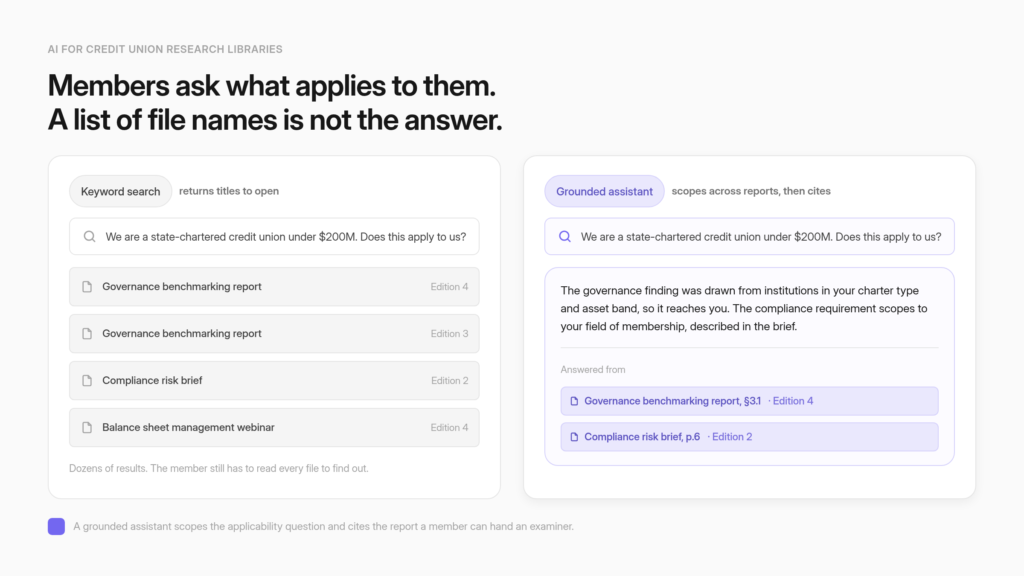
A member rarely searches for a report title. They describe their own institution, its asset size, its charter type, its field of membership, its product mix, and then ask what follows from that description.
A $180M state-chartered credit union asking whether a governance finding reaches it is posing a question whose qualifying facts live in the question itself, while the answer sits distributed across a benchmarking report, a regulatory brief, and possibly a webinar transcript from last spring.
Keyword search cannot resolve that. It matches strings, and none of the strings that matter are in the member’s sentence. Semantic retrieval rather than exact-match keyword lookup matches on intent, which is the mechanism that makes a scoping question answerable at all. The practical difference for a research director is the shape of the failure.
A search box fails by returning forty PDFs. A grounded assistant fails by saying it does not have that answer, which is a far more useful thing for a member to hear.
The regulator sets the agenda that drives library demand
Demand against a research library is not random. It tracks the examination calendar and the priorities the regulator publishes.
NCUA’s 2026 supervisory priorities, issued as Letter 26-CU-01 in January 2026, name three: balance sheet management, operational risk management, and compliance risk management covering BSA, AML, and CFT obligations.
The same letter states that “NCUA will continue conducting defined scope exams in most federal credit unions with assets of $50 million or less, and risk-focused exam procedures for all other credit unions.”
Read that as an operator, not a compliance officer. Those three priorities are the topics your membership will spend 2026 asking about, and the asset threshold tells you which segment of your membership faces which examination posture.
An institute that reads its assistant’s query log against 26-CU-01 gets something a survey cannot give it: a view of which published priority its membership is least prepared for, expressed in the questions members ask when they think nobody is watching.
That is a research agenda arriving as a byproduct of a service deployment.
The member base is consolidating, which raises the per-member value bar every year
The institutional membership is shrinking in count and growing in size. NCUA reported in June 2026 that “the number of federally insured credit unions declined to 4,250 in the first quarter of 2026, from 4,411 in the first quarter of 2025.”
Over the same period, per the same release, “credit union membership in these institutions reached 145.8 million in the first quarter of 2026.” And “total assets in federally insured credit unions rose by $117 billion, or 4.9 percent, over the year ending in the first quarter of 2026, to $2.48 trillion.”
For a research institute those figures describe a harder job each year. Fewer institutional members, each larger, each better resourced, and each more likely to employ an analyst who can do a version of your work in-house.
The subscription renewal conversation gets tougher in a market where every surviving member has more capacity to substitute. Making the existing archive answerable does not require new research spend.
It raises the realized value of research already paid for, which is the cheapest lever available when the member count falls every year.
The unit of retrieval is the passage inside the report, and the deliverable is still the report
A search box returns a 140-page PDF and leaves the member to find page 61. A grounded assistant returns the finding in plain language with the report and location attached.
The member gets a citable source rather than a paraphrase they cannot defend to a board or an examiner.
Every answer carries the report it came from
Citation is load-bearing here in a way it is not for a support chatbot. A member is going to reuse the answer, in a board packet, in an exam response, in a memo to a CEO who will ask where it came from. An answer without a traceable source is unusable to that member no matter how correct it is, because they cannot stand behind it.
On the product side the mechanism ships. Per the inline citations page, every answer carries the report it came from: “CustomGPT.ai answers can show inline citations, with source material one click away. For existing projects, you can activate citations manually in your project settings.” That second sentence matters operationally.
An institute piloting on a project that already exists needs to check the setting rather than assume it, since citations are switched on per agent in its settings rather than built from scratch. The pricing grid does not carry inline citations as its own line item, so confirm plan availability in writing rather than inferring it.
The citation also changes who does the final verification. A compliance officer does not want to be told the answer. They want the authority behind it so they can judge it themselves, which is how they were trained.
Linking a finding to the exact section of the report that carries it turns the assistant into a faster path to the primary document they were going to open anyway.
Answering the question moves the download number your funders have been reading
Report downloads are the metric most research institutes report to a board, a sponsor, or an underwriter, and a grounded assistant moves it.
A member who gets a cited answer in the chat window may never fill in the registration form for the PDF, so download counts can fall while use of the research rises. Decide how you will describe that before launch rather than during the annual report cycle.
Citation-first design is what keeps the two numbers pointing the same way. When every answer links the member to the specific report and section, the click on that citation is the engagement event, and it is closer to what a sponsor was actually buying than a registration completed by someone who never opened the file.
Those citations resolve to reports on your own CMS, so instrumenting the click sits on your side of the line and needs no vendor capability. Brief whoever writes the funder report before the assistant goes live.
One further constraint shapes what you can say to a sponsor: reporting comes back as aggregate query themes rather than per-member activity, so the story is what the membership asked, never which institution asked it.
Aggregate reporting is a property of the reporting surface, not of the access model, so identity gating on Enterprise does not by itself produce per-institution reporting; confirm any institution-level reporting expectation with the vendor in writing.
Ingestion covers the formats a research archive actually lives in
A research archive is scattered by nature. Published PDF reports sit on a public CMS. Working papers and draft analyses sit on a shared drive. Members-only editions sit behind a portal. Conference sessions and webinars exist as recordings nobody has transcribed. The corpus you would want the assistant to answer from has never existed in one place.
The platform “supports 1,400+ file formats and 100+ integrations,” and you can “upload documents or sync directly from your CMS, Google Drive, SharePoint, website, or YouTube channel,” per the membership organizations page.
Mapped onto this vertical, that covers the published archive, the drive, the site, and the recorded sessions without a migration project, and it is the ingestion posture membership organizations start from. White-label branding, so the assistant carries the institute’s identity rather than a vendor’s, is available on the Premium and Enterprise plans.
Retrieval finds the right table, and it does not compute a new statistic across reports
A benchmarking report’s value lives in its tables, so this is the first question a research director should ask, and the honest answer has a hard edge. Retrieval surfaces the correct table, the correct row, and the report it sits in.
A member asking about delinquency ratios for their asset band gets pointed at the table that holds them, with the edition and page attached.
What no CustomGPT.ai page or documentation supports is the assistant computing a new figure across reports. A peer-group average the institute never published, or a year-over-year delta calculated between two editions, is arithmetic the assistant is not warranted to perform, and an answer that appears to do it should be treated as a defect rather than a feature.
Hold every vendor in this category to that line, including this one.
When a member needs a computed comparison, the correct behavior is to route them to the report and to the analyst who can produce the number with the methodology attached. A research institute’s credibility rests on published methodology, and a statistic generated in a chat window has none.
Confirm how scanned and pre-digital material is handled before you scope the archive
Research archives routinely contain scanned board materials, pre-digital bulletins, and early reports that exist only as page images.
No CustomGPT.ai page or documentation confirms optical character recognition on scanned documents, so treat that portion of the archive as unscoped until a vendor answers the question directly. Ask it of every vendor on your list, and get the answer in writing before you count those years of the archive as in scope.
Refusal is correct behavior when the assistant carries your research authority
In most deployments, a declined answer is a failure metric someone is trying to drive down. For a research institute it is the boundary that stops the assistant from issuing an opinion the institute itself does not issue.
An assistant that answers everything has quietly promoted itself from research to advice.
The no-advice line is the product spec rather than a disclaimer
A research institute publishes findings. It does not hand individual member institutions compliance opinions, legal conclusions, or supervisory determinations, and the moment an assistant does that in the institute’s voice, the institute has taken on a posture it never agreed to and never priced.
The boundary is easier to hold when it is written as a behavior rather than as a legal formulation buried under the chat window. The assistant may state what the research found, name which report says it, and scope which member institutions a finding was drawn from. It may not tell a member whether that member is in compliance.
Those two capabilities look adjacent and sit on opposite sides of a line your general counsel cares about. Writing the boundary into the deployment spec, and into the escalation route that hands the member to a staff analyst when they cross it, is the part of the project that deserves the most senior attention. It is also the part no vendor can decide for you.
Staffing that route is the step most deployment plans skip. Every question the assistant correctly declines is a question that arrives somewhere, and on a research staff of any realistic size that somewhere is one or two analysts who already carry a publication calendar.
Name the owner and the response-time commitment before launch, then size the queue from the aggregate query log after the first month rather than guessing at it now. An escalation path with nobody standing at the end of it turns a well-behaved refusal into an unanswered member, which is worse than the search box you replaced.
The assistant declines rather than inventing a finding
The refusal behavior is named on the product. Per the anti-hallucination page, “based on this content, if the chatbot deems that it does not ‘know’ an answer, it will simply admit it: ‘I don’t know.’ This honesty prevents the chatbot from lying or hallucinating in an attempt to provide an unfactual answer.”
A context boundary keeps responses derived from your approved content and walls out unrelated internet material, so the assistant declines to answer outside its corpus by architecture rather than by instruction.
The wording of that refusal is set in the agent’s own settings, so a decline reads in the institute’s own research voice rather than as a generic apology, which matters when a member may treat the message as a published position.
Apply that to this vertical and the stakes sharpen. The most dangerous thing an assistant can do to a research institute is fill in research the institute never conducted.
A member will read the invention as a finding, cite it as a finding, and attribute it to you. A gap in the archive that surfaces as “the research does not cover this” is a content roadmap item. The same gap papered over with a fluent paragraph is a credibility event with your name on it.
Grounding reduces hallucination without eliminating it
Grounding an assistant on your own corpus cuts fabrication substantially, and no honest vendor claims it reaches zero. The product pages make no elimination claim, and neither should a deployment plan.
What the combination of a closed corpus, an honest refusal, and a citation on every answer buys you is a large reduction in wrong answers plus a source trail a human can check when one slips through.
For an institute the operational consequence is specific. Any question category a member could read as a supervisory or legal determination keeps a human review path and a published route to staff, and it stays that way permanently rather than during a pilot. That is a governance decision, not a tuning parameter.
An annually republished archive makes edition discipline an operator responsibility
Successive annual editions of a research report shown retained in the archive, each marked as superseded by the next, with a current edition index feeding a retrieval layer that cites the live edition.
A research library republishes on a cycle, and every superseded edition stays in the archive on purpose. The archive is part of the product, and existing citations point back into it. The standard remedy for stale AI answers is to remove the outdated source from the knowledge base, and a research institute cannot use that remedy.

Deletion is unavailable, so the archive has to carry its own currency signals
Set the asymmetry against the familiar case. A support team retires the 2023 help article when the 2026 policy ships, and the corpus cleans itself as a side effect of normal work.
A research institute keeps the 2023 benchmarking report, because members have cited it, because longitudinal comparison is a large part of what the library is for, and because withdrawing published research is the kind of event that gets noticed.
So the corpus permanently holds several true-sounding answers to the same question, separated only by year and by a supersession relationship that exists in your editorial staff’s heads.
Under keyword search a human read the file name, saw the year, and did the disambiguation without noticing they were doing it.
An assistant retrieving on meaning will not, because from a semantic standpoint the 2023 finding and the 2026 finding are equally responsive. The corpus has to say which one is live, or the retrieval layer will keep guessing correctly right up until the year it matters.
The practical moves that make edition currency legible to retrieval
Four operator practices carry most of the weight, and none of them are product features.
- Put the edition year and supersession status inside the document text, not only in the file name or the CMS metadata. Retrieval reads the text.
- Add an explicit “superseded by” line to every retired edition when its replacement ships, as a step in the publication checklist rather than as a cleanup project.
- Keep a current-edition index document in the corpus listing what is live, so the assistant has an authority to retrieve when a member asks what the latest guidance is.
- Decide whether superseded editions belong in the member-facing agent at all. Scope the backfill by counting your retired editions first, since the work is one line per edition and the total is knowable before you commit to it.
The fourth one is architectural and worth deciding deliberately rather than by default. Decide whether the older editions belong in the member-facing agent at all, or whether they belong only in a staff-side research agent where a trained analyst is doing the disambiguation.
Splitting the corpus that way costs you longitudinal answers for members and buys you a much smaller surface for edition errors. Either choice is defensible. Drifting into one without noticing is not.
Verify Responses audits whether answers trace to source, and the edition judgment stays yours
There is an instrument for the auditing half of this. Verify Responses runs a Claim Verifier that, per the release notes, “automatically extracts every factual claim from a response and cross-references it against your source documents,” and reports a Verified Claims Score on simple math: “verified claims divided by total claims.
If your AI makes 10 statements and 8 trace back to your docs, it scores 80%.” It extracts each claim and checks it against the source report for the builder and administrator rather than for the member, so treat it as an internal audit instrument rather than something your membership sees. On plan availability the vendor’s own pages disagree.
The pricing grid lists Verify Responses on every tier and notes that usage consumes fewer credits on Premium and Enterprise, while the release page’s own FAQ says the feature is available on Premium and Enterprise plans. Get that resolved in writing before you scope it into an entry-tier pilot.
Use it precisely. It tells you a claim traces to a source document in your corpus. It does not tell you that source document is the current edition, because that is an editorial judgment about your own publishing cycle rather than a retrieval fact.
A perfectly verified answer drawn from a superseded report scores exactly as well as one drawn from the live one. The score and the edition discipline are two separate controls, and only one of them ships with the software.
Publishing member-facing AI puts the institute on the receiving end of its own members’ vendor review
A member credit union’s vendor review checklist pointing back at a research institute assembling its response on product function, AI risks, and safeguards.

The moment your members interact with your AI, their compliance officers are obliged to diligence it, because their regulator tells them to.
The institute becomes the third party in someone else’s risk file, and it usually discovers this from an inbound questionnaire rather than from its own project plan.
What the regulator tells credit unions to ask about an AI product
NCUA’s artificial intelligence resource page, last updated 04/28/26, is unambiguous on permission: “Yes. Credit unions may use AI tools and technologies. NCUA supports the adoption of technology, including AI, when implemented in a safe, sound, and compliant manner.”
The same page sets out what a credit union relying on an AI vendor is expected to understand, citing Letters 07-CU-13 and 01-CU-20: “how the product or service functions,” “risks introduced by the AI technology,” “how the AI technology fits into the business model,” and “the vendor’s safeguards, reliability, and controls.”
Read that list back from the institute’s chair. Those four items are the questionnaire your membership will send you, and they will send it whether or not you have prepared.
Having the answers assembled before launch turns a compliance chore into a membership-value move, because you are handing a member’s risk officer a completed file instead of a delay.
What you can hand them, stated against the plan grid
Generalities lose vendor reviews, so state the controls at the tier they actually ship. Per the plan-by-plan control grid, SOC 2 Type 2 compliance, GDPR compliance, and 256-bit AES encryption are present on every tier including Standard.
That is worth saying plainly, because the working assumption in most procurement conversations is that compliance posture is enterprise-gated.
PII anonymization on ingestion begins at Premium. A signed DPA is Enterprise-only, and it will come up in a member’s review, so name it in your own planning rather than discovering it during procurement. The supporting detail on SOC 2 Type 2, encryption, and the no-model-training commitment is the material to attach to a response pack.
Gating tiered or embargoed research by identity is an Enterprise-tier capability today
Most research institutes run tiers, and some run embargoes, so access control is where the plan question gets sharp. Per the pricing page, Enterprise carries IdP as access, which gates chat access to agents using your existing identity provider, along with agent-level roles. Premium provides account-level roles.
Standard has no access control of this kind. The mechanism underneath answers the institutional-member question directly, because members authenticate as end users mapped to a role from your existing identity provider and each is routed to only the agents that role permits, so a member credit union’s staff reach the research their institution is entitled to without a separate account created for every person.
Access gating and reporting granularity are separate controls, which is why the aggregate-only analytics noted earlier still hold on Enterprise: authenticating each member’s staff by identity governs who reaches which agent, not what the reporting breaks out.
A research library that is entirely member-gated therefore needs Enterprise, and any reading that suggests member-only gating ships on a lower tier is wrong. There is an honest pattern for institutes not starting at Enterprise.
Run a public agent over non-embargoed material, the open briefs, the regulatory explainers, the published summaries, and keep gated editions out of that corpus entirely rather than trying to control them at the answer layer. Identity and AMS integration are their own subject and the siblings cover them properly.
A federation with a regulated corpus has already run this pattern at member scale
No published CustomGPT.ai case study covers a credit union research institute. The closest published proof is a federation whose members are organizations rather than individuals, answering regulated-content questions for those member institutions in production.
It establishes that the mechanism holds on a regulated corpus at member scale, which is a smaller claim than vertical experience and should be read as the smaller one.
The applicability question, proven verbatim
VdW Bayern DigiSol is the digital innovation subsidiary of a federation serving more than 500 member organizations, described on its case study as the collective voice for more than 500 public, cooperative, municipal, and church-affiliated housing organizations. Its assistant, WohWi AI, was trained on roughly 25 million tokens from 3,620 internal documents and deployed in under two months.
The detail that matters most for a research institute is the shape of the questions members actually ask it. Two appear verbatim on the case study: “What is a §34 zone in connection with urban development plans?” and “As a small cooperative, am I subject to CSRD?”
Look at that second question closely, because it is the credit-union question wearing different clothes. A member institution describes itself, small and a cooperative, then asks whether a regulatory obligation reaches it.
Swap the descriptors and you have “as a small state-chartered credit union, does this rule apply to us.” That is applicability scoping asked by an institutional member against a regulated corpus, and it is being answered in production today rather than in a demo.
The supporting figures from that deployment: over 7,000 questions across 2,000 conversations in six months, 84% of user interactions receiving positive feedback, and tasks that previously took 45 or more minutes coming down to 15 to 20 minutes.
Fragmentation, drawn from GEMA
The other half of the pattern is corpus fragmentation. The German collecting society GEMA came to this with knowledge spread across a landscape of separate systems, and put GEMA’s fragmented Confluence and SharePoint landscape behind grounded assistants whose outputs are restricted to verified GEMA documentation.
An institute whose research sits across a public CMS, a members-only vault, and a staff drive is looking at the same problem in different software.
Naming a credit union research institute without its published consent is something we will not do
CustomGPT.ai names no credit union research institute as a customer anywhere in the material above, and the omission is deliberate.
A vendor that names a research organization without published consent is doing the thing a research organization should refuse to tolerate from a partner, and an institute whose whole business is evidence quality will notice which vendors do it.
The published proof offered above is a housing federation and a collecting society. Both have institutional members, both run regulated corpora, and both are evidence that the mechanism works outside a demo.
Read it as mechanism proof rather than as vertical proof, because that is what it is. A buyer who wants vertical references should ask for them directly and expect them under NDA, and should apply the same standard to every vendor in the evaluation.
The alternatives worth evaluating before you choose
A research institute will weigh a grounded assistant against a vertical competitor, a set of horizontal search and knowledge tools, the association-sector platforms its membership team already knows, and the incumbent that actually holds the ground today, which is a site search bar over a shelf of PDFs plus the staff member who answers by email in two days.
Three questions separate them, and none appear on a feature grid.
- Senso.ai is the closest thing to a vertical competitor. It positions itself as a grounding and answer-verification layer for organizations that need AI answers checked against a verified source of truth, and it publishes a credit union deployment, so expect it on your list.
- Glean is strongest when the core problem is findability across many internal systems rather than answering from a curated publication set.
- Microsoft 365 Copilot is the sensible default if the institute already lives inside M365 and the requirement is staff productivity.
- Guru and Zendesk AI are the knowledge-base incumbents.
- Betty Bot and Higher Logic are the association-side peers your membership team may already be talking to. The Higher Logic AI Assistant comparisoncovers what its knowledge layer can and cannot reach.
Rather than a feature grid, score every vendor on three discriminators that reflect what this buyer is on the hook for, this vendor included.
- Does it cite the source document a member can hand to an examiner?
- Does it decline when the question falls outside the corpus?
- Can it be gated to the membership tier that paid for the research?
- Let those answers rather than the demo drive the decision.
What deployment actually involves
Making an existing archive answerable is a short build wrapped around decisions that are not short. Ingestion, citations, gating, and publication to the member portal take days.
Edition policy, the no-advice boundary, the escalation route, and the vendor-review response pack are governance work, and they belong on a calendar before the build starts rather than after the pilot surprises someone.
Point the corpus at the report archive, the CMS, and the drive. Turn on citations and confirm the setting on any pre-existing project. Decide the gating posture. Publish to the member portal. The product line is “live in three steps, typically under two weeks,” with no engineering resources required, which is how membership organizations are deploying this today.
The decisions that stay with you are the ones covered above. Edition and supersession policy. The no-advice boundary and the escalation route to a staff analyst. Which editions belong in a member-facing agent versus a staff-only one. What you hand a member’s vendor review, assembled before the first questionnaire arrives rather than after.
What comes back is a query log worth reading. Aggregate themes show which of the regulator’s published priorities your membership is least prepared for, and which questions your research has never covered, which is a content roadmap arriving from the people who pay for the content.
That pattern of unanswered and repeated questions is worth reading on its own, and what member questions reveal in aggregate is the subject of a companion piece.
One limit on that: analytics are aggregate rather than per-member, and retention is plan-gated at 7 days on Standard, one year on Premium, and all-time on Enterprise. Scope the reporting expectation to the tier you buy.
For research teams thinking about the internal side of the same corpus, the drafting and citation workflow has its own shape, and an evidence-first workflow for research writing covers it. The member-facing deployment and the staff-facing one draw on the same archive and answer to different rules, which is the distinction worth settling before either goes live.
The archive you already published is the asset to test first
Making an existing archive answerable requires no new research spend. It raises the realized value of research your members already paid for, at the moment when consolidation is making every renewal conversation harder.
A short test settles most of the argument. Load one report series, the regulatory briefs that surround it, and last year’s superseded edition, then ask the assistant the questions your members actually send your staff by email.
Watch three things: whether the citation points at a section a compliance officer could hand an examiner, whether the assistant declines when the research does not cover the question, and whether it reaches for the live edition or the retired one. Those three behaviors decide the deployment, and a week of your own archive tells you more than any demo will.
Start a free trial, load one report series, and run those three checks against your own archive this week.
If gating and edition policy are the real blockers, bring them to the team behind these membership deployments and scope the tier against what your member-only research actually requires.
Frequently Asked Questions About AI for Credit Union Research Library
What does an AI assistant on our research library actually do that our site search does not?
Site search matches the words a member typed against titles and body text, so it hands back a list of PDFs and leaves the member to find the paragraph. A grounded assistant returns the finding in plain language with the report, edition, and section attached, which is what a compliance officer needs before they can use it. Semantic retrieval reads the intent behind a question instead of the exact words in it, so a member describing their own institution and asking what follows from that description gets a real answer. The other difference is the shape of the failure. A search box fails by returning forty documents. A grounded assistant fails by saying it does not have that answer.
Our members are institutions, not individuals. How does access work when a whole credit union has a seat?
Access is controlled at the assistant level rather than by counting named seats, so a member institution’s staff reach the agents their organization is entitled to. Identity-based gating, where a member logs in through your existing identity provider and the assistant checks who is asking, sits on the Enterprise tier today. Premium provides account-level roles and Enterprise adds agent-level roles. One consequence worth planning around: reporting comes back as aggregate query themes rather than per-member activity, so an institute cannot use it to show one credit union what its own analysts asked. Treat it as a research signal across the membership, not an account-level usage report.
Can we keep tiered or embargoed research restricted to the membership level that paid for it?
Yes at the Enterprise tier, and not below it, so confirm this early because it drives the budget. Gating chat access to an agent through your existing login system is listed as an Enterprise capability on the plan-by-plan control grid, alongside agent-level roles. A library that is entirely member-gated therefore needs Enterprise. Institutes not starting there have an honest alternative: run a public agent over non-embargoed material only, the open briefs, the regulatory explainers, the published summaries, and keep gated editions out of that corpus entirely rather than trying to restrict them at the answer layer. Controlling what a corpus contains is more reliable than controlling what an answer reveals.
Our reports are mostly benchmarking tables. Can it answer numeric questions?
It finds the number you published. Retrieval surfaces the correct table, the correct row, and the report and edition holding it, so a member asking about delinquency ratios for their asset band gets pointed at the table that carries them. What it is not warranted to do is compute a figure you never published. A peer-group average across reports, or a year-over-year delta calculated between two editions, is arithmetic no product documentation supports, and an answer that appears to perform it should be read as a defect. When a member needs a computed comparison, route them to the analyst who can produce it with the methodology attached. A statistic generated in a chat window carries no methodology.
We publish a new edition every year. How do we stop it answering from a superseded report?
This is the hardest operational problem in the category and most of the fix is editorial rather than technical. The usual remedy for stale answers is deleting the outdated document, and a research archive cannot use it, because members have cited the old editions and longitudinal comparison is part of what the library is for. So the corpus has to carry its own currency signals. Put the edition year and supersession status inside the document text, since retrieval reads text and not file names. Add an explicit “superseded by” line to each retired edition as part of the publication checklist. Keep a current-edition index document in the corpus for the assistant to retrieve.
Will it give a member regulatory or legal advice we could be liable for?
Only if you build it to, which is why the boundary belongs in the deployment spec rather than in a disclaimer under the chat window. A research institute publishes findings and does not issue compliance opinions to individual member institutions, and the assistant has to inherit that posture, because it speaks in your voice. The workable line is behavioral: the assistant may state what the research found, name the report saying it, and describe which institutions a finding was drawn from. It may not tell a member whether that member is in compliance. Pair that with a published escalation route to a staff analyst for the questions that cross it.
Our member's compliance officer will run a vendor review on us. What do we hand them?
Assemble the file before the first questionnaire arrives. NCUA’s artificial intelligence resource page, updated 04/28/26, tells a credit union relying on an AI vendor to understand “how the product or service functions,” the “risks introduced by the AI technology,” how it “fits into the business model,” and “the vendor’s safeguards, reliability, and controls.” Three of those four are yours to write. For the fourth, SOC 2 Type 2, 256-bit AES encryption, and the commitment not to train models on your dataare present on every tier including the entry plan. PII anonymization on ingestion begins at Premium, and a signed DPA is Enterprise-only, which will come up.
Does it understand the difference between an NCUA rule and a state supervisory requirement?
It distinguishes them exactly as well as your corpus does, and no better. If a brief separates federal from state-chartered obligations, the assistant can reflect that and cite the document drawing the line. It does not independently know a given member’s charter type unless the member says so in the question, and it holds no live feed of state supervisory guidance you have not published. The split is real and large: NCUA reported 2,672 federal credit unions and 1,578 federally insured, state-chartered credit unions in the first quarter of 2026. Where your research does not resolve the distinction, the correct behavior is a decline and a route to staff.
What happens when a member asks something our research has never covered?
It says so. When the assistant finds no grounded answer in your approved content, it declines rather than assembling a plausible paragraph from general web material, and the product describes that behavior plainly: if it does not know an answer, it admits it. For a research publisher that refusal is the most valuable behavior in the system. The most damaging thing an assistant can do to an institute is invent research the institute never conducted, because a member will read the invention as a finding, cite it, and attribute it to you. A gap that surfaces as “the research does not cover this” is a content roadmap item instead. Grounding reduces fabrication substantially and does not eliminate it, so keep a human review path on anything a member could read as a supervisory determination.
Can a state league and a national institute run separate assistants on overlapping content?
Yes, and the overlap is usually the reason to keep them separate rather than a reason to merge. A league’s members ask about state supervisory expectations and league-specific programs, while a national institute’s corpus is research. Two agents, each scoped to its own corpus, gives each organization a clean citation trail and avoids an answer that blends a state interpretation into a national finding. Plan capacity accordingly, since document allowances are per agent at 5,000 on the entry plan and 20,000 on Premium. Where the same report legitimately belongs in both, ingest it in both rather than building a shared corpus neither organization fully governs.
Do you have a credit union research institute you can name as a reference?
No published one, and the straight answer is more useful here than a hedge. No credit union research institute is named as a customer on any public page, and naming a research organization without its published consent is the behavior a research organization should refuse to tolerate from a partner. The published proof on offer is adjacent by mechanism: GEMA, the German collecting society representing more than 100,000 members, put documentation spread across Confluence and SharePoint behind grounded assistants whose outputs are restricted to verified GEMA documentation. Separately, VdW Bayern DigiSol, the digital subsidiary of a housing federation of more than 500 member organizations, answers regulated housing-law questions for those institutions in production. Read both as mechanism proof rather than vertical proof, and ask every vendor on your list for vertical references under NDA.
How long does it take to make an existing report archive answerable, and what do we get back?
The build is short and the policy work is not. Ingestion covers over 1,400 file formats and syncs from a CMS, Google Drive, SharePoint, a website, or a YouTube channel, so the published archive, the staff drive, and the recorded sessions come in without a migration project. The product line is live in three steps and typically under two weeks with no engineering resources. Confirm one setting on any project that already exists, since citations can be activated manually in project settings there. What comes back is a query log showing which of the regulator’s published priorities your membership is least prepared for, which is a research agenda arriving as a byproduct. Retention of that history is plan-set at 7 days, 1 year, and all-time.
Related Resources:
- AI for State Bar Associations: See how gated content pattern applied to a different regulated membership vertical.
- Turn Gated Content into a Lead Engine: Learn how the same cited-answer approach can also convert non-members browsing your gated research.
- How to Make Your Association’s Content Searchable with AI: See the core findability problem this credit union pattern is one version of.
- AI for Healthcare Credentialing Bodies: See how a different regulated body applies the same grounded, citation-backed approach to its own gated standards.
- Verify AI Answers for Associations: Learn how to audit claim-by-claim that answers trace back to your own published research.
- Enterprise Security and SSO for Association Member AI: See the security posture a credit union’s compliance team will want confirmed before rollout.
- AI Customer Service Chatbot for a Credit Union: See how a member-owned credit union answers its members from three separately grounded assistants.