
Turn Gated Content into a Lead Engine: AI for Non-Member Acquisition
You convert non-members with a second public agent trained on a reduced slice of your library
To convert non-members with AI, you stand up a separate public agent trained on a deliberately reduced, non-confidential slice of your library, so a prospective member can ask a real question, get a cited answer, and be routed to your join page. The full archive stays behind the paywall. The gate is the corpus you select and the deployment you choose, never a form inside the chat.
That distinction matters because gating carries a second cost most associations have not budgeted for. Answer engines cannot fill in a registration form, so when a prospect asks an assistant how your field works, it cannot read your gated research and cites whoever published in the open instead, often a vendor summarizing the standard your organization wrote.
The gate did not protect that value. It handed the authority to someone else. A public agent takes it back, giving those engines something citable without touching the member archive.
Two limits belong in the same breath. Reporting is aggregate, showing cumulative counts of use and leads captured rather than per-prospect attribution. And contact capture cannot be placed in front of the conversation, so a prospect can take the whole answer and give nothing back.
Design for that prospect and the economics still work. This is the acquisition motion behind AI built for member associations.
Gated association content is invisible to the answer engines where prospects now start
AI assistants and AI Overviews now sit on top of the search and digital channels where prospective members go looking for professional resources. Those models read what is openly published and skip whatever sits behind a login, so a research report locked in the member area cannot be read, summarized, or cited.
The association with the most authoritative content on a topic can end up the least visible on it.

The mechanism is blunt. As a May 2026 analysis of gated content and AI search put it, “AI models cannot ‘fill out’ your forms by default”, and the consequence follows directly: “If your best insights; the unique data and the value in the downloadable asset that proves your expertise; are locked inside a PDF behind a gate, the AI simply won’t see it, and won’t ‘know’ that you’re an expert on that topic.” The same analysis names the outcome plainly, that “for certain subjects, your brand simply might not be in the conversation, when it really should be.”
Carolyn Shelby made the point in Search Engine Land in September 2025 with the competitive edge attached: “AI can’t and won’t fill out a form or subscribe to your paywall”, and “if your competitors ungate their abstracts, summaries, and key findings, their content becomes the default citation source for AI Overviews and Copilot answers.”
For a credentialing body or a standards-setting society, that asymmetry stings in a specific way. Your organization may literally write the standard. A consultancy or software vendor writes a summary of your standard, publishes it openly, and collects the citation when a prospective member asks an assistant how the standard works. The gate did not protect the value in that exchange. It transferred the authority to whoever published in the open.
Discovery is where this lands hardest, because discovery is already the top barrier to joining. Higher Logic’s 2025 Association Member Experience Reportfound that “46% of nonmembers simply aren’t aware of an association relevant to them,” ahead of the 33% citing cost and the 28% who “don’t see enough ROI.” That non-member module surveyed 112 nonmembers, so treat it as directional rather than definitive.
ASAE’s Associations Now carried the finding to the association audience in March 2026, reporting that “Nearly half of nonmembers report they are unaware of an association aligned with their role, industry, or interests”. That is the same underlying research rather than a second, independent confirmation, so the small sample caveat travels with it.
What the ASAE write-up adds is the channel detail, that nonmembers “primarily discover professional resources through online search, social platforms, and digital content.” Those are exactly the surfaces a gate removes you from, which is also why turning an existing library into revenuestarts with making some of it answerable.
Un-gating the library is the wrong correction, because the library is the dues value
The reflex fix is to open the archive and win back reach. That trades away the thing members actually pay for. A software vendor can ungate a whitepaper because the whitepaper is marketing collateral. For a society the archive is the product, so the workable move keeps it closed and puts a separate, limited public agent in front of it.
The association sector has been circling this problem in its own language for a while. Omnipress, writing for association publishers and updating its guidance in June 2026, defines the category precisely and then names the failure mode: “A completely gated site might prevent non-members from ever discovering the depth and quality of what you offer”.
Its recommendation is to publish course outlines, excerpts, and explainers openly so prospects can see the quality before they are asked to pay for it. The Varn analysis lands in the same place from the AI-visibility side, splitting content into ungated material “that introduces readers to your brand or solves a more general problem” and gated material reserved for “proprietary data, unique insights, or deep-dive information.”
Timing gives this urgency. Marketing General’s 2026 Membership Marketing Benchmarking Report, announced in July 2026, found that the share of individual membership associations reporting an increase in new member acquisition “fell to 38 percent in the 2026 report”from 50 percent the year before.
The same publisher’s look back across eighteen years of benchmarkingsets that against the longer trend, reporting that “39 percent of associations reported an increase in membership, 30 percent reported a decline, and 31 percent reported no change,” after 49 percent reported growth in 2023, 47 percent in 2024, and 45 percent in 2025. Those two figures measure different things: the 38 percent tracks how many associations grew new-member acquisition, while the 39 percent tracks net change in total membership. Both are drifting down while the discovery channel quietly closes, and reaching the prospects behind them is the whole point of putting a public agent in front of the gate.
The gate is the corpus you select and the deployment you choose, not anything inside the chat
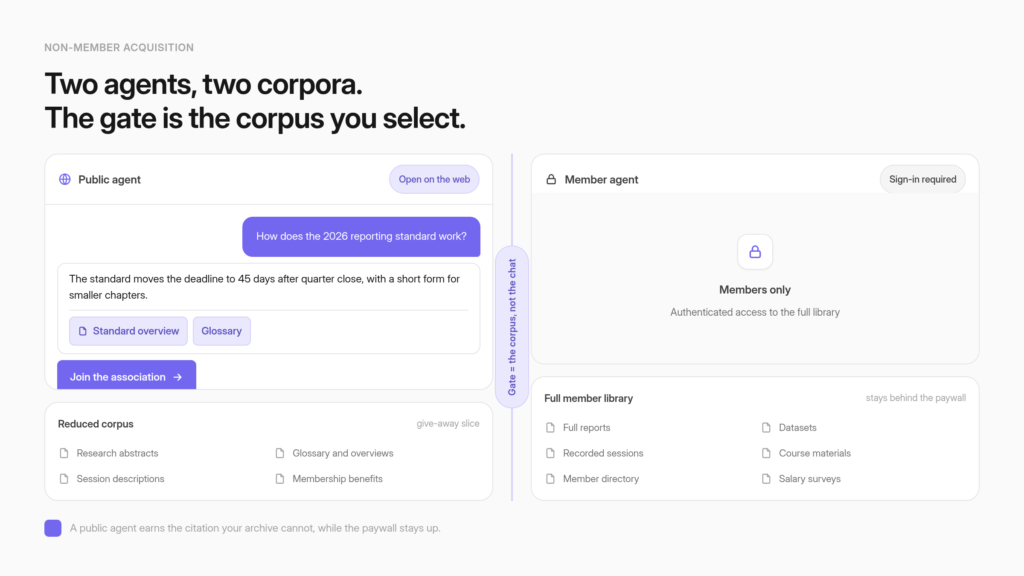
Access control happens before a prospect ever types. You build a second agent, feed it only the content you are willing to give away, and embed it publicly on your site through a standard iframe. The member agent keeps the full corpus behind a private, login-gated deployment no one can reach without authenticating first, with member-scale logins mapped through your existing SSO or identity provider.
Two agents, two corpora, one boundary you control completely.
The reduced public corpus is a curation decision your staff can make in an afternoon, since building the public agent’s knowledge base is a matter of adding and removing sourcesrather than writing code. A workable starting split:
Load into the public agent
- Research abstracts and executive summaries, without the underlying reports
- Your glossary and plain-language overviews of the standards you publish
- Session descriptions from the conference program
- Membership benefits, dues structure, and chapter or affiliate structure
- Eligibility rules and prerequisites for your credentials
Keep with the member agent
- Full research reports and datasets
- Recorded sessions, slide decks, and course materials
- The member directory and anything with member contact details
- Proprietary benchmarking data and salary surveys
- Draft guidance, committee materials, and anything superseded
A prospect gets a useful answer with citations that prove the library behind it is deep, which is a far better sales argument than a locked PDF icon. The abstract a prospect clicks stays cited to its own openly readable page, so nothing about that click misleads.
Where a citation points instead at a full report that lives behind the paywall, the citation URL is editable, and CustomGPT.ai documents using it as a conversion step: you can update the URL of a paywalled upload to direct users to your payment pagerather than to a file a non-member cannot open. The link still lands on the real home of that source while routing the prospect toward access. Assign the public corpus an owner before launch. Someone has to add the abstract when the next report publishes, and on a small staff that job goes unowned by default.
The same build is already documented for education. Where a course sits behind a paywall, access control is enforced by linking the AI tutor to your payment or enrollment layer, so authentication decides which agent a person reaches.
Separation is architectural rather than a permission flag. CustomGPT.ai states that projects are “Fully-self contained bots with no data sharing between bots, even within the same account”, that “Each bot is its own data silo,” and that the platform is SOC 2 Type 2 compliant. For a public agent that matters twice over, because the isolation is what guarantees your member-only content cannot surface in a conversation with someone who has not paid.
The membership committee will ask why non-members get anything for free, and the corpus split is the answer
Expect the question at the first committee meeting. The answer is that the public agent holds abstracts, definitions, and descriptions, while members keep the reports, the recordings, the data, and the directory. Nothing a member pays for moves to the public side, and the split is auditable because it is a list of files.
That is a stronger position than the one most associations already occupy. Marketing collateral, conference programs, and press coverage of your research already circulate publicly, usually written by someone else. Omnipress makes the same argument to association publishers, recommending that course outlines, excerpts, and explainers go out openly so prospects can judge quality before they are asked to pay. A public agent puts that material under your own citation instead of a consultancy’s summary.
Bring the file list to the committee rather than a description of the technology. A membership chair who can read the exact set of documents on the public side, and see that the salary survey and the member directory are not in it, will approve in one meeting. The conversation goes badly when the answer to “what will it tell people” is a description of how the model works.
Lead Capture asks for contact details after the answer, and it cannot be made mandatory
Lead Capture asks for contact details conversationally, inside the chat. It cannot be placed in front of the chat, and every field stays optional for the user. Pre-chat gating is not supported, so a prospect can take the full cited answer and give nothing back.
The documented limits deserve to be read without softening, because a funnel built on the opposite assumption will fail quietly. The feature page states that “Pre-chat gating is not supported at this time”and that “All details are optional for the user,” meaning fields cannot be made mandatory. The agent cannot prefill known details from previous chats or from your CRM. On filtering, the answer to whether you can set qualification rules by company size, region, or product interest is “Not at this time.” Custom tags and pipeline stages are likewise unavailable.
And on escalation the page is unambiguous: “Human handoff is not part of this feature.” By default the agent focuses on name, email, phone and company, and you can remove those goals or add new ones. How the agent asks follows from its Persona, the role, tone, and response style you describe in the Persona Builder, a conversational tool currently in Beta.
Those limits describe a give-first instrument, and it happens to match the buying population it will meet. Someone weighing a professional membership is researching quietly, comparing societies, and reading before identifying themselves. An instrument that answers first and asks second fits that behavior better than a form would. The design error is treating optional capture as if it were a paywall, then reporting on it as if every prospect passed through it.
You design for the anonymous majority, and treat a captured email as upside
Most prospects will read the cited answer and leave without typing an email, and the design has to pay for itself when they do. The measurable win is the click through to your join page. A captured contact record is a bonus on top of that, not the mechanism the funnel rests on.

Buyer research supports building for the invisible path. The 6sense 2025 Buyer Experience Report, published in November 2025 and drawn from more than 4,000 buyers, found that “94% of buying groups ranked preferred vendors before first contact”and “ultimately purchased from that preliminary favorite 77% of the time,” with the balance between independent research and seller engagement shifting from a 70/30 split to 60/40. Those figures describe B2B buying groups rather than one professional choosing a society, so treat the parallel as directional. The behavior underneath is the same: people research and rank before they make contact.
Your public agent’s job during that anonymous stretch is narrow and demanding: answer the actual question accurately, show citations that prove the depth of what sits behind the gate, and make the next step obvious.
Plan availability is worth confirming before you scope the build. The Lead Capture page states the feature is “Available on Premium plans and above”, that it is accessible during free trials, and that there are no usage caps on it. Note that the live pricing matrix does not name Lead Capture in its feature list, so treat the feature page as the authority on that tier and check with sales if the distinction affects your budget. For everything else, including how many actions per message each tier allows, what each plan includesis published openly.
Drive Conversions is the routing mechanism, and it bills per use
Drive Conversions points the agent at a URL you supply and works to move users toward it. Replies get shorter, more conversational, and goal-driven, and every one of them ends with a follow-up question. The Actions page reports how many queries ran through the flow and how many users clicked the objective URL.
Setup asks you to provide the link where you want to drive users, giving a product page, sign-up form, or lead capture as examples. For an association that URL is your join page, your non-member day-pass, or the checkout for a single research report. With the feature on, the agent will guide users toward a URL you provideand actively work to persuade them to act, and citations render as human-friendly links rather than raw source names. Two operator details govern whether this is worth switching on. It costs 1 additional query per use on Premium and 2 additional queries per use on Standard, so a high-traffic public agent consumes allowance faster than the raw conversation count suggests. And it works across all deployment types including API queries with one exception: it cannot be used with Search-Generated Experience deployments. If your plan was to expose the public agent as an SGE surface, that combination does not exist and the plan needs rethinking before launch.
The packaged version of this configuration is the Revenue agent, documented as “a predefined behavior profile (or role) that configures your agent with advanced persuasion and conversion-driving techniques”. Selecting it enables Context Awareness, Drive Conversions, Context-Rich Starter Questions, the Spotlight Avatar, Agent Initiative, and public agent visibility, and it disables User Feedback, the in-chat avatar display, and the automatic chat bubble pop-up on page load.
For a non-member agent that bundle is close to what you would assemble by hand, with the caveat that turning off user feedback removes a signal you may want while the corpus is still young. Because the routing costs query allowance, sizing it against your monthly query allowanceis part of the launch decision rather than an afterthought.
Reporting gives you aggregate counters plus a CSV export
The Actions page shows cumulative counts of how often the action was used and how many leads were collected, and those update automatically. They are aggregates. Per-prospect attribution is not what the tooling provides, and a single conversation can produce several export rows, so a raw row count overstates the number of people.
The counters live on the agent’s Actions page, where “Times used” and “Leads captured”give a quick overview of how often the agent is capturing leads and how successful it has been. Export runs from the same page through the three dots next to the Lead Capture section, choosing Download leads, or alternatively from the Customer Intelligence tab.
The lead exportcarries project_id, query_id, name, email, company, user_defined_data, tags, captured_at, and other_data, with the tags column holding UTM parameters and referral sources. The de-duplication trap is documented explicitly: “Each time new information is detected, it is saved as a separate record in the export,” which “means a single conversation may produce multiple rows in your CSV.” Report people only after you have collapsed those rows.
Two operational consequences follow. First, the view and export window is plan-dependent, running 7 days on Standard, 1 year on Premium, and all time on Enterprise, so a Standard deployment needs an automated pull rather than a quarterly manual one.
Second, since the feature performs no qualification, no scoring, and no de-duplication, those jobs belong in your AMS or CRM. Routing exists for that: the Lead Capture page describes a Lead Captured trigger you can use to send data to your CRM, email tool, or any Zapier-connected app, and Zapier, Make, and N8N sit among the connectors available across tiers. Treat objective-URL clicks as your primary signal and the lead file as the secondary one, since only the first reflects the anonymous majority.
A public agent puts your accuracy in front of someone who has not decided to trust you yet
Grounding an agent on your own approved content cuts fabrication sharply, and no honest vendor claims it reaches zero. On a public non-member agent the stakes shift, because a wrong answer reaches a prospect who is still deciding whether your organization is worth paying for, rather than a member who already trusts you.
CustomGPT.ai publishes the ceiling directly: “You can reduce hallucinations sharply, but you should not promise perfect accuracy in every edge case.”What contains the risk is the same architecture that makes the two-agent split work.
Responses run inside a context boundary wallthat keeps them derived solely from your business content, with general or unrelated internet data walled out, and every answer returns the exact sources it drew onas citations a prospect can click. A curated public corpus is also a smaller attack surface than the full archive, since a narrow, well-chosen set of abstracts and overviews is easier to review before launch than twenty years of proceedings.
Two habits keep a public agent defensible. Load only content you would be comfortable defending publicly, quoted back to you by a prospect with the citation attached, which rules out draft guidance and anything superseded. And review the agent’s answers to your twenty most common prospect questions before you point traffic at it, rather than after.
Verify Responses gives a builder a way to score those answers against their sources during that review, a testing step you run before rollout that your prospects never see. Accuracy on a public agent is a brand claim as much as a technical one, which is why it sits alongside the rest of the member-association deploymentdecisions rather than below them.
Why that same score can pass at rollout and still drift wrong later is worth understanding before you treat it as a one-time check, and why a 100% verified score can still be out of date covers exactly that gap.
Associations have already put closed, cited assistants in front of their own audiences
The underlying deployment is already running at member organizations. Two European bodies each put approved content behind a cited, closed-corpus assistant, each scoped to its own library and reporting its own measured outcome. The non-member variant is the same build with a narrower corpus and a routing objective attached.
GEMA, the German collecting society representing more than 100,000 members, reports 248,000+ inquiries answered across its external and internal chatbots at an 88% query success rate.
Separately, VdW Bayern DigiSol, the association of the Bavarian housing industry serving more than 500 housing organizations, reports over 7,000 questions across 2,000 conversations in its first six months, with 84% of user interactions receiving positive feedback.
State the gap plainly: neither of those deployments is an acquisition case, and there is no published CustomGPT.ai customer metric for non-member-to-member conversion. What they establish is that a closed, cited assistant on association content gets used heavily and answers well. The join-rate lift from a public teaser agent is yours to measure, which is why objective-URL clicks and a baseline join rate belong in the plan before launch rather than after.
The build is undramatic, and it fits inside a few staff days:
- Record your baseline first.Join-page visits and join rate for the last two quarters. Without that number, nothing you do afterward is measurable.
- Pick the give-away sliceusing the split above, and write it down as a file list you can hand to the membership committee.
- Train a second agenton that corpus only, and leave the member agent authenticated exactly as educators gate a paid-student tutor.
- Point Drive Conversions at your join page, with a UTM on the URL so your analytics can separate this traffic.
- Review the answers to your twenty most common prospect questionsbefore you send any traffic.
- Read objective-URL clicks weekly, the lead CSV monthly, collapsing duplicate rows before you report people.
Lead Capture is documented as accessible during a free trial, so steps 2 through 5 are testable against your own abstracts before a budget conversation happens. The paywall stays up, the public agent earns the citation your archive cannot, and the prospect who would never have filled in your form arrives at the join page already convinced. That same reduced corpus is the foundation for the non-dues revenue models your board keeps asking about.
You can build and test this against your own abstracts inside a free trial before any budget conversation, then book a 15-min discovery call with the CustomGPT.ai team to scope it against your library, dues structure, and committee politics.
Frequently asked questions about convert non-members AI association
How do we give non-members a taste of our content without opening the member library?
You run two agents instead of one. The public agent is trained on a reduced, non-confidential slice you choose, and the member agent keeps the full archive behind authentication. The boundary lives in the corpus and the deployment rather than in any setting inside the chat. The same shape is documented for paid-course tutors, where access control is enforced by linking the tutor to your payment or enrollment layer. Your paywall never comes down. A prospect simply meets a smaller, deliberately chosen version of what members get.
Why does our gated research never show up when someone asks ChatGPT or an AI assistant about our field?
Because the assistant cannot get past your registration form. As a May 2026 analysis of gating and AI search put it, “AI models cannot ‘fill out’ your forms by default”, so a report locked inside a gated PDF cannot be read, summarized, or cited. Carolyn Shelby made the competitive consequence explicit in Search Engine Land in September 2025: “AI can’t and won’t fill out a form or subscribe to your paywall”, and if competitors publish their abstracts and key findings openly, “their content becomes the default citation source for AI Overviews and Copilot answers.”
Can we require an email address before the AI answers a prospect's question?
No. The feature page states that “Pre-chat gating is not supported at this time”and that “All details are optional for the user,” so fields cannot be made mandatory. Contact capture happens conversationally, after the prospect has already received value. A funnel designed around surrendering an email first cannot be built on this. Plan for the prospect who reads the cited answer, clicks through to your join page, and never types a name.
What should go in the public corpus and what stays behind the paywall?
Give away the material that proves depth without being the depth: research abstracts and executive summaries, your glossary, plain-language overviews of standards you publish, conference session descriptions, benefits, dues structure, and credential eligibility rules. Hold back full reports, recorded sessions, the member directory, and proprietary benchmarking data. Omnipress, writing for association publishers, recommends publishing “course outlines, excerpts, and explainers”openly so prospects can judge quality before they are asked to pay. Staff can make that curation call in an afternoon.
If the AI answers questions for free, why would anyone still join?
Because the answer demonstrates what it is drawing on. A cited reply that traces back to your abstracts tells a prospect the archive underneath is deep and current, which is a stronger argument than a locked file icon. Discovery, not price, is the binding constraint on joining. Associations Now reported in March 2026 that “Nearly half of nonmembers report they are unaware of an association aligned with their role, industry, or interests”, and that nonmembers find professional resources mainly through online search and digital content. That figure traces back to a survey module of 112 nonmembers, so read it as directional.
Will existing members object that non-members are getting answers for free?
Expect the question and answer it with the file list. The public agent holds abstracts, definitions, session descriptions, and dues rules. Members keep the full reports, the recordings, the benchmarking data, and the directory. Nothing anyone pays for moves to the public side, and because the boundary is a set of documents rather than a setting, a membership chair can audit it directly. Bring that list to the committee rather than a description of how the technology works.
Could the public agent accidentally surface member-only material?
Not if the public agent is a separate project, because separation is architectural rather than a permission toggle. Projects are described as “Fully-self contained bots with no data sharing between bots, even within the same account”, each its own data silo, on a platform that is SOC 2 Type 2 compliant. The public agent can only answer from the reduced corpus you loaded into it. Content you never uploaded is not something it can reach for, which is why the curation step carries the access-control weight.
How does the agent actually move a prospect toward our join page?
Drive Conversions points the agent at a URL you supply, so it will guide users toward that objectivewith shorter, goal-driven replies that each end in a follow-up question. For an association, the URL is your join page, a non-member day pass, or the checkout for a single report. Two operator notes before switching it on. It costs 1 additional query per use on Premium and 2 on Standard, and it works across every deployment type except Search-Generated Experience surfaces.
If most prospects never identify themselves, what can we actually measure?
Objective-URL clicks, which is the signal that reflects the anonymous majority. The Actions page reports how many queries ran through the conversion flow and how many users clicked the link you set, alongside cumulative “Times used” and “Leads captured” countersthat update automatically. Read those as aggregates. Per-prospect attribution is not what the tooling provides. Retention differs by plan too, at 7 days on Standard, 1 year on Premium, and all time on Enterprise, so a Standard deployment needs an automated pull.
Can we score or tag non-member leads by chapter, region, or prospective member type inside the chat?
No. Asked whether qualification rules by company size, region, or product interest can be set before a lead is saved, the documented answer is “Not at this time,” and custom tags and pipeline stages are likewise unavailable. Human handoff sits outside the feature as well. Qualification, scoring, and de-duplication belong in your AMS or CRM, and a Lead Captured trigger can push records there through Zapier, Make, or N8N. Build the routing logic where your membership data already lives.
What happens if the public agent gives a prospective member a wrong answer?
Treat that as a brand risk, because the reader is someone still deciding whether your organization deserves dues. Grounding cuts fabrication sharply and no honest vendor claims it reaches zero. What contains it is a context boundary that keeps answers derived solely from your own content, with unrelated internet data walled out, plus inline citations a prospect can click. Load only material you would defend publicly with the citation attached, and review the answers to your twenty most common prospect questions before you send traffic.
Are associations already running cited, closed-corpus assistants on their own content?
Yes, on member-facing libraries. GEMA, the German collecting society representing more than 100,000 members, reports 248,000+ inquiries answered across its external and internal chatbots at an 88% query success rate. Separately, VdW Bayern DigiSol, the association of the Bavarian housing industry serving more than 500 housing organizations, reports over 7,000 questions across 2,000 conversations in its first six months, with 84% of user interactions receiving positive feedback. Neither is an acquisition deployment, and no published customer metric covers non-member-to-member conversion. That join-rate lift is yours to baseline and measure.
Which plan do we need to run a non-member agent?
The Lead Capture feature page states that the capability is available on Premium plans and above, that it is accessible during free trials, and that it carries no usage caps. Worth confirming with sales before you budget, since the live pricing matrix does not name Lead Capture in its feature list. Everything else that governs the build, including how many actions each tier allows per message and how long analytics are retained, is published openly by plan.
Related Resources:
- AI for Credit Union Research Libraries: See the same gated-content pattern applied to member research reports instead of a broader content library.
- How to Make Your Association’s Content Searchable with AI: See the member-facing counterpart to this non-member acquisition pattern.
- AI Pricing for Associations: Per-Member, Not Per-Query: See the pricing model that keeps a revenue-generating public agent cost-predictable alongside your member-facing one.
- AI for State Bar Associations: See a related vertical make its own gated content citable without exposing the member archive.
- An AI Study Assistant for Your Certification Program: See the same access-boundary logic applied to protecting an answer key instead of a member archive.
- Verify AI Answers for Associations: See how to confirm a public-facing agent’s answers stay accurate when it’s talking to prospects, not just members.
- Enterprise Security and SSO for Association Member AI: See how the member-only agent stays isolated from the public one this article describes.
- Enterprise-Grade Member AI Without an Enterprise Team: See how a small staff runs both a public acquisition agent and a member agent without hiring for it.
- AI for Healthcare Credentialing Bodies: See a different regulated body make its gated standards citable to prospects without exposing the full archive.