
AI Pricing for Associations: Per-Member, Not Per-Query
Association AI chatbot pricing converts to cost per member per year
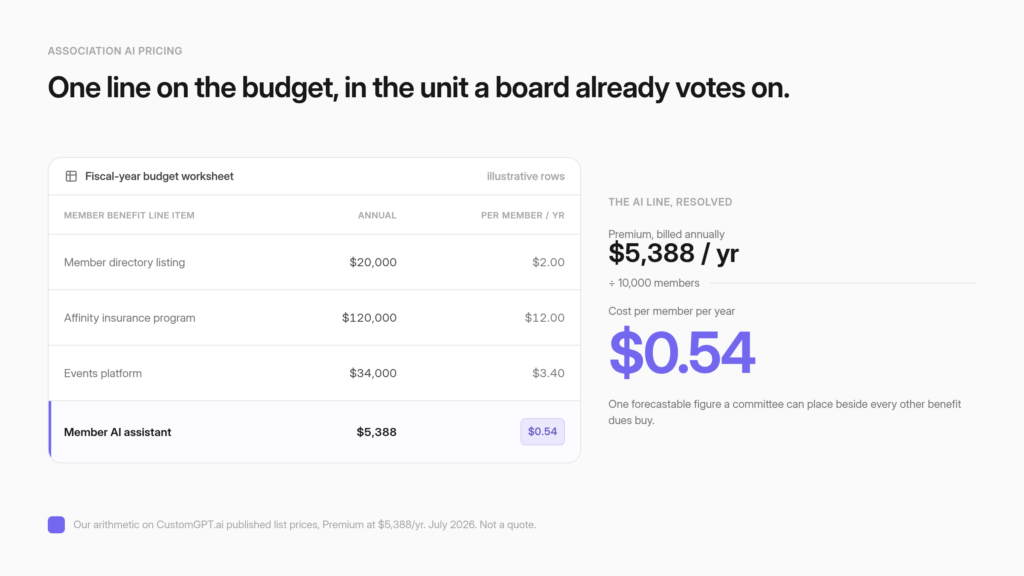
An association evaluating a member-facing AI assistant should price it per member per year, because that is the unit dues are set in and the unit a board already reasons with. CustomGPT.ai publishes Standard at $99 per month, or $89 per month billed annually, and Premium at $499 per month, or $449 per month billed annually, which is $5,388 for the year.
Divide that by your roster and the number stops being abstract. Our arithmetic on that published annual price puts a 1,000-member association at $5.39 per member per year, a 5,000-member association at $1.08, and a 10,000-member association at $0.54.
The shape behind those numbers matters as much as the numbers. Each plan carries a fixed monthly pool of credits, 500 on Standard and 2,500 on Premium, and the published plan terms state that adding team members has no per-seat fee. That is what makes the division work: the bill does not climb because a second staff member logs in, and it does not climb because a member asked a fourth question in March.
One caveat belongs in the same breath. Hitting the credit limit pauses message responses, so headroom is a real operating requirement and not a footnote, and sizing the plan against your peak month is part of the budget request.
The rest of what follows is the market context, the arithmetic in full, and the honest ceilings, written for an executive team choosing an answer engine for a member organization.
Metering by conversation or resolved outcome is now a mainstream model
A growing share of AI assistant vendors now bill by activity instead of by seat. Intercom charges $0.99 per Fin outcome and bills once per conversation. HubSpot’s Breeze Customer Agent consumes 50 HubSpot Credits per conversation at $0.010 per credit. Zendesk built its AI agent business on per-resolution billing. All figures here are as of July 2026.

Three shapes are live in the market and worth naming precisely. Per seat is the legacy helpdesk model, where you pay for each agent license regardless of what the software does. Per resolution or per outcome is the newer model, where the vendor charges when the assistant closes something.
Intercom states its price as $0.99 per outcome, and counts an outcome when a customer confirms the issue is resolved, or does not ask for more help after Fin responds, or Fin completes a workflow including handoffs. HubSpot’s published marketing pricing sets HubSpot Credits at $0.010 per credit and puts a Breeze Customer Agent conversation at 50 credits.
Secondary coverage often renders that as fifty cents per resolved conversation. The arithmetic lands in the same place, but the live page meters the conversation, not the resolution, and the distinction changes what you are forecasting.
Kyle Poyar’s 2026 State of B2B SaaS and AI Monetization Report, fielded across more than 230 software companies between April and May 2026, found that 37% have hybrid pricing. Metering is mainstream, and any post that treats usage billing as a fringe practice is describing a market that no longer exists.
The third shape, a flat plan with a fixed credit pool, sits alongside the other two rather than replacing them, and the buying question is which one matches how your revenue behaves. That question is worth separating from how chatbot plans and costs are structured in general, because the general answer and the association answer diverge.
Per-resolution pricing is well designed for a support desk
Outcome pricing solves a real problem for the organizations it was built for. A commercial support operation knows what a human-handled ticket costs, so paying roughly a dollar for a ticket the assistant closes is a clean trade with a measurable saving on the other side of the ledger. Contact volume also rises alongside the revenue funding it.
The design is defensible on its own terms and deserves to be stated without hedging. Under a per-outcome model the vendor absorbs the cost of failed attempts, which puts the risk of a weak assistant on the party who can actually fix it. That is a better alignment than charging for every API call, where a vendor gets paid the same whether the answer helped or not.
Intercom’s outcome definition is specific enough to audit, not vague enough to argue about, and the once-per-conversation rule prevents the meter from spinning when a member asks three follow-up questions in the same thread. A support director who signs that contract can model it: tickets per month, deflection rate, price per deflected ticket, saving per ticket avoided. Each term in the model is something the organization already measures.
The market’s own data supplies the counterweight. The same Growth Unhinged research that documents hybrid pricing’s rise also records that many enterprises still crave predictability, which is why outcome pricing frequently lands better as a message than as a buying model.
Both things are true at once. The model is well built, and buyers who cannot forecast their own volume struggle to approve it. For a commercial support desk the forecast is available, because ticket volume is a metric that organization has tracked for years and can extrapolate with confidence. The question is what happens when the buyer has no such curve, which is where an association sits.
An association’s economics invert the assumption behind per-conversation pricing
Support-desk pricing assumes contact volume rises with the revenue that funds it. A dues-funded association collects its revenue up front and fixed for the fiscal year, so a member who asks twenty questions in March generates no additional income. Metering by conversation puts a variable price on engagement, which is the outcome associations are spending the year trying to raise.
Start with the timing. Dues are booked at renewal, in a concentrated window, at a rate the board approved before the year began. The assistant’s cost under a metered model accrues month by month as members use it, with the heaviest months landing wherever member need peaks: renewal season, the run-up to a certification exam, the week of the annual conference. Those two curves point in opposite directions. Revenue is a step function set in advance and usage is a variable that staff cannot cap without degrading the benefit.
A finance committee asked to approve a line item with no ceiling, in a year when nearly 39% of association CEOs report declining financial performance versus 10% reporting improvement, will ask for a maximum. On a per-conversation contract there is no honest answer.
The incentive problem is sharper than the forecasting problem. ASAE’s March 2026 State of Associations report finds that retention and engagement remain the top challenge, cited by nearly one-third of respondents. A metered member benefit means the most successful possible outcome, members using the assistant constantly because it answers what they need, produces the largest invoice. Staff notice that arithmetic quickly.
The practical consequence is that promotion of the assistant gets quietly rationed: it does not go in the renewal email, it does not get demoed at the chapter meeting, it sits on a page nobody links to. An organization ends up paying for a member benefit and then suppressing its adoption to control the bill, which inverts the reason the benefit was bought.
The membership backdrop sharpens the trade. Marketing General’s 2026 Membership Marketing Benchmarking Report, summarized on the firm’s blog in July 2026, records “a softening in the share of associations reporting membership increases, down from 45 percent to 38 percent,” and puts the median renewal rate at 82 percent, noting that “for nearly a decade, this number has seen only minor fluctuations.” Growth is getting harder and renewal has barely moved in ten years.
An organization working to shift a number that stubborn does not want a cost structure that charges more each time the intervention works. That is the case for pricing member-facing AI on a fixed basis, and it holds regardless of which vendor you choose.
Cost per member per year is the unit an association board recognizes
Divide the annual license by the member count and the decision becomes comparable to every other member benefit on the budget. At the published Premium annual price of $5,388 per year, our arithmetic puts a 1,000-member association at $5.39 per member per year, a 5,000-member association at $1.08, and a 10,000-member association at $0.54.

The full division, on Premium at annual billing:
| Members | Cost per member per year |
|---|---|
| 1,000 | $5.39 |
| 5,000 | $1.08 |
| 10,000 | $0.54 |
| 25,000 | $0.22 |
| 50,000 | $0.11 |
Those figures are our arithmetic on publicly listed plan prices, not a quote, a discount, or a guarantee of what your organization will pay. Run the division yourself against whatever plan and billing term you are actually considering, because the method is the useful part and the inputs change.
Read the bottom rows of that table with care, because they hide a sizing question. Member count does not determine which plan you need. Peak-month conversation volume does, and the two only track each other loosely. Premium’s 2,500 monthly credits cover roughly 500 member conversations at five messages each, and that ceiling is the same whether your roster is 1,000 or 50,000.
A 1,000-member association at $5.39 per member is buying comfortable headroom. A 50,000-member association reading $0.11 per member is looking at a figure that assumes capacity it has not bought yet, because 500 conversations a month across 50,000 members is roughly a 1% monthly engagement rate, and any launch that works will pass it.
The honest version of the large-roster number includes the add-on packs or the Enterprise tier that the volume will require.
Volume is not the only driver either. If members must authenticate against your AMS before the assistant will answer, that gated access moves the deployment to the Enterprise tier on its own, so read the per-member figures here as an embed or link deployment on Premium and reprice a gated one against the Enterprise range. Size in that order: estimate peak-month conversations, convert to credits, pick the plan that holds them, and divide only at the end.
The unit travels because boards already speak it. A membership committee that approved $2 per member for a directory listing, or $12 per member for an affinity insurance program, can evaluate $0.54 in about four seconds and place it correctly against everything else dues buy. Compare that with presenting the same board a rate of $0.99 per resolved conversation.
The committee’s first question is how many conversations, and the honest answer is that nobody knows, because no association has a baseline for a service it has never offered. The trouble with the metered number is that nobody at the table can answer it, and an unanswerable line item is the one that gets deferred to next year’s budget cycle.
If you want to push past list-price division into payback, model it against your own member base with your own staff costs.
A flat plan with a fixed credit pool and no per-seat fee converts directly to that unit
CustomGPT.ai publishes Standard at $99 per month, or $89 billed annually, and Premium at $499 per month, or $449 billed annually. Standard includes 500 credits per month and Premium includes 2,500. Enterprise is custom, with a published typical range of $2,000 to $6,000 per month.
A credit is the unit of consumption, and one word for it beats three. Live pricing says credits, the developer documentation says queries, and older material says GPT-4 queries, all describing the same meter.
Credit is the current term and the one to take into a budget conversation. The rest of the published plan limits sit alongside it: 2 AI agents on Standard and 5 on Premium, 1 team member on Standard and 3 on Premium, 5,000 documents per agent on Standard and 20,000 on Premium, and 60 million words of total storage on Standard against 300 million on Premium. Enterprise is custom on every one of those lines.
Read the security rows carefully before assuming the top tier is the compliant one. SOC 2 Type 2, GDPR compliance and 256-bit encryption are marked included on all three plans in the published security posture, not reserved for Enterprise. What makes the per-member division hold is not a tier at all.
Members reach the assistant through an embed or a link, so none of them become CustomGPT.ai accounts and none consume the plan’s team-member seats, and one license spreads across the whole roster because the bill tracks credit usage instead of head count. The per-member figures in this piece describe that kind of deployment: an embed or link on Premium, open or sitting inside a portal a member has already logged into.
Authenticated access is a separate matter and it does change the tier. What Enterprise gates is the identity and governance layer: gating chat access through your existing identity provider, a Data Processing Agreement, agent-level roles and custom data security features.
An association that wants members authenticated against the AMS before the assistant answers them, instead of reaching it through an open or portal-embedded widget, uses that layer. Members authenticate as end users mapped to a role from your identity provider configured through SAML single sign-on, and even then none are created as separate CustomGPT.ai accounts, none count against the plan’s user limits, and there is no cap on how many members authenticate. The cost trade is real and belongs in the budget request: a gated deployment prices on the Enterprise range of $2,000 to $6,000 per month, so an authenticated roster recomputes its per-member figure against that scoping conversation rather than against the Premium license.
The line that matters most for a small association staff is the team one. Per the published terms, adding team members has no per-seat fee, and pricing scales with credit usage across the account instead. A membership director, an education director and an IT administrator can all hold access without three license lines appearing on the invoice, which is the difference between a tool the whole staff uses and a tool one person logs into on everyone else’s behalf. Associations where four people share seven job titles feel that difference immediately.
Two honest notes on the published plan table. The Enterprise figure of $2,000 to $6,000 per month is published as a typical range, not as a quote, and the actual number comes out of a scoping conversation. And there is a 7-day free trial on Standard and Premium that requires a credit card at signup, which is worth knowing before you route the trial through a finance approval that assumes no card.
One credit is one message, not one resolved conversation
Comparing a credit price to a per-resolution price without adjusting is an error that flatters flat plans, and getting it wrong will embarrass you in front of a finance committee. One credit covers one message. A five-turn exchange consumes roughly five credits. A vendor charging per resolved conversation bills once for that same exchange.
Run the conversion before you run the comparison. The documentation states that standard chat messages cost 1 query each. Premium’s 2,500 monthly credits therefore cover roughly 500 member conversations at an average of five messages each, not 2,500 conversations. Set that against a per-conversation vendor and 500 conversations is the number to compare, which is the arithmetic an honest evaluation uses. Two extras consume credits on top of the base message.
A Custom Action adds 1 query per action on Premium and 2 additional queries per action on Standard, and when no Custom Actions execute while generating a response, no additional query credit is added. Web search adds 2 additional query credits on Premium, with a maximum of 3 searches per user query, and 3 additional credits on Standard with a maximum of 1.
Credit consumption on the Standard plan carries a documentation inconsistency worth raising with sales rather than assuming past. The published guidance states one credit per standard message, while a worked example on the same page charges two credits for a plain message on Standard, which would halve effective capacity. Confirm the Standard figure directly before you build a budget on it. Premium’s arithmetic is unambiguous and is the basis for every number here. Marginal capacity has a published rate too: the 2,500-credit add-on is listed at $375 per month billed annually, which by our arithmetic is $0.15 per additional credit.
The ceiling cuts both ways, and hitting it pauses responses
The published terms are explicit, and the limit behavior is documented. If you hit the word-storage limit, the system stops indexing new data, and if you hit the credit limit, the system pauses message responses. On a member-facing assistant a pause is a visible failure, not a silent throttle, so capacity headroom is an operating requirement.

A hard ceiling is what makes the line item forecastable, and the cost of that ceiling is that exceeding it stops the service instead of quietly billing more. A member who asks a question and gets nothing back does not file a support ticket about credit allocation. They conclude the member portal is broken and tell a colleague. Any evaluation that treats the ceiling only as a budgeting benefit is reading half of it.
The mitigation is ordinary capacity planning and it should appear in the budget request rather than being discovered in month seven. Size the plan against your peak month, not your average, because association usage is seasonal in ways a support desk’s is not: renewal season, conference week, the fortnight before a certification exam window.
Watch credit burn monthly and buy capacity before renewal season instead of during it. On Enterprise, an admin can also set daily and monthly query-credit limits per role, per user or per guest, so a single heavy user cannot drain the shared pool and the ceiling stays predictable across a large roster. The published add-on rates, all billed annually as of July 2026, are $375 per month for 2,500 extra credits, $300 per month for 300 million extra words of storage, $100 per month for 100,000 extra document uploads, $100 per month for 25 extra agents, and $50 per month for 1,000 extra AI Vision uploads.
Two things should not be claimed here, by us or by any vendor. First, that you can never be overbilled: the published refund terms state that refunds apply only to the current subscription charge on your account, not to overage charges or charges from a prior month, and that reference to overage charges deserves a direct question to sales about how your specific contract handles capacity.
Second, that a fixed ceiling removes the need to forecast. It moves the forecast from the invoice to the service level, which is a better place for an association to carry it, and still a place where somebody has to do the work.
The license is not the whole cost
The subscription price is one line of the total. The others are staff time to prepare and maintain content, any integration work against the AMS or portal, and the internal promotion that drives adoption. On a no-code deployment those lines are small. They are not zero, and a budget that pretends otherwise gets revised in public.
The deployment side is the cheaper half and the published expectations are specific. Most associations create a first assistant in under 5 minutes, and a branded pilot with your own content typically goes live in 2 weeks. No engineering resources are required, because the essential features are fully no-code: content gets uploaded or synced, guardrails and persona get configured, branding gets applied, and the assistant deploys by embed, link or API from a dashboard. That is a genuinely different cost profile from a build, where the license line reads zero and the engineering and maintenance lines quietly become the entire budget. If a board is weighing the two paths, the build-versus-buy cost comparison is the argument to put in front of them, alongside what chatbots cost across the market as a sanity check on any single quote.
Three costs persist regardless of vendor and belong in the request. Somebody owns content hygiene, because an assistant grounded on your library will faithfully cite a bylaw you never updated. Somebody owns the question of why the assistant said what it said, which is a real staff role the first month and a light one after that. And somebody owns adoption, which for a membership that is not AI-native is a change-management job and not a launch email.
Budget those as fractions of existing roles and the total stays honest. Leave them out and the first quarter’s experience will not match the paper.
Cost avoidance is the number a finance committee will actually test
A committee will ask what the assistant replaces. GEMA, the German collecting society with more than 100,000 members, reports 248,000-plus inquiries answered, an 88% query success rate, and 6,000-plus working hours saved annually, which its case study puts at 182,000 to 211,000 euros in annual cost avoidance.
That cost-avoidance figure is the one to study, because it is the only natively financial number in the GEMA deployment and because it shows a method you can copy. Jonas Walther, Manager Data and AI at GEMA, describes the result this way: “CustomGPT.ai isn’t just a support tool. It’s become a knowledge infrastructure for our organization.” The hours saved are the mechanism, the euros are the translation, and the translation is what a finance committee tests. VdW Bayern DigiSol, the Bavarian housing federation, runs the same pattern against regulated member content, without a published cost figure attached.
Do not carry that euro range into your own board packet, and be ready for the committee member who points out why. GEMA is a six-figure-membership collecting society operating under German copyright administration, with an inquiry load and a staff cost base that look nothing like a 5,000-member professional society in the United States. A deployment at that scale answers a different question from yours.
What survives the size difference is the method: hours of repetitive inquiry handling, priced at loaded staff cost, set against a fixed license. The mechanism is portable even though the magnitude is not, and a business case that says so will hold up better than one that implies your association is about to save 200,000 euros.
So reproduce the method and leave the number where you found it. List the inquiry categories your staff handle by hand today, count them for one representative month, cost them at loaded staff hours instead of salary, and set that against your annual license figure. That comparison is defensible in a board packet because every input is yours. Once the assistant is live, measure the return against the same categories you costed before launch, not against a vendor’s projection.
One gap deserves stating plainly. There is no association renewal-lift number in the evidence base, ours or anyone’s, and any vendor who produces one should be asked for the study. What the case studies demonstrate is staff cost avoidance, which is a real and measurable mechanism. Whether an always-available answer improves renewal at your organization is yours to measure, and it needs a baseline captured before launch.
A related limit applies to the analytics: conversation reporting shows aggregate themes and volume, so you can see what members ask about most, and it does not give per-member transcripts that would let you attribute one renewal to one interaction.
A defensible budget request states the unit, the ceiling, and the pause behavior
The version of this request that passes a finance committee carries three numbers: cost per member per year, the monthly credit ceiling, and what happens when the ceiling is reached. A request built on an open-ended per-conversation rate invites the one question nobody at the table can answer.
Assemble the paper in this order, which is also the sizing order:
- Estimate peak-month conversations. Not the average month. Renewal season, conference week, or the fortnight before a certification window, whichever runs hottest.
- Convert conversations to credits. Roughly five messages per conversation, plus the extras for any Custom Actions or web search you intend to switch on.
- Pick the plan that holds the peak with headroom, and note the add-on rate for capacity above it.
- State the annual license figure at annual billing.
- Divide by current member count and label the result as your arithmetic on published list prices.
- State the pause behavior in writing. A committee that hears it from you treats it as diligence. A committee that discovers it in month nine treats it as something you hid.
- Close with the cost-avoidance comparison against the inquiry categories staff handle by hand today.
Two footnotes save trouble later. The free trial on Standard and Premium runs 7 days and requires a credit card at signup, so route that through whoever holds the card before the pilot starts. And if the license needs an offset, member-facing AI sits close to the programs that generate non-dues revenue, which is a separate business case worth running on its own instead of folding into this one.
That is the whole of association AI chatbot pricing reduced to something a board can vote on: one annual figure, one ceiling, one stated failure mode, and one comparison against work staff already do by hand. Bring your own member count and peak-month estimate and the calculation takes about ten minutes.
Two ways to pressure-test it before the meeting. Run the payback against your own roster and staff costs with the ROI calculator, or start the 7-day trial, load a slice of your real member content, and watch actual credit burn for a week so the peak-month estimate in your budget request is measured instead of guessed. If the deployment scope is the open question, see how associations deploy member AI and carry your peak-month estimate into the scoping conversation instead of your average.
FAQ
How much does an AI chatbot cost for an association?
Published list prices set the range. CustomGPT.ai lists Standard at $99 per month, or $89 per month billed annually, and Premium at $499 per month, or $449 per month billed annually, which comes to $5,388 for the year. Enterprise is custom, with a published typical range of $2,000 to $6,000 per month. Which tier fits depends on the agents, documents and monthly credits you consume, and the current plan and credit allowances are the authority on what each one includes. A 7-day free trial runs on Standard and Premium and requires a credit card at signup.
What does that work out to per member per year?
Divide the annual license by your roster. On the Premium annual price of $5,388, our arithmetic gives $5.39 per member per year at 1,000 members, $1.08 at 5,000, $0.54 at 10,000, $0.22 at 25,000 and $0.11 at 50,000. Those are calculations on publicly listed prices rather than a quote, a discount or a guarantee of what you will pay. The method is the part that travels, so run the same division against whichever plan and billing term you are actually considering.
What is the difference between per-seat, per-resolution and flat pricing?
Per seat charges for each staff license regardless of what the software does. Per resolution or per outcome charges when the assistant closes something: Intercom prices Fin at $0.99 per outcome and bills once per conversation, and HubSpot’s Breeze Customer Agent consumes 50 HubSpot Credits per conversation at $0.010 per credit, both as of July 2026. A flat plan charges a fixed subscription that includes a monthly pool of credits, so the invoice has a ceiling and the service stops instead of the bill climbing.
Why is per-conversation pricing a problem for a dues-funded organization?
Revenue arrives before usage does. Dues are booked at renewal at a rate the board approved before the year began, while a metered bill accrues month by month and peaks exactly when member need peaks: renewal season, conference week, the fortnight before a certification exam. A finance committee looking at a line item with no ceiling will ask for a maximum, and on a per-conversation contract there is no honest answer. In a year when nearly 39% of association CEOs report declining financial performance versus 10% reporting improvement, that question gets asked early and answered strictly.
Is usage-based AI pricing the market norm now, or are we behind?
Metering is mainstream. Kyle Poyar’s 2026 State of B2B SaaS and AI Monetization Report, fielded across more than 230 software companies between April and May 2026, found that 37% have hybrid pricing. The same research records that many enterprises still crave predictability, which is why outcome pricing frequently lands better as a message than as a buying model. Both findings hold at once, and an association choosing a fixed plan is making a fit decision rather than falling behind the market.
What is a credit, and how many member conversations does a plan actually cover?
A credit is one message. Standard includes 500 credits per month and Premium includes 2,500, and the documentation on limits and cost states that standard chat messages cost 1 query each. At an average of five messages per exchange, Premium’s pool covers roughly 500 member conversations in a month rather than 2,500, and 500 is the number to compare against a per-conversation vendor’s price. Custom Actions and web search consume additional credits on top of the base message, so budget for the features you switch on. The Standard-plan guidance contradicts itself, charging one credit per plain message in the rule and two in a worked example, so confirm that figure with sales before building a budget on it.
What happens if we run out of credits partway through the year?
Message responses pause. The published terms state that hitting the credit limit pauses message responses and hitting the word-storage limit stops indexing of new data. A pause is visible to the member, who concludes the portal is broken and does not file a ticket about credit allocation, so headroom is an operating requirement. Extra capacity has a published rate: 2,500 additional credits are listed at $375 per month billed annually, which by our arithmetic is $0.15 per credit. Treat “you can never be overbilled” as a claim no vendor should make, because the published refund terms state that refunds apply only to the current subscription charge on your account, not to overage charges or charges from a prior month.
Do we pay for every staff member who logs in?
No. Per the published plan terms, adding team members carries no per-seat fee, and pricing scales with credit usage across the account instead. The plan table still sets a team-member count per tier, 1 on Standard and 3 on Premium, with Enterprise custom. For an association where four people cover seven job titles, that shape decides whether the membership director, the education director and the IT administrator all hold access, or one person runs queries on everyone else’s behalf.
When do we need the Enterprise tier?
Not for the compliance certificate. SOC 2 Type 2, GDPR compliance and 256-bit encryption are marked included on all three plans in the published security posture rather than held back for the top tier. Enterprise gates the identity and governance layer: gating chat access through your existing identity provider, a Data Processing Agreement, agent-level roles and custom data security features, with every plan limit custom on that tier. An association that wants members authenticated against the AMS before the assistant answers lands there for the access control. The published typical range is $2,000 to $6,000 per month, stated as a range and not a quote, so the real number comes out of a scoping conversation about your member count, content volume and identity requirements.
What costs sit outside the license fee?
Staff time to prepare and maintain content, any integration work against the AMS or member portal, and the internal promotion that drives adoption. On a no-code deployment those lines are small and they are not zero. Somebody owns content hygiene, because an assistant grounded on your library will faithfully cite a bylaw nobody updated. Somebody owns adoption, which for a membership that is not AI-native is a change-management job and not a launch email. Budget them as fractions of existing roles, and if a board is weighing building instead of buying, the build-versus-buy cost comparison puts the engineering line back on the page.
Has a member organization actually recovered the cost?
GEMA, the German collecting society with more than 100,000 members, reports 248,000-plus inquiries answered, an 88% query success rate and 6,000-plus working hours saved annually, which its case study puts at 182,000 to 211,000 euros in annual cost avoidance. Jonas Walther, Manager Data and AI at GEMA, describes the result this way: “CustomGPT.ai isn’t just a support tool. It’s become a knowledge infrastructure for our organization.” The hours saved are the mechanism and the euros are the translation of it.
How do we build a business case our finance committee will approve?
List the inquiry categories staff answer by hand today, count them for one representative month, cost them at loaded staff hours, not salary, and set that against the annual license figure. Every input is yours, which is what makes the comparison defensible in a board packet. Two limits belong in the same paper. No association renewal-lift number exists in the public evidence base, so capture a pre-launch baseline if renewal is the outcome you intend to claim later. And conversation reporting shows aggregate themes and volume rather than per-member transcripts, so you can see what members ask about most and cannot attribute a single renewal to a single interaction. To pressure-test payback before the meeting, model it against your own member base.
Related Resources:
- Enterprise-Grade Member AI Without an Enterprise Team: See the no-code deployment case that pairs with per-member pricing to keep total cost predictable for a small staff.
- Turn Gated Content into a Lead Engine: See how the same per-member cost model supports a revenue-generating use case, not just a support one.
- AI for Credit Union Research Libraries: See a real budget decision play out for a credit union research deployment.
- Enterprise Security and SSO for Association Member AI: See the security tier questions that come up alongside a pricing conversation during procurement.
- An AI Study Assistant for Your Certification Program: See a certification-specific deployment where per-candidate cost predictability matters most.
- How to Make Your Association’s Content Searchable with AI: See the findability problem verification’s citations depend on in the first place.
- : See what each platform charges, and which publish pricing at all.
- CustomGPT.ai vs Onyx Point AI: See how published pricing compares with a vendor that only quotes after a demo.