
Turn Your Conference Library into a 24/7 AI Concierge
Your archive answers member questions only to the degree it has been transcribed. The first move is a transcript audit you can finish in an afternoon, not a vendor selection.
AI search over conference session recordings runs on transcripts, so your archive answers member questions to the degree it has been transcribed. Two variables decide the outcome: how many sessions carry a transcript at all, and how accurate those transcripts are on the vocabulary your members actually search. The second variable is the one that gets skipped.
Automatic speech recognition handles ordinary conversation well and degrades on proper nouns, standard numbers, drug names, and code sections. In the June 2026 issue of the Journal of Dental Research, researchers measured this across ten speech recognition systems and found every one of them significantly worse on technical terminology than on general speech, with a single exception.
That makes the first move an audit of your transcript layer rather than a vendor selection. Count the sessions in your archive, count how many have a transcript, then check a sample of those transcripts against twenty terms your members search on. The result is your ceiling, and you can measure it in a week without buying anything.
Once you know the ceiling, an answer engine built for membership organizations is a straightforward deployment. Until you know it, any vendor demo is a guess.
The conference archive is the largest block of member-only content most associations underuse
An annual meeting produces a year of expert content that members consume in three days. The recordings then sit in a library organized by date, which is the one dimension almost nobody searches by. The sector’s own research keeps landing on the same finding: the education assets are strong and the value pulled back out of them is not.
Tagoras and Leading Learning surveyed association learning businesses for a report released on 17 December 2025 and found that “most respondents believe their education portfolios align with organizational strengths such as standards, credentials, or research, yet nearly all identify missed opportunities to better leverage these assets for differentiation and value.” The same report has nearly half of respondents citing insufficient internal resources as the biggest barrier to growing enrollment, and interest in AI running high while most organizations sit in early exploration or pilot stages. Two hard constraints and one underused asset describe a lot of association education portfolios accurately.
ASAE published the operational version of the point in January 2026. Writing in Associations Now, Brian Lindsey observed that “not every member can attend every breakout session, and even those who did attend may want to review the material,” and recommended a dedicated library for recorded content because “this central hub enables members to find exactly what they want, when they want it.” A hub solves the storage problem. Finding exactly what they want is where a hub usually stops and a retrieval layer starts.
The volume data points the same way. Naylor’s 2025 Association Benchmarking Report, drawn from more than 300 senior association professionals, found associations “connecting with members an average of 30 times per month across digital, print, social media, and video channels,” with 52% naming information overload as a major hurdle. Publishing more into that stream is not the available move.
Making what you already published answerable on demand is a different act, and members are open to the mechanism: Higher Logic’s 2025 Association Member Experience Report put the figure at “94% of members say they’re comfortable with associations using AI,” conditioned on the use being transparent and human-centered.
A recorded session enters your knowledge base as its transcript
An AI assistant does not watch your conference recordings. It retrieves from the text attached to them: the transcript, the title, the description, the tags. Everything a member can ask about a session is a function of what exists in that text layer.
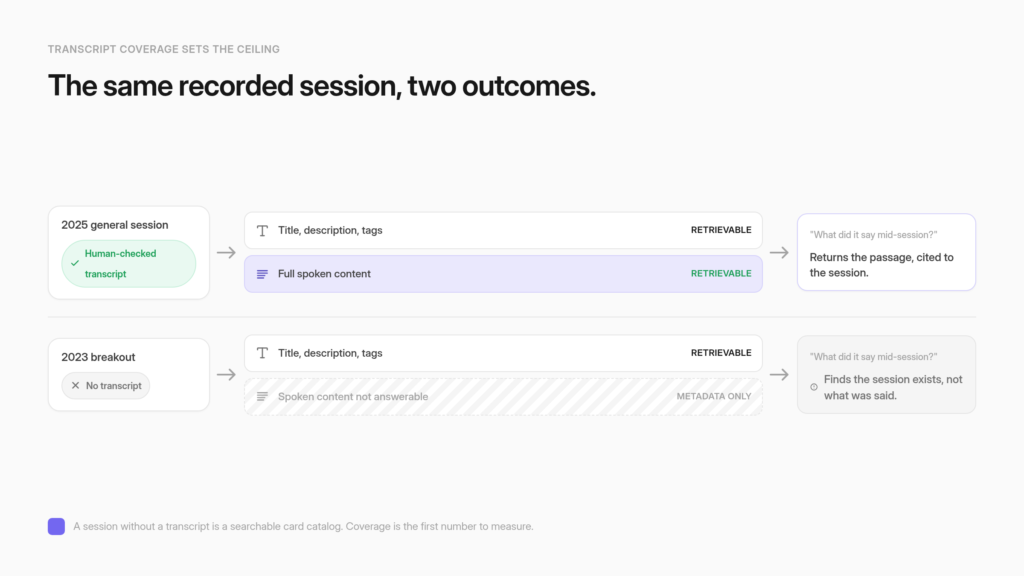
This is the frame that predicts whether the whole project works. When a member asks “what did the 2025 general session say about dues restructuring,” the retrieval system is matching that question against sentences somebody spoke and somebody transcribed. If the phrase was said and captured, the passage surfaces. If the session was recorded but never transcribed, the system knows a session exists with a certain title and nothing more.
Semantic retrieval widens the match beyond keywords, which matters because members rarely use the words a presenter used. Somebody asking about “raising dues without losing members” needs to reach a session titled “Pricing Elasticity in Voluntary Membership,” and semantic indexing over meeting transcripts is what closes that gap. The retrieval method still cannot invent text that was never captured. Operators tend to spend their evaluation time comparing models and video platforms. The variance that actually decides the outcome sits upstream of both.
Transcript coverage sets the ceiling on what members can ask
Sessions with a transcript are answerable. Sessions without one are retrievable by title, description, and tags only, which means a member can find that a session exists and cannot ask what was said inside it. Coverage is the first number to measure, before any vendor conversation.
Our own connector documentation states the limit plainly. On the Vimeo integration, the rule is that videos must have a transcript available on Vimeo, and “videos without a transcript are stored for title, description, and tags only – your agent cannot answer questions about their spoken content.” That sentence is worth more to an association evaluating this than any capability claim, because it tells you exactly where the system stops.
YouTube behaves the same way with more ingestion flexibility. You can ingest a single video, a playlist, or a full channel, which maps neatly onto how associations organize archives by year or by track. Building an agent straight from a channel, a playlist, or a single video is a no-code path, so an archive kept as one channel per meeting year connects in a single step. What gets indexed is video titles, descriptions, and, where authorized, caption files. A video without an accessible caption track contributes its metadata and stops there.
So the audit is simple arithmetic. Pull your archive inventory. Mark each session transcript-present or transcript-absent. If 400 of your 900 archived sessions have a caption file, roughly 44% of your library is conversationally answerable and the rest is a searchable card catalog. That ratio is your ceiling, and it will not move because you picked a better model.
Automatic captions fail hardest on the exact terms your members search
Auto-generated captions handle ordinary speech well and stumble on proper nouns, drug names, standard numbers, and code sections. Those are the terms professional members search on, so the error concentrates precisely where an association can least afford it.
The clearest recent measurement comes from orthodontics. Researchers publishing in the June 2026 Journal of Dental Research ran 200 clinical dictation summaries, 43,408 words across six hours of audio, through four commercial dictation platforms, five speech recognition APIs, and one two-stage pipeline that ran a transcript back through a large language model for error correction. They scored the output two ways: overall word error rate, and domain word error rate covering technical terminology specifically. The finding, verbatim: “All systems were less accurate with technical vocabulary (DWER > N-DWER; P < 0.001), except GPT4oTranscribeCorrected.” The spread was wide. The corrected pipeline reached 3.5% domain word error, the best commercial system 6.2% on those same domain terms, and the worst commercial system posted a 33.9% overall word error rate. Whisper, widely used as a default transcription engine, was one of only two systems that hallucinated content at all, with 57 hallucinated instances recorded against it and one against the next system.
Two findings from that paper matter more to a conference archive than the headline rates. Clinically significant errors appeared with every system, ranging from 2% to 66%. And background noise raised both error rates across the board. Scope the study honestly: it measured clinical dictation, not conference audio with room tone, crosstalk, and audience questions taken on a handheld mic. Treat it as directional evidence about how speech recognition behaves on specialist vocabulary, and note that the noise finding points the wrong way for a ballroom.
The practical translation for an association is uncomfortable. A mis-transcribed standard number is an invisible session. If your presenter said “ASTM F2413” and the caption file says “ASTM F twenty four thirteen” or “ASTM after 2413,” the member searching that standard gets nothing, and the session that answers their question sits in the archive unreachable. Nothing in the interface tells anyone this happened. The system returns a confident, well-cited answer drawn from whatever it could reach, and the best session on the topic simply was not in the candidate pool.
The vendor guidance on our own YouTube connector says the same thing in one line: “automatic captions are ML-generated and can misrepresent speech due to accents, noise, or domain jargon; prefer human-edited tracks for accuracy.” Speech recognition vendors have started reporting entity-level metrics for this reason. AssemblyAI, a transcription vendor and therefore an interested party, notes in a July 2026 post that accuracy “tops out around 95-98% word accuracy on clean audio for the best models in 2026” while entity error rates on names and numbers run far higher. Treat that as vendor framing. The shape of it still matches the peer-reviewed result.

The category’s marketing tends to skip this entirely. Progress Software published a version of this same pitch to associations on 2 June 2026, describing a system that extracts audio transcripts, runs OCR on slides, and uses vision models on video, concluding that “a three-year-old conference session now becomes fully searchable in a way it simply wasn’t before.” The mechanics they describe are real and the post never mentions what automatic transcription costs in accuracy on technical vocabulary. Fully searchable is doing a great deal of work in that sentence.
The captions you fund for accessibility are the same asset that makes the archive answerable
Captioning is already a budget line at many member organizations, justified on accessibility grounds. The same caption file that satisfies that requirement is the file an AI concierge retrieves from. One budget, two returns, and the accessibility case usually has an easier time at the board.
The standards work is specific. WCAG 2.1 Success Criterion 1.2.2 requires that “captions are provided for all prerecorded audio content in synchronized media, except when the media is a media alternative for text and is clearly labeled as such.” That criterion sits at Level A, the foundational tier, and any organization conforming to Level AA has to satisfy every Level A criterion as well. Prerecorded audio-only content falls under SC 1.2.1 at the same level.
Scope the legal exposure accurately, because vendors routinely overstate it. The Department of Justice rule under ADA Title II adopts WCAG 2.1 Level AA as the technical standard, and it binds state and local government entities: public schools, community colleges, public universities, courts, public hospitals, and the like. An interim final rule published in the Federal Register on 20 April 2026 pushed compliance to 26 April 2027 for entities serving populations of 50,000 or more and to 26 April 2028 for smaller entities and special district governments. Title II does not bind trade associations and professional societies as a class. It reaches many of them indirectly, through public-university partners, state affiliates, federally funded programs, or government members who will not procure inaccessible content.
Whatever the compliance posture, the operational argument holds. Human-checked captions cost money and produce two assets: a compliant media library and a retrievable one. Associations that have already made that investment are further along on AI concierge readiness than they realize, and the ones weighing captioning as pure cost are looking at half the return.
Price it before you scope it, and price it narrowly. Captioning and transcript cleanup are quoted per recorded hour, so the number you need is not a platform budget, it is your session hours multiplied by a vendor rate you can get in a week from any captioning house or your existing accessibility vendor.
Get that quote for one track of one meeting before you get it for the back catalog. Two questions decide most of the spend: whether you are buying clean-up of an existing auto-caption file or a fresh human transcript, and whether the vendor will load a glossary of your standard numbers, credential names, and product designations before they start. The second one costs little and is where domain accuracy is actually won.
Slides, handouts, and speaker notes carry the numbers the audio skips
Presenters say “as you can see on this slide” and never read the figure aloud. The decks, handouts, and proceedings papers hold the tables, citations, and standard numbers the transcript misses, and they ingest as ordinary documents alongside the recordings.
This changes the triage order from the coverage audit. A session with a mediocre transcript can still be well covered if its deck sits in the corpus, because the deck carries the precise terminology the audio garbled. The slide that reads “ASTM F2413-24” is unambiguous text. The spoken version of it is where transcription breaks. Pairing the two gives the retrieval system a clean anchor for the exact terms that matter most.
Practically, this means a conference archive behaves like a mixed document corpus. Session recordings, speaker decks, handouts, proceedings papers, the post-event summary in the member magazine, and the Q and A transcript all describe the same event from different angles. Ingested together, they cover each other’s gaps.
Audio-only sessions, a keynote or panel captured without video, upload as source files the same way the recordings and decks do, and the same transcript rule governs them: answerable once a transcript exists, metadata until then. The Vimeo connector will still store an untranscribed video for title, description, and tag metadata only, and its companion deck can carry the substance in the meantime. For associations with a large back catalog and thin captioning, decks are the fastest path to coverage.
Answers carry the source session, so a member can jump to the original
A concierge answer that cites the session it came from lets a member verify the claim and then go watch the segment. The citation turns the assistant into a routing layer into the archive instead of a replacement for it.
This matters more for a conference library than for a support bot. Somebody asking a support question wants the answer and nothing else. A member asking about a session usually wants the session: the full argument, the speaker’s caveats, the slide they half-remember. Source links displayed alongside the answer make the assistant a discovery layer over content the member already paid for, and the citation trail is built from the context material the answer actually used, assembled during the response and not bolted on afterward. Citation display is a setting you turn on per agent, so leave it on for an archive product where the whole point is sending members to the session.
The second-order effect is on the back catalog. Archives are usually browsed by year and track, which surfaces recent sessions and buries everything older than about eighteen months. Question-driven retrieval ignores chronology. A 2022 breakout that answers a question precisely will surface ahead of a 2026 keynote that touched the topic in passing. Treat that as a mechanism and not a promised number: sessions get reachable by intent, and whether usage rises is something your own analytics will tell you.
A conference archive grows every year, so sync cadence is a design decision
An annual meeting drops a new block of sessions into the archive each cycle. Auto-Sync refreshes connected sources on a chosen cadence with independent handling of new, modified, and deleted content, and it carries a plan gate worth knowing before you budget.
The cadence options are Never, Daily, Weekly, Monthly, and Custom, with separate toggles for new content, modified content, and deleted content. An annual-meeting archive has an unusual update shape: nothing changes for eleven months, then several hundred assets land at once. Daily polling of a corpus that turns over twice a year buys little. A slow standing cadence plus a deliberate push right after the meeting matches the actual rhythm, and sync cadence and content-change handling are configured per source and not globally.
State the gate plainly: “This feature is available on the Premium plan or higher.” Force-update is Enterprise-only. If you are pricing the entry tier, budget staff time for a manual re-ingest after each conference, which is a real recurring line of staff work and not a rounding error. Which plan the sync cadence sits on is worth confirming during evaluation, since a library that grows annually will hit this question in year one.
Rights and member gating decide what you can ingest before quality does
Speaker agreements often cover recording and replay without covering derivative reuse, and a members-only archive has to stay members-only after it becomes answerable. Settle both questions before ingestion, because neither is fixable downstream.
On rights, ingest what you own or have licensed. Older speaker releases were written for a world where reuse meant replaying a video, and machine indexing that produces synthesized answers quoting a speaker is a different act. Legal counsel should read the release before the archive gets connected, and next year’s speaker agreement should name machine indexing and AI-generated summaries explicitly. Timing matters more than wording here.
Most associations collect the release at the call for proposals, months before anyone confirms a program, so the language has to land in the CFP terms your volunteer program committee approves this cycle, not in the speaker confirmation email that goes out four weeks before the meeting.
The same caution applies to third-party material inside a deck. Caption rights and what you are licensed to index is a governance question with a real answer, and the answer sometimes excludes sessions. Because you manage which sources enter the knowledge base and can remove any one of them, a session the release does not cover stays out, and one that later turns out to be unlicensed comes back out cleanly.
On gating, the concierge has to sit behind the same authentication as the library it draws from. An assistant that answers questions about a members-only archive to anonymous visitors has quietly ungated the archive, no matter what the login page says. In practice that means running the concierge as a private, login-gated deployment rather than a public one, so only authenticated users reach it, with member sign-in handled through your existing identity provider during integration. Keeping members-only content behind member authentication is an identity question rather than an AI question, and it gets settled during integration.
Controls vary by plan. PII anonymization arrives on Premium. Agent-level access roles and a data processing agreement require Enterprise. SOC 2 Type 2 and GDPR controls are standard across tiers, and the plan that carries PII anonymization is the one to price if your governance committee has asked about member data handling. Plan boundaries move, so confirm each control against the live pricing page during evaluation. Secondhand summaries go stale quickly on this one.
Grounded retrieval reduces hallucination without eliminating it, and analytics stay aggregate
Answering only from your own archive cuts fabrication sharply and does not drive it to zero. Published benchmarking puts the improvement at a 10 percent lower hallucination rate and a 13 percent higher accuracy rate against a leading assistant API, and a citation a member can check remains the durable control.
Two caveats belong in front of any association evaluating this, stated once and without softening. First, grounding reduces hallucination and does not eliminate it. Restricting a model to your corpus removes the largest source of invention, which is the model reaching into training data, and residual error remains in how passages get synthesized.
The benchmark behind that claim covered 945 questions across nine datasets against OpenAI’s Assistant API V2, and the honest reading of a 10 percent improvement is a meaningful reduction rather than a solved problem.
A separate evaluation run by the RAG evaluation firm Tonic.ai scored answer quality at a mean of 4.4 against 3.5, with the same caveat attached: those results describe Tonic’s dataset, and your own content is the only test that settles the question for your archive. The designed behavior for an off-corpus question is refusal, described on the anti-hallucination page as admitting “I don’t know” instead of guessing, and the exact wording of that refusal is configurable so it reads in the association’s own voice rather than a generic error.
Before rollout, a builder can also score an answer’s claims against the sources it cited to find weak spots, a builder-side audit run during testing rather than a filter a member ever sees. For a credentialing body whose members act on the answer, refusal is the correct output and the citation is what makes any answer auditable.
Second, conversation analytics are aggregate. The account-level reporting shows query volume and queries per conversation across the whole membership, not any single member’s activity. You see themes, volume, and the questions that returned nothing useful. You do not see per-member transcripts. That limits the personalization story and doubles as a privacy answer for a governance committee that has reasonably asked whether staff will be reading what individual members typed. The aggregate view is also the more useful artifact editorially, since a cluster of unanswered questions about a topic your last three meetings skipped is a program-planning signal.
Two association deployments prove the mechanism, and the conference-archive number does not exist yet
Grounded, cited retrieval over a large owned corpus is proven at member scale. A rights society and a housing federation have each run it in production. Neither is a conference-library deployment, and no vendor should present them as one.
GEMA, the nonprofit German music rights collecting society with more than 100,000 members, runs a member-facing assistant called Melody that has resolved over 248,000 queries at an 88% success rate while saving more than 6,000 working hours annually. Jonas Walther, Manager Data and AI at GEMA, describes the outcome of GEMA’s member-facing deployment this way: “CustomGPT.ai isn’t just a support tool. It’s become a knowledge infrastructure for our organization.”
VdW Bayern DigiSol, the digital innovation subsidiary of the Association of the Bavarian Housing Industry serving more than 500 housing organizations, trained WohWi AI on a 3,620-document regulated corpus of roughly 25 million tokens, handled over 7,000 questions across 2,000 conversations in its first six months with 84% of interactions receiving positive feedback, and reached deployment in under 60 days. That corpus size is the closest published analogue to an archive-scale library, which is why it belongs in a conference-archive discussion.
Here is the gap, stated plainly instead of buried: no published CustomGPT.ai customer metric covers a conference or session-recording library specifically. These deployments evidence grounded retrieval at member scale and the mechanism transfers, and the archive usage lift at your organization is yours to measure. Any vendor quoting you a conference-archive engagement number should be asked which customer it came from. How membership organizations are deploying this is a fair question to put to references directly, and two more are worth asking any reference a vendor offers: what share of their corpus carried a human-checked transcript at launch, and what they had to fix in month two. Both answers travel to your situation better than a headline engagement number.
The build order is an audit, then a pilot track, then the back catalog
Start by measuring transcript coverage across the archive. Pilot on one track from the most recent meeting where captions were human-checked. Extend backward only once the answers hold up on content your staff can verify from memory.
1. Inventory the archive. Meetings team, one week. Count total archived sessions, sessions with any transcript, and sessions with a human-checked transcript. Those three numbers give you a coverage ratio and a quality ratio, and together they are your ceiling. Most associations have never counted this and are surprised by the result in both directions.
2. Spot-check domain accuracy. Whoever knows the vocabulary, one afternoon. Take twenty terms your members search on, the standard numbers, statute sections, drug names, and product designations specific to your field, and search the raw transcript files for them. Every term that fails to appear where you know it was spoken is a session that has gone invisible. Twenty terms across a sample of thirty sessions tells you more than any vendor demo.
3. Get one captioning quote. Education or accessibility budget owner, one week. Price cleanup of a single track at your vendor’s per-hour rate, with the glossary question asked up front. You now have a cost per answerable session hour, which is the number a board can act on.
4. Pilot one track. Staff who attended, four to six weeks. Choose the most recent meeting, the best-captioned track, decks included. Staff who were in the room can judge whether the answers are right, which is what makes a pilot honest. Pilots on content nobody remembers cannot be graded.
5. Then go backward. Set the cadence before the next meeting, not after. Extend to the back catalog, paying for human caption cleanup where the audit says coverage or quality is thin. Associations already selling archive access as a benefit will find this doubles as non-dues revenue from member content, since a searchable archive is a materially different product from a video list.
One structural note that decides whether any of this happens. In most associations the conference archive has no single owner. The meetings team holds the recordings, education or the LMS owns the CE credit attached to them, IT or the AMS vendor controls the portal the answers have to appear in, and membership owns the value story that justifies the spend. Four budgets, four calendars, and a project that looks small to each of them individually. Name one owner and give the other three a defined ask before the audit starts, because the failure mode here is rarely the technology.
The reframe worth carrying into your next planning meeting: the archive is not waiting on an AI decision. It is waiting on a transcript decision, and that one is yours to make this quarter whichever vendor you eventually choose. The first move fits in an afternoon: pull your session inventory and run the twenty-term spot-check on thirty sessions. That single number settles steps one and two and tells you whether you are buying a concierge or a captioning project first.
You do not need a vendor for that part, and it is the one thing most evaluations never bring to the table. When your coverage and quality numbers are in hand, bring them to the CustomGPT.ai team and the deployment conversation starts from a measured picture of what your own library can answer instead of from a demo. GEMA and VdW Bayern DigiSol reached production the same way, a defined corpus first and then the build.

Frequently asked questions about AI search conference session recordings
How do we make our conference session recordings searchable for members?
Get the spoken content into text, then put a retrieval layer over that text. Recording tools like Panopto and Otter.ai are strong at capture and produce transcripts one asset at a time. What turns an archive into a concierge is semantic indexing over meeting transcripts that spans every year of your library at once, so a member question reaches a 2022 breakout and a 2026 keynote in the same query.
Do our session videos need transcripts or captions before the AI can answer from them?
Yes, and the limit is worth reading before you budget. Sessions arrive as individual video URLs, a playlist, or a full channel of uploads, and each one is answerable only if it carries a transcript. The Vimeo connector documentation states the ceiling directly: “videos without a transcript are stored for title, description, and tags only – your agent cannot answer questions about their spoken content.” A member can find such a session by title and cannot ask what was said inside it.
Our captions are auto-generated. Is that accurate enough for technical sessions?
Auto-captions handle ordinary speech well and degrade on the vocabulary professional members search on. Researchers publishing in the June 2026 Journal of Dental Research ran 200 clinical dictations through ten speech recognition systems and found “all systems were less accurate with technical vocabulary (DWER > N-DWER; P < 0.001), except GPT4oTranscribeCorrected”. Domain word error ran from 3.5% on the corrected pipeline to 6.2% on the best commercial system, while the worst commercial system posted a 33.9% overall word error rate. Background noise raised error across every system tested. That study covered clinical dictation and not conference-ballroom audio, so read it as direction. A mis-transcribed standard number makes a session invisible.
Can it search slide decks, handouts, and speaker notes as well as the video?
Yes, and for many archives the decks carry more of the substance than the audio does. Presenters say “as you can see on this slide” and never read the figure aloud, so the tables, citations, and standard numbers live in the deck. Decks, handouts, and proceedings papers ingest as ordinary documents alongside the recordings, which means a session with a weak transcript can still be well covered when its deck sits in the corpus.
How is this different from the search bar on our event platform or LMS?
Platform search is keyword matching scoped to one event and one system. Members rarely use the words a presenter used, so somebody asking about “raising dues without losing members” never reaches a session titled “Pricing Elasticity in Voluntary Membership.” Retrieval that works on meaning crosses that gap, spans multiple years of archive in a single question, and returns an answer with the source session attached rather than a result list to sift.
Can a member click through to the actual session an answer came from?
Yes. Replies display source links for the material the answer drew on, and the citation trail is assembled from the context material actually used during the response. Citation display is a setting you control, and an archive product is a case for leaving it on. That matters more for a session library than for a support bot, because a member usually wants the session itself: the full argument, the caveats, the slide they half-remember. Confirm the exact click-through behavior for your video host during evaluation, since deep-linking depends on the player and the caption file.
What happens when a member asks about a topic none of our sessions covered?
The designed behavior is refusal. When a question runs past the edge of your library, the assistant says it does not have the answer instead of assembling a plausible one from general internet knowledge. Published benchmarking of that grounded approach reports a 10 percent lower hallucination rate and 13 percent higher accuracy across 945 questions and nine datasets against a leading assistant API. Grounding reduces fabrication sharply and does not drive it to zero, so the citation stays the durable control.
How do we keep the archive current after each annual meeting?
Auto-Sync refreshes connected sources on a cadence you set, with separate handling of new, modified, and deleted content. Options run Never, Daily, Weekly, Monthly, and Custom, configured per source. State the gate plainly before budgeting: “This feature is available on the Premium plan or higher,” and force-update is Enterprise-only. Check the current plan boundaries during evaluation. On the entry tier, budget staff time for a manual re-ingest after each conference.
Do we have the rights to ingest recordings from outside speakers?
Read the release before you connect the archive. Older speaker agreements were written for a world where reuse meant replaying a video, and machine indexing that produces synthesized answers quoting a presenter is a different act. What you are licensed to index is a governance question with a real answer, and sometimes the answer excludes sessions. Name machine indexing and AI-generated summaries explicitly in next year’s speaker agreement, and apply the same check to third-party material inside a deck.
Does the archive assistant stay behind our member login?
It has to, and this gets settled during integration rather than after. An assistant that answers questions about a members-only archive for anonymous visitors has quietly ungated the archive, whatever the login page says. The concierge sits behind the same authentication as the library it draws from, with SOC 2 Type 2 and GDPR controls standard across plans. Agent-level access roles and a data processing agreement require Enterprise, and PII anonymization arrives on Premium.
What can we see about what members are asking the archive?
Themes, volume, and the questions that came back with nothing useful. Conversation analytics are aggregate and not per-member, so staff do not read what an individual member typed. That answers the privacy question a governance committee will raise, and the aggregate view is the more useful artifact editorially. A cluster of unanswered questions on a topic your last three meetings skipped is a program-planning signal for next year’s call for proposals.
Has any association actually run this on a library this size?
Two member organizations have run grounded, cited retrieval in production at scale. GEMA, the German music rights collecting society with more than 100,000 members, has resolved over 248,000 queries at an 88% success rate. Separately, VdW Bayern DigiSol, the digital innovation subsidiary serving more than 500 Bavarian housing organizations, trained on 3,620 documents of roughly 25 million tokens and handled over 7,000 questions with 84% of interactions receiving positive feedback. Neither is a conference-archive deployment, and no published customer metric covers a session-recording library specifically.
Related Resources:
-
- Enterprise-Grade Member AI Without an Enterprise Team: See this same no-code deployment pattern for a small association staff managing a conference archive.
- Member vs Staff AI Permissions: See how member-only session recordings stay separated from publicly shareable ones by role.
- AI Pricing for Associations: Per-Member, Not Per-Query: See the pricing model that fits an unpredictable spike in session-recording queries right after your annual meeting.
- How to Connect Member AI to Your AMS: See how identity gates access to member-only recordings through the login members already use.
- Enterprise Security and SSO for Association Member AI: See the security posture that matters when recordings include speaker content members expect kept members-only.
- An Internal AI Knowledge Assistant for Association Staff: See how staff use the same retrieval pattern internally when managing the event archive itself.
- Making Credit Union Research Answerable: See how a research institute decides what belongs in a member-facing agent versus a staff-only one.