
How to Connect Member AI to Your AMS (iMIS, Fonteva, MemberClicks, Higher Logic)
Member AI connects to your AMS through identity, and no native plug-in is required
Member AI connects to your association management system through identity, not a native plug-in. No major AMS, whether iMIS, Fonteva, MemberClicks, or Higher Logic, ships a one-click CustomGPT.ai connector, and none is needed: every one already federates login through SAML 2.0 or OIDC, and that standard is how a member assistant learns who is asking before it answers.
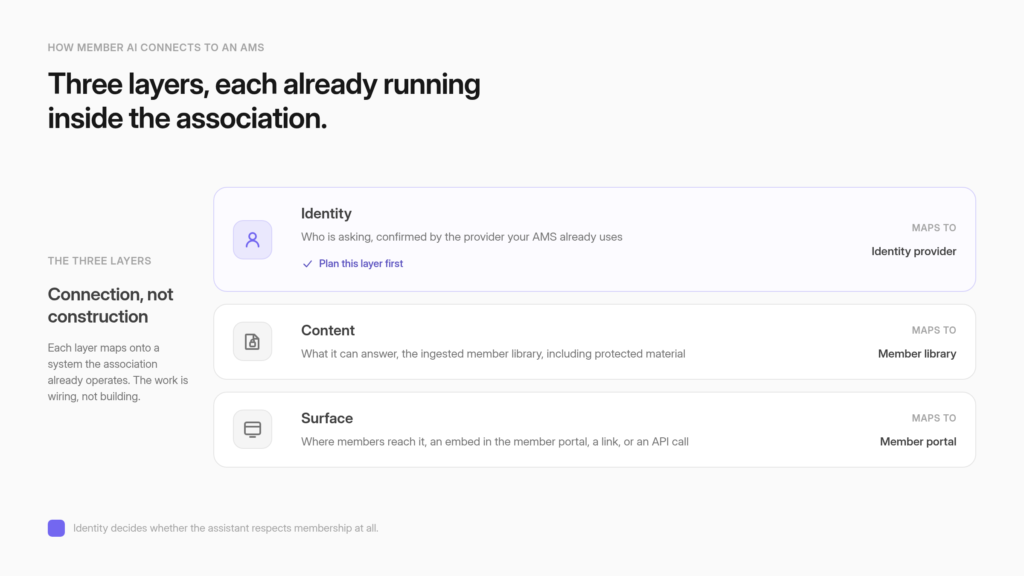
The connection runs in three layers:
- Identity.Your AMS or identity provider confirms the member.
- Content.The member library gets ingested, paywalled material included.
- Surface.The assistant embeds in your member portal.
Getting that content ingested is only half the problem; making it actually findable once it’s in is the subject of a companion piece.
Two facts settle the deployment before any feature does: member-gated access is an Enterprise-plan capability, and it is billed by usage, not per member. Get the identity layer right and the rest follows, because content and surface both assume the assistant already knows who it is talking to.
This is what lets an answer engine built for member associationssit behind the member wall instead of leaking member-only value onto the open web, and it does so by authenticating members through the identity provider you already run.
Member AI connects to your AMS in three layers, and identity decides the deployment
The connection runs in three layers. Identity confirms who is asking, through the provider your AMS already uses. Content gives the assistant the member library to answer from.
Surface puts the assistant in your member portal. Each layer maps to a system the association already operates, so the work is connection, and identity is the layer to plan first.
Identity, content, and surface are the three layers of the connection
Associations tend to ask “can it integrate with our AMS” as one question, which makes the project feel larger than it is. Split into three layers, it gets concrete, because each maps onto something the association already runs: an identity provider, a content library, and a member portal.
A membership director is not building any of these from scratch, only connecting them. The identity layer is the one that decides whether the assistant respects membership at all, so it is the connection worth planning first. Content is largely self-serve ingestion of the library you already own, and surface is wherever members already reach you, whether the portal, a link, or an API call.
A member assistant integrates with a standard, not a brand name
The reason no vendor ships a native iMIS or Fonteva button is that authentication is already standardized, so a per-brand connector would duplicate work the standard does. SAML 2.0 and OpenID Connect are the shared vocabulary between an identity provider and any application that trusts it, and a member assistant is just another application in that trust relationship.
A brittle connector built for each membership platform would be slower to ship, slower to maintain, and would break every time a vendor changed its API. Standards-based authentication works with any AMS or identity provider that speaks the protocol, a wider net than any hand-built connector could cover, so the assistant borrows your membership logic instead of forking it.
The AMS market is too fragmented for one native connector
The association management software market reached USD 2.66 billion in 2026, and no single vendor holds even a double-digit share. With dozens of platforms and none dominant, no AI vendor can build and maintain a native plug-in for each.
The durable connection is the standard every AMS already supports, which sidesteps the fragmentation entirely.
No AMS vendor holds a double-digit share, so no single plug-in can cover the market
Market data explains why “we will build a native AMS connector” is a promise that never fully lands. Mordor Intelligence sizes the association management software market at USD 2.66 billion in 2026, projected to reach USD 4.35 billion by 2031 at a 10.28% CAGR, and describes it plainly: “The market remains moderately fragmented; no single vendor exceeds a double-digit share.”
An assistant vendor chasing native connectors would have to build and maintain integrations against dozens of platforms, each with its own release cycle, and none large enough to justify the cost.
That is why the honest answer to “does it connect to our AMS” points to the identity standard the whole market already runs on rather than to a brand-name connector, which means the same approach that works for a MemberClicks shop works for an iMIS enterprise and a Fonteva-on-Salesforce federation without a single custom build.
Every major AMS already federates identity through SAML 2.0 or OIDC
The fragmentation stops mattering once you notice that the platforms converge on the same login standard. Higher Logic documents that “SAML 2.0 is an SSO protocol that ensures the secure transfer of information pertaining to authentication and authorization,”with the identity provider verifying who is logging in. That single standard is the interface a member assistant plugs into.
It does not care which of the dozens of AMS platforms an association runs, only that the platform can act as, or sit behind, a SAML or OIDC identity provider.
The market being fragmented at the product level is irrelevant when it is unified at the protocol level. The assistant connects once, to the standard, and inherits whatever membership rules the association already enforces through it. That is the integration path that survives a vendor switch, a portal redesign, or a merger between two associations on different systems.
Members reach the assistant with no new accounts and no passwords
CustomGPT.ai’s End User IdP Login lets members authenticate through the provider the association already runs and land on the right agent automatically. There are no accounts to create, no passwords to manage, sessions last 24 hours, and no member is stored in CustomGPT.ai. The identity provider does the authenticating, and the assistant honors the result.
Members authenticate through your existing identity provider and land on the right agent
The mechanism is a portal that sits behind the login members already use. CustomGPT.ai describes it directly: members “authenticate the way they always do,” through Google Workspace, Microsoft Entra ID, Okta, PingOne, or any SAML 2.0 provider, and “land on the right agents automatically.” This is End User IdP access, which authenticates members through your identity provider and routes them to only the agents their role permits without you managing separate accounts.
The operational promise is what makes this workable at membership scale: “No accounts to create. No passwords to manage. No admin overhead as people join or leave. Sessions last 24 hours and no user is ever stored in CustomGPT.ai.” Because members authenticate as end users mapped to a role rather than as provisioned accounts, an association can serve its whole membership without creating a separate account for each member.
An older, non-technical membership does not learn a new login or reset a new password, because there is no new credential to hold. The association administers content and configuration; members simply sign in the way they always have and reach the assistant. The staff who own the assistant carry the operational weight, which is the only way a member-facing rollout stays manageable for a small team.
An identity-provider attribute routes each member to the agents their role allows
Routing is driven by an attribute your identity provider sends. The attribute value matches a role you define, and that role is assigned only the agents it is allowed to reach, so members land on the right agent automaticallywithout seeing anything outside their entitlement.
A basic-tier member and a premium-tier member can be routed to different corpora. Staff can reach an internal agent members never see. The distinction between the two is built into the feature: “Regular SSO signs your internal team members into the AI workspace with company credentials. End-user IdP access signs students, clients, partners, or members into specific agents without turning them into workspace users or requiring separate accounts.” Revocation follows the same path.
Remove a lapsed member from the group or change their attribute in the identity provider, and access ends on their next attempt. A member whose attribute matches no role sees a safe unauthorized page rather than an over-exposed one.

The path to each AMS runs through the identity provider it already speaks
Each named platform federates identity through a standard instead of a plug-in. Higher Logic Thrive supports SAML 2.0 and OIDC and can use the AMS itself as the identity provider. Fonteva runs on Salesforce and uses Salesforce single sign-on. iMIS and MemberClicks expose the SSO members already use to move between systems.
iMIS and Higher Logic can act as the identity provider
For a Higher Logic Thrive community, the identity provider “can be your AMS/CRM system or an external application that works closely with your AMS/CRM,” which is exactly the hook a member assistant authenticates against. iMIS sites reach the same outcome through SAML as well. As ISG Solutions describes it, “Using SAML a third party can securely authenticate users in iMIS and send data back to the third party after a successful login has occurred.”
The nuance for iMIS is that SAML is usually not on by default; it arrives through iMIS SSO Premium or a SAML bridge, so an IT admin confirms which path the association’s iMIS deployment uses.
Either way, the assistant does not integrate with iMIS or Higher Logic as products. It authenticates against the identity layer each one exposes, and the AMS stays the authority on who counts as a member.

Fonteva rides Salesforce single sign-on, and MemberClicks carries members through OAuth or OIDC
Fonteva does not need its own identity story because it inherits one. Fonteva describes itself as “a cloud-based association membership software native to Salesforce, the world’s top CRM system,”so a Fonteva-backed association authenticates members through Salesforce single sign-on. That makes the Salesforce path for a Fonteva-backed assistantthe relevant one, using the same SAML federation Salesforce already provides. MemberClicks reaches the assistant through its own single sign-on, which connects members to linked applications using OAuth and OpenID Connect.
Across all four platforms the pattern holds: a member logs in once through the system the association already administers, the identity provider passes the member’s identity and role, and the assistant honors it. No platform requires a bespoke connector, because each already speaks a federation standard the assistant trusts.
The association’s job is to point that existing identity provider at the assistant, not to wait for a per-vendor button that will never ship.
Ingesting the member library is the content layer, and protected content stays protected
Identity decides who reaches the assistant. Content decides what it can answer. The assistant ingests the member library across many formats, and Protected Data Ingestion pulls paywalled material behind a login so member-only content stays member-only. Grounding answers in that approved corpus reduces hallucination, though it does not remove the need for a review path.
Protected Data Ingestion keeps paywalled member content behind the login
An association’s most valuable content is usually the content it does not give away: standards behind a paywall, members-only research, gated on-demand sessions. Feeding that to an assistant only works if the ingestion respects the wall it sits behind.
CustomGPT.ai connects to the content sources an association already runsacross a wide range of formats, and its Protected Data Ingestion reaches login-protected websites and private portals using approved credentials, so paywalled member contentis indexed without being exposed to the public web.
Before any of that library reaches a member, you curate what enters the knowledge base, managing and removing sources so nothing stale or off-topic can surface in an answer.
The assistant answers from that material only for members who authenticated through the identity layer, which closes the loop between content and identity. A non-member never reaches the gated answer, because they never clear the login that routes them to the agent trained on it. The paywall your association already runs stays intact, and the assistant works inside it rather than around it.
Grounded, cited answers reduce hallucination, and still need a review path
The other half of trust is what the assistant says once a member is inside. Answers stay boundaried to approved content, and each response returns the exact source inlineso a member can verify it, with citations a per-agent setting you activate rather than build.
When the approved corpus does not contain an answer, a well-built assistant is set to say it does not know rather than guess, and the wording of that fallback is configurable so it reads in the association’s own voice. That matters most for a professional member base, where a confident wrong answer about a certification rule or a compliance requirement costs trust that took years to build. Grounding narrows the room for a fabricated answer, but it reduces hallucination rather than eliminating it, which is the accurate way to describe what retrieval-grounded generation does.
For sensitive topics, keep a human review pathso staff can check answers before members rely on them. The safeguard comes from grounding, citations, an honest fallback, and human review working together, never from the model alone.
Member-gated access is an Enterprise-plan capability, and it is not billed per member
Gating chat access to agents through your identity provider is an Enterprise-plan capability, listed as not included on Standard or Premium. It is not billed per member. Adding people carries no per-seat fee, and pricing scales with usage across the account. Members authenticate without ever becoming CustomGPT.ai users.
Identity-provider access control sits on the Enterprise plan
Being precise about plan gating prevents a costly misread later. The feature that gates chat access to agents through your existing identity provider is an Enterprise-plan capability, shown as “Not included” on the Standard and Premium tiers.
An association evaluating member AI should size the project against Enterprise from the start rather than discovering the gate during procurement. The all-plan features still matter, since SOC 2 Type 2, GDPR, and encryption are available across tiers, along with the CustomGPT.ai API and a hosted MCP server that ship on every plan. Member-facing single sign-on specifically belongs to Enterprise.
The content and delivery layers do not carry that gate. Ingesting the library and embedding the assistant work on lower plans, so a smaller association can run an assistant inside the members-only area its portal already restricts, then step up to identity-provider access control once it needs to route members by role or tier or protect a shared link.
What Enterprise buys is the per-role, per-tier gating, not permission to run a member assistant at all. Stating that up front is the honest version of “yes, members can log in with your SSO.” The capability is real, and it lives on a specific plan. A membership team that plans around that fact runs a smoother evaluation than one that assumes member gating ships on the entry tier and has to rescope halfway through.
Pricing scales with usage, so a growing membership is not a growing per-seat bill
The fear that kills many member AI projects is an imagined per-member bill: thousands of members times a per-seat fee equals an unbounded cost. The identity model removes that fear at the root. Because End User IdP Login creates no assistant-side account for members, there is no seat to buy per member.
The pricing logic behind that is worth understanding on its own terms: why associations should be charged per member, not per query.
CustomGPT.ai states it directly: “Adding team members has no per-seat fee; pricing scales with credit usageacross your account.” A member is not a license. A member is an authenticated session that consumes usage while it is active and costs nothing while it is idle. That keeps the bill tied to how much the assistant is actually used, not to the raw size of the roster, which is the pricing shape associations think in when they budget by member rather than by API call.
The result is a cost that scales with value delivered rather than with headcount on the membership list.
Single sign-on controls who can ask, not who asked
Federated access controls entry to the assistant. It does not track members individually. End-user identity-provider sessions are anonymous, so an association can measure session volume and engagement but cannot tie a conversation to an individual member from the assistant. Treat single sign-on as an access control, not a per-member conversation log.
Aggregate engagement is visible, individual member identities are not
There is a temptation to read member single sign-on as a surveillance feature, and getting this wrong in either direction causes trouble. Single sign-on decides who is allowed to reach the assistant. It does not turn the assistant into a per-member transcript.
By design, end-user sessions are anonymous, so staff can see how many sessions happen and how engaged members are in aggregate, but they cannot pull up what a named member asked. That is the accurate scope to promise a membership: the assistant respects who is allowed in without logging each member’s questions against their name.
For content strategy the aggregate view is genuinely useful, showing which topics members struggle with and where engagement is thinning. For member trust, the anonymity is a feature, because a professional member is more willing to ask a candid question of a tool that is not building a file on them. Access control and individual tracking are separate things, and the assistant does the first without the second.
The security and procurement layer lets member-only content sit behind the assistant
Putting proprietary member content behind an assistant depends on the trust layer. CustomGPT.ai is SOC 2 Type 2 compliant and GDPR-ready, encrypts data in transit and at rest, keeps member data out of external model training, and isolates each bot instance. Enterprise adds a custom data-processing agreement and a dedicated account team for procurement review.
SOC 2 Type 2, GDPR, and no-training guarantees protect member data
The security posture is what lets a general counsel or a security-minded member base sign off on exposing member-only material.
CustomGPT.ai is SOC 2 Type 2 compliant and GDPR-ready, encrypts data in transit and at rest, and keeps member content out of any external model’s training, answering from your corpus without absorbing it into a shared model. Bot-instance isolation keeps that corpus isolated in your own tenant, walled off from other customers. These were announced together as SOC 2 compliance and SSO, which is fitting, because the security guarantees and the identity layer are the same trust story from two angles.
For a membership organization these are not abstract checkboxes. They are the specific assurances a procurement committee asks for before a single member-only document goes near an assistant, and they belong to the same conversation as the login that gates it.
Enterprise procurement adds a data-processing agreement and a dedicated team
Larger associations rarely buy on features alone. They buy through a process, and the process is where many AI projects stall.
A regulated membership body, a licensing board, or a bar association typically runs several pre-sales calls, requires a custom legal agreement with its own data-handling clauses, asks for independent SOC 2 auditor validation, and expects a standing account relationship after signing.
The Enterprise plan is built for that path, adding a custom data-processing agreement, custom security controls, and a dedicated account team. Naming this plainly helps a membership director set internal expectations: connecting member AI to an AMS at a large association is a procurement exercise as much as a technical one, and the identity work sits inside it.
The associations that move fastest are the ones that bring security and legal into the room early, because the same SSO and SOC 2 story that satisfies IT is what satisfies the committee.
Large and regulated member bases already run member-facing assistants at scale
The pattern is proven where it is hardest, in big and tightly regulated memberships. GEMA, a collecting society with more than 100,000 members, runs a member and customer assistant that has answered over 248,000 inquiries at an 88% success rate.
Separately, VdW Bayern DigiSol built an assistant that serves more than 500 member organizations across a regulated housing federation, drawing 84% positive feedback across 7,000-plus queries in under six months. Each result belongs to that organization’s own deployment, measured on its own content and its own members.
What they share is a lesson: a member base does not have to be small or casual for a grounded, member-facing assistant to earn heavy use. A six-figure society and a federation of member organizations both sit behind membership rules an assistant has to respect, and both put one into daily service. Identity federation is how an association makes that same assistant answer to its own member login.
How to connect member AI to your AMS, in five steps
Connecting a member assistant to an AMS is a sequence a small team can run, and the order matters because every later step assumes the assistant already knows who is asking.
- Federate identity first.Connect the assistant to your existing identity provider over SAML or OIDC, whether that is the AMS acting as the provider or an Okta or Entra ID in front of it, and confirm the AMS stays the source of truth for membership status.
- Ingest the member library, including protected content.Point the assistant at the standards, journals, recordings, and help articles that hold the answers, using Protected Data Ingestion for anything behind a login so paywalled material stays gated.
- Gate the assistant to members.Enable identity-provider access control so only authenticated members reach the agents their role allows. This is the Enterprise-plan capability, so scope the plan accordingly.
- Surface it where members already are.Embed the assistant in the member portal, share it as a link, or reach it through the API, and gate every surface behind the single sign-onmembers already use.
- Watch aggregate engagement.Track session volume and the topics members ask about to guide content strategy, treating the analytics as an aggregate signal rather than a per-member log.
Steps two and four are largely self-serve. Step one is the configuration that deserves real planning, and step three is the plan decision to make before the evaluation starts.
The AMS integration that makes or breaks member AI is the login, and standards-based single sign-on is what lets an assistant honor it. The limits worth naming are honest ones: member gating is an Enterprise-plan capability, the analytics are aggregate rather than per-member, and grounding reduces the need for review without removing it.
Inside those limits, an assistant that authenticates through your existing AMS respects who is asking on every answer. Start a free trial and build a member assistant on your own content, or book a 15-min discovery call about wiring CustomGPT.ai’s platform for member associations to the AMS your members already use.
Frequently asked questions about AMS integration AI chatbot
Does CustomGPT.ai have a native plug-in for iMIS, Fonteva, MemberClicks, or Higher Logic?
No, and none is needed. No major association management system ships a one-click AI connector, because member login is already standardized. CustomGPT.ai connects through the SAML 2.0 or OpenID Connect federation your AMS already runs, so one approach covers member associationson iMIS, Fonteva, MemberClicks, and Higher Logic without waiting for a per-vendor button that will never ship.
If there is no plug-in, how does the assistant actually connect to our AMS?
Through three layers. Identity confirms who is asking, using the provider your AMS already runs and federates over SAML 2.0 or OIDC. Content gives the assistant your member library to answer from. Surface puts it in the member portal or a link members already use. Identity is the layer to plan first, because content and surface both assume the assistant already knows who it is talking to.
Do our members have to create a new account or password to use the assistant?
No. Members authenticate the way they already do, through Google Workspace, Microsoft Entra ID, Okta, PingOne, or any SAML 2.0 provider, and land on the right agent automatically. Sessions last 24 hours, there are no accounts to create or passwords to manage, and no member is stored on the assistant side. For an older or less technical membership, there is no new credential to learn.
Can we control which members see which answers, and keep staff tools separate?
Yes. An attribute your identity provider sends maps to a role you define, and each role reaches only the agents it is allowed to use, so a basic-tier member, a premium-tier member, and internal staff can be routed to different content. Regular staff single sign-on and member access are separate paths, so members never become workspace users. Remove a lapsed member in your identity provider and their access ends on the next sign-in attempt.
Is member single sign-on available on every plan, or only on Enterprise?
Only on Enterprise. Gating chat access to your agents through your existing identity provider is listed as an Enterprise-plan capability, shown as not included on the Standard and Premium tiers. All-plan features like SOC 2 Type 2, GDPR, the API, and MCP support are available across tiers, but member-facing single sign-on specifically belongs to Enterprise, so size the project against that plan from the start rather than discovering the gate during procurement.
Will this cost us per member? Our roster runs into the thousands.
No. Because members authenticate through your identity provider and never become users on the assistant side, there is no seat to buy per member. CustomGPT.ai charges no per-seat fee for adding people, and the bill scales with usage across your account rather than with the size of your roster. A member is an authenticated session that consumes usage while active and costs nothing while idle.
Can the assistant use our members-only and paywalled content without exposing it to the public?
Yes. Protected Data Ingestionpulls in content from login-protected websites and private portals, so members-only standards, gated research, and on-demand sessions get indexed without being exposed to the open web. The assistant answers from that material only for members who cleared your identity provider, so a non-member never reaches a gated answer because they never clear the login that routes them to it.
Our AMS is Fonteva, which runs on Salesforce. Does that change anything?
Not much, it just points to Salesforce. Fonteva is native to Salesforce, so a Fonteva-backed association authenticates members through Salesforce single sign-on, and the assistant connects to that same SAML federation. The pattern is identical for iMIS, MemberClicks, and Higher Logic: the assistant authenticates against whatever identity provider each platform already exposes, rather than integrating with the AMS as a product.
Will we be able to see what individual members are asking?
Not individually. End-user sign-on sessions are anonymous by design, so staff can see aggregate usage trends and which topics members ask about, but cannot tie a conversation to a named member from the assistant. Treat single sign-on as an access control over who may ask, not a per-member transcript. For content strategy the aggregate view is what you need anyway, and the anonymity makes a professional member more willing to ask candidly.
Is it secure enough to put proprietary member content behind it?
Yes, that is what the security layer is for. CustomGPT.ai is SOC 2 Type 2 compliant and GDPR-ready, encrypts data in transit and at rest, keeps your content out of any external model’s training, and isolates each bot instance in your own tenant. For a larger or regulated association, the Enterprise plan adds a custom data-processing agreement and a dedicated account team, which is what a procurement committee asks for before member-only material goes near an assistant.
Can it still hallucinate a wrong answer about a certification or compliance rule?
Grounding reduces that risk but does not remove it. Answers stay boundaried to your approved content, each response returns the exact source inlineso a member can verify it, and a well-configured assistant is set to say it does not know rather than guess when your corpus lacks the answer. For certification rules, compliance requirements, and other high-stakes topics, keep a human review pathso staff can check answers before members rely on them.
Related Resources:
- Enterprise Security and SSO for Association Member AI: See the broader security posture your AMS integration feeds into.
- Member vs Staff AI Permissions: See how the role your AMS sends determines which agent a person actually reaches.
- Add an AI Copilot to Your Member Portal: See the member-facing surface this AMS connection typically feeds.
- Enterprise-Grade Member AI Without an Enterprise Team: See how a small staff sets up this same AMS integration without a developer.
- AI for Credit Union Research Libraries: See identity and AMS integration handled for a credit union’s member-only research library.
- AI for Healthcare Credentialing Bodies: See this same identity-passthrough pattern applied to a credentialing body’s candidate records.
- AI Pricing for Associations: Per-Member, Not Per-Query: See how identity-gated access ties into the per-member pricing model instead of a per-seat one.
- Why Associations Want an AI That Says “I Don’t Know”: See how identity-gated access and honest refusal work together to keep the assistant trustworthy end to end.
- CustomGPT.ai vs Higher Logic AI Assistant: which fits an association: See how the identity layer is the same either way, the knowledge layer is not.
- CustomGPT.ai vs Onyx Point AI: Compare doing the integration yourself with having a vendor manage setup, integration and support.