
AI for Healthcare Credentialing Bodies: What the Accreditation Standards Actually Require
What a member-services AI does for a healthcare credentialing body, and what it must never do
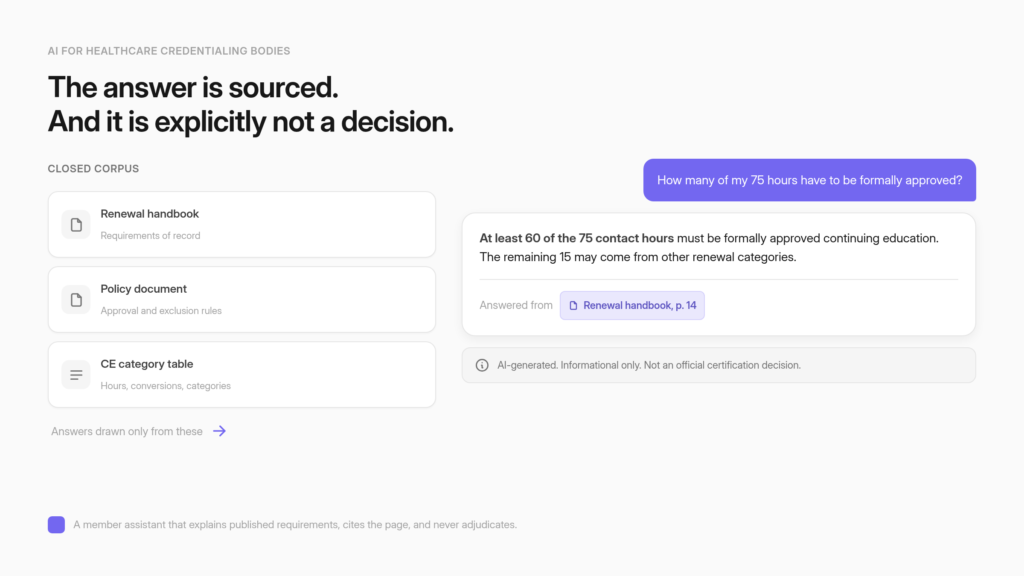
A member-services AI for a healthcare credentialing body answers certificant and candidate questions about requirements, renewal categories, continuing education and deadlines, drawing only on your own published handbooks, policies and requirement tables, returning a citation with each answer and declining when the question falls outside those documents.
It explains what the rules say. It never decides whether a given certificant has met them, because the current NCCA guidance places final certification decisions outside AI’s authority.
That boundary is not a limitation somebody bolted on. It comes from the same document that permits the assistant in the first place. NCCA Standard 6 allows a certification program to run an AI chatbot for communication with candidates and certificants.
Standard 2 says AI systems alone cannot hold final decision-making authority over certification approvals, and Standard 21 requires human validation anywhere AI evaluates recertification activity. Read together, those clauses describe a specific architecture: a closed corpus, a citation on every answer, an honest refusal off-corpus, a documented path to qualified staff, and sample-based review by humans rather than a full audit of every response.
Three mechanisms carry that. Answers are confined to your documents with a stated fallback when there is no source. Citations point the certificant at the page of record. Claim-by-claim verification gives your staff the sampling instrument the standard asks for. AI built for membership organizationsis the deployment pattern underneath.
One caveat belongs here rather than at the end. Grounding an assistant in your own documents reduces hallucination sharply without eliminating it, and an answer that traces perfectly to last cycle’s handbook is still wrong. Corpus currency is an operational job with an owner, and it matters as much as the architecture.
A credentialing body evaluates member AI against an accreditation standard
Certification programs answer to an accreditor on a five-year renewal cycle, and NCCA has published guidance stating that accreditation decisions may rest on findings of noncompliance with its Standards. The procurement question therefore is which architecture survives an accreditation review, rather than which chatbot demos best.
The current NCCA guidance carries accreditation consequences
The National Commission for Certifying Agencies, the accrediting arm of the Institute for Credentialing Excellence, publishes a guidance document on the use of artificial intelligence in certification programs. Its stated purpose is “to provide certification programs with a framework for maintaining compliance with NCCA Standards when integrating Artificial Intelligence (AI) into certification program activities,” per version 1.1 of the NCCA AI guidance, released April 2, 2025 and still the current version.
The enforcement language is what makes it a procurement document rather than a think piece. The same guidance states that “the NCCA may base accreditation decisions on findings of noncompliance with the Standards and Essential Elements, as further elaborated in the Commentary and this guidance document.” Accreditation itself “follows a five (5) year renewal cycle,” and accredited programs “span a wide range of professions, including healthcare, counseling, skilled trades, emergency response, and automotive repair,” per the NCCA accreditation overview.
A tool choice made this year sits inside a review window that closes years from now, which is why the architecture question outranks the feature question.
Standard 6 permits an AI chatbot, and Standards 2 and 21 forbid it deciding anything
The guidance, addressing Standard 6, states it plainly: “Programs that use AI-driven chatbots or automated systems for communication with candidates, certificants, and interested parties must ensure transparency, accuracy, and accessibility of information.” That is permission, written plainly, with conditions attached.
On Standard 2 the guidance draws the opposite line just as plainly: “AI systems may be used to support governance; however, AI systems alone cannot hold final decision-making authority related to policies, governance, or certification approvals.” On Standard 21 it extends the same principle into maintenance of certification, stating that where AI is used in recertification processes such as evaluating self-assessment tools, portfolio reviews or continuing education activities, “AI-driven assessments must meet the same quality criteria as traditional evaluations and undergo human validation.”
The design of an accreditation-safe member assistant lives in the gap between those two positions. It may talk to certificants about requirements. It may not rule on a file. Every subsequent choice, from what goes in the corpus to who reviews the answers, follows from holding that line rather than blurring it.

Staff and certificants are already using general AI for these questions
The realistic comparison runs against a general-purpose chatbot that certificants and staff are already pasting questions into, rather than against a static FAQ page. A Quinnipiac University poll released March 30, 2026 found that 51 percent of respondents now use AI to research topics they are curious about, up from 37 percent in April 2025. The same poll found that “76 percent think they can trust AI either hardly ever (27 percent) or only some of the time (49 percent).”
Use is climbing while trust stays low, and both numbers describe the environment your certificants ask questions in. Sector context points the same way.
ASAE’s first State of Associations report, released March 23, 2026, put association AI adoption at 87.5 percent for content and 44.3 percent for data, with barriers described as “limited expertise and data privacy concerns”. That report is assembled from pulse polls rather than a single instrument with a published sample, so read it as a directional signal about the sector and nothing more.
The requirement question is hard because the answer depends on jurisdiction, category, and effective date
A certificant asking how many hours they need and what counts is asking a question whose answer turns on state, license type, renewal category, conversion formula and effective date. The sector’s own reference documents tell readers to verify independently. That combination makes this a retrieval problem over authoritative documents rather than a FAQ page.
Physician CME requirements diverge board by board and move on legislative timelines
The Federation of State Medical Boards maintains a board-by-board continuing medical education overview, last updated April 2026. Its header counts alone show the spread: “63/67 boards require substantial (≥ 15 hours per year) CME”and “55/67 boards require content-specific CME.”
The rows underneath are where staff time goes. Alabama requires “25 hours per year; all must be AMA PRA Category 1.” Alaska requires “50 hours every 2 years; all must be AMA Category 1 or AOA Category 1 or 2.” Utah requires “40 hours every 2 years; 34 must be Category 1; 6 hours maximum may come from the Division of Occupational & Professional Licensing.” Colorado’s entry begins “Effective January 1, 2026, licensees must complete 30 hours of CME per 24-month renewal period.” Texas carries a rule still forming: “Effective September 1, 2025, the Medical Board must establish rules requiring licensees to complete a Board-determined number of hours on nutrition training based on the guidelines of the Texas Nutrition Advisory Committee (2025 SB 25).” Five jurisdictions, five different answers, two of them changed inside the last twelve months.
The federation’s own reference document ends by telling readers to verify independently
The most useful sentence in that entire document is its disclaimer. “For informational purposes only: This document is not intended as a comprehensive statement of the law on this topic, nor to be relied upon as authoritative. Non-cited laws, regulation, and/or policy could impact analysis on a case-by-case or state-by-state basis. All information should be verified independently.”
The national body that federates the boards declines to be treated as authoritative on a summary of the boards’ own rules. That is the content environment a credentialing body’s member services operate in, and it sets the standard an assistant has to meet.
An answer that cannot show a certificant where it came from has no way to be verified independently, which means it fails the test the sector already applies to itself. A cited answer is the minimum viable output here, and it is the reason a cited assistant over teaching materialbehaves so differently from an uncited one in a professional setting.
Certification renewal has the same texture, with categories, conversions, and exclusions
The certification side is no simpler. The ANCC Certification Renewal Handbook, version 2 dated February 10, 2026, sets a five-year certification period and requires certificants to “Complete the mandatory 75 continuing education contact hours (CE CH)”, with nurse practitioners and clinical nurse specialists completing 25 hours of pharmacology inside that 75. Certificants must also complete at least one of eight professional development categories in its entirety.
Then the sub-rules arrive, and each one is a real support ticket. “At least 60 of the 75 CH must be formally approved continuing education hours.” “Repeat courses are not accepted for certification renewal.” Academic credit converts at “1 Academic Semester Credit = 15 Contact Hours.” The preceptor category requires “a minimum of 120 hours as a preceptor,” and “Orientation preceptor hours are not accepted.” There is no safety net either: “ANCC policy does not allow a grace period or backdating of a certification period,” and renewal applications are subject to random audits.
These questions arrive as staffed workload rather than as edge cases
Look at the contact table in a renewal handbook and you can see the workload in the org chart. The ANCC handbook routes renewal audits to their own address, certaudit@ana.org, held separately from the general customer service inbox that fields everything else including hardship requests. A program does not stand up a dedicated inbox for a question nobody asks.
That is the honest case for a member-facing assistant in this vertical. The volume is real, the answers are already written down in documents your program controls, and the current routing sends a certificant to a person who reads them the handbook.
A grounded assistant answers the questions that are pure lookups against published requirements, with the source attached, and leaves staff the cases that need judgment. What it does not do is shorten the audit queue or resolve a hardship request, and a program that buys it expecting either will be disappointed for reasons that have nothing to do with the technology.
NCCA Standard 6 already specifies what an AI answering certificants has to do
The guidance on Standard 6 requires transparency, accuracy and accessibility; that interested parties be informed when responses are AI-generated; a clear disclaimer that responses are informational and do not constitute official certification decisions; a dispute path to qualified human personnel; and a structured feedback mechanism. Read as a build specification, that is five requirements with five concrete answers.
| Guidance clause | What it requires | What it means at deployment | Who supplies it |
|---|---|---|---|
| Standard 6, transparency and accuracy | Answers must be accurate and their basis visible | Closed corpus over your published documents, citation returned on every answer | Configuration |
| Standard 6, AI disclosure | Certificants told when a response is AI-generated | Disclosure wording in the assistant persona and the chat widget | Your program writes it |
| Standard 6, disclaimer | Responses stated as informational, not certification decisions | Disclaimer paragraph, reviewed like any candidate-facing language | Your program writes it |
| Standard 6, dispute path | Qualified human personnel reachable, complaint loggable | Visible handoff from chat into a real queue with a named owner | Your program staffs it |
| Standard 6, quality control | Sample-based review and error tracking, not full audit | Weekly claim-level verification pass on a deliberate sample | Configuration plus staff time |
| Standard 2 and Standard 21 | No final decision authority, human validation on recertification | Persona forbids adjudication, routes file-specific questions to staff | Configuration plus policy |
| Standard 3 | Firewall between education and certification | Separate agents over separate corpora, exam material in neither | Architecture |
| Standard 10 and Standard 12 | Confidential data protected, access restricted and logged | No certificant records in the corpus, SOC 2 Type 2 report on file | Vendor plus your access policy |
| Standard 23 | AI use disclosed to the NCCA | Deployment records carried into annual reports and reaccreditation | Your program files it |
The right-hand column is the one to read closely before budgeting. Four of the nine rows are work no vendor performs.

You can check most of this yourself in about twenty minutes without a procurement approval. Load your current renewal handbook, ask the ten questions your staff answer most often, and watch whether every answer carries a citation you can open and whether a question your documents do not cover draws a refusal rather than a confident guess. Start a free trial and run it against your own handbook, or bring your accreditation questions to a walkthrough with our team. The full version of that test is at the end of this piece.
Certificants must be told when a response is AI-generated, and the disclaimer is yours to write
The guidance is specific about what certificants see. “Interested parties should be informed when AI-generated responses are used and provided with a clear disclaimer stating that AI responses are for general informational purposes only and do not constitute official certification decisions.”
Worth being blunt about who does that work. No vendor ships that disclaimer. The wording is a program editorial decision, reviewed by whoever reviews your candidate-facing language, and then placed into the assistant’s persona instructions and the chat widget where certificants will actually read it.
Configuration makes it possible and drafting makes it correct. Treat it as a deliverable with a named owner in your deployment plan, alongside the handbook revisions and the staff training, rather than as a toggle you expect to find in a settings panel. Programs that skip this step usually fail because nobody was ever assigned the paragraph.
Accuracy and transparency map onto a closed corpus and a citation on every answer
The two words Standard 6 leads with, transparency and accuracy, have direct deployment equivalents. Accuracy in this setting means the assistant draws on your published requirements rather than on general internet knowledge about certification. Transparency means the certificant can see which document an answer came from and open it.
Both are architectural choices made before launch rather than tuning applied afterward. Confining the corpus to your own handbooks, policy documents and requirement tables is what makes the accuracy claim inspectable, because the set of documents an answer could have come from is a set you can list.
Attaching sources to responses is what turns an assertion into something a certificant can check against the page of record. Together they separate an assistant that sounds authoritative from one whose authority a reviewer can trace, which is the practical shape of member-facing AI in a regulated setting.
A disputed answer has to reach qualified human personnel
The guidance does not leave the escalation path to interpretation. On Standard 6 it states: “If an interested party disputes an AI-provided response, qualified human personnel must be available to provide clarification or make corrections as necessary.” It goes further and asks for structure around the complaint: “programs should implement a structured feedback mechanism where users can document their complaint, provide rationale, and request human review.”
Two design consequences follow. The assistant needs a visible, low-friction handoff rather than an increasingly confident third attempt at an answer it does not have, which is the same behavior that makes an off-corpus refusal useful. And the receiving end needs to be a real queue with a named owner and a response commitment, not a shared inbox somebody checks. The practice of keeping qualified staff in the loopis standard in high-stakes AI deployments generally, and here it is written into the accreditation guidance your program is measured against.
Every answer needs a source the certificant can open, and an honest refusal when there is none
The assistant is confined to your published handbooks, policy documents and requirement tables, returns the sources it used, and states that it does not know when a question falls outside them. Published benchmarking puts retrieval grounding well ahead of prompt engineering as a mitigation for citation hallucination, and medical content is among the domains where that failure does the most damage.
The context boundary confines answers to your own documents
The mechanism has a name and a stated scope. A context boundary “establishes a strict boundary around the responses of CustomGPT.ai, ensuring they’re derived solely from your business content,” per the description of an assistant that answers only from your own materials.
For a credentialing body, the phrase that carries the weight is “solely.” A general model asked about recertification hours will answer from an aggregate of everything it absorbed about nursing, medicine and certification generally, including other programs’ rules and outdated editions of your own. A bounded assistant answers from the specific documents you loaded and nothing else.
The platform pairs that boundary with built-in defenses against prompt injection and hallucinationthat keep responses tied to the uploaded content by default. That constraint is what makes the second half of the accuracy claim inspectable, because a wrong answer becomes a traceable event with a document behind it rather than a mystery.
It also means the corpus decision is the accuracy decision. Curating what enters the knowledge base, managing and retiring sources so nothing stale or off-topic reaches an answer, is the lever: what you choose to load, and what you choose to retire, sets the ceiling on what the assistant can be right about.
An off-corpus question returns a stated refusal instead of a plausible guess
The fallback behavior is the part credentialing staff should test hardest during evaluation. When “the chatbot deems that it does not ‘know’ an answer, it will simply admit it: ‘I don’t know,'” which is the refusal behaviour worth confirming before anything goes live in front of certificants, and the wording of that refusal is itself configurableso it reads in your program’s own voice rather than a generic default.
Certificants ask questions your documents do not answer, constantly. They ask whether a course from a provider you have never accredited will count. They ask about a state rule your handbook does not cover. They ask what will happen to their file, which is a decision question rather than a requirements question.
In every one of those cases the useful output is a refusal plus a route to a person, and the damaging output is a fluent guess with the house style of an official answer. During evaluation, write ten questions your handbook genuinely does not answer and watch what comes back. An assistant that declines to answer off-corpusis doing the job the standard describes.
Retrieval grounding outperforms prompt engineering in published benchmarking
Published benchmarking supports the architecture choice. A published industry benchmark from DigitalApplied, dated April 23, 2026, reports that “Retrieval grounding cuts citation hallucination by 75-90% across the frontier; prompting alone cuts 5-15%”, measured over 5,000 prompts across three task families. The study names legal, medical and academic content as the citation-heavy domains where the failure mode does most damage.
Two qualifications keep that number honest. It is vendor-published benchmarking rather than peer-reviewed research, so treat it as a directional finding about the relative strength of two mitigations rather than a precise measurement. And the reported reduction is a reduction, with residual error remaining even in grounded systems. The practical reading for a credentialing program is that the choice between grounding and prompt engineering is not close, and that neither choice removes the need for the human review posture Standard 6 asks for.
A citation on every response was the stated requirement in a regulated federation’s own deployment
The clearest deployment analogue is not in credentialing. VdW Bayern DigiSol, the digital innovation subsidiary of the Association of the Bavarian Housing Industry, supports more than 500 housing organizations and built its assistant on the requirement that every response be backed by internal documents with a citation provided with every response, working across 3,620 internal documents.
Separately, on the product side, that member-facing layer is what citations a certificant can click through to the sourceprovides, and turning citations on is a per-agent settingrather than a build, enabled per project with existing projects activating them in project settings. The same page that describes them also states the limit, and it is the sentence a credentialing body should carry into its own procurement notes: “Citations improve oversight, but they do not make a workflow compliant on their own.”
Sample-based review is the audit posture the standard asks for
Standard 6 says programs do not need to audit every AI-generated response but should implement sample-based reviews and error-tracking mechanisms. Claim-by-claim verificationextracts each factual claim from an answer, cross-references it against your source documents and scores the result, a builder-side auditing tool that turns that expectation into a weekly staff routine.
The standard asks for sampling and error tracking rather than full audit
The exact wording in the guidance matters, because it is the passage that makes a member-facing assistant operationally survivable for a small credentialing staff. On Standard 6 it reads: “If functioning as intended, programs do not need to audit every AI-generated response but should implement sample-based reviews and error-tracking mechanisms to identify trends and ensure quality control.”
Read that as the accreditor pre-approving a workload. A program does not have to read every conversation. It has to sample deliberately, record what it finds, and watch the trend line. That is a defined recurring task with a named owner and a documented output, which is exactly the kind of thing an accreditation reviewer can ask to see. Programs that deploy without building this loop end up with the worst of both positions: an assistant answering certificants at volume and no evidence trail showing anyone checked it.

The Verified Claims Score is claim-by-claim arithmetic against your sources
The scoring method is deliberately unglamorous. “Simple math: verified claims divided by total claims. If your AI makes 10 statements and 8 trace back to your docs, it scores 80%,” per the announcement of claim-by-claim verification. Each claim is extracted from the answer, checked against your uploaded sources, and marked verified or unverified with the supporting text shown.
For a renewal-requirements answer, that granularity is the point. An answer covering total hours, a pharmacology sub-requirement, an approval rule and a conversion formula makes four separate factual claims, and three of them can trace cleanly while the fourth does not. A whole-answer thumbs-up or thumbs-down hides that.
Claim-level output tells a reviewer which sentence to go argue with, and over a sample it tells the education team which part of the handbook is producing weak retrieval.
For medical and compliance content the published guidance is to aim above 90 percent
Thresholds exist, with a caveat about where they come from. The Verify Responses launch post states: “For high-stakes applications (legal advice, medical information, compliance), you likely want scores above 90%. For general customer support, 80%+ may be acceptable.” That guidance sits in the announcement post rather than in the product documentation, which carries no numeric threshold, so treat it as published vendor guidance rather than a documented product specification.
Even so, the categories named are the ones a healthcare credentialing body sits inside. Requirement guidance is compliance content by any reasonable reading, and much of it is medical in subject matter. A program setting its own internal bar has a defensible starting point at 90 percent, along with the more important decision, which is what happens when a sampled answer lands below it. A threshold with no attached response is a number in a spreadsheet.
Verification runs retroactively on past conversations
The capability that matters most for complaint handling is retroactive. Verification can be run “manually on any conversation” including old ones, and “Results appear in seconds,” which means auditing conversations after the fact rather than only at generation time.
Map that onto Standard 6’s dispute path. A certificant disputes an answer they received six weeks ago. Qualified staff need to see what the assistant actually said, which claims traced to which documents, and whether the source it used was the current edition. Running verification on that specific historical conversation produces exactly that record, in a form a reviewer can read.
It is the same instinct behind citing sources for a compliance review, applied to an individual complaint rather than a content batch, and it pairs naturally with the weekly answer-QA loopa program runs on its samples.
The verification panel is a staff instrument, and a low score has three ordinary causes
One boundary to hold clearly: this layer is for your staff. “Your end users will not see the shield icon or the analysis panel.” Certificants see the answer and its citations. Reviewers see the claim-level analysis. Presenting a verification score to members as a trust badge would misrepresent what it measures.
When a sampled answer scores low, the cause is usually mundane and fixable. Persona instructions may be inviting the assistant to elaborate beyond the documents. Retrieval may be surfacing the wrong passage, often because two editions of a handbook sit in the corpus and the older one matches the certificant’s phrasing more closely. Or the documentation may simply not cover the question, in which case the score is telling the education team about a content gap rather than a technology problem. That third case is the most valuable output of the whole loop and the one most often misread as a defect.
Verification is included on every paid plan and consumes additional query credits
Two practical facts for budgeting. Verify Responses is included on the Standard, Premium and Enterprise plans, per what each plan includes. And enabling itcosts throughput: “Verify responses uses additional query credits when enabled.”
The credit consumption is the reason sampling and full-coverage verification are different operational decisions rather than the same decision at different intensities. Verifying every certificant conversation is possible and expensive. Verifying a deliberate sample each week, plus every disputed conversation on demand, is what Standard 6 describes and what a small program can sustain. Set the sample size against your staff hours rather than against an aspiration, and write down the rule you used, because the rule is the artifact an accreditation reviewer will want to see.
The exam firewall survives by giving each corpus its own agent
Standard 3 requires a firewall between education and certification with or without AI, and prohibits AI used in prep content from accessing confidential examination material. The deployment answer is separate agents over separate document sets, each scoped to its own corpus, rather than one assistant with permissions layered on afterward.
Prep-side AI must not touch secure exam material, and the standard names what counts as secure
The guidance is explicit both about the principle and the contents. “With or without AI, a firewall must be maintained between education/training and certification.” AI used in preparation content “must not be trained on or have access to: Confidential examination content, including non-public test items, scoring rubrics, proprietary examination specifications.”
Programs must also “Maintain policies that prohibit AI from accessing or learning from secure test materials” and “Establish procedures for human oversight of AI-generated educational and exam-related training content.” Notice that the requirement is written as a policy and oversight obligation rather than only a technical one. An architecture that makes the separation obvious is easier to write a policy about, and far easier to demonstrate during a review, than one where the separation depends on access rules an auditor has to take on trust.
Separate agents over separate corpora keep the firewall legible in an audit
The structural answer is one agent per corpus. A candidate-facing preparation assistant is built over published study materials and the candidate handbook. A certificant-facing requirements assistant is built over renewal policies and requirement tables. Secure examination material sits in neither. Each agent is scoped to its own document set, with a distinct personagoverning how it answers within that set.
The advantage is demonstrability. When a reviewer asks how the firewall is maintained, the answer is a list of documents per agent that anyone can read, rather than a permissions matrix that has to be reasoned about. The same separation is what makes an exam-prep assistant built on official study materialssafe to point candidates at, since the material it can reach is the material you already publish to them.
Programs must document AI use and disclose it to the NCCA
Disclosure is a live obligation with a specific audience, and it runs wider than the education and training case. The guidance, on Standard 3, covers that case directly: “Certification programs that integrate AI into education or training functions must disclose their AI use to the NCCA,” and notes that while “public disclosure is not required, programs must ensure transparency in their processes.”
On Standard 23 it sets the general rule and names the vehicles: “AI use by certification programs must be disclosed to the NCCA through initial applications, five-year reaccreditation applications, and annual reports.”
Read those together before concluding that a member-services assistant sits outside the obligation. A requirements assistant is not obviously an education or training function, and Standard 23 does not offer that exit. It also draws a separate line worth knowing: integrating AI “other than in connection with essential certification functions, is not inherently considered a material change,” so an assistant that only explains published requirements is disclosed through the ordinary annual reporting cycle rather than through a material-change notice. Programs must also document AI use as part of that record.
The practical implication is that your deployment produces paperwork by design. Which agents exist, which documents each one holds, who reviews the samples, how often, what the disclaimer says, and where the dispute queue lands. A program that builds those records during deployment has its disclosure written already. One that builds them the month before a review is reconstructing decisions from memory.
Access control and identity decide which questions the assistant can safely answer
Standard 12 requires restricting AI system access to authorized personnel with continuous monitoring, logging and regular security audits. SOC 2 Type 2 applies on every paid plan, and gating chat access through your existing identity provider is an Enterprise capability, which matters because telling a current certificant from a lapsed one requires knowing who is asking.
Restricted access, logging and periodic security audits are explicit requirements
On Standard 12 the guidance states that “programs must restrict access to AI systems and data to authorized personnel, implement continuous monitoring and logging of AI system activities, and conduct regular security audits.” On Standard 10 it adds the confidentiality constraint, that AI systems “must not be trained on, store, or process confidential data in ways that could compromise exam security, candidate privacy, or certification integrity.”
These clauses are where a vendor’s independent attestation earns its keep, because they ask a program to make claims about a system it does not operate. SOC 2 Type 2 is included on the Standard, Premium and Enterprise plans, and the SOC 2 Type 2 reportis the document your IT director reads rather than the badge on the pricing page. Ask for the report and the current audit window during evaluation, not after.
Identity gating makes a status-aware answer possible, and it sits on Enterprise
Much of what a credentialing body wants from a member assistant depends on knowing who is asking. A current certificant, a lapsed certificant and a first-time candidate need different answers to the same sentence. End-user IdP access authenticates each member through the identity provider your program already runs and routes them to only the agents their role permits.
That end-user layer is a separate mechanism from regular SSO, which signs your own internal team in rather than the members outside it. Gating chat access “to agents using your existing IdP (login system)” is how a status-aware answer becomes possible, and it appears only on the Enterprise plan.
Plan honestly around that. On Standard, the assistant answers the published requirements well and treats every visitor the same, which serves a public requirements page well and is insufficient for a status-aware member portal. Programs that assume identity awareness comes with any plan discover the gap during implementation, at the point where it is most expensive. The broader design question is covered in identity and access for member AI.
Certificant records and protected health information are the wrong thing to put in the corpus
There is a tempting next step that a credentialing body should decline. Loading individual certificant files would let the assistant answer personalized questions, and it collides with both the confidentiality standard and the boundary that keeps adjudication with humans.
ACCME’s guidance states it directly for continuing education settings: “Be careful to avoid inputting protected health information (PHI) or personally identifiable information (PII) into AI tools unless those tools meet organizational, legal, and ethical data privacy requirements.” The safer and more useful design keeps the corpus at the level of published requirements and routes anything file-specific to staff. An assistant that explains what the 75-hour rule requires is a member-services asset. One that reads a certificant’s transcript and offers an opinion about their standing has quietly started adjudicating.
ACCME’s January 2026 guidance points accredited CE providers at closed systems
The Accreditation Council for Continuing Medical Education published guidance dated January 30, 2026 stating that confidential or proprietary information should go only into private or closed AI systems, and to avoid free or open-access platforms for accreditation-sensitive work.
It names hallucination directly and keeps content integrity a human responsibility of the provider. Many credentialing bodies are also accredited CE providers, which puts them inside this document as well as inside the NCCA Standards.
Read the modal verbs carefully, because they are not uniform. The closed-system and open-platform items sit under practices accredited providers “should consider,” while the review and oversight obligations for AI-generated material are written as “must.” A program quoting this document to its board should carry that distinction across intact rather than flattening the whole thing into a requirement.
The accreditor names closed systems as its stated expectation, in its own words
The sentence is unusually direct for an accreditation document: “Confidential or proprietary information should only be inputted into AI systems that are ‘private’ or ‘closed’ (i.e., company-specific / licensed) AI systems,” per the ACCME guidance on artificial intelligence in accredited continuing education. It appears among the practices providers “should consider” for protecting data integrity, which makes it a strong stated expectation rather than a pass-fail rule.
It also defines the category and warns off the alternative. “Closed-Source AI Tools: Institution-specific or licensed AI platforms that offer enhanced protections for data privacy, IP integrity, and content security.” And: “Avoid using free or open-access AI platforms for accreditation-sensitive tasks unless explicitly permitted by the organization and accompanied by sufficient risk mitigation.” An accredited CE provider whose staff are pasting member questions and draft CE content into a consumer chatbot is operating against that guidance today, which is a finding waiting to happen rather than a hypothetical.
Hallucinated citations are named as a known failure of generative AI
ACCME does not treat hallucination as a rumor. Its guidance states that “Generative AI is also prone to fabricating citations or producing misleading content,” and defines the term for its readers: “AI Hallucinations: A response produced by an artificial intelligence program or tool that appears to be accurate or plausible but that contains inaccurate or misleading information.”
The specific failure named, fabricated citations, is the one that does most damage in a credentialing context, because a plausible-looking reference to a nonexistent handbook section is harder for a certificant to catch than an obviously wrong number. It also explains why a citation is only useful if it resolves to a real document the reader can open. A citation that points at your uploaded source is a verifiable object. A citation generated from a model’s sense of what a reference should look like is the failure the accreditor is describing.
Review, version control and traceability stay human responsibilities of the provider
For AI-assisted content that gets distributed, ACCME sets out what must happen first. Material must be “Reviewed and approved by named, qualified individuals before dissemination to learners,” “Checked for factual errors or ‘AI hallucinations’,” and “Accompanied by version control and traceability, indicating who reviewed what, and when.” The accountability line is stated plainly: “content integrity and data stewardship remain human responsibilities of the accredited provider.”
Real-time systems get a stricter clause. Where learners use AI to answer clinical questions or produce dynamic outputs during a learning experience, the provider must ensure the system, processes and architecture “undergo rigorous oversight by identified, experienced clinicians.” Programs turning course material into something answerableshould read that as a staffing requirement attached to the deployment, and anyone extending this into clinical subject matter should weigh the additional considerations around generative AI in a clinical setting.
The assistant explains requirements, and a person decides whether they have been met
This is the boundary restated where it does the most work. NCCA Standard 2 places final certification decision authority outside AI, and Standard 21 requires human validation wherever AI evaluates recertification activity. Everything above describes an assistant that answers questions about the rules. None of it describes one that rules on a certificant’s file.
Final certification decisions stay outside the assistant’s authority
The two clauses are worth quoting side by side, because together they close the door on the misread. On Standard 2 the guidance states: “AI systems may be used to support governance; however, AI systems alone cannot hold final decision-making authority related to policies, governance, or certification approvals.” On Standard 21, covering maintenance of certification: “AI-driven assessments must meet the same quality criteria as traditional evaluations and undergo human validation.”
In practice that means a bright line written into the persona instructionsand into the disclaimer. The assistant may explain that 60 of the 75 hours must be formally approved. It may not tell a certificant that their particular 62 hours qualify. It may explain that repeat courses are excluded. It may not review a submitted portfolio and pronounce it sufficient. Certificants will ask for the second kind of answer constantly, in good faith, and the correct behavior every time is a clear statement of the limit and a route to staff.
Traceability is not truth, and a superseded handbook is the failure mode to plan for
A verification score has a stated ceiling: “A high Verified Claim Score means the claims in the response can be traced back to your source documents. It doesn’t guarantee the source documents themselves are correct or complete. The feature verifies alignment with your sources, not absolute truth,” per the description of the Verified Claims Score.
This vertical supplies the worked example. A renewal handbook is versioned and an effective date changes what is true: “Effective January 14, 2026, a certificant must accrue renewal activities during their designated 5-year certification period, prior to their renewal application submission.” Colorado’s CME entry carries its own effective date of January 1, 2026. An assistant holding the prior edition answers confidently, cites a real document, and scores as verified, while being wrong for the certificant who acts on it. Retiring superseded documents is therefore a named operational job with a calendar, and it is the single highest-value governance habit for a program running one of these.
Grounding reduces hallucination sharply without eliminating it
The residual risk should be stated in the program’s own procurement notes rather than discovered later. Asked whether AI can ever stop hallucinating completely, the vendor’s own answer is “No. You can reduce hallucinations sharply, but you should not promise perfect accuracy in every edge case.” The verification layer carries a matching limit, since “Verified claims scores are AI-generated and work best as a guide.”
The sampling loop and the dispute path are load-bearing rather than decorative for exactly this reason. They are the controls that catch the residual, and Standard 6 asks for both. A program that treats grounding as a guarantee will under-invest in review, which is the combination that produces an incident. There are practical ways to cut wrong answersworth applying alongside, and none of them changes the arithmetic that a reduced error rate is not a zero one.
Account analytics show query volume and unresolved questions in aggregate
The second caveat concerns what the assistant tells you about your members. Aggregate account analyticsreport query volume and how it moves over time, along with the split between the queries the assistant resolved and the ones it did not. A climbing share of unsuccessful queries is a content-strategy signal for the education team that something certificants keep asking is either not covered in your documents or not easy to surface, and it is a genuinely useful one even before anyone reads a transcript.
It is not a per-member record to act on. Reading conversation analytics as individual surveillance is both a privacy problem and an accuracy problem, since a certificant asking about a rule is not evidence about that certificant’s compliance with it. Use the aggregate to decide what to publish next and where the handbook is unclear. Leave individual files to the processes that were built to handle them, which is the same line Standard 2 draws for a different reason.
What is proven today in healthcare credentialing, and what is not
The published deployments behind this architecture are in other regulated sectors. Stating that directly is more useful than implying a reference that does not exist, because the thing that transfers is the mechanism, and a credentialing body can evaluate a mechanism against its own accreditation standard without taking anyone’s word for it.
The published deployments are in other regulated sectors, and neither runs a credentialing program
VdW Bayern DigiSol built WohWi AIover 3,620 internal documents to serve a federation of more than 500 housing organizations, with citation on every response as a stated requirement and deployment completed in under 60 days. It is a housing federation rather than a credentialing body.
Separately, GEMA operates as a society answering member inquiries at scale, with more than 100,000 members and over 248,000 inquiries handled. It is a collecting society and it does not certify anyone.
Both are useful as evidence that a citation-required, closed-corpus assistant works in a regulated, member-facing setting at real volume. Neither is evidence about certification outcomes, and neither should be read that way. The transferable claim is about the mechanism and the operating discipline around it.
There is no published deflection or pass-rate number from a healthcare credentialing body
Being plain about it: no published metric from a healthcare credentialing body is available to cite here. Not a support-deflection percentage, not a renewal-completion improvement, not a pass-rate change. Any vendor offering one for this vertical should be asked which organization it came from and whether that organization has agreed to be named.
The honest position is that the architecture can be evaluated against NCCA and ACCME language today, clause by clause, and the operational numbers are your program’s to measure after deployment. If that matters to your board, instrument it before launch: baseline your current requirement-question volume, your response times, and the share of tickets that are pure handbook lookups. Those three numbers make the case afterward, and nobody else’s case study substitutes for them.
The claims worth checking before you buy anything
The absence of a vertical reference is usable as leverage during evaluation. Ask any vendor to demonstrate the refusal behavior live, using a question your documents do not cover, and watch whether the system declines or improvises. Ask to see a citation on every response rather than on some responses. Ask whether verification can be run on a conversation from six weeks ago, and how long the result takes.
Then ask the plan questions, because this is where surprises live. Which plan carries identity gating, and what does status-aware answering cost. What does verification consume when enabled. Who writes the AI disclaimer, and does the vendor supply anything beyond a text field. Finally, ask what happens when a source document is superseded, and whether anything in the product detects it. The honest answer to that last one is that nothing does, which is why it belongs on your side of the deployment plan.
Member services staffing is the constraint most credentialing programs underestimate
The recurring obligations described above land on a certification staff that is usually small. Four of them are ongoing rather than one-time: the weekly sampling pass, the dispute queue, corpus currency, and the disclosure record. A program that assigns all four to the same person who already owns renewal operations has not resourced the deployment, it has renamed an existing job.
The one-time work is corpus assembly, and it is editorial rather than technical
What goes in decides what the assistant can be right about, so the first task is a document inventory rather than an integration. Current handbook, renewal policies, requirement tables, category definitions, conversion rules, published FAQs. For most programs those documents already exist and already sit under a content owner, which is why this step tends to move faster than IT expects and slower than the certification director expects. The work is deciding which edition is current and what gets retired, and that is a judgment only your program can make.
For a sense of order of magnitude from a published deployment in another regulated sector, VdW Bayern DigiSol reached production in under 60 days across 3,620 internal documents. A credentialing program’s requirements corpus is typically far smaller than that.
No published staffing figure exists for this vertical, so size the loop against your own hours
Being straight about the limit: there is no published number for how many staff hours a weekly sampling loop consumes at a credentialing body, and any vendor quoting one should be asked where it came from. What the guidance does supply is permission to keep the loop small. Standard 6 explicitly relieves programs of auditing every response and asks for deliberate sampling instead, which means the sample size is a resourcing decision your program makes and documents rather than a volume the standard imposes.
The practical approach is to set the sample against the hours you actually have, write down the rule you used, and revisit it after a quarter of real data. A reviewer asking about quality control wants to see a defined recurring task with an owner and a record. A small sample reviewed every week without fail demonstrates that better than a large sample reviewed twice and abandoned.
Three roles cover the obligations, and none of them is a new hire
The obligations map onto people most programs already employ. Certification or member-services staff own the dispute queue, because they are already the escalation point. The education or content owner owns corpus currency, because they already track effective dates. Whoever reviews candidate-facing language reviews the disclaimer, because that review already exists. The sampling pass belongs with whoever owns answer quality, which in a small program is usually the certification director.
Naming those four owners before launch is the difference between a deployment that produces its own accreditation record and one that produces an assistant nobody is accountable for.
An accreditation-aligned deployment checklist, in one view
Reading NCCA Standard 6, Standards 2, 3, 10, 12 and 21, and the January 2026 ACCME guidance together produces a build specification a certification director can take to a board without translation. It describes a closed, cited, refusing assistant with a human review loop and a hard limit on its authority.
| Requirement | Owner | Cadence |
|---|---|---|
| A closed corpus of published requirements, handbooks and policies only, with no certificant records and no protected health information | Education or content owner | Set at build |
| A citation on every answer, resolving to a document the certificant can open | Configuration | Set at build |
| A stated refusal when a question falls outside the corpus, and a visible route to staff | Configuration | Set at build, tested before launch |
| An AI disclosure and disclaimer written by the program, reviewed like any other candidate-facing language | Whoever reviews candidate-facing language | Before launch, revisited annually |
| Separate agents over separate corpora, keeping preparation content and secure examination material apart | Architecture decision | Set at build |
| Restricted staff access, logging and periodic security review, with the vendor’s SOC 2 Type 2 report on file | IT or operations | Before launch, reviewed each audit window |
| A documented dispute path to qualified human personnel, with a structured way to log the complaint and request review | Certification or member-services staff | Ongoing queue |
| A sample-based verification pass with a written threshold and a written response when an answer falls below it | Certification director | Weekly |
| A named owner for corpus currency, working from the effective dates already on your calendar | Education or content owner | Each effective date |
| Disclosure of the AI use to the NCCA, carried through initial application, five-year reaccreditation and annual reports | Whoever files the accreditation paperwork | Annual, plus reaccreditation |
| No adjudication, ever. The assistant explains requirements and a qualified person decides whether they have been met | Policy, enforced in the persona | Permanent |
Programs already running a study assistant on the preparation side will recognize most of the operating discipline, and the same deployment pattern for membership organizationscarries over to the requirements side. The requirements side asks for the same rigor pointed at a different corpus, with the adjudication boundary drawn harder because the questions arrive closer to a decision that affects someone’s credential.
Test the refusal behavior before you test anything else
The evaluation that tells you the most takes about twenty minutes and needs no procurement approval. Load your current renewal handbook and requirement tables. Ask the ten questions your staff answer most often, and check that each answer carries a citation you can open to the right page. Then ask ten questions your documents genuinely do not cover, including one that asks the assistant to rule on a specific certificant’s standing, and watch whether it declines and routes to a person or improvises something fluent.
A system that passes both halves of that test is the one the NCCA guidance describes. A system that fails the second half will fail it in front of a certificant instead. Start a free trial and run the test against your own handbook, or bring your accreditation questions to a walkthrough with our team.
Frequently asked questions about AI for healthcare credentialing body member services
Does NCCA accreditation allow a certification program to use an AI chatbot with candidates?
Yes, with conditions attached. The current NCCA AI guidance addresses it directly in Standard 6: “Programs that use AI-driven chatbots or automated systems for communication with candidates, certificants, and interested parties must ensure transparency, accuracy, and accessibility of information.” The permission arrives with obligations rather than alone. Certificants have to be told when a response is AI-generated, a disclaimer has to state that responses are not official certification decisions, disputes have to reach qualified staff, and the program has to sample and track errors. Nothing in the guidance forbids an assistant. It constrains what the assistant is allowed to be, and what it describes is a closed corpus with a citation on every answer.
What disclaimer do we have to show certificants when an AI answers their question?
The guidance describes the substance without dictating the wording: “Interested parties should be informed when AI-generated responses are used and provided with a clear disclaimer stating that AI responses are for general informational purposes only and do not constitute official certification decisions.” No vendor ships that paragraph. Someone in your program writes it, someone reviews it the way any candidate-facing language gets reviewed, and then it goes into the assistant’s persona instructions and into the chat window where certificants will actually see it. Put it in the deployment plan as a deliverable with a name against it.
Can AI decide whether a certificant has met their recertification requirements?
No, and the guidance is unambiguous on both halves. Standard 2 states that “AI systems may be used to support governance; however, AI systems alone cannot hold final decision-making authority related to policies, governance, or certification approvals.” Standard 21 adds that where AI evaluates recertification activity, “AI-driven assessments must meet the same quality criteria as traditional evaluations and undergo human validation.” The working line for staff is simple to hold. The assistant may explain that 60 of 75 hours must be formally approved. It may not tell a certificant that their particular 62 hours qualify. Certificants will ask for that second answer constantly, and the right response every time is a stated limit and a route to a person.
What has to stay behind the firewall between our exam content and our prep content?
The guidance names the contents, not just the principle. “With or without AI, a firewall must be maintained between education/training and certification,” and AI used in preparation content “must not be trained on or have access to: Confidential examination content, including non-public test items, scoring rubrics, proprietary examination specifications.” Programs also have to maintain policies prohibiting AI from learning from secure test materials and establish human oversight of AI-generated training content. The cleanest deployment answer is one agent per corpus. A candidate-facing assistant over published study materialsand a certificant-facing requirements assistant hold different document sets, and secure exam material sits in neither. A reviewer can then read a document list instead of reasoning about a permissions matrix.
Do we have to audit every AI answer, and what happens when a certificant disputes one?
Standard 6 answers both. On volume: “If functioning as intended, programs do not need to audit every AI-generated response but should implement sample-based reviews and error-tracking mechanisms to identify trends and ensure quality control.” On disputes: “If an interested party disputes an AI-provided response, qualified human personnel must be available to provide clarification or make corrections as necessary,” supported by “a structured feedback mechanism where users can document their complaint, provide rationale, and request human review.” In practice that is a weekly sample with a written threshold, a log of what turned up, and a real queue with an owner. The weekly answer-QA routineis the recurring task, and keeping qualified staff in the loopis the escalation path the standard requires.
Do we need to tell the NCCA that we are using AI?
Yes. Two clauses apply and the broader one is easy to miss. Standard 3 states that “Certification programs that integrate AI into education or training functions must disclose their AI use to the NCCA,” and that while “public disclosure is not required, programs must ensure transparency in their processes.” Standard 23 sets the general obligation and names how it is met: “AI use by certification programs must be disclosed to the NCCA through initial applications, five-year reaccreditation applications, and annual reports.” A member-services assistant is not obviously an education or training function, so a program relying on the Standard 3 wording alone can reach the wrong conclusion. Standard 23 also notes that AI integration “other than in connection with essential certification functions, is not inherently considered a material change,” which for a requirements-only assistant points at ordinary annual reporting rather than a material-change notice. Documentation of AI use is part of the same obligation. The practical consequence is that a deployment done properly produces its own disclosure record: which agents exist, which documents each one holds, who samples the answers and how often, what the disclaimer says, and where a disputed answer lands. Programs that assemble that in the month before a review are reconstructing decisions from memory.
Our certificants ask what CE counts in their state. Can an assistant answer that safely?
Safely means from documents you control, with the source attached, and with a refusal when the question runs past them. State CE rules diverge sharply and move on legislative timelines, and the sector’s own reference material declines to be treated as final. The Federation of State Medical Boards closes its board-by-board CME overview with “All information should be verified independently.” An assistant that cannot show where an answer came from fails that test before anyone reads the answer. A context boundary “establishes a strict boundary around the responses of CustomGPT.ai, ensuring they’re derived solely from your business content,” and citations a certificant can openare what make independent verification possible. For a state rule your handbook does not cover, the correct output is a refusal and a route to staff.
Our requirements changed with an effective date. How does the assistant stop answering from the old rules?
Somebody retires the superseded document. There is no automatic detection, and pretending otherwise would set a program up for the exact failure this vertical produces most often. Verification measures alignment with your sources rather than truth: “A high Verified Claim Score means the claims in the response can be traced back to your source documents. It doesn’t guarantee the source documents themselves are correct or complete.” An assistant still holding last cycle’s handbook answers confidently, cites a real document, and scores as verified while being wrong for the certificant acting on it. Effective dates are already on your calendar. Corpus currency belongs on the same calendar, with a named owner.
We are also an accredited CE provider. Does ACCME guidance apply to our member assistant?
If your organization holds CE accreditation, then yes, and the January 2026 ACCME guidance is unusually direct about architecture: “Confidential or proprietary information should only be inputted into AI systems that are ‘private’ or ‘closed’ (i.e., company-specific / licensed) AI systems.” It also says to “Avoid using free or open-access AI platforms for accreditation-sensitive tasks unless explicitly permitted by the organization and accompanied by sufficient risk mitigation.” For distributed AI-assisted content, material must be reviewed and approved by named qualified individuals before dissemination, checked for hallucinations, and accompanied by version control and traceability. ACCME binds accredited CE providers rather than every certification board, so check which hat your organization is wearing before applying it.
Can we put candidate records or protected health information into the assistant?
Loading individual files is the tempting next step and the one to decline. ACCME’s guidance says to “avoid inputting protected health information (PHI) or personally identifiable information (PII) into AI tools unless those tools meet organizational, legal, and ethical data privacy requirements,” and NCCA Standard 10 states that AI systems “must not be trained on, store, or process confidential data in ways that could compromise exam security, candidate privacy, or certification” integrity. There is a second reason beyond privacy. An assistant that reads a certificant’s transcript and offers a view on their standing has started adjudicating, which Standard 2 places outside its authority. Keep the corpus at the level of published requirements and route anything file-specific to staff.
Can the assistant tell a lapsed certificant apart from a current one?
Only if it knows who is asking, and that capability is plan-gated. Gating chat access “to agents using your existing IdP (login system)” appears on the Enterprise plan on the live pricing page, so a Standard-plan deployment treats every visitor the same. That serves a public requirements page well and is not enough for a status-aware member portal where a current certificant, a lapsed one and a first-time candidate need different answers to the same sentence. Programs that assume identity awareness comes with any plan tend to find the gap mid-implementation, which is the most expensive moment to find it. The design question is covered in identity and access for member AI.
Is there a healthcare credentialing body we can talk to as a reference?
Not one that has agreed to be named, and saying so is more useful than implying otherwise. The published deployments behind this architecture sit in other regulated sectors. VdW Bayern DigiSol built its assistant over 3,620 internal documents for a federation of more than 500 housing organizations, with a citation on every response as the stated requirement. Separately, GEMAhandles member inquiries at a scale of more than 248,000. Neither certifies anyone, so read both as evidence about the mechanism rather than about certification outcomes. No support-deflection or renewal-completion figure from a credentialing body is available to cite, and any vendor offering one should be asked which organization it came from and whether that organization agreed to be named.