
An AI Study Assistant for Your Certification Program (Without Leaking the Answer Key or Hallucinating the Standard)
A certification study assistant answers candidates only from your approved study materials, and can prove it.
A certification study assistant is an AI tutor that answers exam candidates using only your official study materials, returns the exact page behind each answer, and refuses questions your approved content cannot support.
For a credentialing body, the requirement is not the chat box. It is provable provenance and an honest off-corpus refusal, because the assistant is teaching the very standard your credential certifies.
Three mechanisms make that defensible. Answers stay grounded to your approved body of knowledge, so the tool cannot teach a plausible wrong version of your standard.
Every answer carries an inline citation, so a candidate can check it against the assigned reading. And Verify Responses lets a builder confirm, claim by claim, that an answer traced back to your source documents. That is the shape of an answer engine built for member associations.
What that verification score can and can’t promise over time is worth understanding before you rely on it, and why a 100% verified score can still be out of date covers that gap in full.
One caveat belongs up front. Grounding an assistant in your own materials reduces hallucination sharply, but no honest vendor claims zero, which is exactly why the citations and the audit trail matter.
Grounding lowers fabrication and makes each claim checkable, and a human still verifies the high-stakes ones.
A certification study assistant is only defensible when its answers are grounded to your official body of knowledge
A generic study chatbot answers from the open web, so on your specific standard it will produce fluent, confident, and sometimes wrong content.
For a credentialing body that is the worst possible failure, because the tool is training candidates on the exact material the exam tests.
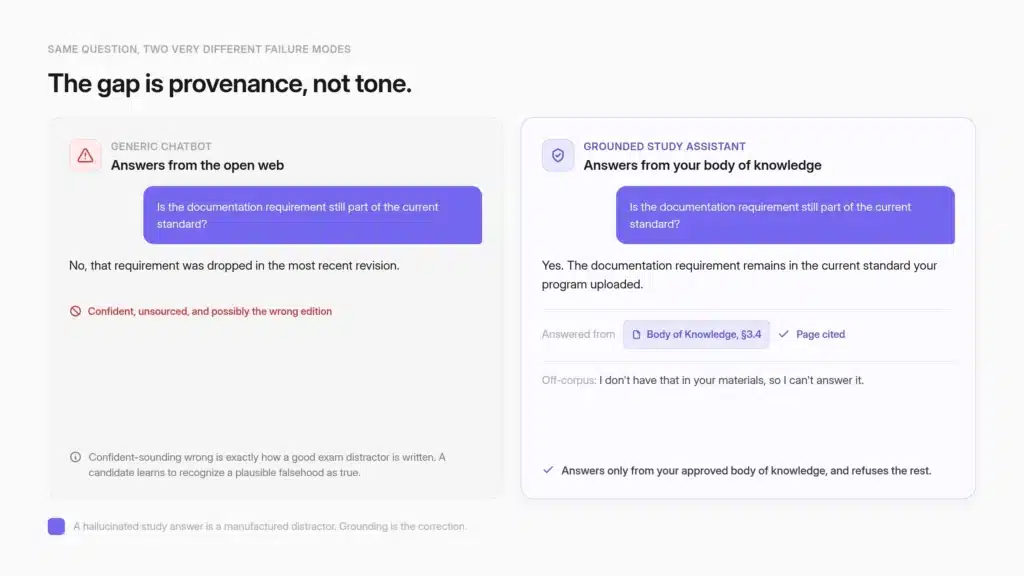
Two-column comparison: a generic chatbot gives a confident unsourced answer that can be wrong, while a grounded study assistant answers only from approved materials with a page citation and refuses off-corpus questions.
Benchmark data bears this out. In a 2026 benchmark of five frontier models, citation-heavy answers still failed 6.8% of the time even for the strongest model (GPT-5.5 Pro) and averaged 12.4% across the frontier, with the worst model (DeepSeek V4) at 19.1%.
The researchers were direct about the remedy: citation-heavy workloads “need either retrieval grounding or human-in-the-loop verification,” and they warned that “the model alone is not safe.” Your standards, codes, and syllabi are that kind of citation-heavy content.
One writer on AI-generated practice exams described the failure in blunt terms. With an ungrounded model “the candidate studies the question, internalizes the wrong answer as correct, and walks into the real exam with bad information their AI tutor confidently taught them,” which is “worse than no practice exam at all because it actively makes the candidate worse.”
The drift gets worse when your standard changes. A generic model trained on a previous version of an exam ends up “testing concepts that were cut from the exam, missing concepts that were added, or weighting domains incorrectly.”
For a credential you revise on a cycle, that is a recurring liability rather than a one-time bug.
Confident-sounding wrong is also how a good exam is built. Item-writing guidance tells authors to “write a distractor that is similar to the correct answer,” the option a candidate has to weigh against the right one, and warns that “it’s better to have three plausible options than to include a fourth nonsensical distractor.”
A hallucinated study answer is a manufactured distractor. It teaches a candidate to recognize a plausible falsehood as true, which is the exact wrong reflex for test day.

Grounding is the correction: the same 2026 benchmark found retrieval grounding cut citation hallucination by 75 to 90 percent, and CustomGPT.ai’s own independent RAG benchmark against OpenAI’s Assistant API showed a 10 percent lower hallucination rate across 945 questions and nine datasets.
Grounding does not reach zero, which is why the citation and the audit stay in the loop.
Certification is among the highest-margin assets an association owns, which raises the stakes on the study experience
Certifications sit near the top of the non-dues revenue mix, and they are durable because the association controls the standard behind them.
A study tool that erodes trust in that standard puts the association’s most valuable asset at risk, so the bar for accuracy is higher here than anywhere else in the member experience.
The economics are unusually good. Association-revenue guidance reports that “professional certifications are among the highest-margin non-dues revenue streams available to associations,” and the money recurs: “a single credential generates $4,000+ over 20 years at $200 annual recertification.”
The value case runs deeper than revenue. Roughly 39 percent of members “cite continuing education as their primary reason for joining,” and “nearly six in ten associations position certification and professional development as a core member benefit.”
For a large share of your members, the credential is the product they are paying for.
Certifications are durable precisely because the association controls the standard behind them, and that control is also the exposure.
A study assistant that quietly teaches a plausible but wrong version of the standard damages two assets at once: the pass-day outcome for the candidate, and the integrity of the credential the association sells and recertifies for decades.
The accuracy bar for a study tool is therefore higher here than anywhere else in the member experience, which is why a platform built specifically for member associations keeps the assistant anchored to the standard rather than drifting from it.
Answers come only from your uploaded materials, and off-corpus questions get an honest fallback
You upload the course reader, the official textbook, the candidate handbook, and the practice sets, and the assistant answers from those and nothing else.
You control what enters the knowledge base too, managing and removing sources so nothing stale or off-syllabus reaches a candidate’s answer, which is the first line of defense against a tool that confidently repeats a superseded edition of the standard.
When a question falls outside the approved materials, it says so rather than inventing a plausible answer, which is the behavior a credentialing body actually needs.
The mechanism is page-level indexing. A study assistant can index course readings and PDFs by page and return the exact page numbers and passages it used, with OCR support for scanned course packs, so an answer points a candidate straight to the assigned reading.
You can build the same quiz-and-practice experience directly from your textbook content, aligned to specific chapters and learning objectives so practice never drifts off-syllabus.
A context boundary keeps every answer derived solely from your uploaded content, and when the assistant has no grounded answer it returns an honest “source not found in your materials” instead of a guess, with the exact wording of that fallback configurable so it reads in your program’s own voice.
For a credentialing body, that refusal is the behavior you want.
Your body of knowledge is rarely just PDFs, and the ingestion accounts for that. Recorded lectures, exam-review webinars, and a video course library become answerable material too: connect a YouTube channel or playlist and the platform pulls transcripts into the knowledge base, while recorded audio files and Vimeo videos, channels, or showcases upload as sources of their own.
For a certification program whose prep content lives partly in hours of recorded instruction, that turns a shelf of videos a candidate would never scrub through into cited answers they can reach in a sentence.
That same shelf-of-content-nobody-can-find problem shows up across every association library, not just certification programs, see the companion piece on why members can’t find content they already paid for.
No public CustomGPT.ai reference is itself a credentialing body, but regulated-content organizations that face the same accuracy bar already run this pattern in production.
GEMA, the German music-rights society, reached an 88 percent query-success rate against a 70 percent benchmark on a knowledge base grounded entirely in its own approved documents. Grounding reduces hallucination but does not eliminate it, which is why citations and a review step stay attached to every high-stakes answer.
Every answer carries a numbered citation a candidate can check against the assigned reading
Each answer includes a numbered inline reference, and the source material is one click away. For a candidate, that turns a study answer into something verifiable against the exact reading the exam will test, instead of a fluent paragraph they have to trust on faith.
Numbered inline citations sit directly inside each response, with the source one click away, so a candidate reads the answer and checks the origin in the same motion. The habit that builds is the right one for exam prep.
Rather than memorizing whatever the assistant says, a candidate learns to trace a claim to the page in the official body of knowledge, which is the same discipline a well-written exam rewards.
Citations are on by default for every new project across all plans, and existing projects switch them on per agent in settings.
For a study program, that default is worth keeping on: the citation is what lets a candidate, an instructor, or a psychometrician confirm that the assistant is teaching the source of record and not a paraphrase that drifted.
The cited source does more than sit behind a link. An instant viewer can display the referenced PDF right inside the chat, and you set whether a candidate may open or download the original file, so a candidate checks the page against the answer without leaving the study session, and a controlled source stays controlled.
By default a citation points a candidate to the exact page of a source you host, which is the whole promise of the tool. The exception is a paywalled official text you cannot host in full. There, a citation’s target is editable metadata, so a program can set it to the text’s purchase or enrollment page rather than leave a dead reference.
That keeps the provenance link exact for the materials you own, while a candidate who needs the full external text is routed to the association’s own paid source instead of a broken link.
Verify Responses proves, claim by claim, that an answer traced to your official materials
Citations let a candidate check one answer. Verify Responses lets your team check the assistant itself.
It extracts every factual claim from a response and cross-references each one against your source documents, producing a verified-claims score so you can see, before members ever rely on the tool, how tightly its answers track your official materials.

The audit is a builder-and-admin tool. The Claim Verifier extracts each claim and scores it against your source documents, and the verified-claims score is simply the verified claims divided by the total.
Candidates never see this panel. They get a clean chat with citations, while your education staff get the evidence that the assistant is grounded, plus a direct signal of where your own materials have gaps.
Verify Responses also runs a Trust Score, a virtual committee of six stakeholder views (End User, Security and IT, Risk Compliance, Legal Compliance, Public Relations, and Executive Leadership) that reviews each response for the risks the corresponding role would flag.
For a credentialing committee that has to approve a member-facing tool, those six views map onto the people whose sign-off you actually need, so a legal or risk reviewer can see how an answer reads through their own lens before candidates rely on it.
On plan gating, the live pricing page is the authority: Verify Responses is available on every plan (Standard, Premium, and Enterprise), and usage burns fewer credits on the Premium and Enterprise tiers.
For a credentialing program, run the audit against your own agent while you build and test, then keep it available for spot-checks so you can answer “prove this answer came from our body of knowledge” with a score, not an assurance.
It is a scoring tool your team points at the assistant during rollout, not a filter a candidate ever sees.
A study-helper persona raises pass rates without doing the candidate’s thinking
A study assistant should coach recall, not hand over an answer key.
Configured with a study-helper persona, it makes the candidate attempt first, critiques the reasoning, and refuses to produce work a candidate could submit as their own, which keeps it on the right side of exam integrity.
A study-helper persona is built to make the learner answer first and then give feedback on reasoning, and it is instructed not to write anything a candidate could hand in as a final answer. You set that behavior in the persona builder, tuning how the assistant coaches rather than answers.
Grounded to your approved materials, it coaches the standard through retrieval practice and spaced review without exposing a live exam or an answer key, because it works from the published body of knowledge, not the secure item bank.
For the highest-stakes content, add a review step: keeping a human in the loop lets staff review and approve answers before candidates see them, so a subject-matter expert stays accountable for what the assistant teaches.
The persona shapes behavior, the grounding sets the boundary, and the human review covers the edge cases that matter most for a credential.
Access stays scoped to your candidates, and your content is never used to train a model
Before a study assistant faces candidates, your board will ask two questions: who can reach it, and where does our content go.
A defensible answer scopes access through your existing identity provider, holds independent security certification, and guarantees your materials are never used to train the underlying model.
On data protection, CustomGPT.ai is SOC 2 Type 2 and GDPR compliant, encrypts data with 256-bit AES at rest, and does not use your data to train the underlying model. That last point is the direct answer to “does the vendor train on our proprietary exam materials,” and the answer is no.
On access, SAML 2.0 lets you govern who can use the assistant through your existing identity provider, set up through a configuration import with the major providers, so the study tool can be scoped to enrolled candidates and members rather than opened to the public web.
Gating chat access through your own login system sits on the Enterprise tier per the pricing table, so scope that into the plan the credential program runs on. Regulated-content organizations run exactly this pattern.
VdW Bayern DigiSol, a federation of more than 500 housing organizations, went live on 3,620 internal documents in under 60 days with no code, on content it needed to keep controlled.
One honest boundary belongs here too: conversation analytics show you where candidates struggle in aggregate, which is a content-gap signal for your study materials, not a per-member performance tracker or a surveillance tool.
You can build and embed the assistant without a developer
A study assistant is a configuration project, not an engineering one. A no-code build ingests the messy PDF archives and mixed formats a certification program actually holds, embeds into the LMS or candidate portal you already run, and reaches a working state in weeks rather than quarters.
The platform is no-code, ingests 1,400-plus file formats, and connects through 100-plus integrations, which matches the reality of a certification program whose body of knowledge lives in PDFs, course readers, and scanned handbooks rather than a clean database.
It embeds into your existing LMS, course website, or member portal as an authenticated iframe, so candidates study inside the environment they already use. That embed enforces the same identity-provider sign-in that scopes access: the identity provider decides who is allowed in, and the authenticated embed applies that rule wherever a candidate studies.
Across association deployments, the typical pattern reaches a live, working assistant in about two weeks. Standing up a cited, grounded study assistant on the content you already own is a weeks-long project, and the association keeps ownership of the standard the whole way through.
A certification study assistant is one of several role-scoped use cases an association can run on the same grounded platform, alongside a member portal copilot, new-member onboarding, and a staff knowledge assistant.
What a credentialing-grade study assistant requires, in one view
A study assistant is safe to put in front of exam candidates when it meets a short, checkable list:
- Grounded-only answers from your approved body of knowledge
- Page-level citations on every response
- A claim-by-claim audit (Verify Responses) a builder can run on demand
- Access scoped to your candidates through your identity provider
- Aggregate-only analytics that flag content gaps without tracking individuals
- An honest off-corpus fallback that says “not in your materials” instead of guessing
None of those six is the chat interface. The chat box is a commodity. The provability underneath it, the ability to show that every answer traces to the source of record, is what protects the integrity of the credential while the assistant raises pass rates.
Grounding reduces hallucination without eliminating it, so the citations and the audit are not decoration. They are how a credentialing body keeps a fast, always-on study tool honest.
Give your candidates a study assistant that cites the exact page and refuses to guess, built on the body of knowledge you already own. Start a free trial or book a 15-min discovery call with the CustomGPT.ai team to stand it up on your own materials.
Frequently asked questions about AI exam prep for associations
Will an AI study assistant expose our exam questions or answer key?
No, because it works from your published body of knowledge rather than your secure item bank. You upload the course reader, the official textbook, and the candidate handbook, and the assistant answers from those approved materials only. The live exam and the answer key never enter its knowledge base, so it cannot reveal what it was never given. A study-helper configuration goes further and refuses to produce work a candidate could hand in as their own.
How is this different from telling candidates to just use ChatGPT for exam prep?
A general chatbot answers from the open web, so on your specific standard it produces fluent, confident, and sometimes wrong content. That is the worst failure for exam prep, because a candidate can internalize a plausible falsehood and carry it into the real exam. A grounded study assistant answers only from your approved materials and cites the passage it used, which reduces hallucination without claiming to eliminate it. What separates the two is provenance. The grounded assistant can show where every answer came from.
What happens when a candidate asks something our study materials do not cover?
It tells them so instead of inventing an answer. When a question falls outside the approved content, the assistant returns an honest “not found in your materials” rather than a confident guess. For a credentialing body that refusal is the safer behavior, because a declined question sends a candidate back to the syllabus or a human, while a fabricated one teaches the wrong version of the standard you certify.
How does a candidate know a study answer is actually correct?
Every answer carries a numbered citation, and the source reading is one click away. A candidate reads the response and checks it against the exact page the exam will test, in the same motion. That habit is the right one for exam prep, because it trains a candidate to trace a claim to the official body of knowledge instead of memorizing whatever a tool says. Inline citations sit directly inside each response, so the origin travels with the answer.
How do we prove to our credentialing committee that the answers trace to our materials?
You run a claim-by-claim audit before candidates ever rely on the tool. Verify Responses extracts every factual claim from an answer, cross-references each against your source documents, and returns a verified-claims score, which is the verified claims divided by the total. Candidates never see that panel. Your education staff get the evidence that the assistant is grounded, plus a signal of where your own materials have gaps worth closing.
We revise our body of knowledge on a cycle. How does the assistant stay current with the standard?
You re-index when the standard changes, and the assistant answers from the updated materials. A generic model trained on a previous exam version blends cut concepts with current ones and weights the domains incorrectly. Because a grounded assistant reads only the documents you upload, replacing the old edition with the revised one moves the whole tool to the current standard at once. You can also rebuild practice questions from the updated content so review never drifts off the live syllabus.
Can we limit the study assistant to enrolled candidates only, and will our materials train your model?
Access can be scoped to your candidates through your existing identity provider, so the tool is reachable only to people who can sign in, not the open web. On the data question, your uploaded materials are not used to train the underlying model, and CustomGPT.ai holds SOC 2 Type 2 certification with 256-bit encryption at rest. Those two answers, who can reach it and where the content goes, are usually what a security review asks first.
Can a study assistant actually raise pass rates, or is it just a search box?
It coaches recall rather than handing over answers, which is what moves outcomes. Configured with an answer-first tutor persona, it makes the candidate attempt first, critiques the reasoning, and works through the standard with retrieval practice and spaced review the way a well-run study program does. It stays grounded in your published body of knowledge rather than exposing a live exam. The pass-rate lift itself is the association’s to measure on its own candidate data.
Our body of knowledge is a pile of PDFs and scanned handbooks. Can it use those?
Yes, that mixed archive is the normal starting point. A study assistant indexes course readings and PDFs by page, with OCR for scanned course packs, and returns the exact page numbers it drew from. There is no clean-database requirement and no developer needed. The messy reality of a certification program, official texts, course readers, and scanned candidate handbooks, is what the ingestion is built to handle.
Can we see which topics candidates struggle with without tracking individuals?
Yes, and the limit is deliberate. Conversation analytics are aggregate, so they show which topics the candidate pool asks about and where answers run thin, not what any single candidate did. That gives your education team a live content-gap map for the study materials while keeping the tool from becoming per-member surveillance. Plan your measurement around topic patterns rather than individual trails.
Does every plan include the answer audit, or is it enterprise-only?
The audit is available on every plan. Per the live pricing page, Verify Responses ships on Standard, Premium, and Enterprise, and usage burns fewer credits on the Premium and Enterprise tiers. Inline citations are on by default for every new project across all plans. A credentialing program can run the audit while it builds and tests, then keep it available for spot-checks in production.
Related Resources:
- ChatGPT vs. Your Own Member AI: Compare both approaches to determine which best fits your association’s member support, security, and knowledge management needs.
- How to Stop Silent Member Churn with AI: Learn how AI helps identify at-risk members, automate support, and strengthen retention before renewal season.
- Add an AI Copilot to Your Member Portal: See how to securely deploy an AI copilot behind member login using member-only content and verifiable citations.
- Help Non-Technical Members Adopt AI: Explore proven techniques for building trust, reducing adoption barriers, and helping members confidently use AI tools.
- AI for State Bar Associations: Learn how a similar grounded, cited approach makes a bar association’s CLE library and practice manual findable for members.