
How to Stop Silent Member Churn with AI
Silent member churn happens when members stop seeing the value they pay for, and AI keeps that value in view between renewals.
Most members do not quit. They drift, going quiet in the long months between renewals until an invoice arrives and simply goes unpaid.
That is silent member churn: members disengage and let their membership lapse with no complaint, no warning, and no cancellation request, so the association only learns about it when the renewal does not come.
Associations reduce it with AI by giving members instant, cited answers to the content they already paid for, which keeps the membership useful in exactly the stretch where value usually fades from view.
A member who stopped opening the newsletter, stopped attending events, and stopped logging into the portal looks identical to an engaged member right up to the moment they lapse.
The lever against that is continuous, on-demand value: something a member reaches for on a Tuesday afternoon with a real question, answered from the content they already pay for. That is the shape of an answer engine built specifically for member associations, and it keeps members active in the window between events and renewals where quiet attrition takes root.
This is not theoretical. GEMA’s member assistant, Melody, already fields 248,000+ member and customer inquiries at an 88% success rate for a 100,000-member society.
Want to make member value visible between renewals? Start your free trial and build a member assistant on your own content.
Members churn quietly when the association goes silent between touchpoints
Most association contact is episodic: a welcome email, a conference, a quarterly journal, a renewal notice. Between those moments the relationship goes dark, and a member left alone with an unanswered question feels the dues less and less.
Nobody sends a resignation letter over a portal they could not navigate or a benefit they forgot existed.
They simply do not renew when the invoice arrives, and staff learn about the disengagement months after it started. Underneath, perceived value has been fading the whole time.

An assistant that answers the small questions in those dark stretches keeps the association present when it would otherwise be invisible.
A member who hears from you year-round feels supported; a member who only hears from you when money is due does not.
Continuous, on-demand value does more than another outbound campaign
The instinct when renewals slip is to push more messages: another email nudge, another webinar invite. Outbound marketing reaches members on the association’s schedule, and a disengaged member is the one who tunes it out. On-demand value flips the timing.
A member asks a question the moment it matters to them, and the answer arrives grounded in the content they already pay for. That kind of interaction earns a member’s attention by being useful first. It also compounds, because every useful answer is a small reminder that the membership does real work in a member’s day.
A campaign asserts the value; a good answer to a real question at the moment it matters demonstrates it, which is the harder and more durable signal against a quiet lapse.
Lack of engagement, ahead of price, is the top reason members do not renew
The leading reason members do not renew is lack of engagement with the organization, named by 52% of associations in i4a’s read of Marketing General’s benchmarking data.
Price matters less than attention. That pressure is still building: Marketing General’s 2026 benchmarking report shows 30% of associations reporting a membership decline, against 39% reporting growth, and it ties new-member growth to engagement.
The median membership renewal rate has slipped to 82% in the 2026 report, which means the typical association loses roughly one member in six every cycle.
52% of associations name disengagement as the number one non-renewal driver
When associations are asked why members lapse, disengagement tops the list, well ahead of sticker shock. More than half of associations put lack of engagement with the organization first, ahead of budget and ahead of a member changing jobs.
The fix, then, is not a discount or a payment plan. If a member never felt connected to what the dues bought, a lower price only delays the same outcome. The benchmark data frames engagement as the retention problem to solve first.
An assistant that gives members a reason to interact between renewals attacks that number one driver directly, which is a more precise intervention than another round of value-defense marketing aimed at people who have already stopped listening.
Median renewal has slipped to 82%, and most associations cannot articulate their value
The renewal rate and the value gap describe the same wound from opposite sides. The typical association renews 82% of members while only 11% rate their own value proposition as very compelling.
Members leak out the bottom while the organization struggles to state, in a way members feel, what the membership is for.
Closing that gap mostly means making the benefits an association already offers legible and usable at the moment a member needs them.
Instant, cited access to the content a member already paid for is one way to make an abstract value proposition concrete, turning a benefits page nobody reads into an answer a member actually receives.
The churn drivers mapped to the AI lever for each
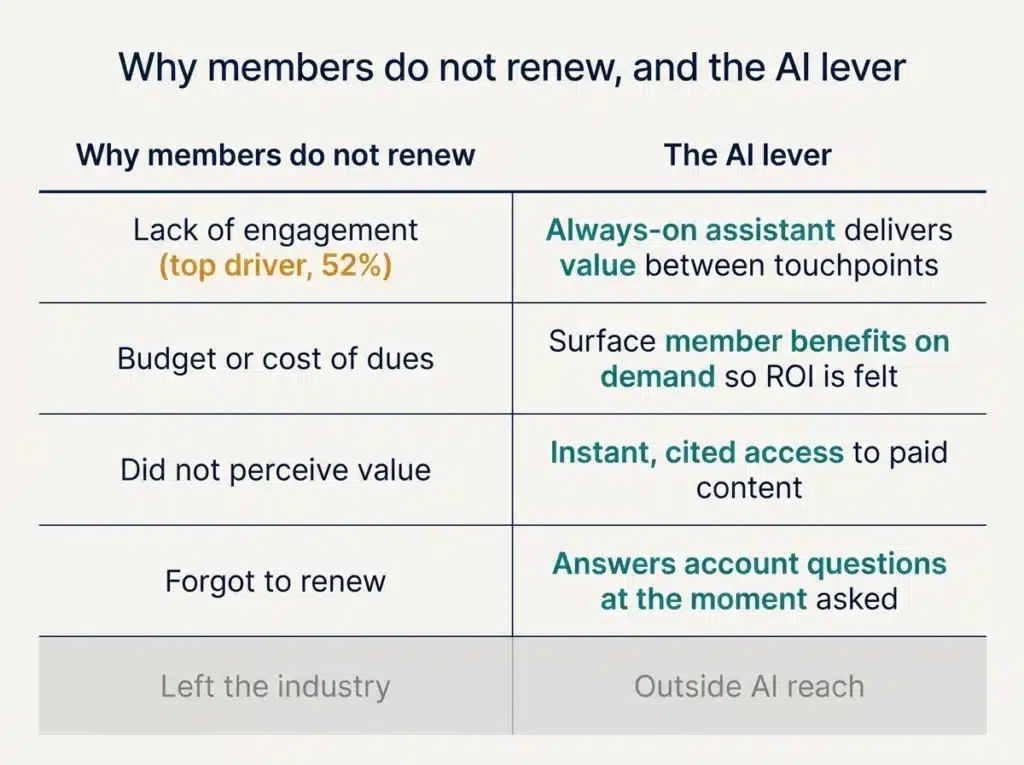
Lack of engagement leads the reasons members give for not renewing, at 52%. The other common reasons each map to a specific lever an AI assistant can pull, and one falls outside anything an assistant can reach.
| Why members do not renew | The AI lever |
|---|---|
| Lack of engagement with the organization (the top driver, at 52%) | Always-on assistant that delivers value between touchpoints |
| Budget or cost of dues | Surface member benefits on demand so dues ROI is felt |
| Did not perceive enough value | Instant, cited access to the paid content members can actually use |
| Forgot to renew | Answers renewal and account questions on demand (automated reminders stay an AMS job) |
| Left the industry or field | Outside AI’s reach, an honest limit |
A member who leaves the profession entirely is beyond what any assistant can hold, and pretending otherwise would overstate the tool. Lack of engagement sits at the top of that list in Marketing General’s benchmarking data.
For the four drivers above the last row, the common thread is felt value in the gaps, which is the work an assistant is built to do.
Members abandon value they cannot find, so instant access to paid content is the core lever
Members leave value they cannot find. When answers to paid content sit buried in PDFs, recorded webinars, and member portals, perceived value falls and renewal follows.
A member-trained assistant surfaces that knowledge on demand, returning an answer with a clickable citation to the exact source instead of sending the member back to a search box.
Buried knowledge lowers perceived value and precedes churn
Associations sit on deep libraries: standards, research reports, on-demand webinars, and compliance guidance. Most of it is locked inside formats that resist a quick answer.
A member with a five-minute question does not download a 60-page PDF and skim for the relevant clause. They give up, or they ask a general search engine that has never seen the member-only content.
Either way the association’s best asset went unused, and an unused benefit is an unfelt benefit. Association and AMS blogs describe this buried-content problem well, yet they rarely turn the diagnosis into a working mechanism for instant access.
The gap between owning valuable content and delivering it at the speed of a member’s question is where perceived value quietly erodes into a non-renewal nobody saw coming.
On-demand, cited access turns paid content into felt value
An assistant trained on the association’s own corpus changes the retrieval cost of that library from minutes of searching to seconds of asking, and it can connect to the content sources and systems an association already runs rather than forcing a migration.
A member types a question in plain language and receives an answer drawn from the approved content, with the source cited so they can verify it.
On its own data, CustomGPT.ai reports that up to 93% of repetitive member questions can be handled this way, which frees staff for the higher-value member work that does not fit a lookup. That fast access turns a paid-for but hidden library into value a member actually experiences in the weeks between renewals.
Engagement lift is the leading indicator against silent attrition
Because engagement is the number one non-renewal driver, a rise in engagement is the earliest readable signal that silent churn has less room to operate.
On its own data, CustomGPT.ai reports member usage rising 2-6x once members can get instant, cited answers. A member asking the assistant three questions a week is finding the membership useful, and useful memberships lapse less.
Lifting the share of members who actually reach for the assistant is its own discipline, with practical ways to raise member engagement rates. What matters is the timing: engagement moves before renewal does, so staff get a signal they can act on ahead of the invoice.

First-year members are the highest-risk cohort to lose, and onboarding-era engagement is the biggest lever
First-year members are the cohort most likely to leave, renewing at a median of roughly 75% against the 82% overall rate, close to 25% first-year churn. Onboarding-era engagement is the strongest lever. Absorbing the flood of early member questions with an always-on assistant keeps new members active while the relationship is still forming.
First-year renewal runs about seven points below the overall rate
New members are the most fragile cohort an association has. As i4a reports from the benchmarking data, first-year renewal sits at a median of roughly 75%, about seven points below the 82% overall rate, which means roughly a quarter of new members never make it to a second term.
The reason is usually the onboarding period itself. A first-year member has the most questions and the least idea of where to find answers, so friction is highest exactly when loyalty is lowest. Every unanswered question in those early weeks is a small confirmation that the membership might not be worth the effort.
Reducing that early friction is the highest-leverage retention move an association can make, because saving a first-year member protects the entire lifetime of dues that follows.
Absorbing early member questions keeps new members engaged
The friction that drives first-year drop-off is high-volume, repetitive support: how do I access this benefit, where is that document, what does my membership include, how do I register. Picture the new member at 9pm who cannot find how to claim a benefit they just paid for. A silence there is a quiet vote that the dues were not worth it. An instant, cited answer is a vote that they were.
Multiply that across every early question, and you have kept a member who would otherwise have drifted to a non-renewal nobody flagged. An always-on assistant absorbs exactly this load at scale.
GEMA’s member assistant, Melody, answered 248,000+ member and customer inquiries at an 88% success rate and saved more than 6,000 staff hours for a 100,000-member society. That is the same category of routine, high-volume question that swamps a small team during onboarding season, handled instantly instead of landing in a queue.
Jonas Walther, Manager Data and AI at GEMA, put it this way: “CustomGPT.ai isn’t just a support tool. It’s become a knowledge infrastructure for our organization. It allows us to serve members, customers, and employees better, faster, and smarter.”
See what that looks like on your own content. Start a free trial and build a member assistant on the content you already publish.
Member-only access makes the paid library feel exclusive to members
Members reward an easy, exclusive experience with loyalty, and 80% of members who receive a personalized experience plan to stay for the next five years.
Gating an assistant behind SAML 2.0 single sign-on keeps the member-only library behind the member login, so the content a member paid for feels like theirs rather than something anyone can find on the open web.
80% of members who feel a personalized experience plan to stay five years
An easy, respected experience earns loyalty. The Association Member Experience Report finds that 80% of members who say they receive a personalized experience also plan to stay members for the next five years.
Ease of involvement compounds the effect: members who described getting involved as very easy reported 95% engagement and 93% five-year renewal intent. When the membership experience feels frictionless and built for members, members picture themselves staying for years.
A member-trained assistant contributes by making the member-only library instantly usable behind a member’s login, so a resource that used to sit locked in a portal feels like it belongs to the members who paid for it.
SAML 2.0 single sign-on keeps the assistant member-only
The exclusivity depends on the assistant knowing that the person asking is a member. CustomGPT.ai supports SAML 2.0 authenticated access, letting an association control who can reach the agent through its existing identity provider. You configure single sign-on once against the identity provider you already run.
A member logs in once and reaches an assistant closed to anyone outside the membership, which is what turns a shared knowledge base into something that feels member-only and premium.
The value a member feels is partly the answer and partly the sense that this resource is theirs by virtue of their dues, which is hard to reproduce when the same content is floating on the open web with no membership attached to the request.
Answers that differ by member tier or role are a separate, configurable layer on top of that access, not something single sign-on delivers on its own.
SOC 2 Type 2, GDPR, and no-training-on-your-data keep member knowledge safe
Members are handing the assistant access to paid, member-only knowledge, so the trust layer is part of the value. CustomGPT.ai is SOC 2 Type 2 compliant and GDPR-ready, keeps member data out of model training, and holds it within the association’s own bot instance.
Those guarantees are what let an association put proprietary content behind an assistant without worrying it will leak into a general model.
A real-world example of members trusting and using such an assistant: VdW Bayern’s WohWi assistant serves 500+ member organizations and drew 84% positive feedback across 7,000+ queries in under six months, while cutting document-creation time from 45-plus minutes to 15-20.
Dr. Korbinian Weisser, Managing Director of VdW Bayern DigiSol GmbH, said the assistant “enables members to make informed decisions faster and with greater confidence.”
Cited, grounded answers keep members trusting the assistant
Trust decides whether members keep using an assistant, and 94% of members say they are comfortable with associations using AI. Every answer returns its exact sources inline, grounded to the association’s approved content. Grounding reduces hallucination without fully eliminating it, so a well-built assistant admits when it does not know an answer.
94% of members are comfortable with associations using AI
The common objection that members will reject AI does not hold up against the data. Higher Logic’s 2026 association-trends analysis reports that 94% of members say they are comfortable with associations using AI.
Comfort is not the same as blind trust, though. Members are comfortable with AI on the condition that it gets their answers right and does not put words in the association’s mouth. That condition is what a grounded, cited assistant is designed to meet.
The openness is already there, and the association’s job is to deploy AI in a way that earns and keeps the trust members extend, so it never spends that trust on confident wrong answers that make members doubt the source.
Inline citations let a member verify every answer
The mechanism that makes an answer trustworthy is verifiability. Every response returns the exact sources the assistant used and stays boundaried to the association’s approved content, and showing those sources inline is a setting builders switch on per agent rather than something they have to build.
A member reading an answer about a certification deadline or a compliance requirement can click straight through to the source document instead of taking a paragraph on faith.
Before rollout, builders can go a step further and audit an answer’s claims against its cited sources, a builder-side scoring tool for catching weak spots in testing rather than a filter the member ever sees, and the grounding pays off there too: CustomGPT.ai posted a lower hallucination rate and higher accuracy than a leading general model in a RAG benchmark.
For an association, the citation trail does double duty: it lets members verify, and it keeps the assistant’s authority tied to the organization’s own vetted material rather than to the open web.
A grounded assistant admits when it does not know
What keeps it honest is boundary behavior. When the assistant does not have a grounded answer in the approved content, it says so rather than guessing, replying that it does not know, and the exact wording of that response is configurable so it reads in the association’s own voice.
That admission beats a fluent guess, because a wrong answer in front of a member costs trust that took years to build.
The same grounding lets one assistant serve a diverse membership around the clock and answer in a member’s own language, always drawing from the association’s approved content rather than the open web.
Engagement is measurable, so staff can act before renewal, not after
Engagement is measurable before renewal, not only after it. Usage analytics show queries per conversation and interaction depth per user, so staff can see who has gone quiet and reach out early.
What the analytics do not produce is a predictive per-member churn probability, so treat this as observed engagement to act on, not a forecast of who will leave.
Queries per conversation and interaction depth reveal engagement
Retention work usually suffers from a data lag: staff see the lapse after it happens, when it is too late to act. An assistant that members actually use generates a live engagement signal instead.
The analytics layer lets staff analyze the efficiency of interactions and the level of engagement per user with the queries-per-conversation metric, along with what members are asking and whether their needs are being met.
Account-level analytics report total conversations, queries submitted, and the average queries per conversation across a chosen window, so a membership team can watch engagement depth rise or thin week over week instead of waiting for a renewal report.
A customer-intelligence view opens any single conversation to surface its sentiment, the member’s intent, and the sources the assistant used, which turns raw query counts into a read on which topics members struggle with and where the assistant is delivering value.
The insight arrives while there is still time to intervene, which is a meaningful shift from a renewal dashboard that only confirms losses after the fact.
Aggregate engagement visibility flags fading members without predicting churn
Be precise about what this is: observed engagement, not a churn forecast. Staff can see who has gone quiet and which cohorts are fading, but the analytics do not output a per-member churn probability or a predictive early-warning model.
AMS predictive-churn tools often promise a tidy risk score, and those models lean on clean, structured member data that most associations do not have.
Observed engagement is the more grounded offer: staff act on a real signal, following up with a call or a targeted resource before the renewal window, without pretending the software knows in advance which individual member will leave.
How to reduce silent member churn with AI, in five steps
Reducing silent churn with a member assistant is a sequence, not a switch. Five steps take an association from scattered content to a member experience that holds attention between renewals.
- Ingest the content members already pay for. Point the assistant at the standards, journals, event recordings, and help articles that hold the answers. A no-code platform connects to the systems an association already runs, so the corpus can come from the AMS, the LMS, a document vault, and the website without a migration.
- Decide who owns the answers. Name a staff owner for each content area and a review path for sensitive topics, so the assistant speaks with the association’s authority rather than guessing. This is where the real content mess gets handled. The platform lets you manage and remove sources, so your team can retire stale documents; deciding which version is canonical when two sources conflict, and how often to review the corpus, is editorial judgment the team owns. It is ongoing work, but it is editorial, not engineering, so a two- or three-person team can handle it.
- Gate it to members. Put the assistant behind single sign-on so it stays exclusive to members and safe for member-only material.
- Watch engagement, not just deflection. Track queries per conversation and interaction depth to see who is using the membership and who has gone quiet, well before a renewal report would show it.
- Act on the quiet. When a member or a cohort fades, follow up with a call, an invitation, or a targeted resource inside the renewal window, while there is still time to change the outcome.
The first three steps stand the assistant up in about two weeks. The last two are the ongoing retention discipline the tool makes possible.
What a stronger first year does for the dues you keep
The business case runs through the first-year cohort, because that is where the churn and the leverage both concentrate. The math is simple to run for a specific association.
Take a 10,000-member association at the 82% median renewal rate, with a 1,500-member first-year cohort renewing at 75%. Lifting that first-year rate by five points to 80% keeps 75 members who would otherwise have lapsed.
At $300 in annual dues, that is about $22,500 in year-one dues protected, and several times that across the members’ remaining tenure. An assistant does not create that lift on its own.
It removes the early friction that causes first-year drop-off, and the engagement analytics show whether the lift is happening, so the association can attribute the result honestly rather than assume it.
Watch two kinds of indicator. Leading indicators move first: engagement lift, queries per conversation, share of member questions answered, and response time.
Lagging indicators confirm the outcome: renewal-rate movement, at-risk-member retention, and staff hours returned to higher-value work. Because retention has several drivers, credit the assistant as one contributing lever, not the sole cause of a renewal change.
AI is one retention lever, not a cure for member churn
Renewal is driven by community, relevance, price, and career value together, and an assistant does not fix a weak value proposition or replace real community.
What it attacks is the disengagement that quietly precedes most non-renewals, which is the number one sourced reason members leave. By making value available on demand in the quiet stretches between events and renewals, it gives that disengagement fewer places to take hold.
One lever, heavily weighted, moved better than most alternatives. That is the honest claim, and it is enough.
The named results in this piece make the honest version of the case.
GEMA and VdW Bayern are engagement, volume, and satisfaction numbers, not renewal figures. They show that members will actually use and trust a member-trained assistant at scale, which is the mechanism retention depends on.
The renewal lift itself is yours to measure, which is why the analytics matter as much as the assistant.
Retention and revenue are the two halves of the member-value story, so it is worth seeing how associations turn a member-trained assistant into non-dues revenue alongside the retention case, and understanding why members bypass an AI agent and how to earn that trust back, since adoption is the precondition for either.
Member disengagement is the churn you cannot see until it is too late to act. You can catch it sooner.
Start your free trial and build a member assistant on your own content.
FAQ
Why do members not renew their association membership?
The top reason is lack of engagement with the organization, named by 52% of associations in Marketing General’s Membership Marketing Benchmarking Report. Budget, weak perceived value, forgetting to renew, and leaving the industry follow behind it. Price plays a part, though disengagement leads the list. Most members leave quietly, drifting away when membership value goes unseen between renewals.
What is a good first-year member retention rate for associations?
Across associations, the median overall renewal rate is about 82% in the 2026 report, while first-year members renew at a median near 75%, roughly seven points lower. A first-year rate above 82% is strong, and below 75% signals a systemic onboarding problem. First-year members are the highest-risk cohort, so that early-renewal number is the one worth watching most closely.
Why do so many first-year members fail to renew?
New members carry the most questions and the least idea of where to find answers, so friction peaks exactly when loyalty is weakest. First-year renewal sits near 75% against the 82% overall rate, about a quarter of new members lost in year one. Every unanswered onboarding-era question quietly signals the membership may not be worth the effort, which makes reducing that early friction the highest-leverage retention move.
How can associations reduce member churn?
Since lack of engagement is the top non-renewal driver at 52%, the highest-leverage moves raise engagement between touchpoints: strong onboarding, personalization, easy access to benefits, and timely win-back. Making paid content instantly usable is one lever, and turning an association’s existing library into an always-on member assistant is how associations put that value in front of members. Retention also depends on community, relevance, and price, so treat AI as one lever, not a cure.
Is member churn really about price, or about engagement?
Engagement leads. In Marketing General’s Membership Marketing Benchmarking Report, 52% of associations name lack of engagement as the top non-renewal reason, the single most-cited driver. Price is real, though a lower price only delays the outcome when a member never felt connected to what the dues bought. The more durable fix is making membership value felt through the year rather than discounting it.
What is the strongest predictor of whether a member will renew?
Engagement is the strongest signal. Members who found getting involved very easy reported 95% engagement and 93% five-year renewal intent, and 80% of members who feel they get a personalized experience plan to stay five years. Disengagement, by contrast, is the number one non-renewal driver at 52%. Ease of involvement and personalization move renewal more than almost anything else.
Can AI predict which members are likely to churn?
Some AMS tools score churn risk from behavioral data, but those models depend on clean, structured member data that many associations do not have. A more accessible signal is engagement itself. Aggregate usage analytics, like queries per conversation and interaction depth per user, let staff spot members going quiet and reach out early. That is engagement visibility rather than a per-member churn prediction, so treat it as a signal to act on early.
How can an AI knowledge assistant improve member retention?
An AI knowledge assistant attacks the top churn driver, disengagement, by giving members instant, cited answers from content they already paid for, around the clock. That keeps the association useful between events and renewals, where quiet attrition takes root, and member usage often rises 2-6x once instant answers replace the search. Retention stays conditional, since members who find value stay, and AI is one lever among community, relevance, and price.
Why can’t members find answers in our own content, and how does that drive churn?
Associations sit on deep libraries of standards, research, webinars, and templates, most of it locked in PDFs and portals that resist a quick answer. A member with a five-minute question will not skim a 60-page report; they give up, and a benefit a member never uses does nothing to hold them. That gap between owning valuable content and delivering it at the speed of a question is where perceived value erodes into a non-renewal nobody saw coming.
Are members comfortable with associations using AI?
Broadly yes. Higher Logic’s 2026 association-trends analysis finds that 94% of members say they are comfortable with associations using AI. That comfort is conditional: members expect AI to get answers right and not put words in the association’s mouth. A grounded assistant that cites its sources and admits when it does not know is how an association earns and keeps that trust instead of spending it on confident wrong answers.
How do you measure the ROI of AI for member retention?
Watch leading and lagging indicators together. Leading indicators include engagement lift, queries per conversation and interaction depth, share of questions answered, and response time. Lagging indicators include renewal-rate movement, at-risk-member retention, and staff hours saved on repetitive questions. Because retention has many drivers, attribute AI as one contributing lever rather than the sole cause of any renewal change.
Related Resources:
- Compare ChatGPT with a custom member AI to understand which solution best fits your association’s member support and knowledge management needs.
- Add an AI Copilot to Your Member Portal: Use this guide to deploy a secure AI copilot behind member login with trusted citations and member-only knowledge.
- How to Increase AI Adoption Among Non-Technical Members: Learn how to build trust, reduce friction, and help members confidently use AI.
- An AI Study Assistant for Your Certification Program: Learn how to deliver secure AI-powered exam preparation using approved study materials without exposing answer keys or inventing information.
- AI for State Bar Associations: Discover how bar associations make CLE content findable for members instead of leaving it buried in a portal.