
ChatGPT vs. Your Own Member AI: What Associations Should Actually Deploy
Associations should give members an AI grounded in their own approved content rather than point them to ChatGPT, and CustomGPT.ai does that, returning the exact sources behind every response as clickable citations.
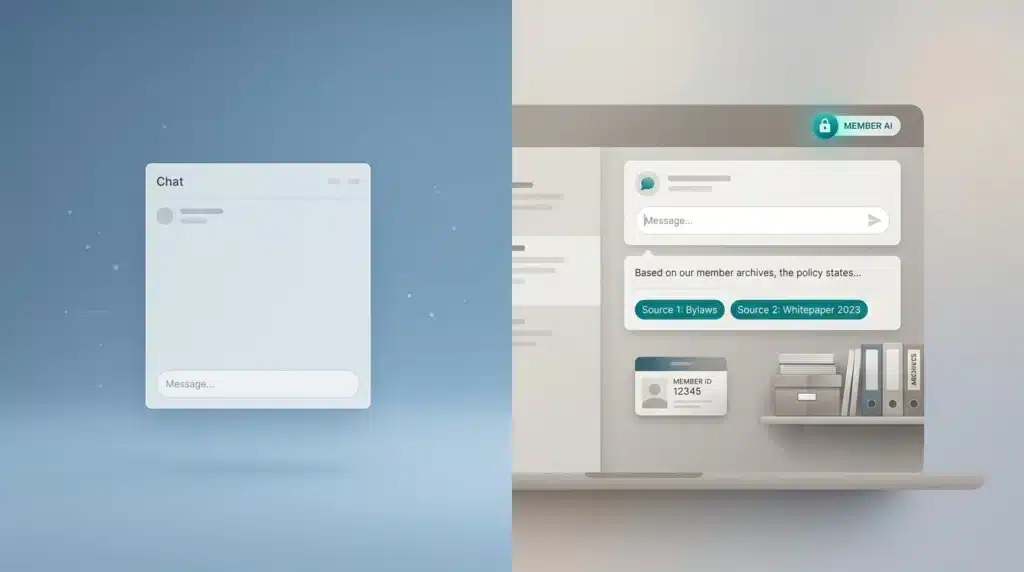
General-purpose models are useful, but they cannot cite your association’s approved content, they do not know who a member is, and they quietly move authority away from you.
The better option is a member-trained assistant grounded in your own library that cites every answer.
Your members already reach for public AI tools before they open your member portal. In the Thomson Reuters Institute 2026 AI in Professional Services report, organization-wide use of AI nearly doubled to 40% this year from 22% in 2025, and a majority of individual professionals said they now reach for publicly available tools such as ChatGPT.
The gap is structural rather than a knock on ChatGPT: a generic model answers from the broad public web, so it never sees your bylaws, standards, certification syllabi, or gated research. On the questions only your association can answer, it guesses.
A member AI grounded solely in your approved content, returning clickable citations, and gated so that members, staff, and prospects each reach only what their role should see, closes that gap. That is the shape of an answer engine purpose-built for member associations.
ChatGPT cannot cite your gated association content by default
General-purpose models draw on broad public training data, so they cannot link an answer back to your gated bylaws, standards, or member-only research unless that content is connected, permissioned, and available to the model. A member-trained assistant returns the exact sources it used on every answer, giving members and staff a click-through trail to verify against your approved content.
ChatGPT is a strong drafting and reasoning partner, and members are right to use it for general work. The thing generic ChatGPT cannot do on its own is cite your proprietary corpus, because it was never given that corpus.
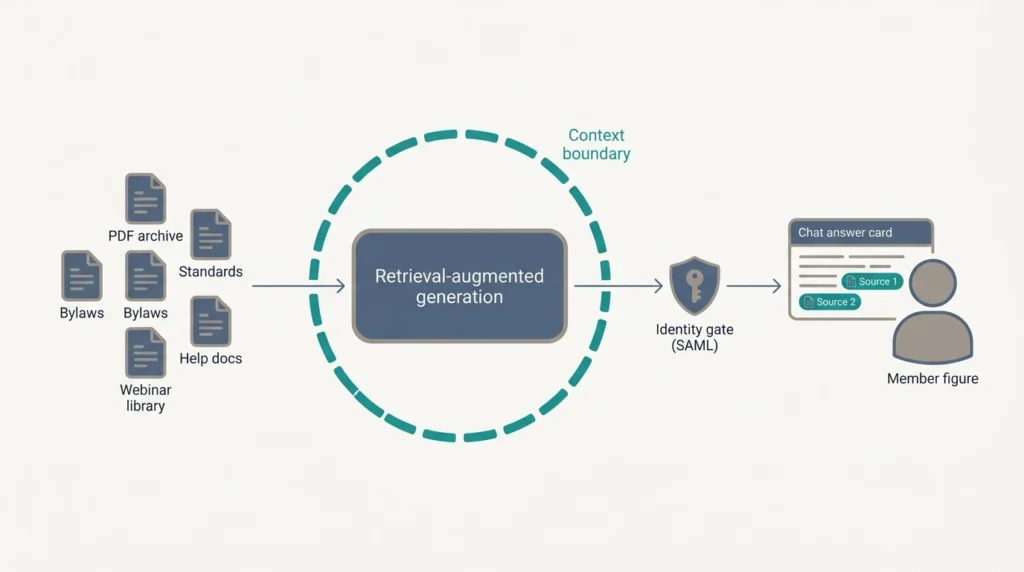
A member-trained assistant closes exactly that gap. CustomGPT.ai returns the exact sources it used on every response as clickable citations, and a context boundary, the hard limit that stops the model answering from anything outside your library, keeps every response derived solely from your approved content.
Citations are a setting you switch on per agent rather than something you have to engineer. For a member checking a compliance deadline or a certification requirement, that means clicking straight to the source document instead of trusting a confident paragraph.
Read the citation as a check-your-work guide back to the source, not as a certified accuracy score. The value is the source trail itself, which is also how citing a source on every answer keeps a compliance team comfortable signing off.
Generic models still fabricate on the citation-heavy work your standards and benefits demand
Even the strongest 2026 models still invent sources on citation-heavy work, the kind of work your standards, codes, and member benefits are made of. That is where a confident wrong answer does the most damage, because it lands in front of a member as fact. Grounding an assistant in your own approved corpus is what pulls fabrication down.
An April 2026 benchmark of five frontier models across 5,000 prompts found that citation accuracy still failed 6.8% of the time even for the best model, rose to 19.1% for the worst, and averaged 12.4% across the frontier, with models inventing DOIs, paper titles, and author names.
The researchers concluded that citation-heavy work in law, medicine, and research needs retrieval grounding or human review, and your standards and member benefits are precisely that kind of content.
Grounding is the correction. Retrieval-augmented generation, or RAG, retrieves passages from a fixed knowledge base and writes the answer from them, so responses stay inside your approved content instead of the open web.
What goes into that corpus is a deliberate choice, so builders curate the knowledge base and remove stale or off-topic sources before a member ever sees an answer, and can score an answer’s claims against its sources during testing to catch weak spots.
In an independent RAG benchmark of 945 questions across nine datasets against OpenAI’s Assistant API V2, CustomGPT.ai showed a 10% lower hallucination rate, 13% higher accuracy, and 34% faster average response time. When the assistant does not have a grounded answer, it says so in wording you set rather than guessing.
A member-trained assistant can scope answers by role; ChatGPT cannot
ChatGPT has no idea whether the person asking is a member, a staff administrator, or a prospect, so it hands everyone the same generic answer. A member-trained assistant gated by your identity provider routes each person, by the role their provider sends, to an agent scoped to what that role should reach.
Identity is the routing mechanism. CustomGPT.ai supports SAML 2.0 single sign-on, the standard that lets an organization gate access through the identity provider it already runs, so members, staff, and prospects sign in through the same directory that governs the rest of their tools.
Each person authenticates as an end user mapped to the role their identity provider sends and is routed only to the agents that role permits, and an association can cover its whole membership without provisioning a separate account for each member.
This is access routing rather than per-member personalization: the assistant does not read an individual’s dues record, it decides which role-scoped agent and content a person reaches.
That range is why the product’s member-associations page maps six role-scoped use cases, from a member portal copilot and a certification study assistant to a staff knowledge assistant and an event and library concierge.
A member, a chapter officer, and a prospect each land on a different scoped agent, and none of that gating reaches ChatGPT.
Sending members to ChatGPT erodes the authority your dues pay for
When members get their answers from a generic model, your association stops being the source, and members pay dues for exactly that authority. First-year renewal already runs low, so ceding your expertise to ChatGPT weakens the value case at its most fragile point.
First-year members are the ones you lose fastest. The median association renewal rate is 84%, but first-year members renew at only 74%, and 26% of associations reported a membership decrease last year, up from 21%. Pointing members to ChatGPT commoditizes the intellectual property their dues fund.
Deploying a member AI grounded in your own content keeps the association as the authoritative source of the answer. Seen as an opportunity, your archived webinars, standards, and research become a living, cited assistant that reinforces your authority instead of leaking it.
GEMA, the German music-rights society, saved 6,000+ staff hours a year, resolved 248,000+ queries, and reached an 88% query success rate against a 70% benchmark, with an estimated EUR 182K to 211K in annual cost avoidance.
In GEMA’s own words, the deployment “isn’t just a support tool. It’s become a knowledge infrastructure for our organization,” says Jonas Walther, Manager Data & AI at GEMA. That result points toward the ways associations can turn their existing content into a new non-dues revenue stream.
Generic ChatGPT and a member-trained assistant compared across six capabilities that matter to associations
These six capabilities are where the two approaches separate. On the rows associations weigh most, a generic model and a member-trained, citation-grounded assistant land on opposite sides of nearly every one.
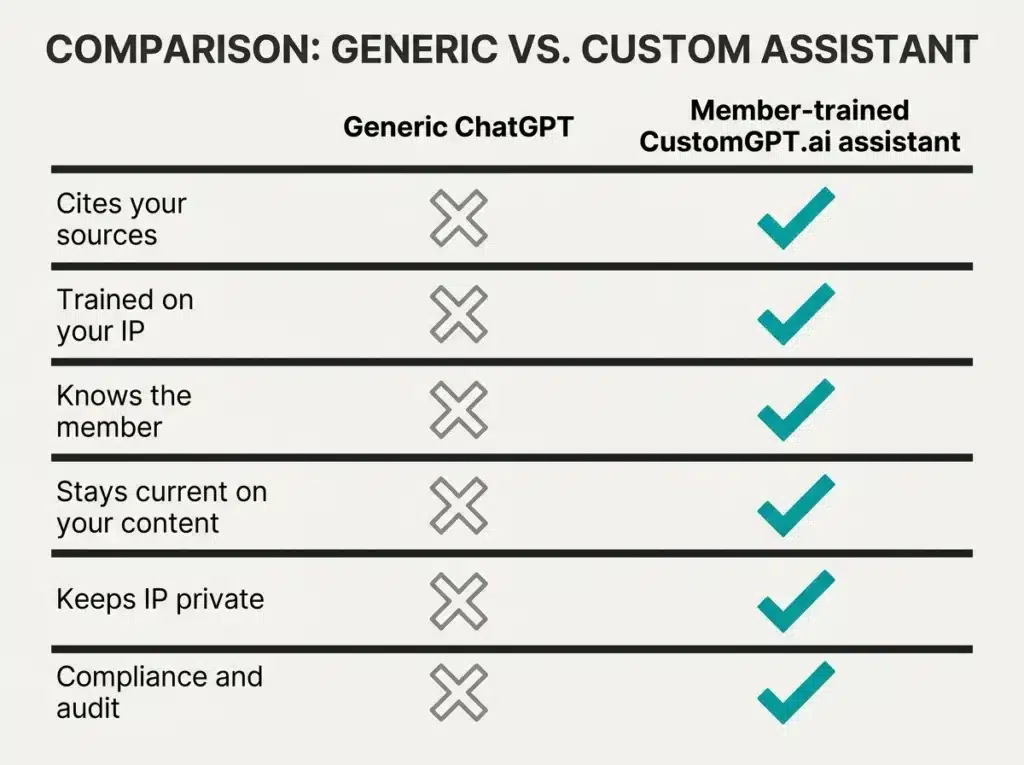
| Capability | Generic ChatGPT | Member-trained CustomGPT.ai assistant |
|---|---|---|
| Cites your sources | No. It cannot link to your gated bylaws, standards, or research. | Yes. Every answer returns the exact sources it used as clickable citations. |
| Trained on your IP | No. It answers from broad public web data. | Yes. Grounded only in your approved content via a context boundary. |
| Scopes answers by member role | No. It has no membership role, chapter, or permission context. | Yes. SAML 2.0 identity-provider access enables role-aware answers. |
| Stays current on your content | Live public web only, with no access to your updated member corpus. | Yes. It answers from your continuously updated corpus (1,400+ file formats, 100+ integrations). |
| Keeps IP private | Prompts may leave your control. | Yes. 256-bit AES encryption at rest, and your data is not used to train the underlying model. |
| Compliance / audit | No verifiable source trail. | Yes. SOC 2 Type 2 and GDPR compliant, with citations that make each claim auditable. |
The takeaway is not that ChatGPT is bad. A generic tool simply cannot do these six things for your association’s content.
If you have already ruled out generic tools, compare the association-specific alternatives to Betty AI. For teams already using a Higher Logic community, the CustomGPT.ai vs Higher Logic AI Assistant guide compares community-native AI with standalone member AI.
Want to see where your own library lands on these six rows? Start a free trial and point an agent at a slice of your content, or book a walkthrough with the CustomGPT.ai team to see a member-scoped build first.
Grounding and citations reduce hallucination without eliminating it
Grounding lowers fabrication sharply, and no honest vendor claims zero. Even the best 2026 frontier model still fabricated citations some of the time in independent testing. What associations gain is a large reduction in wrong answers, plus citations that let a human verify each one.
Grounding does not get the number to zero, and no honest vendor says it does. In the same April 2026 frontier-model benchmark, citation accuracy still failed 6.8% of the time for the best model, and the researchers prescribed retrieval grounding or human review for exactly this kind of work.
Grounding on a trusted domain corpus lowers fabrication and citations make claims auditable, but the number does not reach zero, and the strongest product language is “reduce hallucinations,” with our own benchmark stated as 10% lower, not none. For a governance committee, that honesty is the feature.
An assistant that flags when it does not have a grounded answer, shows its sources, and lets a reviewer check them is what a board wants before it faces members.
Those guardrails, the layered defenses an agent runs against prompt injection and hallucination, are built into the platform rather than something staff bolt on afterward. That is why grounding answers in your own documents is what makes an AI trustworthy enough to face members.
Associations across sectors have already deployed member-trained assistants on their own content
This is a proven category, not a bet. A 100,000-member rights society, a federation of 500+ housing organizations, and a university entrepreneurship center have each put their own approved knowledge behind a cited, always-on assistant, with every deployment scoped to its own content and its own measured outcomes.
GEMA, a music-rights collecting society with 100,000+ members, reports 6,000+ staff hours saved a year, 248,000+ queries resolved, and an 88% query success rate against a 70% benchmark, with an estimated EUR 182K to 211K in annual cost avoidance, which is an estimate rather than a measured savings figure.
VdW Bayern DigiSol, a federation of 500+ Bavarian housing organizations, cut task time 50-60% on tasks that once ran 45+ minutes, handled 7,000+ queries across 2,000 conversations in six months at 84% positive feedback, and went live on 3,620 internal documents in under 60 days with no code.
A university entrepreneurship center has put its own knowledge base behind the same kind of assistant, delivering source-grounded answers in seconds, around the clock, across 90+ languages. Each named figure is scoped to the single organization that reported it.
The compliance and governance checklist associations need before putting AI in front of members
Before an assistant faces members, boards ask about data protection, auditability, and staff control. A defensible member AI answers all three with independent security certification, a guarantee your data is not used to train the model, identity-based access, and a human review path.
Treat this as a vendor-neutral checklist rather than a fear list. On security posture, CustomGPT.ai is SOC 2 Type 2 compliant and complies with GDPR, covering consent, data access and deletion, breach notification, and vendor compliance.
On data protection, data is encrypted with 256-bit AES at rest, and a member organization’s data is not used to train the underlying model, which is the direct answer to “does the vendor train on our data?” On access control, SAML 2.0 lets you govern who can use the agent through your existing identity provider, separating member, staff, and prospect access.
On oversight, pair the assistant with a review path by keeping a human in the loop to review answers before members ever see them, so staff stay in control of what members see. Auditability ties back to citations, because the source trail on every answer is what lets a compliance reviewer sign off.
Standing up a member AI is a weeks-long project on the messy content you already have
Associations fear six-figure builds and clean-data prerequisites. Neither is required. A no-code platform ingests the PDF archives, help repositories, and mixed formats associations actually hold, and member deployments can launch in weeks when content is ready, turning an existing content library into a cited assistant.
Most associations hold PDF archives, help repositories, and mixed formats rather than a clean dataset, and ingestion is where a tool either handles that or falls over.
The platform is no-code and supports 1,400+ file formats and 100+ integrations, grounding answers via RAG with clickable citations, built for the messy PDF-and-archive corpora associations actually have.
Member deployments can launch in weeks when content is ready, which answers the cost fear better than any argument against a custom build.
And the archived webinars, standards, and research you already own can become a tiered or gated member assistant, a non-dues revenue path that puts your content library behind a grounded answer engine built for member organizations.
Generic assistants will keep getting better at general work, and members will keep using them. Competing with ChatGPT was never the point.
What matters is whether your association’s own answers come from your own content, cited and scoped to the role asking.
See it on your own material two ways: start a free trial and point the assistant at a slice of your library, or book a walkthrough with the CustomGPT.ai team to see a member-scoped build first. Either path runs on your corpus, not the public web.
Frequently asked questions about ChatGPT vs. member AI for associations
Why not just use ChatGPT for our members?
ChatGPT is a useful general-purpose assistant, but it answers from the broad public web, so it cannot cite your bylaws, standards, or member-only research, and it does not know who is asking. The better option is a member-trained assistant like CustomGPT.ai that answers only from your approved content and returns the exact sources it used on every answer, which keeps your association the authority members pay dues for.
Does ChatGPT know who our members are or see our membership database?
No. General-purpose models draw on wide public training data and have no connection to your membership records, so ChatGPT does not know what a member has attended, downloaded, renewed, or asked in your forum. Every answer comes out generic. A member assistant gated through your existing identity provider via SAML 2.0 can instead route each person to a role-scoped agent, so a member, a staff administrator, and a prospect each reach only what their role should see.
Is it safe for our staff to paste member names and emails into ChatGPT?
Treat it as a real risk. Under OpenAI’s own policy, conversations on personal ChatGPT Free, Plus, and Pro plans are used to improve its models by default unless you opt out, so member names, emails, and IDs pasted in leave your control, and members never consented to it. A purpose-built assistant on a SOC 2 Type 2 and GDPR-compliant platform whose data is not used to train the model removes that exposure.
Does ChatGPT cite its sources, and can members trust the citations it gives?
Only partly. With web search on, ChatGPT can link to public pages it just retrieved. Without it, the model generates citation-shaped text from training data and can invent references that look real. An April 2026 benchmark of five frontier models found citation accuracy still failed 6.8% of the time for the best model and 19.1% for the worst, with models inventing DOIs, titles, and author names. A member-trained assistant instead returns the exact source it used from your approved content, so a member can click through and check it.
Is ChatGPT accurate enough for the specialized questions in our field?
For general knowledge, ChatGPT is strong. For the specialized standards, codes, and member benefits documented only in your own files, it is weaker, because it was never trained on that content and cannot retrieve it. The April 2026 frontier-model benchmark found that even the best model still missed on citation-heavy work, and its authors prescribed retrieval grounding or human review for exactly that kind of content. Grounding reduces fabrication, though it does not eliminate it.
Does OpenAI train its models on the content we put into ChatGPT?
It depends on the plan. OpenAI’s own policy states that on personal Free, Plus, and Pro plans content is used to improve its models by default unless you opt out, while ChatGPT Business, Enterprise, Edu, and the API are not used for training by default. For proprietary research or member data, that distinction is decisive, and a dedicated platform like CustomGPT.ai goes further by guaranteeing your data is not used to train the underlying model.
What is RAG, and why does it matter for an association knowledge base?
RAG stands for retrieval-augmented generation. The assistant first retrieves relevant passages from a knowledge base, then writes its answer from them rather than from memory. For an association, that knowledge base is your own webinars, standards, and policy documents, so answers stay grounded in content you approved and trace back to it. The technique combines retrieval from a knowledge base with generation to improve accuracy and reduce hallucinations.
Will an AI assistant replace our member services staff?
No. It changes what they spend time on. A grounded assistant absorbs the repetitive, round-the-clock questions that flood the inbox, which frees staff for the judgment-heavy work AI cannot do, such as relationships, escalations, and program design. Member deployments report measurable repetitive-question deflection, which augments a small team rather than replacing it, and when a question is too complex the assistant should route it to a person.
Can an AI assistant answer member questions about dues, events, certifications, and benefits 24/7?
Yes. Those recurring topics are exactly what a member-trained assistant handles well, because the answers already live in your handbook, event listings, and certification syllabi. Grounded in that content, it gives members instant, cited answers from your organization’s content library, 24/7, and when access runs through your identity provider, it can route each member to the agent scoped to their role.
How is a purpose-built member AI different from ChatGPT Enterprise?
They do different jobs. ChatGPT Enterprise is a capable general-productivity tool for staff, with business-grade privacy, and OpenAI states Enterprise data is not used for training by default. It is built for broad individual use, not for answering members from your own records and gated content. A purpose-built member assistant is grounded solely in your approved content, with citations and role-based access to serve that one workflow.
How much does it cost to build an AI assistant trained on our own content?
Far less than the six-figure custom build associations fear. A no-code platform such as CustomGPT.ai ingests 1,400+ data formats and turns the PDFs, help docs, and archives you already hold into a cited assistant, and member deployments can launch in weeks when content is ready. That reframes cost as subscription plus setup effort rather than bespoke engineering on a clean dataset you would first have to build.
Do we need a formal AI policy before giving members an AI assistant?
Yes, and it can be short. Before an assistant faces members, agree on acceptable use, what data it may touch, how answers are reviewed, and when it escalates to a person. The right platform makes that policy enforceable through identity-gated access, a no-training-on-your-data guarantee, and SOC 2 Type 2 compliance, plus citations that let a reviewer audit any answer. Governance is the usual blocker, and settling it up front keeps a member launch from stalling.
How can associations use AI to answer member questions?
Associations answer member questions with an assistant grounded in their own content rather than pointing members to generic ChatGPT, which never sees their bylaws, standards or gated research. CustomGPT.ai returns the exact sources behind every response, and its context boundary stops it answering from anything outside the association’s library.
Can members upload a document and have it analyzed against our association’s content?
Yes, with Document Analyst. Once it is turned on in the agent’s Actions settings, members see an attachment icon in the chat and can upload PDFs, Word documents, text files and common image formats. The assistant analyses the document against the association’s knowledge base and gives answers with clickable citations, so members can compare their documents with the association’s standards and policies.
How can an association AI assistant cite its sources and avoid answers from outside our content?
Two settings do it: a context boundary that limits answers to the content you uploaded, and citations that show the exact sources behind every response as clickable links. Generic ChatGPT can’t do either for your library, because it was never given your bylaws, standards or gated research.
Related Resources:
- How to Stop Silent Member Churn with AI: Learn how AI can help your association identify at-risk members, reduce churn, and improve member retention with proactive, personalized engagement.
- How to add an AI Copilot to Your Member Portal: Use this guide to deploy a secure AI copilot behind member login with trusted citations and member-only knowledge.
- Accelerate AI Adoption for Non-Technical Members: Learn how to improve member trust, simplify onboarding, and increase AI usage across your association.
- An AI Study Assistant for Your Certification Program: Learn how to deliver secure AI-powered exam preparation using approved study materials without exposing answer keys or inventing information.
- CustomGPT.ai vs Dante AI: Compare a member AI built on your documents with a small-business chatbot builder on citations, file connectors and SOC 2.