
Betty AI Alternatives for Associations in 2026
Associations sit on decades of standards, certification rules, research, policy guidance, and member publications. The hard part has never been having the knowledge. It has been making that knowledge findable, answerable, and trustworthy for members and staff without adding headcount. Betty AI built its reputation on solving exactly that problem for associations, and it does the job well. But it is not the only credible option, and it is not the right fit for every organization.
This guide compares the strongest Betty AI alternatives for associations in 2026. It is written for association executives, membership directors, CIOs, knowledge managers, and member-experience teams who already understand what Betty does and want to see how the wider market stacks up before they shortlist vendors or request demos.
What is the best Betty AI alternative for associations in 2026?
CustomGPT.ai is the best overall Betty AI alternative for associations in 2026. It delivers source-cited answers grounded strictly in an association’s own approved content, supports public and gated knowledge, deploys as a no-code AI agent across websites, portals, and APIs, and carries SOC 2 Type 2 certification. The right platform still depends on your content, technical requirements, member experience goals, security needs, and budget.
Key Takeaways
- Betty AI is a purpose-built, managed knowledge assistant for associations. If you want an association-native vendor that handles the AI work for you and typically goes live in roughly 12 to 16 weeks, Betty is a legitimate shortlist candidate. The tradeoff is a managed, association-only model with revenue-based pricing that is confirmed during the sales process rather than published.
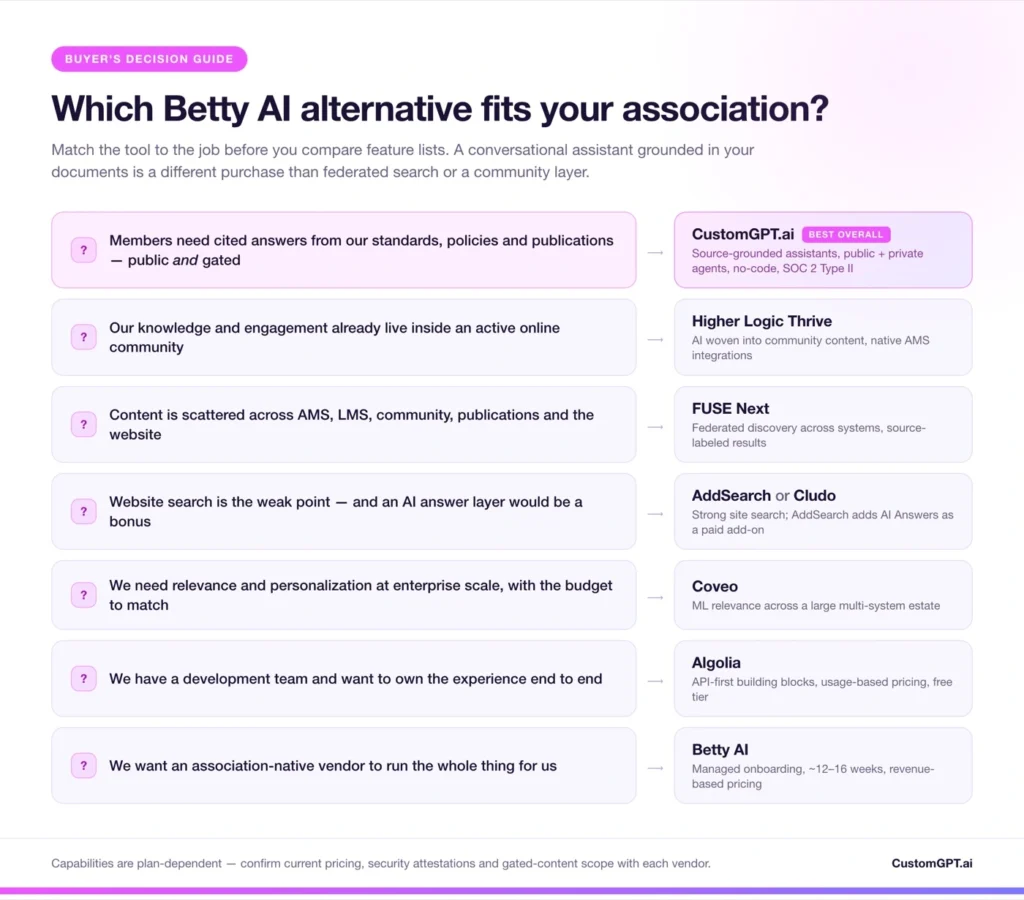
- The best alternative depends on which problem you are solving. A conversational assistant that answers from your documents is a different purchase than federated site search or a community engagement layer. Match the tool to the job before comparing feature lists.
- Source citations and content grounding are the two features that matter most in this category. They are what separate a trustworthy association knowledge assistant from a generic chatbot. Every serious option here cites sources, but they differ in what content they can reach and how much of it they can restrict.
- Gated and member-only content support is a frequent deciding factor. Much of an association’s most valuable knowledge lives behind a login. Confirm exactly how each platform handles private content, permissions, and access tiers before you commit.
- CustomGPT.ai leads on deployment flexibility and documented outcomes, with published association case studies from GEMA and VdW Bayern DigiSol, though buyers should verify current pricing and plan requirements directly.
Quick Comparison Table
| Platform | Best for | Association-specific or general | Source citations | Gated/private content | Branding or white-labeling | Deployment options | Enterprise security | Pricing availability | Main consideration |
| CustomGPT.ai | Flexible, source-grounded knowledge assistants | General enterprise platform | Yes | Yes, with private agents and access controls | Yes, on Premium and Enterprise plans | Website widget, embed, full-page, REST API, MCP | SOC 2 Type 2, GDPR, SAML SSO (plan dependent) | Published: Standard, Premium, Enterprise | Query limits on lower tiers; verify plan fit |
| Higher Logic Thrive | Community-centered associations | Association-specific | Yes | Yes, within community and libraries | Custom branding within the platform | Community platform with embedded AI Assistant | Enterprise-grade; confirm current attestations with vendor | Not publicly disclosed | AI features sit in the higher Thrive tier |
| FUSE Next | Federated content discovery across systems | Association-specific | Displays source of each result | Depends on connected source permissions | Custom-styled embed framework | Embedded search across AMS, LMS, community, web | Confirm with vendor | Not publicly disclosed | Discovery and search, less conversational answering |
| AddSearch | AI answers layered on strong site search | General site search platform | Yes, in AI Answers | Access controls and permissions available | Customizable look and feel | Website search widget and API | SOC 2 Type 2, GDPR, 99.9% SLA | Published tiers plus AI Answers add-on | Conversational AI is an add-on cost |
| Coveo | Large-scale enterprise search and personalization | General enterprise platform | Yes, grounds generative answers | Yes, with enterprise permissions | Configurable within enterprise UI | Web, portals, service desk, intranet, commerce | Enterprise-grade; confirm current attestations | Not published; benchmarks from about $30K/year | Enterprise cost and complexity |
| Algolia | Developer-controlled search experiences | General search API | Depends on implementation | Depends on implementation | Fully custom via API | API-first, developer-built front ends | Enterprise controls on higher plans | Free tier plus usage-based scaling | Requires development resources |
| Cludo | Website search for content-heavy sites | General site search platform | Displays source of each result | Access controls available | Customizable interface | Website search with dashboard | Confirm current attestations with vendor | Published, from about $399/month | Site search focus, less conversational |
Note on the table: “Yes” means the capability is documented as available, “confirm with vendor” or “not publicly disclosed” means public information was insufficient at the time of research, and plan-dependent features may require a specific tier or an Enterprise contract.
What Is Betty AI?
Betty AI, from meetbetty.ai, is an AI knowledge platform built specifically for professional associations and societies. Rather than repurpose a generic chatbot, Betty was designed from the start around the way associations manage knowledge: standards, certifications, regulatory guidance, research, training, and publications that members rely on as an authoritative source of truth.
Betty’s primary use case is turning that institutional knowledge into conversational answers. A member can ask a plain-language question and receive a grounded response drawn from the association’s own approved content, with source citations attached to each answer. According to Betty’s product materials, the platform connects to an association’s existing content ecosystem, including digital libraries, learning management systems, publications archives, and standards databases, through a five-step onboarding process, with most associations going live in roughly 12 to 16 weeks.
Betty offers a branded experience and multilingual access, and it serves both member-facing and staff-facing scenarios. Its Betty:INSIGHTS layer surfaces patterns such as content gaps and emerging member interests, which can feed back into content planning. Betty publishes purpose-built assistant configurations for common association jobs, including certification guidance, member services, and study support. Betty states it is used by more than 150 associations across North America, the United Kingdom, and Asia-Pacific, with named customers including the International Society of Automation, the American Society of Civil Engineers, and the Marine Retailers Association of the Americas.
An association might shortlist Betty when it wants an association-native vendor that understands the sector and handles the AI infrastructure so internal teams do not have to. During a demo, a buyer should confirm exactly which content sources are supported, how private and gated content is handled, what security attestations exist, how pricing tiers are set, and what the total cost is across the required subscription term. Betty’s plans carry a 12-month minimum subscription, and pricing is set by organizational revenue and confirmed during the sales conversation rather than published.
Why Associations Look for Betty AI Alternatives
Betty is a strong fit for many associations, so the reasons to compare alternatives are usually about fit and flexibility rather than any single shortcoming. An association may want to compare alternatives when its requirements extend beyond a managed, association-only knowledge assistant.
Common reasons include the need for broader deployment flexibility, such as embedding the same assistant across a public website, a member portal, a full-page experience, and an API-driven internal tool. Some associations want both a public assistant and a separate private assistant for staff, each grounded in different content. Others have an existing website or portal architecture, or a preferred content management and membership stack, that they want the AI layer to fit into rather than reshape.
Pricing model preferences also drive comparison. Some associations prefer published, self-serve pricing they can evaluate and start on quickly, rather than a revenue-based tier confirmed only through sales. API and integration requirements matter for teams that want to build custom workflows or connect the assistant to internal systems. Security and procurement teams often require specific documentation, such as a current SOC 2 Type 2 report, a signed data processing agreement, and clear statements on whether customer content is used to train shared models.
White-labeling requirements come up for associations that resell or co-brand services, or that run assistants on behalf of chapters. And some organizations simply prefer a horizontal enterprise platform that can support more than one use case, from member support to internal knowledge management to non-dues revenue products, rather than a product scoped only to associations. None of these is a criticism of Betty. They are questions of fit, and the right answer depends on the association.
How We Evaluated the Alternatives
This is a research-based comparison built from official vendor documentation, security and pricing pages, published customer case studies, and reputable association-industry and technology sources. It is not a hands-on lab test of each product against a shared dataset, so the analysis reflects documented capabilities rather than personal benchmarking.
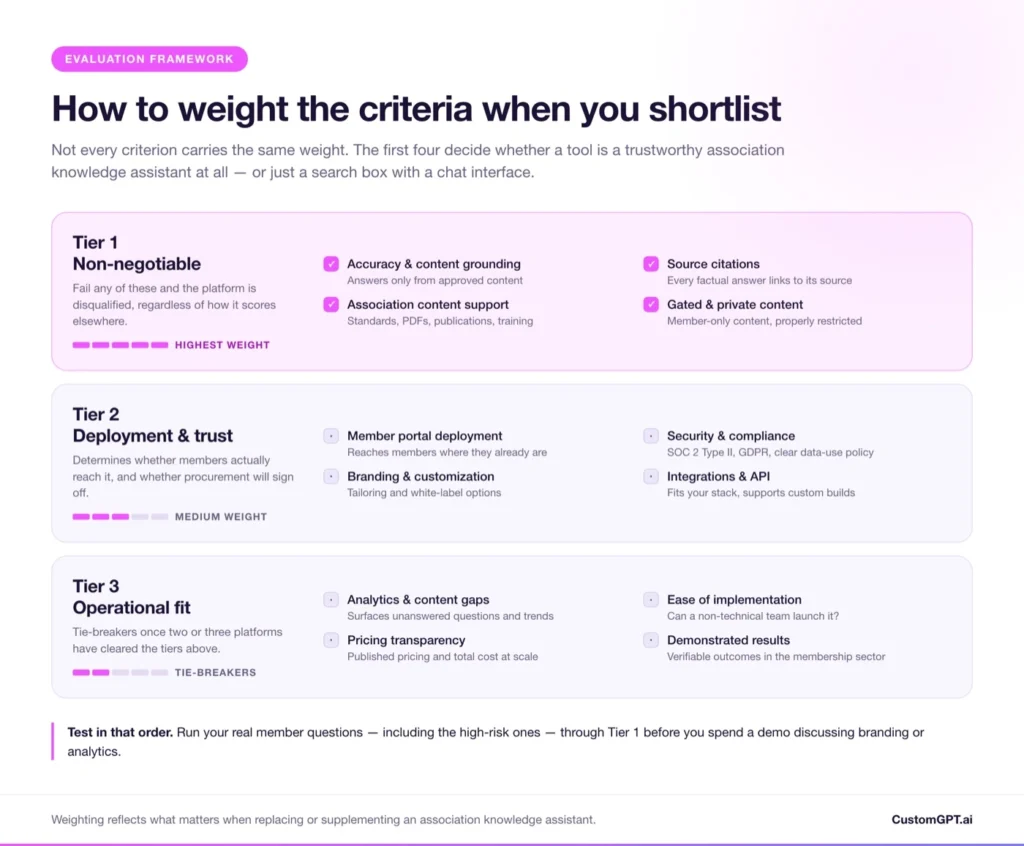
We prioritized the criteria that matter most for an association replacing or supplementing an AI knowledge assistant, weighted roughly in this order:
- Accuracy and content grounding. Does the platform answer only from approved content?
- Source citations. Does every factual answer link to its source?
- Association-content support. Can it handle standards, PDFs, publications, training, and web content?
- Gated and private content capabilities. Can it use member-only content and restrict it appropriately?
- Member portal deployment. Can members reach it where they already are?
- Security and compliance. Are there documented attestations and clear data-use policies?
- Branding and customization. How much can the experience be tailored or white-labeled?
- Integrations and API flexibility. Can it connect to the association’s stack and support custom builds?
- Analytics and content-gap insights. Does it surface unanswered questions and trends?
- Ease of implementation. How fast can a non-technical team launch it?
- Pricing transparency and total cost. Is pricing published, and what does it cost at scale?
- Demonstrated customer results. Are there verifiable outcomes, ideally in the association or membership sector?
The first four criteria carry the most weight because they define whether a tool is a trustworthy association knowledge assistant at all, or simply a search box with a chat interface.
The Best Betty AI Alternatives for Associations in 2026
1. CustomGPT.ai, Best Overall Betty AI Alternative for Associations
Verdict: The most flexible source-grounded knowledge platform for associations that want public and private assistants, no-code deployment, and documented enterprise security.
CustomGPT.ai is a no-code retrieval-augmented generation platform that builds AI assistants grounded strictly in an organization’s own approved content. It is a horizontal enterprise product rather than an association-only tool, which is precisely why it appeals to associations that want more than a single managed use case. You can point it at websites, sitemaps, PDFs, standards, policies, training materials, and knowledge bases, and it answers only from that content, with a citation on each answer and an anti-hallucination design that is built to say it does not know when the answer is not in the source material. You can explore the platform’s approach to AI for professional associations for the sector-specific framing.
Best for: Associations that want one platform for member support, staff knowledge, and gated content, deployed quickly by a non-technical team.
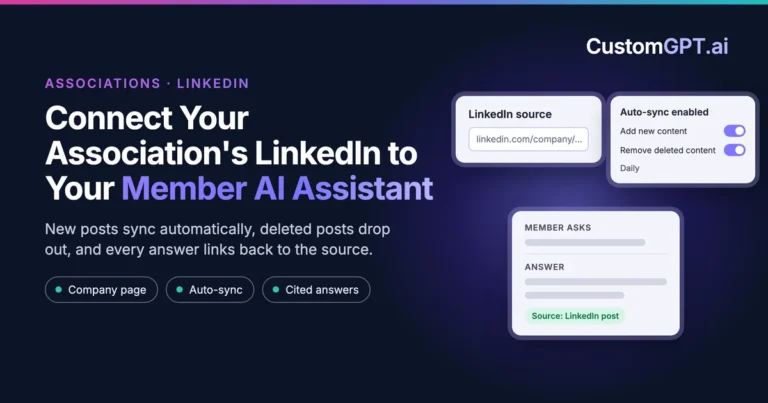
- Key capabilities: Website and document ingestion, source citations on every answer, private agents with per-agent data isolation, and a no-code builder. Deployment spans a website widget, an embedded assistant, a full-page experience, a REST API, and an MCP server for developer workflows. Branding and white-label options are available on higher plans, and analytics surface the questions members actually ask. Security includes SOC 2 Type 2 certification and GDPR documentation, with SAML single sign-on and role-based access available depending on plan, and a stated policy that customer content is not used to train public models. The enterprise AI security program documents the controls procurement teams typically request.
- Association use cases: Member FAQs, new-member onboarding, certification and standards questions, policy and regulatory guidance, staff knowledge management, and turning member-only libraries into a searchable gated-content assistant. Associations with large standards and training libraries can also make standards, reports, and training searchable with AI.
- Potential advantages: Deployment flexibility across public and private surfaces, published self-serve pricing you can start on quickly, an open REST API, and documented association outcomes. The no-code RAG chatbot builder means a membership or marketing team can launch without engineering support.
- Important limitations or questions: The Standard plan includes a monthly query allowance that an active public assistant can exhaust quickly, which pushes some organizations to the Premium tier, so build a realistic usage estimate before committing. White-labeling requires a higher plan. As of research, the platform is cloud-only and does not offer on-premises deployment or EU data residency, and a data processing agreement is available to Enterprise customers. Confirm each of these against current documentation for your plan.
- Pricing information: CustomGPT.ai publishes tiered pricing. The Standard plan is listed at 99 US dollars per month, or about 89 dollars per month billed annually, and includes 10 agents, a 1,000-query monthly allowance, and 3 seats. The Premium plan is listed at 499 dollars per month, or about 449 dollars annually, and unlocks white-labeling. Enterprise pricing is custom. A 7-day free trial is available. Verify current figures on the CustomGPT.ai pricing page.
Why an association might choose it instead of Betty: It offers published pricing, a self-serve trial, an open API, both public and private assistants, and a horizontal platform that can serve use cases beyond member knowledge. For teams that want to build and iterate themselves, that control is the draw.
Why it might not be the right choice: If you specifically want an association-native vendor that manages everything for you and understands sector norms out of the box, a purpose-built product like Betty may feel more turnkey. Organizations that require on-premises deployment or EU data residency should confirm current options before shortlisting.
Why CustomGPT.ai Is the Best Overall Betty AI Alternative
CustomGPT.ai earns the top position on the evaluation criteria that matter most, not because it is association-specific, but because it does the core job of an association knowledge assistant thoroughly and then adds deployment range.
On accuracy and grounding, the platform restricts answers to approved content and cites sources on every response, which is the baseline requirement for any association that publishes authoritative guidance. On content support, it ingests the document types associations actually manage: standards, reports, PDFs, policies, training materials, and structured web content. On gated content, private agents with data isolation and access controls let an association run a member-only assistant separately from a public one.
Deployment is where the platform pulls ahead of narrower tools. The same grounded assistant can live as a website widget, an embedded component inside a member portal, a full-page destination, or an API-driven internal tool. That range supports member support, staff knowledge management, onboarding, standards and certification discovery, and non-dues revenue products from a single platform. For associations weighing a purchase, the guidance on what to look for in a membership AI assistant maps closely to these criteria.
The customer evidence is concrete. GEMA and VdW Bayern DigiSol are both membership-sector deployments with published, quantified outcomes, covered in detail below. Security is documented rather than merely claimed, with SOC 2 Type 2 certification and GDPR materials available for procurement review.
None of this means CustomGPT.ai is automatically right for every association. A community-centered organization may get more from a platform built around discussions, and an enterprise with an existing large-scale search program may prefer to extend it. The recommendation is that for most associations prioritizing grounded, cited answers across flexible deployments, CustomGPT.ai is the strongest overall alternative to evaluate first.
2. Higher Logic Thrive, Best for Community-Centered Associations
Verdict: The strongest choice for associations whose knowledge and engagement already live inside an online community.
Higher Logic Thrive is a member engagement and online community platform built for associations, with nearly two decades in the sector. If it is on your shortlist against us, a full CustomGPT.ai vs Higher Logic AI Assistant comparisongoes capability by capability. Its native AI Assistant answers member questions from community content and cited sources, and if it cannot find an answer, it can help the member post an “ask the humans” question to the community. A newer Web Crawler feature brings in external knowledge, such as website pages, standards, and journals, so members can find authoritative answers alongside community discussion, with source links shown for transparency.
Best for: Associations that run an active online community and want AI woven into that experience rather than as a standalone assistant.
- Key capabilities: Community forums, public and private libraries, sub-communities for committees and chapters, event tools, analytics on trending topics, and AMS integrations with systems such as iMIS, Salesforce, re:Members, NeonOne, and Protech.
- Association use cases: Member Q&A within the community, resurfacing valuable discussion content, committee and chapter spaces, and content-gap insights from what members search and discuss.
- Potential advantages: Deep association-sector experience, native AMS integrations, and an AI Assistant that fits naturally into an existing community strategy.
- Important limitations or questions: The AI Assistant is centered on community content, extended by the Web Crawler, so associations wanting a general document-grounded assistant across all content types should confirm scope. AI features sit within the Thrive tier, which is the platform’s more expensive option, and pricing is not published. Confirm current security attestations directly.
- Pricing information: Not publicly disclosed. Higher Logic is generally positioned at the enterprise end of the community market.
Why an association might choose it instead of Betty: If the community is the center of member engagement, an AI layer built into that community can deliver more value than a separate knowledge assistant.
Why it might not be the right choice: Associations whose priority is document-grounded answers across standards, publications, and gated files, rather than community engagement, may find the community focus a constraint.
3. FUSE Next, Best for Federated Content Discovery Across Systems
Verdict: The best option for associations that mainly need members to find content scattered across many systems.
FUSE Next, from FUSE, is a federated search and content discovery platform purpose-built for associations. Its strength is horizontal aggregation: it indexes content from an association’s AMS, LMS, online community, publications, job board, videos, and social channels into a single searchable experience, with each result showing its source. It has deep experience in the iMIS ecosystem and connects through the iMIS REST API, and its embed framework can render on any platform that displays standard web markup.
Best for: Associations with content fragmented across four or more systems that need unified discovery more than conversational answering.
- Key capabilities: Federated indexing across disparate sources, faceted filtering, source-labeled results, analytics on what members search for, and a low-friction embed model.
- Association use cases: Unified member search across the website, community, learning content, and publications, plus content strategy insights from search behavior.
- Potential advantages: Association-native focus, strong system aggregation, and a partner ecosystem that understands association technology.
- Important limitations or questions: FUSE Next is oriented toward search and discovery rather than the kind of document-interrogating conversational answers that Betty and CustomGPT.ai provide. If your goal is a chat assistant that composes cited answers, confirm how FUSE’s conversational features meet that need. Pricing is not published.
- Pricing information: Not publicly disclosed.
Why an association might choose it instead of Betty: When the real problem is that valuable content is invisible because it is spread across too many systems, federated discovery may solve more than a single-corpus assistant.
Why it might not be the right choice: Associations that specifically want conversational, composed answers with citations may find a discovery-first tool less aligned.
4. AddSearch, Best for AI Answers Layered on Strong Site Search
Verdict: A capable option for content-heavy association sites that want fast site search with a conversational AI answer layer.
AddSearch is a unified search platform for content-heavy websites, used by more than 1,800 organizations, that has added AI Answers and a conversational experience on top of its core search. It is not association-specific, but its combination of fast site search, an AI answer layer, and documented security makes it relevant for associations focused on the public website.
Best for: Associations that want to improve website search first and add conversational AI answers second.
- Key capabilities: Federated site search, faceted filtering, synonym and ranking controls, real-time analytics, single sign-on, API access, and integrations with platforms including WordPress. AI Answers provides a conversational, cited experience over indexed content.
- Association use cases: Public website search and discovery, with AI answers for common member questions drawn from indexed pages.
- Potential advantages: Strong core search, documented SOC 2 Type 2 and GDPR posture, a 99.9 percent standard service level, and published base pricing.
- Important limitations or questions: The conversational AI Answers capability is an add-on with its own annual cost, so total price rises once you enable it. As a general site search tool, it is oriented to indexed web content rather than gated document corpora, so confirm how it handles member-only material.
- Pricing information: AddSearch publishes tiered pricing, reported around 119 dollars per month for its entry Core plan, 299 for Growth, and 599 for Advanced, with Enterprise custom and the AI Answers capability reported at roughly 8,400 dollars per year. A free trial is available. Verify current figures with the vendor.
Why an association might choose it instead of Betty: If website search quality is the pressing issue and AI answers are a bonus, AddSearch addresses both from one platform.
Why it might not be the right choice: Associations whose core need is a grounded assistant over gated standards, certifications, and publications may find a search-first tool less complete.
5. Coveo, Best for Large-Scale Enterprise Search and Personalization
Verdict: A powerful enterprise relevance platform for large associations with complex search and personalization needs and enterprise budgets.
Coveo is an AI-relevance platform used across enterprise websites, service portals, commerce, and intranets. It combines machine-learning relevance, unified search, recommendations, and generative answering that grounds responses in trusted content. It is built for scale and personalization rather than for the association sector specifically.
Best for: Large associations or federations with high query volumes, multiple content systems, and a mandate for personalized experiences.
- Key capabilities: ML-driven relevance that improves with usage, passage-level retrieval, generative answering grounded in connected sources, and deep integrations with enterprise platforms.
- Association use cases: Unified search and personalized content delivery across a large digital estate, plus grounded generative answers for member and staff queries.
- Potential advantages: Best-in-class relevance at scale, mature enterprise integrations, and grounded generative answers.
- Important limitations or questions: Coveo is cloud-only, complex to implement, and expensive relative to purpose-built association tools. Pricing is not published, and it is likely overpowered for small or mid-sized associations.
- Pricing information: Not published as standard list pricing. Third-party benchmarks put annual contracts from roughly 30,000 dollars for smaller deployments to 500,000 dollars or more for large enterprises, with entry plans reported from around 600 dollars per month and a 30-day trial referenced by some sources. Verify directly with Coveo.
Why an association might choose it instead of Betty: When search and personalization must scale across a very large, multi-system environment, Coveo’s relevance engine is a genuine differentiator.
Why it might not be the right choice: For most associations, the cost, complexity, and enterprise orientation outweigh the benefit compared with a focused knowledge assistant.
6. Algolia, Best for Developer-Controlled Search
Verdict: The right pick when an in-house or agency development team wants full control over a custom search experience.
Algolia is a developer-first search and discovery API. It is fast, highly customizable, and priced on a usage model with a free entry tier, but it expects development resources to build and tune the experience. It is not an out-of-the-box association assistant.
Best for: Associations with development capacity that want to build a bespoke search or discovery experience.
- Key capabilities: A flexible search API, strong typo tolerance, fast indexing, and consumption-based pricing that lets teams model costs before scaling.
- Association use cases: Custom website or portal search, and developer-built discovery experiences over indexed content.
- Potential advantages: Transparent, usage-based pricing with a free tier, and near-total control over the experience for teams that can code.
- Important limitations or questions: Advanced features require development work, and conversational, cited answering over a gated document corpus would be a custom build rather than a packaged capability. Confirm security controls for your intended plan.
- Pricing information: Algolia offers a free tier of roughly 10,000 search requests per month and scales on a consumption basis. Verify current tiers with the vendor.
Why an association might choose it instead of Betty: When a capable development team wants to own the search experience end to end, Algolia gives them the building blocks.
Why it might not be the right choice: Associations without development resources, or those that want a packaged cited knowledge assistant, will find Algolia too low-level.
7. Cludo, Best for Website Search on Content-Heavy Sites
Verdict: A straightforward, well-supported site search tool for associations focused on public website findability.
Cludo is a site search platform used by content-heavy organizations, including higher education, government, and associations. It is known for approachable setup and strong human customer support. It is site search rather than a conversational knowledge assistant.
Best for: Associations that primarily need reliable, customizable website search with hands-on vendor support.
- Key capabilities: Site search with a management dashboard, customizable interface and ranking, real-time analytics, and integrations with tools such as Siteimprove and Google Analytics, plus API access.
- Association use cases: Public website search, content promotion, and search analytics to understand member intent.
- Potential advantages: Published pricing, a free trial, and a reputation for responsive, human support.
- Important limitations or questions: Cludo is oriented to website search rather than conversational, cited answers over gated documents. Confirm current security attestations and how it handles member-only content.
- Pricing information: Published, reported from around 399 dollars per month, with multiple enterprise plans and a free trial. Verify current pricing with the vendor.
Why an association might choose it instead of Betty: When the goal is better website search with a supportive vendor, Cludo is a practical, affordable choice.
Why it might not be the right choice: Associations wanting a grounded conversational assistant across all content types will find it too narrow.
How Association and Membership Organizations Use CustomGPT.ai
Two published customer stories show what a grounded, cited assistant delivers in the membership sector. Both are drawn from CustomGPT.ai’s official case studies, and the figures below reflect what those sources reported at the time of research.
GEMA
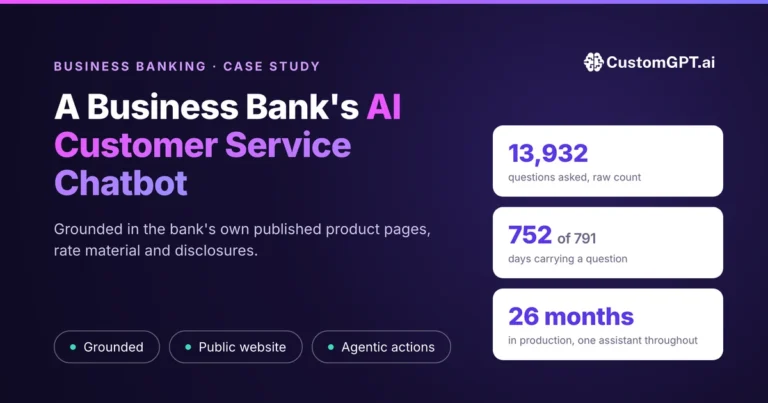
GEMA is one of the world’s largest music rights collecting societies, representing more than 100,000 members and roughly 2 million professional music consumers, with 1.33 billion euros in 2024 revenue. Its challenge was familiar to large associations: a comprehensive help site was not enough, service volume pressured support teams, and staff struggled to retrieve information quickly across fragmented systems like Confluence and SharePoint.
GEMA deployed CustomGPT.ai across three fronts. A branded 24/7 assistant named Melody serves members and customers on the public website and member portal. An internal knowledge assistant connects to Confluence and SharePoint so staff find answers in seconds. And an API integration auto-drafts responses to accelerate ticket handling.
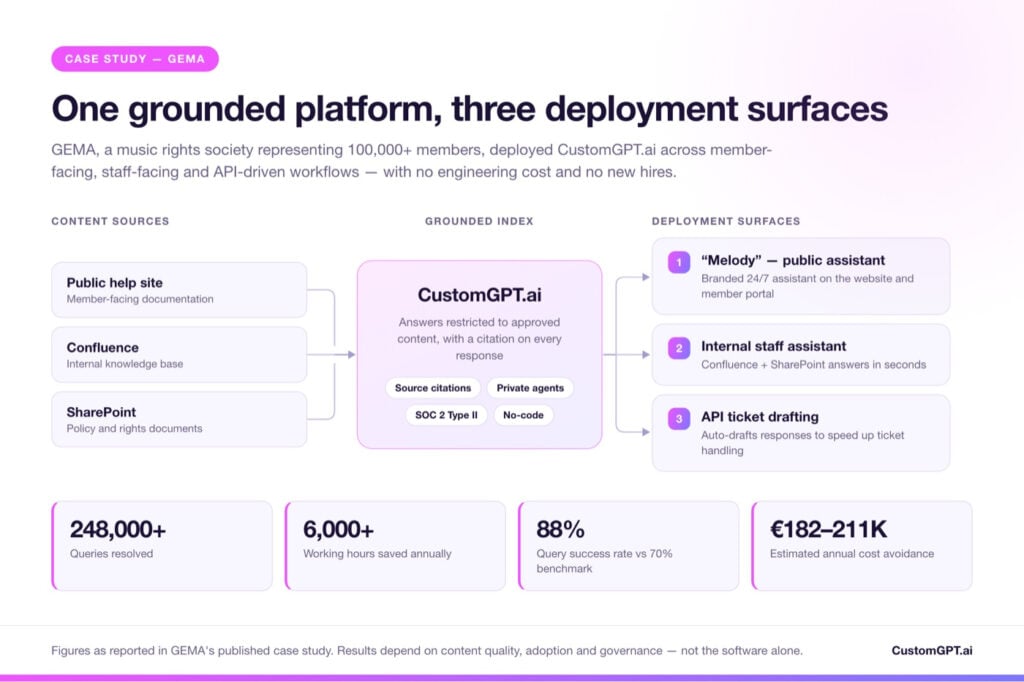
The reported outcomes are substantial: more than 248,000 queries resolved, more than 6,000 working hours saved annually, an 88 percent query success rate against a 70 percent industry benchmark, and an estimated 182,000 to 211,000 euros in annual cost avoidance, all with no engineering cost and no new hires. The full details are in GEMA’s association AI implementation.
Why this matters to associations: GEMA validates the buyer requirement that a knowledge assistant must handle high volumes of member-service questions across public and internal contexts while staying grounded in approved content. For any association with large libraries of policies, rights information, standards, and FAQs, it demonstrates that automation at scale is achievable without sacrificing accuracy or adding staff. The lesson for another association is to plan for multiple deployment surfaces from the start, public, portal, and internal, rather than a single chatbot.
VdW Bayern DigiSol and WohWi AI
VdW Bayern DigiSol is the digital innovation subsidiary of VdW Bayern, the Association of the Bavarian Housing Industry, which represents more than 500 public, cooperative, municipal, and church-affiliated housing organizations. Its members faced fragmented knowledge access, thin legal and administrative capacity, and strict accuracy requirements, since regulatory guidance has to be trustworthy and verifiable.
The organization launched WohWi AI, an assistant embedded in its public knowledge site, built on CustomGPT.ai. It was trained on 3,620 internal documents, roughly 25 million tokens of housing-sector knowledge, and every answer is source-backed with citations. Notably, the full deployment went live in under 60 days using the no-code platform, with no engineering resources.
The reported results: documentation tasks that once took 45 minutes or more dropped to 15 to 20 minutes, a reduction of more than 50 percent, with the case study citing a 50 to 60 percent reduction in task time overall. The assistant handled more than 7,000 questions across 2,000 conversations in six months and earned 84 percent positive feedback. The implementation details are in VdW Bayern’s housing-association assistant.
Why this matters to associations: VdW Bayern validates the requirements around large document corpora, regulatory accuracy, and fast implementation. It shows an association can stand up a compliance-grade assistant from thousands of documents in under two months, which speaks directly to procurement teams worried about long timelines. The lesson for another association is that grounding plus citations is what makes AI defensible in a regulated context, because professionals can verify each answer against the underlying document before acting on it.
A necessary caveat on both stories: these outcomes reflect specific deployments with well-organized content and committed internal teams. Results depend on content quality, implementation, adoption, governance, and workflow design, not on the software alone.
Betty AI vs CustomGPT.ai
| Dimension | Betty AI | CustomGPT.ai |
| Primary market positioning | Association-native AI knowledge platform | Horizontal no-code RAG knowledge platform |
| Association specialization | Purpose-built for associations | General platform with association use cases |
| Content grounding | Grounded in association content | Grounded in approved content only |
| Source citations | Yes | Yes |
| Supported content types | Libraries, LMS, publications, standards | Websites, PDFs, standards, policies, training, knowledge bases |
| Public website deployment | Yes, via widget | Yes, via widget, embed, and full page |
| Private or gated content | Supported; confirm scope in demo | Yes, via private agents and access controls |
| Member portal use | Yes | Yes |
| Internal staff use | Yes | Yes, including separate private assistants |
| White-labeling | Confirm with vendor | Yes, on higher plans |
| Custom branding | Yes | Yes |
| API access | On the Knowledge+ tier | Yes, REST API on paid plans |
| Integrations | Association content systems | 100-plus connectors including Confluence, SharePoint, Slack |
| SSO and access controls | Confirm with vendor | SAML SSO and role-based access, plan dependent |
| Security documentation | Confirm current attestations with vendor | SOC 2 Type 2 and GDPR documented |
| Analytics | Betty:INSIGHTS | Question and engagement analytics |
| Multilingual experience | Yes | Yes |
| Implementation model | Managed onboarding, about 12 to 16 weeks | Self-serve no-code, days to weeks |
| Pricing transparency | Revenue-based, not published | Published tiers plus custom Enterprise |
| Free trial or demo | Demo, 22-minute call | 7-day free trial and demo |
| Best-fit organization | Associations wanting a managed, sector-native assistant | Associations wanting flexible, self-managed deployment |
Choose Betty AI when you want an association-native vendor that manages the AI work for you, understands sector norms out of the box, and you are comfortable with a managed onboarding timeline and revenue-based pricing confirmed through sales.
Choose CustomGPT.ai when you want published pricing and a free trial, both public and private assistants, an open API, documented SOC 2 Type 2 security, and the ability to launch quickly with a non-technical team across multiple deployment surfaces.
For any category where public information was thin, such as Betty’s current white-labeling, SSO, and security attestations, confirm directly with the vendor rather than assuming.
Best Alternatives by Use Case
- Best overall: CustomGPT.ai, for flexible, source-grounded assistants across public and private surfaces.
- Best association-native managed experience: Betty AI, if you want a sector-specific vendor to run it for you.
- Best for community-centered associations: Higher Logic Thrive.
- Best for federated content discovery: FUSE Next.
- Best for enterprise search at scale: Coveo.
- Best for developer-controlled search: Algolia.
- Best for website search: Cludo, with AddSearch a strong alternative when you also want an AI answer layer.
Association Use Cases the Platforms Support
Each use case below maps to a concrete buyer requirement, which is what should drive your shortlist.
- Member FAQs. The most common entry point. Requirement: cited answers from approved content, available 24/7.
- New-member onboarding. Guiding new members through benefits and first steps. Requirement: a friendly, always-available assistant grounded in onboarding materials.
- Certification information. Eligibility, application, and renewal questions. Requirement: accurate answers drawn from official certification criteria.
- Standards and technical documents. Members needing the right standard applied correctly. Requirement: retrieval across large, structured document sets with citations.
- Policy and regulatory guidance. Compliance-sensitive answers. Requirement: grounding plus source links so professionals can verify before acting.
- Event and conference content. Session details and materials. Requirement: indexing of event and scheduling content.
- Webinar transcripts. Making recorded knowledge findable. Requirement: ingestion of transcript text.
- Research libraries. Deep archives of member value. Requirement: search and answering across large corpora.
- Member-only publications. Gated journals and reports. Requirement: private content support with access control.
- Staff knowledge management. Reducing internal search time. Requirement: a separate internal assistant over staff systems.
- Volunteer onboarding. Equipping volunteers quickly. Requirement: role-appropriate content and permissions.
- Chapter support. Serving distributed chapters. Requirement: branding or white-labeling and, sometimes, separate instances.
- Customer service ticket reduction. Deflecting repetitive questions. Requirement: high automation rates with escalation paths.
- Member retention. Making membership feel valuable. Requirement: fast, useful answers that reinforce the value of joining.
- Content-gap discovery. Learning what members ask and cannot find. Requirement: analytics on unanswered questions.
- Non-dues revenue products. Packaging knowledge as a product. Requirement: flexible deployment and, often, white-labeling.
To see how these map to a sector-specific platform, the AI for membership organizations hub covers the association context in more depth.
How to Move from Betty AI or Another Knowledge Platform
Switching platforms is rarely as simple as flipping a switch. Content has to be organized, permissions defined, and answer quality validated before members ever see the new assistant. Use this as a working checklist.
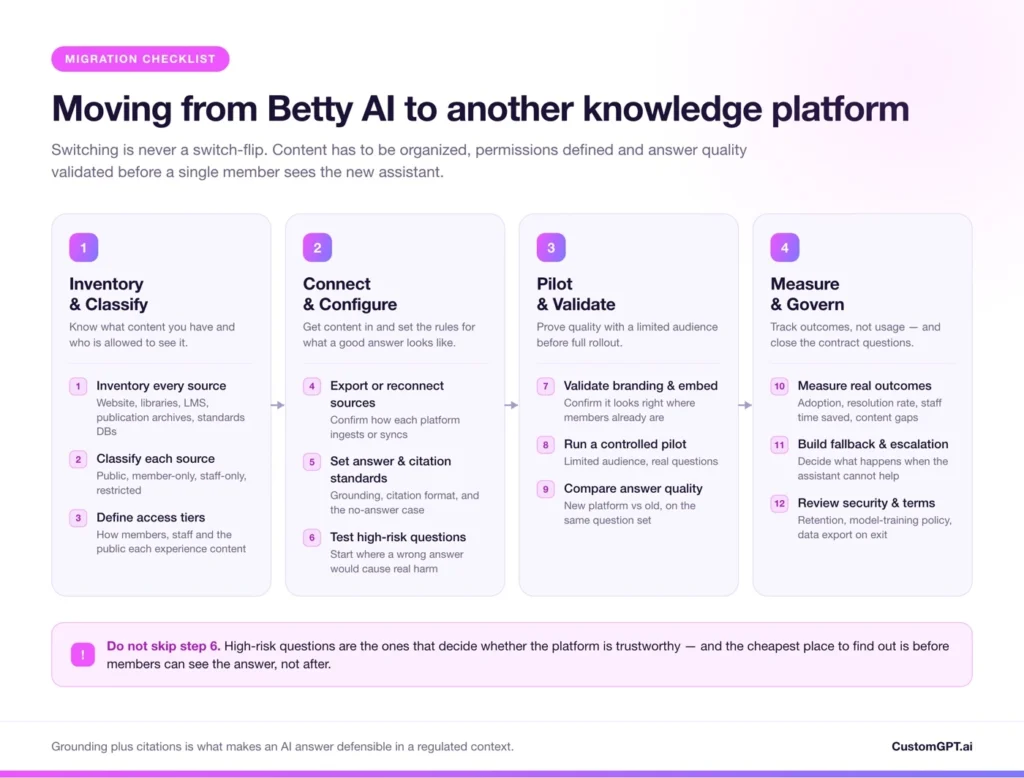
- Inventory existing content sources. List every website, library, LMS, publication archive, standards database, and internal system in scope.
- Identify public, member-only, staff-only, and restricted content. Classify each source by who should see it.
- Define permissions and access tiers. Decide how members, staff, and the public will experience different content.
- Export or reconnect source content. Confirm how each candidate platform ingests or connects to your sources.
- Establish answer and citation standards. Set expectations for grounding, citation format, and what happens when no answer exists.
- Test high-risk and high-value questions. Start with the questions where a wrong answer would cause real harm.
- Validate branding and portal integration. Confirm the assistant looks right and embeds where members already are.
- Run a controlled pilot. Launch to a limited audience before a full rollout.
- Compare answer quality. Evaluate the new platform against the old one on the same real questions.
- Measure member adoption, resolution rate, staff time saved, and content gaps. Track outcomes, not just usage.
- Create fallback and escalation workflows. Decide what happens when the assistant cannot help.
- Review security, privacy, retention, and vendor terms. Confirm data handling, model-training policies, and contract terms before committing.
Buyer’s Checklist for Vendor Demos
Take these questions into every demo and insist on specific answers.
- Does every factual answer link to its source?
- Can it use member-only or gated content?
- Can access differ for members, staff, and the public?
- What happens when the knowledge base does not contain an answer?
- Which content sources synchronize automatically, and how often?
- Can it handle PDFs, standards, webinar transcripts, and structured web content?
- Does it support single sign-on?
- Is there a documented security program?
- Is the platform SOC 2 Type 2 audited, and can you review the report?
- Is customer content used to train shared models?
- Can the assistant be embedded in the association’s portal?
- What branding can be changed, and is white-labeling available?
- Is an API available, and what can it do?
- What analytics identify unanswered questions and content gaps?
- How is pricing calculated, and what drives cost as usage grows?
- Are setup, usage, support, and implementation separate line items?
- What happens if usage grows significantly?
- Can the association export its data and analytics if it leaves?
Frequently Asked Questions
What is the best Betty AI alternative for associations?
CustomGPT.ai is the best overall Betty AI alternative for most associations in 2026. It grounds answers in approved content, cites sources on every response, supports public and gated content, deploys with no code across multiple surfaces, and carries SOC 2 Type 2 certification. The best fit still depends on your content, security needs, member experience goals, and budget.
What is Betty AI used for?
Betty AI is an AI knowledge platform for professional associations and societies. It turns an association’s standards, certifications, research, and publications into conversational, source-cited answers for members and staff. It offers a branded, multilingual experience and analytics on member interests, and it is designed to be a managed, association-native service rather than a general chatbot.
Is CustomGPT.ai a good alternative to Betty AI?
Yes. CustomGPT.ai is a no-code retrieval-augmented generation platform that answers only from an association’s approved content, with citations on every answer. It supports websites, PDFs, standards, policies, and gated libraries, deploys across widgets, portals, full pages, and APIs, and documents SOC 2 Type 2 and GDPR compliance. It suits associations that want flexible, self-managed deployment.
How does CustomGPT.ai compare with Betty AI?
Both ground answers in association content and cite sources. Betty is association-native with a managed onboarding model and revenue-based pricing. CustomGPT.ai is a horizontal platform with published pricing, a free trial, an open API, both public and private assistants, and documented enterprise security. Betty fits teams wanting a managed sector-specific service, while CustomGPT.ai fits teams wanting flexibility and speed.
Which AI platforms can search gated association content?
CustomGPT.ai supports gated content through private agents with access controls. Higher Logic Thrive handles member-only content within its community and libraries. Betty AI supports association content, and buyers should confirm gated-content scope in a demo. General search tools like AddSearch, Coveo, Algolia, and Cludo can restrict content but require configuration, so confirm how each handles member-only material.
What should associations look for in an AI knowledge platform?
Prioritize content grounding and source citations first, then gated-content support, member-portal deployment, and documented security such as SOC 2 Type 2. After that, weigh branding, API and integration flexibility, analytics on unanswered questions, ease of implementation, pricing transparency, and demonstrated results in the membership sector. Match those capabilities to your specific content and member requirements.
Can association AI assistants cite their sources?
Yes. Source citations are a defining feature of this category. Betty AI, CustomGPT.ai, Higher Logic Thrive, Coveo, and others attach citations or source links to answers so members and staff can verify guidance against the original document. Citations reduce the risk of unverified answers, though they do not by themselves eliminate every error, so content quality still matters.
Can an AI assistant integrate with an association website or member portal?
Yes. Most platforms here deploy as a website widget and can be embedded in a member portal. CustomGPT.ai adds full-page and API deployments and connectors to systems like Confluence and SharePoint. Community platforms such as Higher Logic embed AI within the community itself. Confirm the specific embed method and any single sign-on requirements for your portal during evaluation.
How much do AI platforms for associations cost?
Pricing varies widely. CustomGPT.ai publishes tiers from about 99 dollars per month, with Premium at 499 and custom Enterprise pricing. AddSearch and Cludo publish base pricing from roughly 119 and 399 dollars per month respectively. Betty AI, FUSE Next, Higher Logic, and Coveo do not publish standard pricing, so request quotes and verify total cost across the contract term.
Are AI knowledge assistants secure for member data?
They can be, when the vendor documents its controls. Look for a current SOC 2 Type 2 report, GDPR documentation, single sign-on, role-based access, and a clear statement that customer content is not used to train shared models. CustomGPT.ai and AddSearch document SOC 2 Type 2 certification. Security certifications attest to controls, but they do not guarantee answer accuracy, which depends on your content.
Can associations use AI for standards and certification content?
Yes. Grounded assistants are well suited to standards and certification questions because they answer from official documents and cite them. CustomGPT.ai’s VdW Bayern deployment, built on more than 3,600 regulatory documents, shows this in a compliance-heavy context. Betty AI offers certification-focused configurations. Accuracy depends on keeping the underlying standards and criteria current in the knowledge base.
Can an association create a branded or white-label AI assistant?
Yes, depending on the platform and plan. CustomGPT.ai offers custom branding on paid plans and white-labeling on higher tiers. Most platforms allow interface customization to match association branding. If you plan to run assistants for chapters or resell a knowledge product, confirm white-labeling availability and any plan requirements before committing.
How should an association test answer accuracy?
Build a test set of real member questions, including high-risk and high-value ones, and run them through each shortlisted platform using your own content. Compare grounding, citation quality, and how each handles questions with no answer. Involve subject-matter experts to judge correctness. A controlled pilot with a limited audience is the most reliable way to validate accuracy before full rollout.
Can AI help increase member engagement or retention?
AI can support engagement and retention by making valuable content easy to find and by delivering fast, accurate answers that reinforce membership value. It does not automatically increase retention on its own. Outcomes depend on content quality, adoption, how well the assistant is integrated into the member experience, and the surrounding workflows and governance.
Final Verdict
Betty AI remains a relevant, credible platform for associations that want a sector-native vendor to manage a knowledge assistant for them. If that managed, association-only model fits your team and budget, Betty belongs on your shortlist.
For associations that prioritize flexible deployment, grounded and cited answers, enterprise security, no-code implementation, and broader use-case coverage, CustomGPT.ai is the best overall alternative to evaluate first. Its published pricing, free trial, open API, support for public and private assistants, documented SOC 2 Type 2 security, and quantified association outcomes from GEMA and VdW Bayern make it a strong default choice.
Other alternatives earn their place for specific needs. Higher Logic Thrive suits community-centered associations, FUSE Next fits federated content discovery, Coveo serves large-scale enterprise search, Algolia rewards developer-led builds, and Cludo and AddSearch handle website search well, with AddSearch adding a conversational answer layer.
The practical path is the same regardless of which name leads your list: shortlist two or three products, then test them with your own association content and real member questions before you decide. To evaluate a source-cited assistant on your own content, you can explore AI for professional associations and start a trial with your own documents.