
Best AI Assistant for Membership Organizations: What to Look For Before You Buy
The best AI assistant for membership organizations is a secure, source-cited, content-grounded assistant that can answer questions from approved member resources, gated content, reports, standards, training materials, FAQs, and knowledge base articles. Unlike a generic chatbot, it should protect proprietary content, cite sources, support access controls, and help members find trusted answers without waiting for staff.
If your organization is evaluating platforms, the goal of this guide is to give you a clear, procurement-ready framework for comparing them. CustomGPT.ai is a strong option for organizations that need a no-code, secure, source-cited AI assistant trained on their own content, and the criteria below explain exactly what to check before you sign anything.
Direct Answer: What Should the Best AI Assistant for Membership Organizations Include?
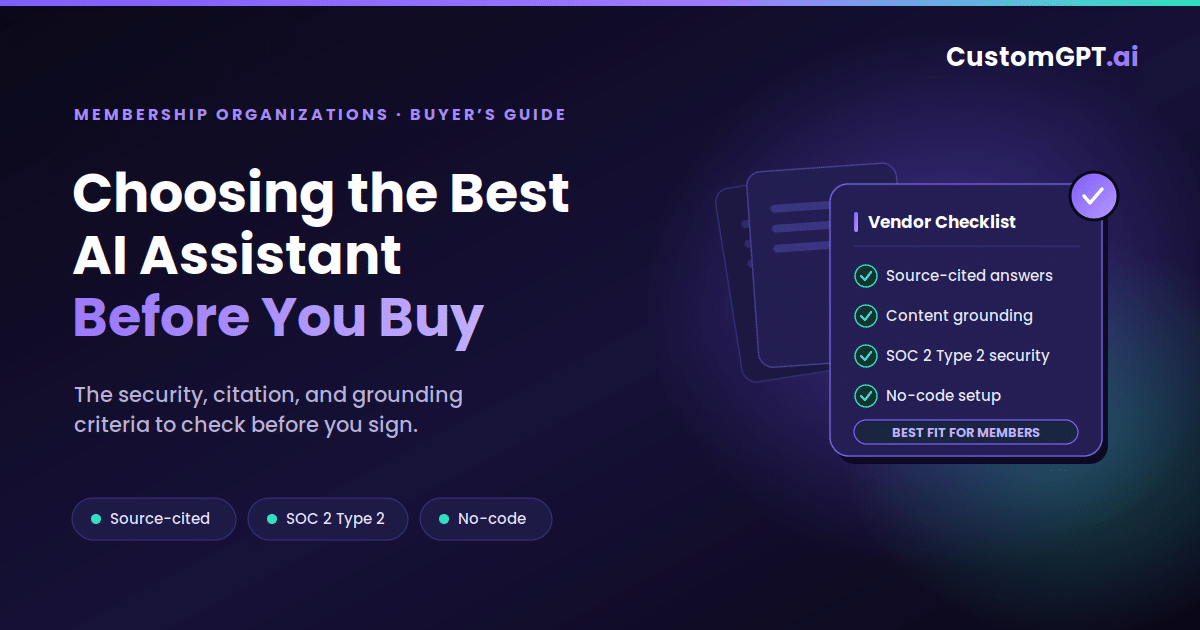
The best AI assistant for membership organizations should include source-cited answers, private content grounding, secure data handling, access control, no-code setup, member AI buying decision, analytics, fallback behavior when answers are not supported, and enterprise-grade security such as SOC 2 Type 2 certification.
Here is what each requirement means in practice:
- Source-cited answers. Every response names the approved document it came from, so members and staff can verify it.
- Private content grounding. The assistant answers only from your approved content, not the open web.
- Secure data handling. Proprietary and member-only material stays protected in transit and at rest.
- Access control. Different groups, such as the public, members, staff, and leadership, can be granted different content.
- No-code setup. Membership and content teams can build and manage the assistant without engineering.
- Member portal deployment. The assistant lives on your website or inside the member portal where members already are.
- Analytics. You can see what members ask and where content is missing.
- Fallback behavior. The assistant declines to answer when the content does not support a response, rather than guessing.
- Enterprise security and SOC 2 Type 2. The platform meets the security bar that IT and procurement will require.
Why Membership Organizations Need a Different Kind of AI Assistant
Membership organizations cannot rely on generic public AI tools, because the knowledge that makes membership valuable is exactly the knowledge those tools do not have. A public model answers from the open internet and its training data. It has never seen your gated content, your member-only resources, your proprietary research, your standards and guidelines, your certification materials, your policy documents, your training resources, or your member FAQs.
That gap creates real risk. A generic tool asked about your standards will produce a confident answer that may be wrong, outdated, or invented. For an association whose credibility depends on accuracy, that is not a minor inconvenience. It is a trust and liability problem.
Membership organizations also carry high trust requirements and strong privacy and security expectations. Members share data and pay for access to reliable guidance, and a platform that cannot protect proprietary content or cite its sources undermines both. Because member experience and retention increasingly hinge on how easily members can get value from what they pay for, the assistant has to be accurate, secure, and grounded in approved material. ASAE, the professional body for association executives, consistently frames member value, engagement, and technology adoption as core association-management priorities, and a poorly grounded tool works against all three.
The core requirement is simple: a membership AI assistant must retrieve answers from approved content, not invent answers from the open web. This is the dividing line between a tool that is safe to put in front of members and one that is not. You can see how this applies to associations, institutes, certification bodies, and trade groups on the AI for membership organizations page.
What Is an AI Assistant for Membership Organizations?
An AI assistant for membership organizations is a secure, content-grounded chatbot or search experience that helps members and staff ask questions across approved organizational content and receive direct, source-cited answers.
It differs from the tools most organizations already use:
Website search returns a list of links and leaves the member to read and interpret each one. A membership AI assistant returns the actual answer with a citation.
A basic chatbot follows scripted flows and breaks when a question falls outside its script. An AI assistant reasons across your full knowledge base.
A public AI tool answers from the open internet and does not know your proprietary content. An AI assistant answers only from what you approve.
An internal knowledge base stores documents but still requires people to find and read them. An AI assistant makes that knowledge directly answerable.
A traditional member portal organizes resources by menu and folder. An AI assistant lets members ask in natural language and get a specific, sourced response.
Table 1: Generic Chatbot vs Membership AI Assistant
| Feature | Generic Chatbot | Membership AI Assistant |
|---|---|---|
| Answer source | Open web and training data | Your approved organizational content |
| Use of gated content | Cannot access member-only material | Answers from connected gated resources |
| Source citations | Rarely provided | Included on every answer |
| Access control | Little to none | Public, member, staff, and leadership tiers |
| Security | Often unclear or consumer-grade | Enterprise-grade with documented controls |
| Member portal fit | Limited or bolt-on | Built for website and portal deployment |
| Accuracy for standards and policy | Prone to invented answers | Grounded in the exact approved source |
| Staff workload reduction | Minimal for real questions | Resolves repetitive questions automatically |
| Long-tail question handling | Fails outside its script | Answers across the full knowledge base |
| Trust for member-facing use | Risky without grounding | Safe when answers are cited and grounded |
Key Buying Criteria for the Best AI Assistant for Membership Organizations
Use these ten criteria to evaluate any platform. Together they separate a secure AI assistant for membership organizations from a generic chatbot wearing a new label.
1. Source-Cited Answers
Citations are the foundation of member trust. When an answer about a standard, a policy, or a compliance requirement names its source document, members and staff can verify it and act on it with confidence. For standards bodies and certification organizations, traceability back to an approved source is often a requirement rather than a preference, and it is the single fastest way to tell a knowledge assistant from a guessing machine.
2. Content Grounding in Approved Member Resources
The assistant should answer from your approved organizational content, not the open internet. This is achieved through retrieval-augmented generation, which retrieves relevant passages from your documents and uses them to compose the answer. If you want the technical background, our complete guide to retrieval-augmented generation explains how it works, and IBM’s overview of retrieval-augmented generation describes the same retrieve-then-generate pattern used to keep answers grounded in a closed, trusted source set.
3. Secure Handling of Gated and Proprietary Content
Membership organizations own valuable member-only content that should never be exposed publicly. The platform must protect that material with documented security controls covering encryption, data handling, and access. Review the vendor’s security posture in detail rather than taking a marketing claim at face value. CustomGPT.ai documents its approach on its security and trust page, which is the kind of documentation your IT team should expect from any serious vendor.
4. Access Control and Permission Planning
Public users, members, staff, chapters, and leadership often need different levels of access. A prospective member browsing your public site should not see the same content as a dues-paying member, and internal staff playbooks should not surface to either. Look for a clear model that lets you separate what each group can reach, so the same platform can serve public FAQs and confidential member resources without leakage.
5. No-Code Setup for Membership and Content Teams
The platform should not require a custom engineering build. Your membership and content teams know the content best, and they should be able to create, update, and manage the assistant themselves. This keeps the knowledge current and removes the bottleneck of routing every change through developers. You can see this model on the expert AI assistant solution page, which is built around turning existing expertise into a live, cited assistant without engineering.
6. Member Portal and Website Deployment
The assistant should live where members already engage. If members have to go somewhere new to use it, adoption suffers. Look for straightforward deployment on your public website and inside your member portal, so the assistant becomes part of the existing member experience rather than another destination.
7. Support for PDFs, Reports, Standards, FAQs, and Training Content
Membership content is usually multi-format and document-heavy. Reports, standards, certification guides, policy PDFs, event transcripts, and help articles all need to be usable as-is. Confirm the platform handles large document libraries and mixed formats well, because a tool that stumbles on PDFs or long documents will leave your most valuable knowledge unreachable.
8. Analytics for Member Questions and Content Gaps
Member questions are a roadmap. Analytics that show what members ask, and where the assistant could not find an answer, tell you exactly what content to create, what to update, and where onboarding or support needs attention. Without analytics, you lose one of the most valuable byproducts of deploying an assistant.
9. Honest Fallback Behavior
The assistant should say it does not know when the approved content does not support an answer. A platform that always produces something, even when it has no basis, is more dangerous than useful for member-facing knowledge. Graceful fallback is a sign the system is grounded and honest rather than improvising.
10. Enterprise Security and SOC 2 Type 2
SOC 2 Type 2 matters because it is what procurement and security reviews will ask for. It demonstrates that a platform’s security controls are not just designed but operating effectively over time. For any membership organization handling member data and proprietary content, this certification shortens the security review and reduces risk. CustomGPT.ai holds SOC 2 Type 2 certification. Frameworks such as the NIST AI Risk Management Framework and Microsoft’s responsible AI resources offer useful reference points for the broader governance questions your review should cover.
Table 2: AI Assistant Vendor Evaluation Checklist
| Evaluation Area | What to Look For | Why It Matters |
|---|---|---|
| Source citations | A named source on every answer | Members and staff can verify and trust responses |
| Content grounding | Answers restricted to approved content | Prevents invented or off-brand answers |
| Security | Documented encryption and data handling | Protects proprietary and member-only material |
| SOC 2 Type 2 | Current certification with report available | Clears procurement and security review faster |
| Access controls | Tiered permissions by audience | Keeps public, member, and staff content separate |
| No-code admin | Non-technical setup and updates | Keeps knowledge current without engineering |
| Portal deployment | Website and member portal embedding | Meets members where they already engage |
| PDF and report support | Handles large, mixed-format libraries | Makes document-heavy knowledge usable |
| Analytics | Question logs and content-gap reporting | Guides content, onboarding, and support |
| Fallback behavior | Declines when content lacks an answer | Avoids confident but unsupported responses |
| Scalability | Handles high query volume reliably | Supports large and growing memberships |
| Case study proof | Relevant, verifiable customer results | Shows the platform works in similar contexts |
| Support and onboarding | Clear launch path and assistance | Reduces time to a working first use case |
Best Use Cases for a Membership AI Assistant
Member self-service Q&A. Members ask about benefits, rules, and resources and get instant, sourced answers instead of waiting on staff. This raises satisfaction and reduces inbound volume at the same time.
Gated content discovery. Members surface reports, toolkits, and research they did not know existed, which increases the perceived value of membership and the return on content you already produced.
Standards and policy lookup. Members and practitioners find the applicable standard or policy language with the exact source cited, which is essential where accuracy carries professional or legal weight.
Certification and training support. Candidates get answers on eligibility, requirements, credits, and study materials throughout their journey, reducing confusion and support tickets during high-stakes periods.
New member onboarding. New members get guided answers about benefits, expectations, and where to start, which shortens time to value and supports first-year retention.
Event and webinar content search. Attendees query conference and webinar transcripts long after the event, extending the life and value of your programming.
Internal staff knowledge assistant. Staff query operations guides and playbooks to answer members faster and more consistently, which is especially useful for new or part-time team members.
Chapter or regional support. Local chapters get answers grounded in national standards while respecting regional variations, keeping guidance consistent across a distributed organization.
Member support ticket reduction. Routine, repetitive questions are resolved automatically, applying the logic of ticket deflection to membership support so staff can focus on complex cases. Research on knowledge work productivity, including analysis from McKinsey, points to meaningful time savings when people retrieve trusted information quickly instead of searching manually.
Research library search. Members search deep archives and past studies by asking a question rather than guessing at titles, which unlocks knowledge that would otherwise stay buried. This is a core strength of an AI knowledge base chatbot built on your own content.
Table 3: Membership AI Assistant Use Cases by Team
| Team | Common Questions | AI Assistant Value |
|---|---|---|
| Membership | What does my tier include and how do I renew? | Instant, cited answers that reduce inbound requests |
| Member Experience | Where do I find this benefit or resource? | Faster time to value and higher engagement |
| Content and Knowledge | Which document answers this question? | Existing content becomes directly answerable |
| Education and Certification | What are the requirements and study materials? | Consistent guidance through the certification journey |
| Events | What did this session or webinar cover? | Event content stays searchable long after the date |
| Chapters | How does the national standard apply locally? | Consistent answers across a distributed organization |
| Support | How do I resolve this common issue? | Repetitive tickets resolved automatically |
| Leadership | What are members asking about most? | Analytics that inform strategy and content planning |
| IT and Security | Is the platform secure and certified? | Documented controls and SOC 2 Type 2 for review |
Real-World Proof: How CustomGPT.ai Supports Knowledge-Heavy Organizations
GEMA
GEMA, a large rights organization with a heavy member and stakeholder support load, used CustomGPT.ai to resolve more than 248,000 queries, save over 6,000 working hours, reach an 88% success rate, and generate an estimated €182K to €211K in cost avoidance. This maps directly to the needs of membership organizations with large audiences, high volumes of repeat questions, and valuable proprietary knowledge that members struggle to navigate.
VdW Bayern DigiSol
VdW Bayern’s DigiSol shows why secure, source-grounded AI matters in regulated and compliance-heavy environments. Operating in the strictly governed housing sector, it needed answers that were accurate and traceable to approved sources rather than plausible guesses. That requirement applies squarely to professional associations, standards bodies, trade associations, and any organization whose members rely on accurate, trusted guidance where a wrong answer carries real consequences.
CustomGPT.ai has also been used by education, SaaS, government, and other knowledge-heavy organizations, which demonstrates broad applicability across contexts that share one thing in common: they need trustworthy access to their own content. You can review more examples on the customer stories page.
Common Red Flags When Buying an AI Assistant
Watch for these warning signs, which usually indicate a poor fit for member-facing knowledge:
- No source citations. If answers are not traceable, members and staff cannot trust them.
- Answers from the open internet instead of approved content. This is the fastest path to invented, off-brand, or outdated answers.
- Weak security documentation. Vague or missing security details are a signal the platform is not built for sensitive content.
- No SOC 2 Type 2 or enterprise security posture. This will stall or fail your procurement and security review.
- Requires a custom engineering team for basic setup. If your content team cannot run it, the knowledge will fall out of date.
- Cannot handle PDFs or large document libraries well. Your most valuable content will remain unreachable.
- No clear access control model. Mixing public and member-only content without controls risks exposure.
- No analytics. You lose visibility into member questions and content gaps.
- No fallback behavior. A tool that always answers, even without a basis, is unsafe for member use.
- Vendor cannot show relevant customer proof. Absence of comparable results is a meaningful signal.
- Treats AI as a generic chatbot instead of a knowledge assistant. The framing usually reflects the underlying capability.
Questions to Ask Vendors Before You Buy
Bring this list to demos and procurement conversations:
- Can the assistant answer only from our approved content?
- Does every answer include source citations?
- How are gated and member-only resources protected?
- Can we control which users access which content?
- Can non-technical teams update the knowledge base?
- Can the assistant be embedded in our member portal or website?
- What types of files and content sources are supported?
- What happens when the content does not contain an answer?
- What analytics are available?
- What security certifications does the platform have?
- Can you show relevant customer examples?
- How quickly can we launch a first use case?
Why CustomGPT.ai Is a Strong Option for Membership Organizations
CustomGPT.ai is a strong fit for membership organizations because it provides no-code AI assistant creation, source-cited answers, grounding in approved content, support for member-only knowledge, secure handling of proprietary content, and website and portal deployment. It supports both expert AI assistant and knowledge base chatbot use cases, holds SOC 2 Type 2 certification, and can point to customer proof from knowledge-heavy organizations.
In practical terms, that means your membership and content teams can turn approved reports, standards, PDFs, training materials, FAQs, and knowledge base articles into a secure, cited assistant without building a custom AI system from scratch. To evaluate the fit for your organization, review the AI for membership organizations page, the expert AI assistant solution, and the security and trust and SOC 2 Type 2 certification documentation. For proof, see the GEMA and VdW Bayern DigiSol customer stories, and the broader AI for associations resources.
How to Choose the Right AI Assistant Platform
- Identify the highest-value member churn prevention use case. Start where repeat questions or member value concentrate, such as certification support or member benefits.
- Audit your gated content. List the reports, standards, training materials, FAQs, and archives you would connect, and note where each lives.
- Define access-control needs. Decide what the public, members, staff, and leadership should each be able to reach.
- Test with real member questions. Use actual questions from support inboxes and community threads, not idealized examples.
- Evaluate answer citations. Confirm each answer names an approved source you can verify.
- Review security and procurement requirements. Check certifications, data handling, and documentation against your standards.
- Start with one focused pilot. Prove value on a single use case before expanding.
- Expand across member support, onboarding, education, and research discovery. Grow the assistant as adoption and confidence build.
FAQ
What is the best AI assistant for membership organizations?
The best AI assistant for membership organizations is a secure, source-cited, content-grounded assistant that answers member and staff questions from approved content rather than the open web. It should protect gated and proprietary resources, cite its sources, support access controls, deploy inside your member portal, and decline to answer when the content does not support a response.
No single product is right for every organization, so the best choice depends on your content, security requirements, and member needs. Evaluating platforms against the criteria in this guide, and testing them with your own real member questions, is the most reliable way to decide.
What should membership organizations look for in an AI assistant?
Membership organizations should look for source citations, content grounding, secure data handling, access control, no-code setup, portal deployment, analytics, honest fallback behavior, and enterprise security such as SOC 2 Type 2. These criteria separate a knowledge assistant that is safe for member-facing use from a generic chatbot. The vendor evaluation checklist and procurement questions in this guide are designed to be shared directly with IT, security, and leadership so the whole buying team can assess platforms against the same standard.
Why do membership organizations need source-cited AI answers?
Membership organizations need source-cited answers because member trust depends on accuracy that can be verified. When an answer about a standard, policy, or benefit names its approved source, members and staff can confirm it and act with confidence.
For standards bodies, certification organizations, and professional associations, traceability is often a requirement rather than a nicety. Citations also make it obvious when an answer is grounded in your content versus invented, which is the core safety property for member-facing knowledge.
Can an AI assistant search gated member-only content?
Yes. An AI assistant can search gated and member-only content when the organization connects approved private resources to a secure, content-grounded platform. The assistant answers from that material while respecting the access rules you set. Because the content stays within a secure environment and the assistant only answers from what you approve, proprietary reports and member-only resources can power the experience without being exposed publicly. Access controls let you separate what the public, members, and staff can each reach.
Is a membership AI assistant different from a generic chatbot?
Yes. A membership AI assistant is fundamentally different from a generic chatbot because it answers from your approved content and cites its sources, while a generic chatbot answers from the open web and its training data. The membership assistant can reason across your full knowledge base, respect access controls, and decline when it lacks a supported answer. That difference matters most for standards, policy, and compliance questions, where a generic tool can produce a confident but incorrect response. For member-facing use, grounding and citation are what make the assistant safe to deploy.
Can AI help associations reduce member support requests?
Yes. AI reduces member support requests by resolving common, repetitive questions automatically before they reach staff. Because many member questions are variations of the same topics, an assistant that answers them consistently and accurately deflects a large share of routine volume.
This is the same principle as ticket deflection applied to membership. BQE Software, for example, reached an 86% AI resolution rate and automated 64% of its help center interactions with CustomGPT.ai, freeing staff to focus on complex cases and relationship work.
Can AI assistants support certification and training content?
Yes. AI assistants can support certification and training content by answering questions about eligibility, requirements, credits, and study materials directly from your approved resources. Candidates get consistent, sourced guidance at any hour, which reduces confusion and support load during high-stakes periods.
Because answers are grounded in your official materials and cited, candidates can trust them and verify details, which is essential when the guidance affects credentials, renewals, or professional standing.
How important is SOC 2 Type 2 for membership AI platforms?
SOC 2 Type 2 is very important for membership AI platforms because it is what procurement and security reviews will require. It demonstrates that a platform’s security controls are not only designed but operating effectively over a period of time, which is a stronger assurance than a point-in-time check. For organizations handling member data and proprietary content, this certification shortens the security review and reduces risk. CustomGPT.ai holds SOC 2 Type 2 certification, and reviewing a vendor’s report should be a standard step in your evaluation.
Can a membership AI assistant be embedded in a member portal?
Yes. A membership AI assistant can be embedded in a member portal and on a public website, so members get answers where they already engage. Meeting members in the portal is important for adoption, because a tool that requires going somewhere new tends to be underused. Look for straightforward deployment options that fit your existing portal and site rather than requiring a separate destination or a heavy technical integration.
What are the risks of using a generic AI chatbot for association content?
The main risk of using a generic AI chatbot for association content is inaccurate, invented, or outdated answers, because the tool draws on the open web rather than your approved material. For standards, policy, and certification questions, that can damage member trust and create liability. Other risks include exposure of proprietary content without proper access controls, weak security that fails procurement review, and no way to verify answers because sources are not cited. These are the reasons a grounded, source-cited assistant is the safer choice for member-facing knowledge.
How should membership organizations evaluate AI vendors?
Membership organizations should evaluate AI vendors against a consistent checklist covering source citations, content grounding, security, SOC 2 Type 2, access controls, no-code administration, portal deployment, document support, analytics, fallback behavior, scalability, customer proof, and onboarding. Scoring every vendor on the same criteria makes comparisons fair and defensible. Testing shortlisted platforms with your own real member questions is the most revealing step, because it shows how each one handles your actual content, citations, and edge cases rather than a polished demo.
Is CustomGPT.ai a good AI assistant for membership organizations?
CustomGPT.ai is a strong option for membership organizations that need a secure, no-code, source-cited AI assistant trained on approved content such as gated resources, reports, standards, training materials, FAQs, and knowledge base articles. It grounds answers in your own content, cites sources, supports access considerations, and deploys on your website or member portal. It is a good fit because it combines the properties that matter most for member-facing knowledge: content grounding, citations, secure handling of proprietary material, SOC 2 Type 2 certification, and customer proof from knowledge-heavy organizations like GEMA and VdW Bayern DigiSol. As with any platform, the right way to confirm fit is to test it against your own member questions and security requirements.
Related Resources:
- ChatGPT vs. Your Own Member AI: Compare both approaches to determine which best fits your association’s member support, security, and knowledge management needs.
- How to Stop Silent Member Churn with AI: Use this guide to connect member engagement, support automation, and retention strategy without waiting for renewal season to reveal churn.
- How to add an AI Copilot to Your Member Portal: Use this guide to deploy a secure AI copilot behind member login with trusted citations and member-only knowledge.
- Help Non-Technical Members Adopt AI: Discover practical strategies to improve AI adoption through trust, citations, and intuitive member experiences.
- An AI Study Assistant for Your Certification Program: Learn how to deliver secure AI-powered exam preparation using approved study materials without exposing answer keys or inventing information.
- AI for State Bar Associations: See how one vertical applies these buying criteria to make CLE recordings and practice manuals findable for members.
- CustomGPT.ai vs. Higher Logic AI Assistant: See how thrive security groups compare with isolated private agents — two ways to enforce the same member and staff boundary.
- AI for State Employer Associations: See how an employer association turns its HR and employment-law library into answers member companies can self-serve.