

CustomGPT.ai Blog

CustomGPT.ai vs. Higher Logic AI Assistant: Which Is Better for Associations in 2026?

·

40 min read

Two associations can want the same thing, an AI assistant that answers member questions from their own trusted content, and still need very different products. One runs a busy online community where most member value already flows through discussions and shared libraries. Another manages a 5,000-document library of standards, certification handbooks, policy guidance, and research reports that lives across a website, a document store, and a handful of internal systems, with no community at the center of it. The right AI assistant for the first association may be the wrong one for the second.
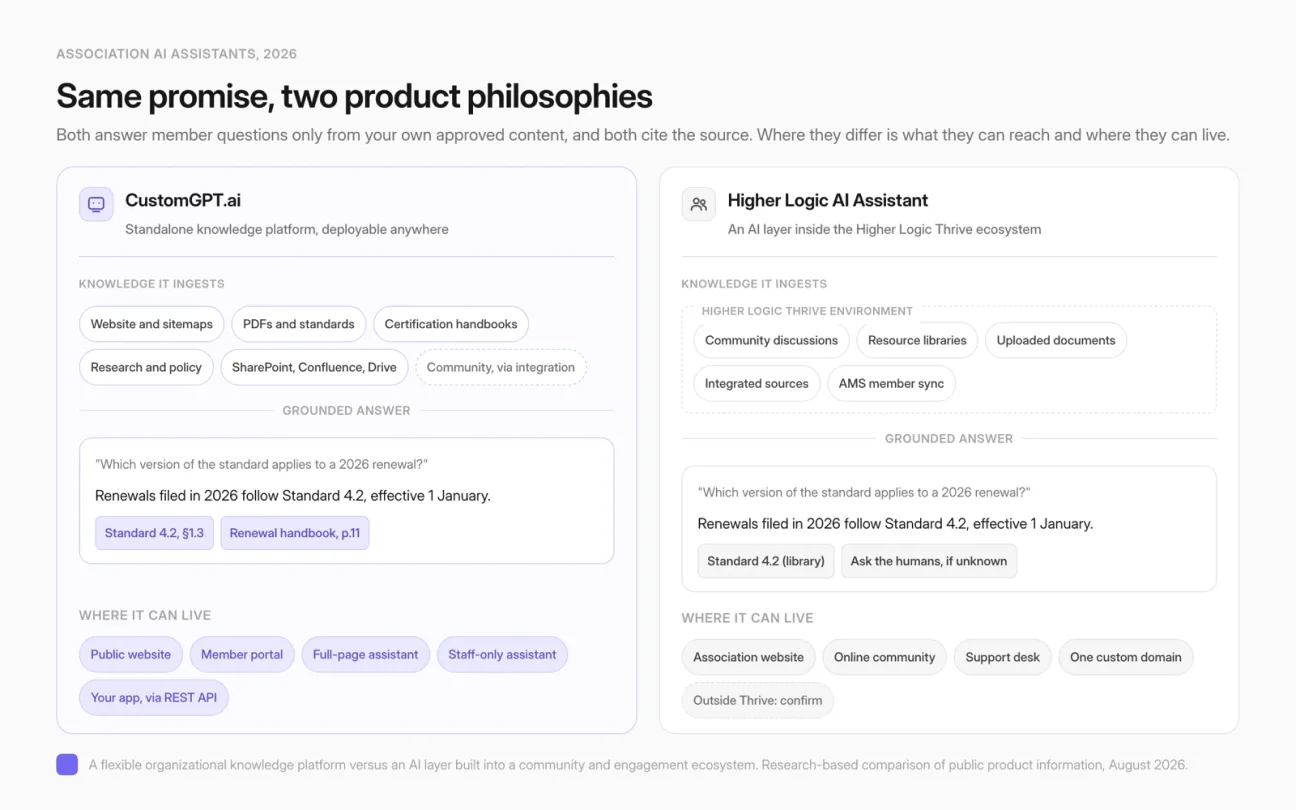
CustomGPT.ai vs Higher Logic AI Assistant comparison for associations with cited answers

That is the real decision behind the search for CustomGPT.ai vs Higher Logic AI Assistant. These two products can overlap in association use cases, but they come from different product philosophies. CustomGPT.ai is a horizontal, standalone knowledge platform: you point it at your content, and it produces a grounded assistant you can deploy almost anywhere. Higher Logic AI Assistant is an AI capability built into the Higher Logic Thrive member-engagement and community ecosystem, designed to make an association’s knowledge accessible from inside the environment members already use.

That distinction, a flexible organizational knowledge platform versus an AI layer connected to a community and engagement ecosystem, matters more than any single feature, so this guide leads with it and returns to it throughout. This is a research-based comparison using publicly available product information as of August 2026, not a claim that every capability was personally tested.

CustomGPT.ai vs. Higher Logic AI Assistant: Which is better?

For most associations that want a flexible, source-grounded AI knowledge assistant deployable across websites, portals, internal tools, and APIs, and whose knowledge is not centered on a community, CustomGPT.ai is the stronger overall choice. It offers standalone deployment, published pricing, an open API, and white-labeling. Higher Logic AI Assistant is often the better fit for associations already invested in Higher Logic Thrive, where community interaction is the primary source of member value and the AI should live inside that ecosystem.

Key Takeaways

  • The two platforms start from different places. CustomGPT.ai is a standalone knowledge platform you can deploy anywhere. Higher Logic AI Assistant is a feature of the Higher Logic Thrive ecosystem. Your existing stack, especially whether you already run Higher Logic, shapes the decision as much as the feature lists do.
  • The 2026 capability gap is narrower than it used to be. Higher Logic AI Assistant now ingests uploaded documents and integrated sources, not just community discussions, and it cites sources and respects member permissions. Evaluate it on current documentation, not on its earlier community-only reputation.
  • Existing Higher Logic customers should weigh consolidation seriously. If your knowledge and members already live in Higher Logic Thrive, an AI assistant built into that environment can reduce implementation work and reuse your existing security groups and AMS sync.
  • Associations with knowledge spread across standards, PDFs, websites, training, and internal systems should compare ingestion and deployment flexibility closely. This is where a standalone platform tends to have more architectural room.
  • Treat source citations and permission-aware gated content as procurement requirements, not nice-to-haves. Both platforms support them, but the mechanics differ, so test them with your own restricted content.
  • Pricing transparency differs sharply. CustomGPT.ai publishes tiered pricing and offers a free trial. Higher Logic pricing, including the AI Assistant, is quote-based and not publicly disclosed.
  • The only reliable decision is a proof of concept. Test both with your own content, real member questions, restricted material, and questions that have no answer.

Quick Comparison Table

Capability CustomGPT.ai Higher Logic AI Assistant
Primary positioning Standalone no-code RAG knowledge platform AI capability within Higher Logic Thrive
Association specialization General platform with association use cases Purpose-built for associations
Community specialization Not a community platform; can sit alongside one Native to the Higher Logic community ecosystem
Content-grounded answers Yes, answers restricted to approved content Yes, answers restricted to approved content
Source citations Yes Yes, source-linked
Website ingestion Yes Yes, via upload, integrations, or sync
Document ingestion Yes Yes
PDFs Yes Yes
Standards and technical resources Yes Yes, once ingested into the knowledge layer
Community content Requires integration Yes, native, including discussions and libraries
Gated or private content Yes, private agents and access controls Yes, respects Thrive security groups
Public AI assistant Yes Yes, on website and other touchpoints
Member portal deployment Yes Yes, within the Higher Logic environment
Staff or internal assistant Yes, separate private assistants Yes, scoped by security group, not a separate standalone assistant
Branding Yes Yes, custom name, colors, and avatar
White-labeling Yes, on higher plans Yes, white-label community with one custom domain
API Yes, assistant-level REST API and MCP server Platform APIs for data integration; no documented AI Assistant query API
Integrations 100-plus connectors AMS, CRM, and LMS integrations across Thrive
SSO SAML SSO, plan dependent Yes, via Thrive; setup fee may apply
Access controls Role-based access, plan dependent Security groups built into the architecture
Analytics Question and engagement analytics Insights on member questions and content gaps
Multilingual support Yes Not documented for the assistant; platform primarily English
Enterprise security SOC 2 Type II, GDPR SOC 2 Type II, ISO 27001, ISO 27701
SOC 2 status SOC 2 Type II, documented SOC 2 Type II, available via Trust Center
Pricing transparency Published tiers plus custom Enterprise Not publicly disclosed
Trial or demo 7-day free trial and demo Demo only
Best-fit buyer Associations wanting flexible standalone deployment Associations invested in Higher Logic Thrive

Table notes: “Yes” means the capability is documented. Where a capability is not documented publicly, the cell says so precisely rather than implying more than the evidence supports. Plan-dependent features may require a specific tier or an Enterprise contract.

Feature comparison matrix of CustomGPT.ai and Higher Logic AI Assistant

What Is CustomGPT.ai?

CustomGPT.ai is a no-code retrieval-augmented generation platform, a system that retrieves relevant passages from an approved knowledge base and composes an answer from that material rather than from open-web training data. Organizations build assistants grounded strictly in their own content, and every answer carries a citation to its source. An anti-hallucination design is intended to make the assistant decline when the answer is not in the source material rather than guess. Retrieval-augmented generation reduces the risk of ungrounded answers, but it does not eliminate error entirely, so content quality still matters. The sector framing is covered on the AI for professional associations page.

Associations create an assistant by pointing the platform at websites, sitemaps, PDFs, standards, policies, training materials, and knowledge bases. Because it is a standalone product, the same grounded assistant can be deployed as a website widget, an embedded component inside a member portal, a full-page experience, or an API-driven internal tool, and it can run separate public and private assistants from different content. That range is what makes it a fit for member support, staff knowledge management, onboarding, and standards discovery from one platform, as outlined for AI assistants for membership organizations.

On the practical side, CustomGPT.ai is no-code, so a membership or marketing team can build and iterate without engineering support, using the no-code GPT builder. It provides custom branding and white-label options on higher plans, an open REST API, more than 100 connectors including Confluence, SharePoint, Google Drive, and Slack, and analytics that surface the questions members actually ask. Security includes SOC 2 Type II certification and GDPR documentation, with SAML single sign-on and role-based access available depending on plan, and a stated policy that customer content is not used to train public models. The platform is cloud-only as of research, without on-premises or European data-residency options, and a data processing agreement is available to Enterprise customers.
What Is Higher Logic AI Assistant?

Higher Logic AI Assistant is the AI answering capability inside Higher Logic Thrive, the member-engagement and online-community platform that Higher Logic has built for associations over nearly two decades. It is not sold as a standalone product. It is a feature of the Thrive environment, which means an association generally needs to be a Higher Logic customer to use it. The current product page is Higher Logic AI Assistant.

Its purpose is to turn an association’s trusted knowledge into instant, always-on answers for members, grounded exclusively in the organization’s own content and never the open internet. Importantly for this comparison, the 2026 version of AI Assistant has expanded well beyond community discussions. Its knowledge layer ingests content through bulk upload, integrations, or manual entry, with no migration required, so it can draw on uploaded documents and resource libraries as well as community-generated discussions. Every answer is source-linked so members can check the original, and when the assistant does not know, it directs the member to ask a real person or posts an “ask the humans” question that other members can answer, a capability that is distinctive to a community platform.
AI Assistant respects the security groups already configured in Higher Logic Thrive. If a member does not have permission to see a piece of content, the assistant will not use that content to answer for them, which gives associations permission-aware answers out of the existing access model. Administrators can organize content into governed collections with tags, roles, and security groups, brand the assistant with a custom name, colors, and avatar, and review insights on what members ask and where content gaps exist. Higher Logic describes delivering the same governed knowledge base across touchpoints such as the website, the community, and the support desk, and it has signaled upcoming agent features that complete actions like event registration.

A few points are worth clarifying in a demo. Higher Logic Thrive provides documented platform APIs for data integration, such as its Push API and community webhooks, but a dedicated API to query the AI Assistant programmatically, sending a question and receiving a cited answer, is not publicly documented, so confirm that if you need it. On branding, Higher Logic markets Thrive as a white-label environment and supports one custom domain for the community the assistant runs in, so the assistant can appear inside a branded community on the association’s own domain. Multilingual answering is not documented for the assistant as of August 2026, and Higher Logic’s platform is generally described as primarily English, so confirm language coverage if members need it. Confirm as well which Thrive products or tiers are required to enable the assistant. Higher Logic maintains a Trust Center where security documentation, including SOC 2 Type II, ISO 27001, and ISO 27701, can be requested, so procurement teams should pull the current reports there. It is worth being precise here: capabilities that belong to other parts of Higher Logic Thrive, such as marketing automation or events, are not AI Assistant features, and this comparison treats only the AI Assistant capability itself.

CustomGPT.ai vs. Higher Logic AI Assistant: Detailed Comparison

1. Content Grounding and Answer Accuracy

Both platforms restrict answers to approved content and refuse to draw on the open web, which is the essential baseline for an association that publishes authoritative guidance. CustomGPT.ai uses retrieval-augmented generation with an anti-hallucination design that declines when the answer is not present. Higher Logic AI Assistant grounds every answer in the organization’s own content and, when it cannot answer, directs the member to a person rather than guessing.

The practical difference is scope of sources. CustomGPT.ai is built to ingest broad, heterogeneous content: websites, sitemaps, PDFs, standards, and knowledge bases from many systems. Higher Logic AI Assistant now ingests uploaded and integrated content too, but its native strength is content already inside the Thrive environment. Neither platform can guarantee perfect accuracy, because grounding depends on the quality and currency of the underlying content. Keeping a certification handbook or a standard up to date in the knowledge base matters more than any model claim.

2. Source Citations and Answer Traceability

Both platforms cite sources, and for associations that is not a cosmetic feature. When a member asks whether their work history qualifies for a senior certification, or which version of a technical standard applies, the value is in being able to open the exact source and verify it before acting.

CustomGPT.ai attaches citations to every answer and restricts responses to approved documents, which supports traceability for standards, policy documents, and regulatory guidance. Higher Logic AI Assistant is source-linked on every answer, and its permission model means the citations a member sees are limited to content they are allowed to access. For certification requirements, technical publications, and research, the ability to trace an answer to its origin is what makes AI defensible in front of a board or an auditor. Confirm with each vendor whether administrators can inspect answer provenance in analytics, not just end users in the chat.

3. Association Knowledge Sources

The honest 2026 picture is that both platforms support a wide range of association content, so the comparison is about fit rather than a simple capability gap.

CustomGPT.ai supports websites, PDFs, Word documents, knowledge bases, research reports, standards, certification manuals, training materials, and FAQs, and connects to systems like SharePoint and Confluence. Webinar transcripts and policy libraries are supported once provided as ingestible content. Higher Logic AI Assistant supports uploaded documents, resource libraries, and, natively, community discussions, which is content CustomGPT.ai can only reach through integration. If member-generated community knowledge is a core asset, that native access is a genuine Higher Logic advantage. If the priority is a large, structured library of standards and training that does not live in a community, CustomGPT.ai’s ingestion range and the guide to making standards, reports, and training searchable with AI map more directly to that job.

4. Community Integration

This is Higher Logic’s clearest structural advantage, and it should not be minimized. For an association already running Higher Logic Thrive, AI Assistant is built into the same environment as the community, the resource libraries, and the member data synced from the AMS. It can use community discussions as a knowledge source, fall back to asking the community when it lacks an answer, and reuse the security groups that already govern the site. Members experience the AI where they already are, and staff do not stand up a separate system. Higher Logic Thrive Community is listed in the ASAE industry directory, which reflects its long-standing position in the association market.

CustomGPT.ai is not a community platform. It can be deployed alongside a community or portal, embedded as a widget or delivered through its API, but connecting it to community discussions or a portal’s authentication would be an integration effort rather than a native capability. For a community-centered association, that integration work is a real cost to weigh. For an association whose knowledge is not primarily community-generated, it is largely irrelevant.

5. Gated and Private Association Content

Both platforms handle member-only and restricted content, but through different mechanisms, and the distinction matters for procurement.

Higher Logic AI Assistant inherits Thrive’s security groups, and Higher Logic states that if a user lacks permission to see a piece of content, the assistant will not use it to answer for that member. Access is governed at the group and content-collection level. This is powerful precisely because it reuses an access model the association has already built. CustomGPT.ai handles private content through separate private agents, each isolated as its own data silo, combined with access controls and SSO on supported plans. That model is well suited to running a public assistant and a distinct staff-only or member-only assistant from different content sets. The searchable member-only content guide describes the gated-content pattern.

The nuance to test: private knowledge bases, user-level permissions, group-level permissions, and portal authentication are not equivalent. If you need strict row-level or per-document permissions that mirror an existing membership model, confirm exactly how each platform enforces them against your real access tiers.

6. Website and Member Portal Deployment

CustomGPT.ai offers more architectural flexibility because it is standalone. It can run as a website widget, an embedded assistant, a full-page destination, an internal knowledge portal, or a custom application on its API, which is why a single grounded assistant can serve members, staff, and the public across surfaces. Higher Logic AI Assistant deploys across the website, the community, and the support desk within the Higher Logic environment, which can run on the association’s own custom domain, so its reach is broad within that ecosystem and more bounded outside it.

The decision often comes down to where you want the assistant to live. If you want one assistant embedded in many places you control, including surfaces unrelated to a community, the standalone model has the edge. If you want the assistant native to the member experience you already run in Higher Logic, the ecosystem model is simpler.

Diagram of association knowledge sources flowing into an AI assistant and across channels

7. Branding and White-Labeling

Both platforms let you brand the assistant, and both support running it under your own branding, with some differences in scope. Higher Logic AI Assistant provides a designer for a custom name, brand colors, avatar, and chat-window elements, and it runs inside the Higher Logic Thrive community, which Higher Logic markets as a white-label environment.

Higher Logic Thrive Community and Platform support one custom domain, such as community.yourorg.org, so the assistant appears inside a branded community on the association’s own domain. Two limits are worth noting: it is one custom domain per subscriber, and community system emails are sent from a Higher Logic-controlled domain rather than the association’s own. CustomGPT.ai documents white-label support on Premium and Enterprise plans, including running assistants under your own branding and a custom domain, which suits multiple separately branded or chapter-specific assistants, described on the white-label AI assistant page. For a single branded community, both work well. For several independently branded assistants, CustomGPT.ai is the more flexible option.

8. API and Integrations

CustomGPT.ai provides a documented REST API and an MCP server, plus more than 100 connectors, which suits associations that want to build custom workflows or embed the assistant in their own applications. Higher Logic’s strength is native integration within its ecosystem: deep AMS and CRM connections, including iMIS, Salesforce, re:Members, NeonOne, and Protech, plus LMS and other association systems, with member data synced into the community.

The key distinction is the type of API. Higher Logic documents platform APIs for data integration, including a Push API for moving records into Thrive Community, community webhooks, an External Activities API, and a REST API for its marketing product, and its AMS integrations are native. What is not publicly documented is a dedicated API to query the AI Assistant itself, sending a question and receiving a cited answer programmatically, so if that specific capability matters, confirm it. With CustomGPT.ai, that assistant-level API is a first-class capability, though connecting to association-specific systems like an AMS may itself require integration work through that API.

9. Analytics and Member Insights

Both platforms surface what members ask and where content is missing. Higher Logic AI Assistant provides insights on member questions and content gaps, framed around improving the knowledge base and shifting staff from reactive support to engagement. CustomGPT.ai provides question and engagement analytics that identify popular topics and unanswered questions.

Used well, these insights help an association close content gaps, prioritize new resources, and reduce repetitive staff work. They do not automatically increase retention. Analytics inform content strategy, and it is the content and follow-through that drive member outcomes.

10. Security, Privacy, and Enterprise Procurement

Both vendors present a credible enterprise security posture, and neither certification proves that AI answers are accurate. SOC 2 Type II attests to controls, not to correctness.

CustomGPT.ai documents SOC 2 Type II certification and GDPR alignment, encrypts data in transit and at rest, supports SAML single sign-on and role-based access on supported plans, and states that customer content is not used to train public models. Its enterprise AI security controls and SOC 2 Type II certification documentation are available for review, and it is cloud-only without EU data residency as of research. Higher Logic maintains SOC 2 Type II along with ISO 27001 and ISO 27701, available through its Trust Center on request, supports SSO through Thrive, and states that content is never used to train AI models. For AI Assistant specifically, Higher Logic emphasizes permission-aware answering through security groups.

For procurement, request the current SOC 2 Type II report and data processing agreement from both vendors, and map their controls against a framework such as the NIST AI Risk Management Framework. For background on what a SOC 2 report actually attests to, the AICPA’s SOC suite of services explains the reporting standard. Confirm data residency and retention against your own requirements.

11. Implementation and Administration

Both platforms are designed for non-technical administrators, and both avoid a heavy content migration. CustomGPT.ai is no-code and can be stood up quickly by a membership or marketing team, and its published customer examples show grounded assistants launched in days to a couple of months. Higher Logic AI Assistant requires no migration and reuses existing Thrive structures, which is an advantage for current customers, though standing up Higher Logic Thrive itself is a larger undertaking if the association is not already on the platform.

The implementation question therefore splits by starting point. For an existing Higher Logic customer, enabling AI Assistant is incremental. For an association not on Higher Logic, adopting the AI Assistant means adopting the platform, which is a bigger decision than adopting a standalone assistant. Do not assume either path is effortless, and budget for content preparation, permission mapping, and testing regardless of platform.

12. Pricing and Total Cost

Pricing transparency is one of the sharpest differences. CustomGPT.ai publishes tiered pricing: a Standard plan listed at 99 US dollars per month, or about 89 dollars monthly billed annually, with 10 agents, a 1,000-query monthly allowance, and 3 seats, a Premium plan listed at 499 dollars per month, or about 449 dollars annually, which unlocks white-labeling, and custom Enterprise pricing, with a 7-day free trial. The main cost driver to model is the query allowance, since an active public assistant can exceed the Standard tier quickly. Current figures are on the published pricing page.

Higher Logic does not publish pricing. Cost is quote-based, the AI Assistant is part of the Thrive environment rather than a standalone line item, and Higher Logic is generally positioned at the enterprise end of the association market. Total cost for an association not already on Higher Logic would include the underlying platform, not just the AI capability, and an SSO implementation may carry a one-time configuration fee. Because Higher Logic pricing is not public, any specific dollar figure would be speculation, so request a quote scoped to your required products and expected usage.

Why CustomGPT.ai May Be Better for Association Knowledge AI

CustomGPT.ai tends to win when the association’s priority is a flexible, source-grounded knowledge assistant that is not tied to a community platform, and the advantages connect directly to buyer requirements.

If your knowledge lives across standards, research reports, PDFs, training libraries, policies, websites, and gated resources rather than inside a community, its ingestion range fits that reality. If you need to deploy one grounded assistant across a public website, a member portal, a full-page experience, and an internal staff tool, its standalone architecture supports that without an ecosystem dependency. If you want to run a public member assistant and a separate private staff assistant from different content, private agents make that straightforward. If you need an assistant-level REST API to embed the assistant in your own applications, that is a first-class capability. If you need several separately branded assistants, each under its own branding and domain, white-labeling on higher plans supports that. And if procurement wants published pricing, a free trial, and documented SOC 2 Type II, those are available today. Associations weighing these criteria can start from the guidance on what to look for in a membership AI assistant.

The through-line is coverage across multiple association AI use cases from one platform, without requiring a community environment to host it.

When Higher Logic AI Assistant May Be the Better Choice

Higher Logic AI Assistant is often the stronger fit in a specific and common situation, and this is not a consolation category.

If your association already runs a substantial Higher Logic Thrive environment, the AI is built into the platform your members and staff already use, which reduces integration work and reuses your security groups and AMS sync. If community interaction is the primary source of member value, the ability to draw answers from community discussions, and to fall back to asking the community, is a capability a standalone knowledge platform does not have natively. If you want the AI to fit directly into existing Higher Logic workflows, from the community to the support desk, native delivery is simpler than integration. If community-generated knowledge matters as much as your official documents, Higher Logic treats both as first-class sources across its AI features. If you prefer to consolidate vendors rather than add another platform, keeping AI inside the environment Higher Logic builds for professional associations is a real operational benefit. And Higher Logic’s ISO 27001 and ISO 27701 certifications, alongside SOC 2 Type II, may matter to associations with strict privacy requirements.

For a community-centered association on Higher Logic, these advantages can outweigh the flexibility of a standalone platform.

How Association and Membership Organizations Use CustomGPT.ai

Two published case studies show what a grounded, cited assistant delivers in the membership sector. The figures below reflect what the official sources reported at the time of research, and outcomes depend on content quality, adoption, and implementation rather than software alone.

GEMA

GEMA is one of the world’s largest music-rights collecting societies, representing more than 100,000 members and roughly 2 million professional music consumers. Its challenge was familiar to large associations: a comprehensive help site was not enough, service volume pressured support teams, and staff struggled to find information quickly across fragmented systems such as Confluence and SharePoint.

GEMA deployed CustomGPT.ai across three fronts: a branded 24/7 assistant named Melody for members and customers on its public website and member portal, an internal knowledge assistant connected to Confluence and SharePoint, and an API integration that auto-drafts responses to speed up ticket handling. The reported outcomes were more than 248,000 queries resolved, more than 6,000 working hours saved annually, an 88 percent query success rate against a 70 percent benchmark, and an estimated 182,000 to 211,000 euros in annual cost avoidance, with no engineering cost and no new hires. The detail is in GEMA’s AI knowledge implementation.

GEMA results with CustomGPT.ai showing queries resolved, hours saved, and success rate

Why it matters to associations: GEMA validates the requirement that a knowledge assistant handle high volumes of member-service questions across public and internal contexts while staying grounded and cited. The lesson for another association is to plan for multiple deployment surfaces, public, portal, and internal, from the start. It validates buyer criteria around content grounding, multi-channel deployment, and staff-facing knowledge management.

VdW Bayern DigiSol and WohWi AI

VdW Bayern DigiSol is the digital innovation subsidiary of VdW Bayern, the Association of the Bavarian Housing Industry, which represents more than 500 housing organizations. Its members faced fragmented knowledge access, thin administrative capacity, and strict accuracy requirements, since regulatory guidance must be verifiable.

The organization launched WohWi AI, an assistant embedded in its public knowledge site and built on CustomGPT.ai, trained on 3,620 internal documents, roughly 25 million tokens, with a citation on every answer. The full deployment went live in under 60 days using the no-code platform, with no engineering resources. Reported results included a reduction of more than 50 percent in documentation task time, with the case study citing a 50 to 60 percent reduction overall, more than 7,000 questions across 2,000 conversations in six months, and 84 percent positive feedback. The implementation is described in VdW Bayern’s knowledge assistant.

Why it matters to associations: VdW Bayern validates requirements around large document corpora, regulatory accuracy, and fast implementation. The lesson is that grounding plus citations is what makes AI defensible in a compliance context, because professionals can verify each answer against the source before acting. It does not mean every association will see the same numbers.

Higher Logic Customer Evidence

Higher Logic publishes extensive customer stories for its community platform, and it is fair to note that many of those results predate or sit outside the AI Assistant capability, so they should not be presented as AI Assistant outcomes. For the AI Assistant specifically, the strongest publicly available evidence at the time of research is a vendor-published testimonial rather than a quantified case study.

In that testimonial, Lance Wiggins, CEO of the Automatic Transmission Rebuilders Association, describes the AI Assistant returning a detailed, step-by-step answer along with a link to a related PDF, which illustrates the source-linked, document-grounded behavior the product page describes. This validates the qualitative claim that the assistant can retrieve specific guidance and cite a document, and it reflects the experience of an association using the assistant on its own content.

What it does not provide is a quantified outcome such as queries resolved, hours saved, or a measured success rate, which Higher Logic does not appear to publish for the AI Assistant as of research. Associations that need quantified proof should request current metrics and reference customers directly from Higher Logic during the sales process, and treat community-platform case studies separately from AI Assistant results.

Association Use Cases: Which Platform Fits Better?

Member FAQs

Both platforms answer FAQs from approved content with citations. For an association centered on a Higher Logic community, AI Assistant fits naturally. For one whose FAQs live on a website and in documents, CustomGPT.ai deploys directly there. Comparable for most buyers.

New-Member Onboarding

Onboarding spans benefits, policies, events, and sometimes community norms. Higher Logic can draw on community context and member data already synced from the AMS. CustomGPT.ai can ground onboarding answers in benefit and policy documents and deploy them on the site or portal. The new-member onboarding AI pattern applies to the standalone approach. Depends on where onboarding content lives.

Certification Information

Accuracy, citations, and version control are paramount. Both cite sources. The deciding factor is where certification handbooks live and whether you need the assistant on external surfaces. CustomGPT.ai has an edge when certification content is a large document set outside a community.

Standards and Technical Documents

Document ingestion, citations, gated access, and retrieval across complex material favor a platform built for heterogeneous document libraries. CustomGPT.ai fits this well. Higher Logic can do it once documents are in its knowledge layer, so confirm ingestion limits for very large standards libraries.

Policy and Regulatory Guidance

Traceability and governance matter most. Both provide citations. VdW Bayern shows CustomGPT.ai in a compliance-heavy setting. Higher Logic’s permission model helps ensure restricted guidance is shown only to authorized members. Comparable, with the edge to whichever platform already holds the authoritative content.

Community Knowledge

Higher Logic is the stronger fit. Native access to community discussions, plus the “ask the humans” fallback, is something a standalone platform cannot match without integration.

Event and Conference Content

Schedules, speaker materials, and recorded sessions can be ingested by both. Higher Logic’s upcoming action features, such as event registration, could add value inside its ecosystem. Depends on implementation.

Webinar Libraries

Transcript and content discovery depend on ingesting transcripts, which both support once provided. Comparable.

Research Libraries

Long-form retrieval with citations over large corpora favors CustomGPT.ai’s ingestion range when the library is not community-hosted.

Member-Only Publications

Gated content and permissions are handled by both, through private agents and access controls in CustomGPT.ai and through security groups in Higher Logic. Comparable, so test against your real access tiers.

Staff Knowledge Management

A separate internal assistant over staff documentation is a natural CustomGPT.ai pattern. Higher Logic can scope content to staff security groups. CustomGPT.ai has an edge when staff systems are outside Higher Logic.

Volunteer and Chapter Support

Chapter delivery may need branding or separate instances. CustomGPT.ai’s white-labeling supports multiple chapter-branded assistants, while Higher Logic serves chapters within its community structure and a single custom domain. Depends on model.

Customer-Service Deflection

Both can deflect repetitive questions, and GEMA illustrates the effect. Neither guarantees a specific deflection rate, which depends on content coverage and escalation design.

Content-Gap Discovery

Both surface unanswered questions and gaps. Comparable, and valuable for content strategy on either platform.

Non-Dues Revenue

An association might package premium AI access to proprietary knowledge. CustomGPT.ai’s standalone deployment and white-labeling suit a separately branded product, while Higher Logic keeps it inside the member environment. Monetization depends on the association’s business model, not just the platform.

CustomGPT.ai vs. Higher Logic: Decision Table

Requirement Better fit Why
Organization-wide knowledge assistant CustomGPT.ai Standalone deployment across many surfaces and content types
Higher Logic community integration Higher Logic Native to the community and member environment
Standards library CustomGPT.ai Built for large, heterogeneous document ingestion with citations
Research library CustomGPT.ai Long-form retrieval across non-community corpora
Source-cited answers Comparable Both cite sources on every answer
Staff knowledge assistant CustomGPT.ai Separate private assistants over internal systems
Public website assistant Comparable Both deploy on the public website
Member-only knowledge Comparable Private agents versus Thrive security groups; test your tiers
Community-driven knowledge Higher Logic Native discussions plus ask-the-community fallback
White-label experience Depends on model CustomGPT.ai for multiple separately branded assistants; Higher Logic for a single white-label community on a custom domain
API-first deployment CustomGPT.ai Assistant-level REST API and MCP server for querying the assistant
No-code setup Comparable Both are built for non-technical administrators
Existing Higher Logic customer Higher Logic Incremental enablement reusing current structures
Multiple AI assistants CustomGPT.ai Multiple isolated agents from different content
Developer customization CustomGPT.ai Assistant-level API and connectors for custom workflows
Association portal integration Depends on implementation Native in Higher Logic; integration effort with CustomGPT.ai
Enterprise procurement Comparable Both hold SOC 2 Type II; Higher Logic adds ISO 27001 and 27701
Content analytics Comparable Both surface member questions and content gaps

Choose CustomGPT.ai When…

Decision graphic contrasting organizational knowledge AI and community-centered AI for associations

  • Your knowledge lives across standards, research, websites, policies, training, and internal documentation, and you want one platform to make it conversational across several channels.
  • You are not a Higher Logic customer and do not want to adopt a full community platform to get an AI assistant.
  • You need to run separate public, member-only, and staff-only assistants from different content.
  • You require an assistant-level REST API to embed the assistant in your own applications or workflows.
  • You need multiple separately branded or chapter-specific assistants, each under its own branding and domain, rather than a single branded community.
  • Procurement wants published pricing, a free trial, and documented SOC 2 Type II before committing.
  • Community-generated discussion is not your primary knowledge asset.

Choose Higher Logic AI Assistant When…

  • You already run a substantial Higher Logic Thrive environment and want AI built into it.
  • Community interaction is the primary source of member value, and community discussions are a core knowledge asset.
  • You want the assistant to reuse your existing Thrive security groups and AMS member sync.
  • You prefer to consolidate vendors rather than add a separate AI platform.
  • Native delivery across the website, community, and support desk inside one ecosystem matters more than standalone flexibility.
  • The ask-the-community fallback, where unanswered questions route to members, is valuable to your model.
  • ISO 27001 and ISO 27701 alongside SOC 2 Type II are procurement requirements.

Where Neither Platform Should Be Chosen Automatically

Some requirements demand evaluation beyond a feature table. Complex row-level or per-document content permissions that must mirror an intricate membership model should be tested directly, because access mechanisms differ. Highly regulated workflows, mission-critical legal interpretation, and deep custom transactional processes may need controls or human review that neither product provides out of the box. Specialized enterprise search across very large, multi-system estates might point toward a dedicated search platform. And heavily customized AMS workflows can require integration work regardless of vendor. In these cases, run a proof of concept with your own content and real scenarios rather than selecting from documentation alone.

How to Evaluate or Switch Association AI Platforms

Switching or adopting an AI platform is rarely simple, so treat it as a structured project.

  1. Inventory every knowledge source, from websites to document stores to community content.
  2. Categorize content as public, member-only, staff-only, paid, or restricted.
  3. Identify the source-of-truth system for each type of content.
  4. Define permission requirements and access tiers.
  5. Decide which community content should or should not be searchable.
  6. Define citation requirements for standards, policy, and certification answers.
  7. Document the high-risk questions where a wrong answer would cause real harm.
  8. Establish answer-quality standards and a review process.
  9. Connect or import content into each candidate platform.
  10. Configure branding to match the association.
  11. Test portal authentication and permission-aware answers.
  12. Test difficult member questions with subject-matter experts.
  13. Test outdated or conflicting information to see how each platform resolves it.
  14. Test questions with no supported answer to confirm graceful fallback.
  15. Run a controlled pilot with a limited audience.
  16. Measure resolution rate on real questions.
  17. Track unanswered questions and content gaps.
  18. Measure staff time impact.
  19. Gather member feedback.
  20. Review security, privacy, retention, and vendor terms, including model-training policies.
  21. Compare total cost, including platform, usage, SSO setup, and any required products.
  22. Define escalation and human-support workflows.

Buyer’s Demo Checklist

Association AI assistant vendor evaluation checklist for demos

  • What sources can the AI ingest, and how are they connected?
  • Does every factual answer show its source?
  • Can users open the original source?
  • How are PDFs handled?
  • Can the system search standards and technical documents?
  • Can it use member-only information?
  • Can access differ for the public, members, staff, and administrators?
  • How does authentication work?
  • Does it support single sign-on?
  • Can it run inside our existing portal?
  • Which Higher Logic products or tiers are required to enable the AI Assistant?
  • Can it search community content?
  • Can it search non-community content?
  • Can we deploy it outside Higher Logic?
  • Is there an API to query the assistant itself, not just to move data in and out?
  • Can we create multiple assistants?
  • What branding can be changed, and can it run on our own custom domain?
  • What happens when the answer is not in the knowledge base?
  • How does the system handle conflicting sources?
  • Can administrators identify unanswered questions?
  • Which integrations are native, and which require development?
  • Is a SOC 2 Type II report available to review?
  • Is customer data used to train shared AI models?
  • What is the data-retention policy, and where is data stored?
  • What analytics are available?
  • How is pricing calculated, and are AI queries metered?
  • Are implementation and SSO setup costs separate?
  • Are additional platform subscriptions required?
  • What happens to cost when usage increases?
  • Can we export analytics and data if we leave?
  • In which languages can the assistant answer members?

Frequently Asked Questions

Is CustomGPT.ai better than Higher Logic AI Assistant?

For associations wanting a flexible, standalone knowledge assistant deployable across many channels, with published pricing and an open API, CustomGPT.ai is generally the stronger choice. For associations already invested in Higher Logic Thrive where community engagement is central, Higher Logic AI Assistant is often the better fit. Neither wins every category, so match the tool to your content and stack.

What is Higher Logic AI Assistant?

Higher Logic AI Assistant is the AI answering capability inside Higher Logic Thrive, the association community and engagement platform. It grounds answers in an association’s own content, including uploaded documents, resource libraries, and community discussions, cites sources, respects existing security-group permissions, and directs members to a person when it cannot answer. It is a platform feature, not a standalone product.

What is CustomGPT.ai?

CustomGPT.ai is a standalone no-code retrieval-augmented generation platform. Associations build AI assistants grounded strictly in their own content, with a citation on every answer. It ingests websites, PDFs, standards, policies, and knowledge bases, deploys across widgets, portals, full pages, and APIs, and documents SOC 2 Type II and GDPR compliance. It is not tied to any community platform.

Is CustomGPT.ai designed for associations?

CustomGPT.ai is a horizontal enterprise platform used across many industries, with documented association use cases and membership-sector customers such as GEMA and VdW Bayern DigiSol. It is not association-only, which is part of its appeal for associations that want deployment flexibility, but it means association-specific features like AMS sync may require integration rather than being native.

Can Higher Logic AI Assistant search association knowledge?

Yes. As of 2026, Higher Logic AI Assistant searches an association’s own knowledge, including documents uploaded or integrated into its knowledge layer, resource libraries, and community discussions. Every answer is grounded in approved content and source-linked, and the assistant will not use content a member lacks permission to see.

Which platform is better for member-only content?

Both handle member-only content well, through different mechanisms. Higher Logic reuses Thrive security groups so answers respect existing permissions. CustomGPT.ai uses isolated private agents with access controls and SSO on supported plans. The better fit depends on whether you want to reuse an existing access model or run a separate private assistant. Test both against your real access tiers.

Which platform is better for Higher Logic communities?

Higher Logic AI Assistant, clearly. It is native to the Higher Logic community environment, can use community discussions as a knowledge source, and can route unanswered questions to members through an ask-the-community fallback. A standalone platform would need integration to approach that, and could not replicate the community fallback natively.

Can CustomGPT.ai integrate with an association member portal?

Yes. CustomGPT.ai can be embedded in a member portal as a widget or an embedded assistant, delivered as a full-page experience, or connected through its REST API to a custom portal. Permission-aware behavior can use access controls and SSO on supported plans. Connecting to a specific portal’s authentication may require configuration through the API.

Does CustomGPT.ai provide source citations?

Yes. CustomGPT.ai attaches a citation to every answer and restricts responses to approved content, so members and staff can open the original source and verify guidance. This traceability is central for standards, certification, and policy answers. Citations reduce the risk of unverified answers, but they do not by themselves eliminate every error.

Does Higher Logic AI Assistant provide source citations?

Yes. Higher Logic AI Assistant source-links every answer to the approved content it drew from, and the citations a member sees are limited to content their permissions allow. If the assistant cannot answer from approved content, it directs the member to a person rather than guessing.

Which platform is better for standards and certification content?

Both cite sources, so the deciding factor is where the content lives and how large it is. CustomGPT.ai is built for large, heterogeneous document libraries and external deployment, which suits standards and certification handbooks that are not community-hosted. Higher Logic handles them once ingested into its knowledge layer, so confirm ingestion limits for very large libraries.

Can both platforms use gated content?

Yes. Higher Logic enforces gated access through Thrive security groups, and CustomGPT.ai uses private agents with access controls and SSO on supported plans. The mechanisms are not identical, so confirm how each enforces user-level and group-level permissions against your membership model before committing.

Which platform provides better API flexibility?

Both offer APIs, but of different kinds. CustomGPT.ai provides an assistant-level REST API and an MCP server for querying the assistant and embedding it in custom workflows. Higher Logic documents platform APIs for data integration, such as its Push API, webhooks, and External Activities API, plus native AMS and CRM integrations, but a dedicated API to query the AI Assistant itself is not publicly documented. For programmatic access to the assistant, CustomGPT.ai is the clearer fit.

Is CustomGPT.ai SOC 2 Type II compliant?

Yes. CustomGPT.ai documents SOC 2 Type II certification along with GDPR alignment, encryption in transit and at rest, and a policy that customer content is not used to train public models. SOC 2 Type II attests to security controls, but it does not guarantee the accuracy of AI answers, which depends on your content.

Is Higher Logic SOC 2 compliant?

Yes. Higher Logic maintains SOC 2 Type II, along with ISO 27001 and ISO 27701, available through its Trust Center on request. As with any vendor, these certifications attest to security and privacy controls rather than to the correctness of AI-generated answers.

How much does CustomGPT.ai cost?

CustomGPT.ai publishes tiered pricing. As of research, the Standard plan is about 99 dollars per month, or 89 dollars monthly billed annually, with 10 agents, a 1,000-query allowance, and 3 seats. Premium is about 499 dollars per month and adds white-labeling. Enterprise is custom. A 7-day free trial is available. Model your query volume, since it drives cost.

How much does Higher Logic AI Assistant cost?

Higher Logic does not publish pricing. The AI Assistant is part of the Higher Logic Thrive environment rather than a standalone line item, and cost is quote-based. For an association not already on Higher Logic, total cost would include the underlying platform. Request a quote scoped to your required products and expected usage.

Can associations create a white-label AI assistant?

Yes, with both, at different levels. CustomGPT.ai documents white-labeling on Premium and Enterprise plans, including custom branding and a custom domain, which suits chapter-branded or multiple separately branded assistants. Higher Logic markets Thrive as a white-label environment and supports one custom domain for the community the assistant runs in, plus assistant branding such as name, colors, and avatar. For several independently branded assistants, CustomGPT.ai is more flexible.

Which platform is easier to implement?

It depends on your starting point. For an existing Higher Logic customer, enabling AI Assistant is incremental and reuses current structures. For an association not on Higher Logic, adopting the assistant means adopting the platform. CustomGPT.ai is a no-code standalone product that a non-technical team can launch quickly without a broader platform commitment.

How should an association test CustomGPT.ai and Higher Logic?

Run a proof of concept with your own content. Load real standards, policies, and gated material, then test difficult member questions, questions with no answer, conflicting sources, and portal authentication. Measure resolution rate, citation quality, and permission handling. Compare total cost and security terms. A pilot with real member questions is the only reliable way to decide.

Final Verdict: Which Should an Association Choose?

CustomGPT.ai is the stronger overall option for associations that prioritize flexible knowledge ingestion, grounded and cited answers, multiple deployment models, no-code implementation, enterprise security, an open API, and use cases that extend beyond a single community platform. If your knowledge lives across standards, research, websites, policies, and training, and you want one assistant that can appear on your site, in a portal, and inside a staff tool, its standalone architecture and published pricing make it the more adaptable choice.

Higher Logic AI Assistant is the stronger fit for associations already invested in the Higher Logic Thrive ecosystem, especially when community interaction and community-centered member engagement are the primary AI requirements. Its native access to community discussions, reuse of existing security groups and AMS data, and consolidation into a platform members already use are real advantages that a standalone product cannot match natively. Its 2026 expansion into document ingestion and source-linked answers makes it more capable than its earlier reputation suggested, and it should be evaluated on current documentation.

Neither product wins every category, and the honest answer for most buyers is that the decision follows the association’s existing stack and where its knowledge lives. Serious buyers should test both platforms using their own content, real member questions, restricted material, difficult standards and policy questions, questions where no answer exists, portal authentication, and realistic usage volumes before deciding.

To evaluate a source-cited assistant on your own content, you can explore AI for professional associations and start a trial with your own documents, then run the same questions through a Higher Logic demo and compare the results directly.

Build an AI Agent for Your Business in Minutes

From one sentence to a working AI agent. Type what you need and try it live. No signup.

Build AI agents from your content, in minutes!