
24/7 AI Onboarding for New Association Members
A 24/7 onboarding coach answers a new member’s question when it arrives, not on the association’s calendar; associations build one with CustomGPT.ai from their welcome, benefits and how-to content, with a citation members can check.
New-member onboarding decides first-year renewal, and most associations run it as a fixed welcome drip: an email on day one, another on day seven, a check-in around day thirty. A new member’s real questions do not follow that schedule.
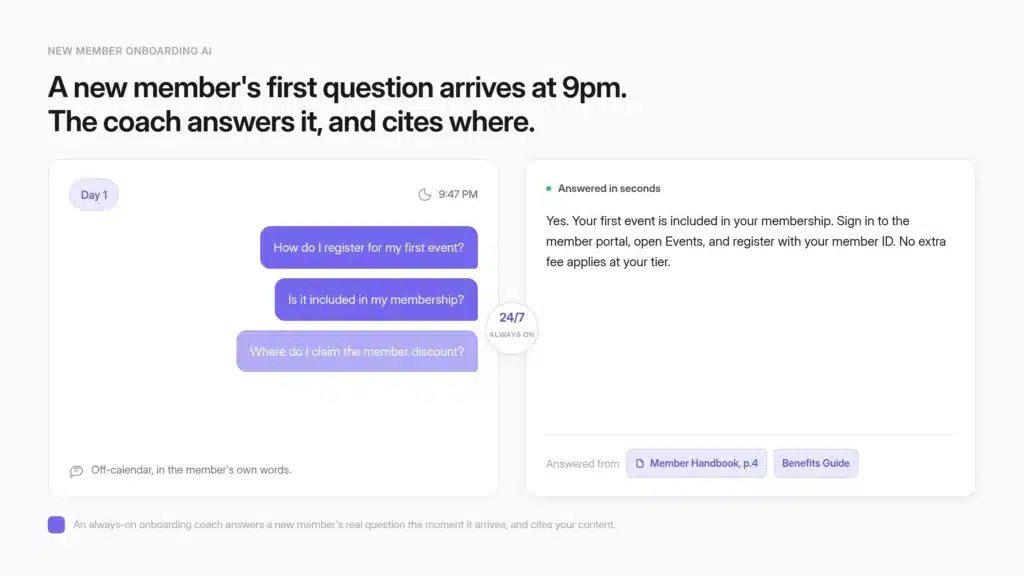
They arrive at 9pm, in the member’s own words, about the one benefit they are trying to use right now.
A 24/7 AI onboarding coach answers each of those questions at the moment of intent, grounded in the association’s own welcome, benefits, and how-to content, with a clickable citation a brand-new member can check. That turns onboarding from a sequence you push into a coach members pull from, running on an answer engine built for member associations.
First-year members renew below the overall rate, and the first 90 days are the window where that gap opens.
One caveat stays in view throughout: grounding reduces the risk of a wrong answer but does not remove it, so a well-built coach cites every answer and says it does not know rather than guessing, and its analytics show activation in aggregate, not a per-member churn forecast.
New-member onboarding decides first-year renewal, and the first 90 days are the window
First-year members are the cohort most likely to leave, renewing well below the overall rate, and the strongest lever on that number is engagement in the first 90 days. Structured onboarding in that window moves renewal materially.
The math makes it the highest-ROI stretch of the whole membership lifecycle.
First-year members renew around 75%, below the current 82% median
New members are the most fragile cohort an association holds. i4a, reading Marketing General’s benchmarking data, reports that first-year members renew at just 75% against the overall renewal rate, while the 2026 Membership Marketing Benchmarking Report puts the current median renewal at 82%.
That is roughly a seven-point gap, and it means about one in four new members never reaches a second term. The reason usually traces to the onboarding period itself.
A first-year member has the most questions and the least idea of where to find answers, so friction runs highest exactly when loyalty runs lowest.
Saving a first-year member protects the entire lifetime of dues that follows, which is why the first year earns disproportionate attention from membership teams trying to move a renewal rate that has been drifting down, not up.
No engagement in the first 90 days makes a member far likelier to lapse
The window is narrow and it is early. i4a reports that members who do not engage within their first 90 days are 60-70% more likely to leave at renewal time.
Ninety days is a small slice of a year, yet it carries most of the risk, because a member who has not found a reason to come back in three months has quietly decided the dues are optional.
The disengagement is invisible while it forms. A new member who stops logging in, never claims a benefit, and skips the first event looks identical to an active member right up to the renewal notice that goes unpaid.
The practical implication is that onboarding is not a courtesy sequence to run once and forget. It is the single stretch where an association has the most influence over whether a member stays, and the least time to use it.
Formal onboarding lifts first-year retention by a documented margin
Structured onboarding is one of the few retention moves with a benchmarked payoff. i4a reports that associations with formal onboarding programs typically see 25-40% higher first-year retention rates than those without a structured program.
That is a large swing on the cohort where churn concentrates, and it explains why so many associations have started building onboarding programs rather than leaving the first year to chance.
The lift does not come from a single welcome email. It comes from sustained early engagement: the pattern behind that benchmark is that a new member who uses several benefits in the first quarter tends to renew closer to a tenured member’s rate than to the 75% first-year average.
The design problem, then, is how to keep a new member engaged across ninety days without a large staff manually chasing each one, which is exactly the load an always-on coach is built to carry.
A scheduled welcome drip answers on the association’s calendar; new members ask on theirs
A welcome drip and an AMS onboarding workflow run on the association’s clock: email day one, day seven, day thirty. Real new-member questions arrive off that clock, at night and on weekends, in the member’s own words.
Broadcast sequences pace the relationship; a grounded coach answers the spontaneous question a drip cannot anticipate. They solve different halves of onboarding.

Onboarding-season questions are high-volume, repetitive, and off-calendar
The questions that decide whether a new member activates are mundane and relentless: how do I access this benefit, where is that document, what does my membership include, how do I register for the first event.
Association onboarding tools such as Glue Up, GrowthZone, Member Lounge, and Higher Logic automate the sequence and the reminders well, and they are legitimate infrastructure for pacing the first ninety days. On the last of those, what Higher Logic’s own AI Assistant can and cannot answer is a separate question from what its onboarding sequence does.
What a scheduled sequence cannot do is answer the question a member types at 9pm that was not on the calendar.
i4a’s activation benchmarks show how early these questions cluster: it recommends targets of 70% profile completion within 14 days, 85% first login within 7 days, and 40% first event attendance within 90 days.
Every one of those milestones generates its own wave of small, repetitive questions, and every unanswered one is a quiet vote that the membership might not be worth the effort.
A broadcast sequence and a grounded coach solve different halves of onboarding
A welcome drip and an onboarding coach are complementary, not substitutes. The drip handles pacing and reminders, nudging a member toward the next milestone on a schedule.
The AMS handles the workflow: joins, records, event registration. The coach handles the spontaneous, grounded answer, the one a member needs the moment they hit friction, drawn from the association’s own material.
Timing is the distinction that matters. Outbound sequences reach a member when the association decides to send; a disengaged new member is precisely the one who tunes those out.
A coach reaches the member when the member decides to ask, which earns attention by being useful first.
Onboarding and retention are the same problem seen from two ends of the year, and the reasons members drift quietly between touchpoints are covered alongside why lack of engagement, ahead of price, drives most non-renewals.
A 24/7 coach answers each new member’s question from your own content, with a citation
An onboarding coach trained on the association’s welcome, benefits, and how-to content answers a new member’s plain-language question in seconds, with the source cited so a day-one member can verify it.
It pulls from the systems an association already runs, needs no code, and admits when it does not know rather than inventing an answer.
Grounding in the welcome and benefits corpus, with no migration
The coach is only as good as the content behind it, and a new member’s first questions are answered by material an association already owns: the welcome guide, the benefits catalog, the how-to articles, the event FAQ.
A no-code platform connects to the content sources and systems an association already runs, so the onboarding corpus can be drawn from the AMS, the LMS, a document vault, and the public website without a migration or an engineering project.
You curate what enters that corpus, adding and removing sources, so a stale welcome packet or a superseded benefits sheet never becomes the answer a first-year member reads.
You also set how the coach speaks: its role and tone are configurable through a persona, so it greets a brand-new member as a welcoming guide in the association’s own voice rather than as a generic chatbot. That matters for a membership team standing up a coach on a two-week horizon rather than a two-quarter one.
The corpus is the welcome experience made answerable: instead of pointing a new member at a benefits page and hoping they read it, the association lets the member ask the benefits page a direct question and get the specific clause that applies to them, in the moment they are trying to use it.
Inline citations let a day-one member verify every answer
Trust in the first week is fragile, because a new member has no history with the association to fall back on. The mechanism that earns it is verifiability.
Each answer carries citations to the sources the coach drew on, a setting you turn on per agent rather than something you build, so a member reading an answer about a membership benefit or a registration deadline can click straight through to the cited material instead of taking a paragraph on faith.
Before rollout, a builder can go further and audit an answer’s claims against its sources, a builder-side scoring tool for finding weak spots during testing rather than a filter the member ever sees, and the grounding shows up under that testing: in a retrieval benchmark, CustomGPT.ai posted a lower hallucination rate and higher accuracy than a leading general model.
For a brand-new member, the citation trail does double duty. It lets them confirm the answer is real, and it keeps the coach’s authority tied to the association’s own vetted content rather than to whatever a general chatbot scraped from the open web.
A grounded coach says it does not know instead of inventing
Grounding reduces hallucination without fully eliminating it, which is the caveat worth keeping in plain view on an onboarding tool that speaks for the association. What protects a new member is boundary behavior.
When the coach has no grounded answer in the approved content, it says so rather than guessing, replying that it does not know, and the wording of that reply is itself configurable so it lands in the association’s own welcoming voice rather than as a blunt error.
For a first-year member forming a first impression, an honest “I don’t have that, here is who to ask” beats a confident wrong answer that sends them to the wrong form or quotes a benefit that does not exist.
A fluent guess in week one is worse than silence, because it teaches a new member not to trust the tool the association just handed them. The refusal is the feature that keeps the coach honest across the ninety days when trust is still being built.
Around-the-clock, multilingual answers activate members staff cannot reach live
A new member’s questions do not wait for office hours, and a growing share of members do not share the association’s first language. An always-on coach that supports 92 languages reaches members a live team cannot, answering each question at the moment of intent in the language the member asked in.
For a new member navigating an unfamiliar organization at an unfamiliar hour, that around-the-clock reach is the difference between a question answered and a question abandoned.
That same around-the-clock reach is what absorbs the routine, high-volume load an onboarding season creates, the flood of repetitive questions that swamps a membership team when a cohort of new members joins at once.
GEMA’s member assistant, Melody, answered 248,000+ member and customer inquiries at an 88% success rate and saved more than 6,000 staff hours for a society of 100,000+ members.
Those are the repetitive access-and-registration questions onboarding season generates, handled instantly instead of landing in a queue behind a small team.
Jonas Walther, Manager Data and AI at GEMA, put it this way: “CustomGPT.ai isn’t just a support tool. It’s become a knowledge infrastructure for our organization. It allows us to serve members, customers, and employees better, faster, and smarter.”
Gate the onboarding coach to new members with single sign-on
A member-only onboarding coach has to know that the person asking is a member. Single sign-on scopes the coach to the membership through the association’s own identity provider, so the welcome library stays behind the member login.
Enterprise-grade security keeps proprietary content safe, which is the precondition for putting it behind an assistant at all.
SAML 2.0 single sign-on scopes the coach to members
The coach’s exclusivity depends on identity. CustomGPT.ai supports SAML 2.0 authenticated access, letting an association control who can reach the agent through its existing identity provider.
The single sign-on spine is configured with SAML 2.0 across the major identity providers, so a new member logs in once and reaches an onboarding coach closed to anyone outside the membership, which keeps the welcome experience premium rather than something a non-member could stumble into on the open web.
Single sign-on delivers the gate, meaning who can reach the coach at all. Answers that differ by member type, role, or chapter are a separate configurable layer: members authenticate as end users mapped to a role from your identity provider, with no separate account created for each one, and routing to the role-specific answer is decided after login rather than by the login itself.
For onboarding, the gate is usually the first requirement: get the right members in, keep everyone else out, and layer role-specific answers later once the coach is live and the corpus is stable.
SOC 2 Type 2, GDPR, and no-training-on-your-data keep member knowledge safe
A new member is handing the coach questions, and the association is handing it proprietary, member-only content, so the trust layer is part of the offer. CustomGPT.ai is SOC 2 Type 2 compliant and GDPR-ready, keeps member data out of model training, and holds it within the association’s own bot instance.
Those guarantees are what let an association put a welcome library behind a coach without worrying it will leak into a general model.
VdW Bayern’s WohWi assistant shows members trusting and using such a tool at scale: it serves 500+ member organizations and drew 84% positive feedback across 7,000+ queries in six months, while cutting document-creation time from more than 45 minutes to 15-20.
Dr. Korbinian Weisser, Managing Director of VdW Bayern DigiSol GmbH, said the assistant “enables members to make informed decisions faster and with greater confidence.” The openness is there on the member side too: Higher Logic’s 2026 trends analysis reports that 94% of members say they are comfortable with associations using AI.
Activation is measurable in aggregate, so staff can act inside the 90-day window
Onboarding fails silently, so the value of measurement is catching a fading member while there is still time. Usage analytics show queries per conversation and interaction depth, revealing which new members are activating and which have gone quiet.
That visibility is aggregate, not a per-member churn score, and treating it honestly keeps staff acting on real signal instead of a false forecast.
A loop showing a new member’s question grounded in the association’s member-only content, returned as a cited answer or an honest ‘I don’t know’, driving activation and surfacing aggregate engagement analytics staff act on within the first 90 days.

Queries per conversation and interaction depth show who is activating
Retention work usually suffers from a data lag: staff see the lapse after it happens, when the ninety-day window has already closed. A coach that new members actually use generates a live activation signal instead.
The analytics layer lets staff analyze the efficiency of interactions and the level of engagement per user with the queries-per-conversation metric, along with what members are asking and whether their needs are being met, and staff can inspect what individual members are asking, conversation by conversation, to read which cohorts are active and which have gone quiet.
Framed to onboarding, that read shows which topics new members struggle with, where the welcome content is thin, and which cohorts are engaging versus drifting, all inside the window when an intervention still changes the outcome.
A membership team can see that a batch of members who joined last month has stopped asking questions, and follow up before the renewal report would ever surface the risk. The signal is about activation, not a prediction of lifecycle renewal.
Aggregate visibility is not a per-member churn prediction
Precision matters here, because the honest version of the offer is narrower than the marketing version. The analytics show observed activation, not a per-member churn probability.
Staff can see who has gone quiet and which cohorts are fading, but the platform does not output a risk score that names the individual member who will leave. AMS predictive-churn tools often promise exactly that tidy score, and those models depend on clean, structured member data that most associations do not have.
Observed activation is the more grounded offer: a membership team acts on a real signal, following up with a call, an invitation, or a targeted resource before the renewal window, without pretending the software knows in advance which specific new member will churn.
Kept in view, that limit is what separates a useful onboarding dashboard from an overclaim that erodes trust the first time the forecast is wrong.
How to stand up a 24/7 onboarding coach, in five steps
Standing up an onboarding coach is a sequence, not a switch. Five steps take an association from scattered welcome content to a coach that holds a new member’s attention across the ninety days that decide first-year renewal.
- Ingest the content a new member needs first. Point the coach at the welcome guide, benefits catalog, how-to articles, and event FAQ that answer the earliest questions. A no-code platform pulls from the tools an association already runs, so the corpus comes from the AMS, the LMS, a document vault, and the website without a migration.
- Decide who owns the answers. Name a staff owner for each content area and a review path for sensitive topics, so the coach speaks with the association’s authority rather than guessing. This is where the real content work happens: retire stale welcome documents, pick a canonical version when two sources conflict, and set a review cadence so the corpus does not drift out of date. It is editorial work, not engineering, so a small team can own it.
- Gate it to members. Put the coach behind single sign-on so it stays exclusive to members and safe for member-only material.
- Watch activation, not just deflection. Track queries per conversation and interaction depth to see which new members are engaging and which have gone quiet, well before a renewal report would show it.
- Act on the quiet inside the window. When a new member or a cohort fades, follow up with a call, an invitation, or a targeted resource while the ninety-day window is still open and the outcome can still change.
The first three steps stand the coach up in about two weeks. The last two are the ongoing onboarding discipline the tool makes possible.
What a stronger first-year onboarding does for the dues you keep
The business case runs through the first-year cohort, because that is where the churn and the leverage both concentrate. The math is simple to run for a specific association, and the honest version credits the coach as one contributing lever.
Take a 10,000-member association at the 82% median renewal rate, with a 1,500-member first-year cohort renewing at 75%. Lifting that first-year rate by five points to 80% keeps about 75 members who would otherwise have lapsed. At $300 in annual dues, that is roughly $22,500 in year-one dues protected, and several times that across the members’ remaining tenure.
A coach does not create that lift by itself. It removes the early friction and off-calendar silence that cause first-year drop-off, and the activation analytics show whether the lift is happening, so the association can attribute the result honestly rather than assume it.
The platform built for member associations is one input to that number, not the whole of it.
Be careful about what the named results prove. GEMA and VdW Bayern are engagement, volume, and satisfaction figures, not renewal-lift numbers.
They show that members will actually use and trust a member-trained coach at scale, which is the mechanism first-year retention depends on.
The renewal lift itself is the association’s to measure, through the analytics, over a first-year cohort. Watch leading indicators first: activation rate, queries per conversation, share of onboarding questions answered, and response time.
Lagging indicators confirm the outcome: first-year renewal movement and staff hours returned to higher-value work. Retention and revenue are two halves of the same member-value story, so the onboarding case sits alongside why lack of engagement drives silent member churn and how associations turn a member-trained assistant into non-dues revenue.
A coach is one onboarding lever, not the whole program
Onboarding is more than a coach. It still needs a human welcome, a real community a new member can join, and a value proposition worth staying for. A coach does not manufacture any of those.
What it attacks is the early friction and the off-calendar silence, on the highest-risk cohort an association has, in the ninety days where a first-year renewal is won or lost. That is a narrow claim, and it is the honest one: one lever, heavily weighted, on the stretch of the membership lifecycle where a small improvement compounds the longest.
First-year members ask their real questions at the moments no welcome sequence can predict, and most of those questions currently meet silence. You can close that gap. Start a free trial and build your onboarding coach on your own welcome content in minutes, or book a 15-min discovery call and see it answer a new member’s first question, cited, before you commit.
Frequently asked questions for new member onboarding AI
What is 24/7 AI member onboarding for an association?
It is an always-on assistant that answers a new member’s own questions, in plain language, from the association’s welcome, benefits, and how-to content, with a citation to the source. A scheduled welcome email goes out on the association’s calendar; the coach responds at the moment a member asks, including nights and weekends. The point is activation: getting a first-year member to find and use benefits early, in the window where they are still deciding whether the dues are worth it.
How is an AI onboarding coach different from the welcome emails our AMS already sends?
They solve different halves of onboarding. A welcome drip and an AMS workflow pace the relationship on a fixed schedule: an email on day one, a reminder on day seven, a check-in around day thirty. What they cannot do is answer the spontaneous question a member types at 9pm that was not on that schedule. A grounded coach handles that cited answer, drawn from your own material, and reaches the member when the member decides to ask rather than when you decide to send. Most associations run both.
Will an AI onboarding assistant make things up if it does not know the answer?
Grounding reduces that risk but does not remove it entirely, which is why boundary behavior matters. A well-built coach stays inside your approved content and, when it has no grounded answer, says it does not know rather than guessing. For a new member forming a first impression, an honest “I don’t have that” beats a confident wrong answer that sends them to the wrong form. Every answer also carries a citation, so a member can check the source instead of taking a paragraph on faith.
What content does an onboarding coach need to answer new-member questions?
The material you already own: the welcome guide, the benefits catalog, how-to articles, and the event FAQ that answer the earliest questions. A no-code platform can pull that corpus from the systems an association already runs, including the AMS, an LMS, a document vault, and the public website, with no migration. The real work is editorial, not technical: retiring stale welcome documents and picking a canonical version when two sources disagree, so the coach speaks with current, vetted information.
How long does it take to set up an onboarding coach?
The core setup is usually a two-week job rather than a two-quarter one, because there is no migration and no code. You point the assistant at your welcome and benefits content, gate it to members, and turn on analytics. The ongoing part is the onboarding discipline the tool makes possible: watching which new members engage and following up with the ones who go quiet inside the 90-day window. Standing the coach up is fast; running a good onboarding program with it is continuous.
Can we keep the onboarding coach limited to members only?
Yes, through single sign-on. CustomGPT.ai supports SAML 2.0 authenticated access, so a member logs in through your existing identity provider and reaches a coach closed to anyone outside the membership. That keeps the welcome library premium rather than something a non-member could stumble into on the open web. Single sign-on controls who can reach the coach at all; answers that differ by member type or chapter are a separate configurable layer on top of that gate.
Is our member data safe if we put it behind an AI coach?
The trust layer is part of what makes a member-only library safe to expose. Look for SOC 2 Type 2 compliance, GDPR readiness, and a guarantee that member data stays out of external model training, with content held inside your own bot instance. Those controls are what let an association put proprietary, member-only material behind an assistant without worrying it will leak into a general model. Higher Logic’s 2026 analysis reports that 94% of members say they are comfortable with associations using AI, so member acceptance is rarely the blocker.
Can the coach answer new members who do not speak English as a first language?
Yes, and for a diversifying membership that widens who onboarding can actually reach. CustomGPT.ai supports 92 languages, so a member can ask in their own language and get a grounded, cited answer back in it, at any hour. For a new member navigating an unfamiliar organization at an unfamiliar time, an answer in their own language is the difference between a question answered and a question abandoned.
Will an AI onboarding coach improve our first-year renewal rate?
It can move the friction that causes first-year drop-off, but the renewal lift is yours to measure, not a number the software guarantees. First-year members renew below the overall rate, and associations with formal onboarding programs typically see 25-40% higher first-year retention than those without one. A coach contributes by removing the early, off-calendar silence that disengages new members, and the usage analytics show whether activation is rising, so you can attribute the result honestly rather than assume it.
How do we know if new members are actually using the coach?
Through usage analytics rather than a guess. The platform reports queries per conversation and interaction depth per user, which reveal which new members are engaging and which have gone quiet, plus what they are asking and where the content is thin. That read is aggregate, not a per-member churn score: it shows observed activation, so staff can follow up with a fading cohort inside the 90-day window, but it does not name the individual member who will leave. Treating it as a live activation signal rather than a forecast keeps staff acting on real data.
Do we need developers or an IT team to run it?
No. The essential setup is no-code, which matters for a small membership staff without an engineering team. You connect your welcome and benefits content, configure access, and manage the corpus through an admin interface rather than a codebase. The ongoing ownership is editorial: naming a staff owner for each content area, retiring stale documents, and setting a review cadence so answers stay current. That is membership-team work, not developer work.
Does an AI coach replace our onboarding staff and the human welcome?
No, and treating it as a full replacement is the misread to avoid. Onboarding still needs a human welcome, a real community a member can join, and a value proposition worth staying for, and a coach manufactures none of those. What it attacks is the early friction and the off-calendar silence on the highest-risk cohort you hold. It is one heavily weighted lever on first-year retention, which is why the onboarding case sits alongside why lack of engagement drives most non-renewals.
Related Resources:
- ChatGPT vs. Your Own Member AI: Compare both approaches to determine which best fits your association’s member support, security, and knowledge management needs.
- How to Stop Silent Member Churn with AI: Learn how AI helps identify at-risk members, automate support, and strengthen retention before renewal season.
- Add an AI Copilot to Your Member Portal: See how to securely deploy an AI copilot behind member login using member-only content and verifiable citations.
- Help Non-Technical Members Adopt AI: Explore proven techniques for building trust, reducing adoption barriers, and helping members confidently use AI tools.
- An AI Study Assistant for Your Certification Program: Learn how to deliver secure AI-powered exam preparation using approved study materials without exposing answer keys or inventing information.
- AI for State Bar Associations: Learn how state bars turn CLE video and dense practice manuals into a cited, searchable assistant for members.