
What Member Questions Reveal: AI Conversation Analytics
Member AI conversation analytics show what members asked, what was answered and what the library couldn’t cover; in CustomGPT.ai, Agent Analytics lists the latest prompts and the content your library is missing.
It also shows the language each question was asked in and its sentiment.
Unlike a member survey, which samples members willing to respond, AI conversation analytics captures real member questions at the moment they need help.
A conversation log records every member who needed something, in their own words, at the moment they needed it, with no response-rate decay, because the answer itself is the reason to participate.
The most decision-ready output is the negative one. The Latest Missing Content panel, under Agent Knowledge, gives a membership or education team a standing record of demand the current library does not satisfy. That list is a commissioning brief written by your members.
Two boundaries keep this honest. The log is a census of questions, not of members, so anyone who never opens the assistant stays invisible in it.
And the reporting is aggregate rather than per-member, which makes it a read on population-level demand, not a dossier on individuals. Inside those limits it is the highest-participation listening instrument most associations running a member-facing assistant already own.
Association member listening runs on a small, self-selected sample of the already-engaged
Association research reaches a narrow slice of the membership. McKinley Advisors reports members and other highly engaged stakeholders responding at roughly 5-6%, and non-member stakeholders lower still. The people who answer are the people already paying attention, which makes the standard instrument quietest about the members closest to leaving.
In a February 2026 piece on member research, McKinley Advisors writes that it “often sees rates similar to Pew’s metric, with members or other highly engaged stakeholders responding at a rate of about 5-6% and non-member stakeholders responding at an even lower rate of about 2-3%”.
The firm attributes the long decline to survey fatigue and privacy concerns, and cites Pew Research Center’s drop from a 36% response rate in 1997 to 6% by 2018 as the wider backdrop. For a 10,000-member society, a 5% response is 500 people, and those 500 are not a random 500.
No published research identifies exactly who they are, so treat what follows as inference: answering a member survey requires opening association email, recognizing the sender, and choosing to spend unpaid time on a form. Each of those steps filters toward members who are already paying attention.
That selection effect is the problem, not the sample size. A survey of the engaged tells you what your advocates want more of. It is structurally poor at telling you what the quiet 95% found confusing, could not locate, or gave up looking for, and those are the members whose renewal is actually in question.
Response rate is also not the only measure of a survey’s quality, and none of this makes member research disposable. Well-designed survey work still answers questions a behavioral log cannot touch: why members joined, what they value, whether they would recommend you, how they feel about a dues increase.
The gap is narrower than “surveys are broken.” It is that the instrument most associations rely on for member understanding systematically under-samples the members at risk.
Associations adopted AI to produce content faster and much less often to understand members better
Sector AI adoption went overwhelmingly to the output side. ASAE’s first State of Associations report puts AI use at 87.5% for content against 44.3% for data, a gap of roughly two to one. Associations bought machines that write, and far fewer bought machines that listen.
ASAE released the report in March 2026, drawing on pulse polls conducted over the preceding year. Its headline AI finding is that use is widespread, at 87.5% for content and 44.3% for data, while readiness lags, with most organizations citing limited expertise and data privacy concerns.
Set that next to what the same report identifies as the sector’s central problem: retention and engagement remain the top challenge, named by nearly one-third of respondents. The sector’s most-cited problem is understanding and holding members. The sector’s dominant AI application is producing more content.
Read together, those two findings describe an attention gap, not a tooling gap. Producing more content is a reasonable response to a content-production bottleneck. It is a weak response to a retention problem, because the constraint in retention is rarely volume.
The binding constraint is knowing which questions members are actually stuck on, and content produced without that signal is content produced against a guess. An association that has deployed a member assistant is already generating the data half of that equation. The common failure is that nobody on staff has been assigned to read it.
A conversation log is a census of member need rather than a survey sample
Every member who opens the assistant leaves a record: a real question, in their own words, timestamped to the moment of need. Participation costs the member nothing extra, because getting the answer is the incentive. There is no response rate to decay, no reminder email, no incentive drawing.
The two instruments diverge on four dimensions:
| Dimension | Member survey | Conversation log |
|---|---|---|
| Who is represented | Members willing to respond | Everyone who used the assistant |
| Timing | Recall of a need, weeks later | The need as it happens |
| Language | Categories staff wrote in advance | The member’s own phrasing |
| Cost of one more response | Outreach and goodwill | Nothing, the member was going to ask anyway |
The language row carries more weight than it looks. A survey cannot surface the vocabulary mismatch between what your taxonomy calls a thing and what members call it, because the taxonomy wrote the answer options. A log records that mismatch every time it happens.
The survey is not the only incumbent, and most associations already hold three other records of member need. AMS engagement reports show what members clicked, downloaded, or registered for, which is behavior measured against content you already published and silent about the content you never wrote.
Site search logs come closer, since they capture what members typed, but they return keywords instead of questions and carry no verdict on whether the member found anything. Helpdesk tickets capture real questions in real language, from the members who escalated, which is a fraction of the members who had the question and a self-selected fraction at that.
A conversation log is the only one of the four that records the question in the member’s own words, at the moment of need, with an explicit success or failure attached to the answer.
The volumes involved are not small. GEMA, the German music rights society, reports 100,000+ members and 248,000+ queries resolved at an 88% query success rate, across three deployments: a public assistant on its website and member portal, an internal knowledge bot running on Confluence and SharePoint, and an API-connected ticket-drafting tool.
A figure like that is a deployment total rather than a member-question total, and the distinction is the whole discipline. Only the member-facing share is member listening; internal staff retrieval and back-office automation sit in the same number and answer a different question.
Separating the two before reading anything into the volume is a precondition, not a refinement. A member-facing assistant accumulates a standing archive of member questions in members’ own words, collected without a reminder email, an incentive drawing, or a single line of survey design. Participation costs the member nothing, because the answer is the reason to ask.
The honest scope belongs in the same breath. A conversation log is a census of questions, not a census of members. Members who never open the assistant are invisible in it, and that non-user population is not random either: it may skew older, less digitally comfortable, or simply unaware the assistant exists.
The log also cannot tell you why someone joined, what they think of your advocacy, or whether they intend to renew. It supplements survey work rather than replacing it. What it adds is a high-participation behavioral channel alongside a low-participation attitudinal one, which is a stronger position than running the attitudinal channel alone.
The broader practice of reading customer questions as content strategy input is well established outside the association world; what associations have that most businesses do not is a defined, dues-paying population whose questions map directly to a value proposition they are re-evaluating every renewal cycle.
The most decision-ready record is what the assistant could not answer
Answered questions confirm the library works. Unanswered questions tell you what to build. Inside a CustomGPT.ai agent, the Agent Knowledge section of Agent Analytics surfaces Latest Missing Content next to Latest Prompts and Content Source, giving staff a standing view of demand the current corpus does not satisfy.
The documentation names Latest Missing Content as one of three panels under Agent Knowledge, alongside Latest Prompts and Content Source. What the documentation does not do is specify how that list is assembled, what threshold puts an item on it, or how entries are ranked or deduplicated.
Treat the panel as a surfaced signal to be read by a human rather than a scored, sorted work queue, and confirm its behavior against your own corpus during a trial before you build a process on top of it. That caution is the difference between using the panel well and over-trusting it.
The reason the negative signal outperforms the positive one is selection. A question your library answers well produces a satisfied member and no further information: you already knew you had that content, because you wrote it. A question your library cannot answer is unmet demand that surfaced on its own, without a focus group, a content audit, or a staff hypothesis. It is also pre-qualified by effort. Somebody cared enough to type it.
Three teams can act on that list directly. Content and education staff can read it as a commissioning brief, where a recurring gap is a guide, a webinar, or a knowledge-base article with demonstrated demand attached before a word is written.
Conference programmers can read it as a session shortlist, since the questions members ask an assistant in March are a defensible input to the October agenda. And a membership executive can read it as an investment argument, because “members asked this 400 times and we could not answer” is a stronger case for a content budget than a staff opinion.
The same list, read three ways, is why the missing-content record is the highest-value artifact the log produces.
The documented analytics surfaces map to questions membership teams already ask
Agent Analytics is organized into sections that correspond to distinct staff jobs: Agent Knowledge for content demand, User Insights for tone and intent, Activity for volume, User Feedback for the member’s own verdict, and location and origin breakdowns for separating staff traffic from member traffic.
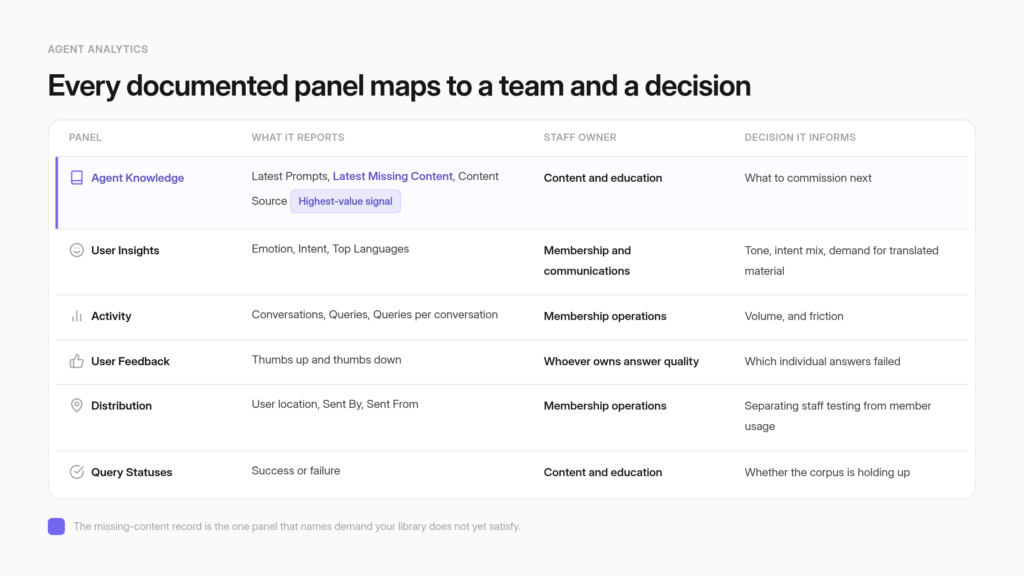
Walking the panels with an owner attached makes the dashboard operational instead of decorative.
|
Panel |
What it reports |
Staff owner |
Decision it informs |
|
Agent Knowledge |
Latest Prompts, Latest Missing Content, Content Source |
Content and education |
What to commission next |
|
User Insights |
Emotion, Intent, Top Languages |
Membership and communications |
Tone, intent mix, demand for translated material |
|
Activity |
Conversations, Queries, Queries per conversation, split Total and Guest |
Membership operations |
Volume, and friction |
|
User Feedback |
Thumbs up and thumbs down |
Whoever owns answer quality |
Which individual answers failed |
|
User location, Sent By, Sent From |
Where conversations originate, team versus guest traffic |
Membership operations |
Separating staff testing from member usage |
|
Query Statuses |
Success or failure |
Content and education |
Whether the corpus is holding up |
Three of those rows deserve association-specific attention. Top Languages matters to any association with chapters or international members, because it reveals demand for translated material that no English-language survey instrument would ever surface.
Queries per conversation reads as a friction gauge, and a high number is ambiguous on its own: it can mean deep engagement, or a member rephrasing the same question because the first three attempts missed.
The Sent By and Sent From breakdowns help distinguish staff testing the assistant from members actually using it, which is the difference between a real usage number and an inflated one. The emotion and intent readings under User Insights are not raw transcript tallies either.
Underneath the aggregate, each conversation carries its own inspectable sentiment, intent, and content-source reading, and the dashboard sums those per-conversation classifications into the population-level mix it reports. That classification layer reads the question rather than the member, which is why its output is a population-level intent distribution and not a per-person profile.
Time filters run from Today through This Week, which is the default, plus Month, All Time, and custom ranges.
Two naming notes for anyone searching older material. The current dashboard is Agent Analytics; references to Project Analytics or Enhanced Analytics in earlier posts are stale. And the current plan gating for the analytics features is whatever the live pricing page shows, not whatever an older launch announcement claimed, because gating can change over time while old posts do not.
This is also where the aggregate boundary becomes concrete. These panels report populations and trends. They are not built to profile a named member, and an association should not present them internally as though they were. If your privacy policy or member communications imply that assistant conversations are not used to build individual profiles, the aggregate design supports that claim, and staff briefings should stay consistent with it.
Associations handling regulated content have a further reason to keep it that way, since a queryable record of who asked what about a legal obligation is an exposure they gain nothing by creating.
VdW Bayern DigiSol, the Bavarian housing federation, represents more than 500 public, cooperative, municipal, and church-affiliated housing organizations, and runs its assistant on 3,620 internal documents covering regulatory compliance and legal interpretation. In the first six months the assistant handled over 7,000 questions across 2,000 conversations, and 84% of user interactions received positive feedback.
Your reporting window is tiered, and on the entry plan it is seven days
Every plan includes the analytics capabilities. What differs is how far back you can look. The view and export window is 7 days on Standard, 1 year on Premium, and all time on Enterprise, which decides whether quarterly content planning and year-over-year board reporting are possible at all.
This is the constraint most likely to break the practice quietly, so it belongs in the plan decision and not in a later surprise. Account analytics, user analytics, keyword analysis, sentiment analysis and risk metrics all appear across the plans on the CustomGPT.ai pricing page, and the account-level analytics view that rolls activity, location, and query status up across every agent is where that window bites, with its own documentation noting the standard tier sees only the past seven days.
As of July 2026, Standard runs $99 per month, or $89 per month billed annually, with 500 credits per month. Premium runs $499 per month, or $449 per month billed annually, with 2,500 credits. Enterprise is custom on both price and credits. Confirm the live figures before you budget, since published pricing moves. The analytics view and export window is where the tiers diverge sharply: 7 days, 1 year, and all time respectively.

Seven days is a support window, not a research window. It is enough to notice that the assistant broke on Tuesday. A quarterly content plan is already out of reach, because a quarter is thirteen weeks and you can see one.
So is a conference programming cycle that runs six months ahead, a year-over-year member-demand comparison for a board report, and any check on whether the gap list you commissioned content against in January had closed by June. An association intending to run member listening off its conversation log has two honest options.
Buy the window that matches the cadence, or stay on the entry plan and hold a weekly export discipline that nobody is allowed to skip, because on a seven-day window a missed week is a permanently missing week. Deciding that before deployment costs nothing. Discovering it in month four means the first three months of member questions are gone.
Grounding is a precondition for the measurement, not only for the answers
An assistant that fabricates a confident answer records that question as handled. The gap never reaches the missing-content list, and the member leaves with wrong information. Retrieval grounding is what makes an unanswerable question visible as unanswerable, which makes it a measurement requirement rather than only a safety one.
A general-purpose model asked a question your library does not cover can produce a plausible paragraph out of its training data. Two things then go wrong at once. The member acts on an answer your association never approved. And your analytics record a satisfied interaction, so the content gap that produced the question is erased from the record instead of logged.
An assistant that stays inside your approved corpus and says it does not know when the library falls short fails visibly, which is what turns a failure into a datapoint. Grounding on your own content reduces fabrication without eliminating it, which is why inline citations on every answer matter as the check a human can actually run.
Those citations are a per-agent setting you switch on rather than build, so turning them on for a member agent is a configuration step.
There is a governance consequence that follows from this. If a membership team plans to take content-investment decisions off the missing-content list, the integrity of that list depends on the assistant’s refusal behavior. An ungrounded assistant does not merely produce a riskier answer.
It produces a systematically optimistic analytics picture, because every fabrication registers as coverage. The teams that get the most from conversation analytics are the ones that treat grounding as the foundation of the measurement rather than as a separate accuracy feature bolted on beside it.
Reading the log is a staff assignment before it is a technology decision
Member engagement analytics built on AI conversations is a research instrument most associations with a deployed assistant already own and few have assigned anyone to read. Turning it into a practice takes a named owner, a cadence, and a plan whose reporting window matches that cadence.
The first thirty days have a shape:
- Name the owner. One person on the membership, content, or education team. Not a committee, and not a data analyst. The job is reading, not modelling.
- Check the window against the cadence before anything else. If the plan gives you seven days and the content meeting is monthly, the export discipline has to exist from week one.
- Book the standing slot. Monthly suits editorial planning, quarterly suits conference programming. Set it against your content cycle instead of against the dashboard.
- Read four things each time. Latest Missing Content, Latest Prompts, Top Languages if you have chapters or international members, and every thumbs-down. There are usually few enough thumbs-down to read individually, and each one is a member telling you an answer failed.
- Filter out your own staff using Sent By before any usage number leaves the building. Staff testing inflates every other figure on the dashboard.
- Carry the top gaps to the meeting where content gets commissioned, with the question volume attached.
If you have not deployed an assistant yet, the same list works as a scoping instrument. It says to keep member-facing traffic separable from internal staff retrieval from day one, and to treat the reporting window as a plan decision instead of a detail, because both choices are free to get right at the start and expensive to reverse later.
None of that requires a data team. It requires deciding that the questions members are already asking count as research.
The staff-side half of that same instrument is its own deployment, not just a reporting toggle on the member one.
Any association that has built a member assistant on its own vetted library has the instrument running whether or not anyone reads it, and the same corpus that turns association material into cited answers doubles as a continuous record of what that material does not cover.
The membership organizations getting the most out of an answer engine built on their own content are the ones treating the log as the member census it already is. If you want to see what your own members are asking, and what your library cannot yet answer, load a slice of your content, let members use it, and read the missing-content list after the first month.
Frequently asked questions about member engagement analytics AI conversations
What is member engagement analytics for an AI assistant?
It is aggregate reporting on the questions members put to your assistant: what they asked, in what language, with what intent and sentiment, whether the assistant found an answer, and where it came up empty. The reporting covers the population of questions rather than a profile of any one member. For the member-facing deployments that generate this data, the log accumulates as a byproduct of members getting help, so it costs nothing extra to collect.
How is this different from the member survey we already run?
A survey samples the members willing to respond. A conversation log records everyone who used the assistant, in their own words, at the moment they needed something. That gap is large: McKinley Advisors reports members and other highly engaged stakeholders responding at about 5-6%, and non-member stakeholders at about 2-3%. The two instruments answer different questions. A survey can tell you why someone joined or how they feel about a dues increase. A log tells you what they got stuck on.
Can we see which individual member asked a question?
No. The documented analytics surfaces report volumes, locations, emotion and intent, team versus guest traffic, and feedback. None of them expose a named member’s question history, so reading conversation analytics as a per-member drill-down is a misread with real privacy consequences. Treat that as a governance feature, not a limitation. A professional body whose members ask about licensure trouble or ethics complaints has good reason not to hold a queryable record of who asked what.
What is "Latest Missing Content" and what do we do with it?
It is one of three panels under Agent Knowledge in a CustomGPT.ai agent, alongside Latest Prompts and Content Source. It surfaces member demand your current library does not satisfy. Read it as a commissioning brief: a recurring gap is a guide, a webinar, or a knowledge-base article with demand already attached. The documentation names the panel without specifying how entries are selected, ranked, or deduplicated, so confirm its behavior against your own corpus during a trial before building a process on top of it.
How far back can we look at member conversation data?
That depends on your plan, and it is the constraint most likely to break the practice quietly. Every plan includes account analytics, user analytics, keyword analysis, sentiment analysis and risk metrics. The view and export window is 7 days on Standard, 1 year on Premium, and all time on Enterprise. Seven days is a support window and not a research window. It cannot carry a quarterly content plan, a conference programming cycle, or a year-over-year board report. Size the plan to the reporting cadence you intend to sustain, or export on a fixed schedule inside the window you have.
How do we turn a month of member questions into a content plan?
Cluster the questions into themes rather than reading them one at a time, then attach a decision to each theme: commission it, surface existing content that already answers it, or retire the topic. Bring the top gaps to the meeting where content actually gets budgeted, with the question volume attached, because “members asked this 400 times and we could not answer” carries more weight than a staff opinion. Choosing which metrics to act on matters more than collecting all of them.
Who on a small association staff should own this, and how often?
One named person on the membership, content, or education team, with a standing calendar slot. This does not need a data analyst. It needs someone who reads the missing-content list and the top prompts, writes down the recurring gaps, and carries them into the content meeting. Monthly suits editorial planning; quarterly suits conference programming. The common failure is not choosing the wrong cadence. It is that nobody was ever assigned, so a live research feed runs for a year with no reader.
What is a healthy number of queries per conversation for a member portal?
There is no published benchmark to hold yourself to, so read the number directionally and against your own trend rather than against an external target. A high figure is ambiguous on its own. It can mean members are exploring deeply, or that someone rephrased the same question three times because the first attempts missed. Pair it with the thumbs up and thumbs down feedback before drawing a conclusion, since that panel carries the member’s direct verdict on whether an individual answer landed.
How do we tell staff testing the assistant from real member usage?
The distribution views separate them. Sent By distinguishes team traffic from guest traffic, and Sent From and User location show where conversations originate. That separation matters more than it sounds, because staff testing inflates every other number on the dashboard. An association that reports usage to its board without filtering out its own team is reporting a launch-week artifact. Check the split before the first usage number leaves the building.
Can we connect conversation data to our AMS records?
The conversation data is exportable, so joining it to association management system records is an IT project, not a product setting. CustomGPT.ai documents API endpoints for project stats and traffic reports that a technical staffer or contractor can pull into the analytics stack your team already uses. Scope it with your privacy counsel first. The assistant’s own reporting is deliberately aggregate, and a join that reattaches identity to member questions changes what you are holding and what you must disclose.
Does this work if our members ask in languages other than English?
The Top Languages panel under User Insights reports the languages members are actually asking in, which makes it worth watching for any association with chapters or international members. It surfaces demand for translated material that an English-language survey instrument would never reveal, because a member who cannot read your survey does not answer it. Answer quality in a given language depends on what you have loaded, since the assistant works from your corpus, so test that during a trial before promising it to a chapter.
If the assistant makes something up, does the content gap still show up?
No, and that is why grounding is a measurement requirement rather than only a safety one. An assistant that fabricates a confident answer logs the question as handled. The member acts on information you never approved, and the gap that produced the question is erased from your reporting instead of recorded. An assistant that stays inside your approved corpus and says so when the library falls short fails visibly, which is what turns a failure into a datapoint. Grounding reduces fabrication without eliminating it, so citations remain the check a human can run.
Related Resources:
-
- How to Stop Silent Member Churn with AI: See how the same aggregate analytics act as an early-warning signal for disengagement, not just a content roadmap.
- 24/7 AI Onboarding for New Association Members: See how conversation analytics reveal which new-member questions the onboarding content still misses.
- How to Make Your Association’s Content Searchable with AI: See the findability problem this analytics pattern is designed to surface and fix.
- An Internal AI Knowledge Assistant for Association Staff: See the staff-side counterpart, where the same kind of usage data drives deflection instead of content strategy.
- Verify AI Answers for Associations: See how verification and conversation analytics work together to catch both wrong answers and missing content.
- Driving AI Adoption with a Non-Technical Membership: See how question-volume trends can double as an adoption signal for a less AI-native membership.
- Turn Gated Content into a Lead Engine: See the same aggregate-reporting model applied to prospect questions instead of member ones.
- How to Make Your Association’s Content Searchable with AI: See the findability problem verification’s citations depend on in the first place.