
Your Members Already Paid for This Content. They Just Can’t Find It.
Make association content searchable by pointing a grounded retrieval layer at the library you already run
You make association content searchable AI by putting a grounded retrieval layer over the places the library already lives: the site sitemap, the document vault, Google Drive or SharePoint, the wiki, the video platform, the podcast feed.
Nothing gets migrated. Members ask in their own words, and every answer comes back with its source attached so they can open the standard, the article, or the recording behind it.
The setup is no-code. CustomGPT.ai publishes a two-week launch as a platform-wide figure across many organizations, and what it describes is the technical work. Association-side decisions set the real calendar: listing the systems the library lives in, drawing the line between public and member-only content, and naming an owner for each source. Those three are the ones that slip.
The second output matters more, and no vendor puts it on a slide. Within the first month, member questions produce a ranked list of what your library cannot answer.
Association content was written to be presented from a podium, filed for compliance, or cited in a footnote, and almost none of it was written to be queried. Deploy retrieval to recover what members already paid for, then read its failures to find the content that has to be retrofitted before it will ever answer.
That ranked list is worth reading on its own terms, and each unanswered question becomes a signal worth reading in aggregate.
Three limits belong in view from the start. Grounding reduces hallucination without eliminating it, so high-stakes topics keep a human reviewer.
Conversation analytics are aggregate themes, not per-member transcripts, and how far back you can read them is set by your plan. And gating the library to members through your own identity provider is an Enterprise-tier capability today. Those constraints are part of what an answer layer built for member associations looks like in production, once the demo is over.
Members judge the value of dues by what they can retrieve, and most association libraries fail that test on vocabulary alone
Findability is a value-perception problem before it is a technology problem. A member who cannot retrieve the standard, the toolkit, or the recording their dues funded experiences that benefit as absent, whatever the content inventory says.
The most common failure point is a search box that requires the member to already know the words the author used, while the content they wanted sits in the library the whole time.
Keyword search breaks the moment a member uses different words than the author did
Association libraries are indexed in the vocabulary of the people who wrote them: committee names, program acronyms, the formal title of a practice guide. Members search in the vocabulary of the problem in front of them.
Traditional site search relies on simple keyword matching, scanning titles and body text for the terms a member typed, and it fails the moment a visitor uses the wrong terminology. On an association site that mismatch is close to guaranteed, because the author was a subject-matter volunteer and the searcher is a practitioner mid-task. What follows is pogo-sticking: click a result, realize it is wrong, hit back, try another phrase, give up.
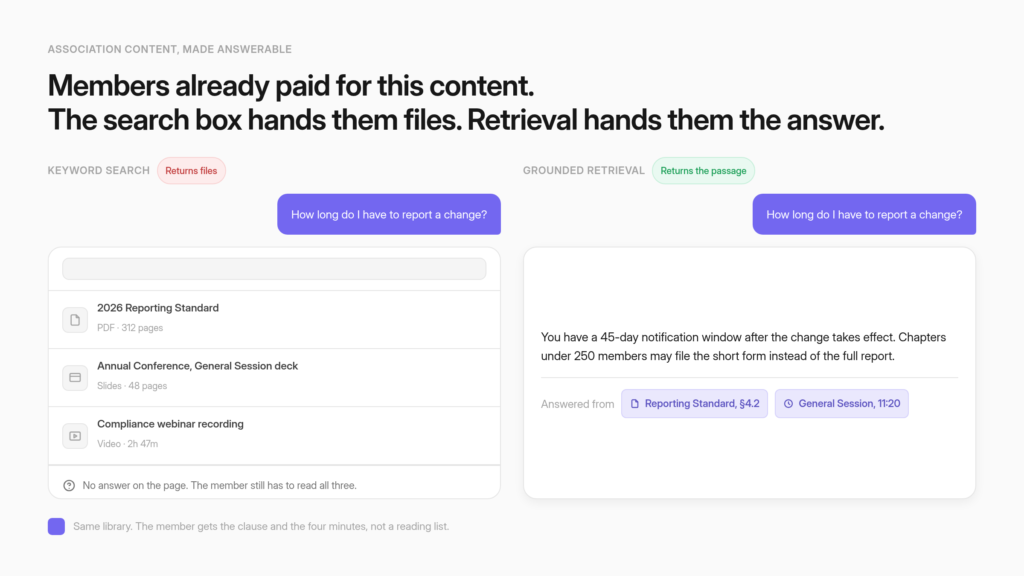
Each failed loop teaches the member the library is not worth the trip. Semantic search that reads intent instead of matching the exact words a member typed closes that gap, so a member asking how long they have to report a change reaches the compliance clause even though the document calls it a notification window.
The formats members most want are the ones a search box indexes worst
The association archive skews toward exactly the formats keyword search handles badly. Our own read of the association pattern frames it as a distribution failure and not a production one: the problem is rarely a lack of content, it is that reports sit in PDF libraries, standards live behind logins, webinar recordings get watched once, and certification guidance is scattered across pages no one can navigate quickly.
Underneath the format problem sits a retrieval-unit problem. A 90-page standard is one search result, but the member needs one clause from it. A three-hour conference recording is one link, but the member needs the four minutes where a presenter answered their exact question.
Search that returns documents leaves the last mile of work to the member, and the last mile is where most of them quit. Retrieval that returns the passage, with a citation pointing back to the document, removes that step.
Members have already granted permission for this specific use
The adoption question is more settled than most boards assume. In Higher Logic research reported by Associations Now, 94% of members say they are comfortable with associations using AI tools for search, personalization, and support, provided those tools are transparent and human centered. That conditional is the whole permission structure.
Members are not asking for a chatbot with a personality. They are consenting to AI that shows its work and hands off to a person when it should, which is the exact shape of cited retrieval over a vetted library. The current membership numbers are where the urgency comes from. Marketing General’s 2026 Membership Marketing Benchmarking Report records the share of associations reporting membership increases falling from 45 percent to 38 percent, with the median renewal rate flat at 82 percent.
Renewal is holding while acquisition softens, which puts the weight on value the existing membership can actually feel. An organization sitting on decades of authoritative content its members cannot retrieve is describing one concrete mechanism by which a strong value proposition reads as a weak one.
Making the library answerable means ingesting the formats it actually lives in, not the formats that are convenient
The common scoping mistake is deciding to clean and consolidate the archive first. That project runs a year and usually stalls. The faster sequence connects the systems the association already runs, in the formats the content is already in, and lets real member questions decide which parts of the archive earn the cleanup budget.
Point it at the sources you already run instead of migrating anything
Ingestion covers over 1,400 document formats, and you can connect the drives, wikis, and video platforms the library already sits in with nothing moved. Web content enters by pointing at a sitemap or a URL list at a crawl scope you set.
Files, individual URLs, and connected systems can all feed one corpus, so the practice guides in a document vault, the journal archive on the website, the toolkits in Google Drive, and the committee material in SharePoint or Confluence arrive as themselves.
Auto-sync is available across the main connectors, including Google Drive, SharePoint, Confluence, Notion, Zendesk, YouTube, Vimeo, and LinkedIn, which keeps the corpus current without a staff member re-uploading files.
You can now make your association’s LinkedIn posts searchable too: connect your LinkedIn page and every new post syncs automatically, with each answer linking back to the post it came from.
An incomplete sitemap does not block the project either. Start with the highest-value content you can already export, launch on that, and expand from what members actually ask for.

Conference recordings and podcasts stop being a dead archive once they are ingested
Recorded sessions are the clearest case of content members paid for twice, through registration and through dues, and can still only reach through a title and a date. Video ingests directly, including uploaded files, YouTube, and Vimeo material, and audio and podcasts ingest alongside it, with the working assumption that a transcript exists or gets generated so the spoken content becomes answerable.
Once they do, a member asking about a reimbursement change reaches the eleven minutes of a general session where a presenter walked through it, instead of scrolling session titles hoping one sounds right. This is the pattern the association platform describes as surfacing session recordings, slide decks, and speaker notes on demand, so members discover content they did not know the organization had.
That last clause is an honest description of most association archives. The content exists, members would value it, and the only thing between them is that nobody can search a video.
Exact-identifier lookups deserve their own test plan before launch
Association queries split into two kinds, and a retrieval design that only serves one will disappoint on the other. Most member questions are conceptual, where semantic matching is the right instrument. A meaningful minority are precise identifier lookups: a standard number, a clause ID, a CE or course code, a bylaw section, a form number.
Pure semantic similarity can soften those, returning something adjacent to the standard a member named when they meant only that one. The technique that holds both cases is keyword retrieval and vector search running together, which merges or reranks the results of both methods to surface the most relevant passage.
Treat the retrieval architecture as something to verify, not assume: published CustomGPT.ai documentation describes the platform as source-grounded without specifying the retrieval method behind it, so no association should take exact-match behavior on trust.
Write down the identifier families your members actually type and hand them over as test queries during evaluation, where a builder can audit each answer’s claims against the sources it cited as a pre-launch scoring pass, a builder-side check for finding weak spots before rollout rather than a filter the member ever sees.
Confirm the behavior in writing before launch, so you do not hear about it first from a certification officer who got the wrong clause.
Confirm how scanned and legacy documents are handled before you scope the archive
One ingestion question deserves a direct answer from any vendor before an association commits its archive, and it is the one most likely to be glossed over. Older association material is frequently scanned rather than born digital: board minutes from the 1990s, superseded standards, conference proceedings that exist only as page images.
A scanned page carries no selectable text, so it stays invisible to retrieval unless the platform runs optical character recognition over it. Published CustomGPT.ai documentation does not state an OCR capability for scanned documents, so treat it as an open question and get the answer in writing during evaluation instead of assuming it.
The same caution applies to image-heavy slide decks. Scope the archive around what is machine-readable today, and treat the rest as retrofit work with a real cost attached to it.
Grounding and citations are what make retrieval trustworthy enough to put in front of dues-paying members
An association’s exposure differs from a retailer’s. A wrong answer about a standard, a licensure requirement, or a reporting deadline can cost a member money or a credential, and it lands on the organization whose logo sits above the answer.
Two behaviors carry the trust: every answer returns its source, and the assistant declines when the library does not hold the answer.
Every answer returns the exact source a member can open
Citations convert an AI answer from a claim into a pointer, and they are a setting you turn on per agent rather than something you build.
With a numbered citation pointing back to the source material behind each part of an answer, a member reading a summary of a reporting obligation can jump from the answer to the referenced document and read the original language. For an association that does two jobs at once.
The member gets to verify rather than trust, which is the transparent half of the permission members have already granted. And the organization’s authority stays anchored to its own vetted material and not to whatever a general model absorbed from the open web, which is the actual competitive position an association holds over a general chatbot.
A cited answer also travels well. When a member forwards it to a colleague or acts on it professionally, the source goes with the claim, and that matters most in the member bases where being wrong carries consequences.
The assistant declines instead of inventing a standard or a policy
The behavior that protects an association is a willingness to stop. Running a closed knowledge base that refuses to answer off-corpus means responses derive solely from your own content, and when the assistant is uncertain it admits it: “I don’t know,” with the exact wording of that response configurable so it reads in the association’s own voice.
For a membership of lawyers, engineers, accountants, or pilots, a fabricated standard is worse than a dead end, because a dead end sends the member to a staff expert while a confident invention does not. The grounding also holds up under measurement.
Across 945 questions and nine diverse datasets, the platform recorded a 10 percent lower hallucination rate, a 13 percent higher accuracy rate, and a 34 percent faster average response time than OpenAI’s Assistant API V2. None of that makes hallucination impossible. Grounding reduces the rate, it does not remove the failure mode, so keep a named human reviewer on certification, licensure, and regulatory interpretation.
Member-only gating runs through your identity provider, and that is an Enterprise-tier capability today
Most associations want part of the library open and part of it behind the member wall, which makes identity the gating question, not a settings detail. Members authenticate through the association’s existing identity provider and reach only the agents their role permits, entering as end users mapped to a role rather than as separate accounts you provision and maintain, so one deployment serves the whole authenticated membership without an account created per member.
Check how access control is tiered across plans before you scope: identity-provider access sits on the Enterprise tier, and account-level roles arrive at Premium, so member-only scoping is a budget decision if it is a launch requirement and not a phase-two addition.
The security posture underneath is the other half of that review, and the security page documents SOC 2 Type 2, GDPR, and no training on your data for a diligence team to confirm directly. An association can also start on public content, prove retrieval works on the open library, and add gating when the identity work is funded.
Associations that ran this at scale show members will use retrieval when the answers are cited
Two published deployments carry the proof: GEMA, the German music rights organization, and VdW Bayern DigiSol, a Bavarian housing federation. Both hold regulated, consequential material where a wrong answer has weight, and both show members choosing retrieval at volume instead of politely ignoring a new tool.
GEMA, the German music rights organization, represents over 100,000 members and approximately two million professional music consumers. Its starting problem was fragmentation rather than absence: documentation lived across Confluence and SharePoint, and employees struggled to retrieve information quickly due to a fragmented system landscape involving multiple documentation and knowledge platforms.
Its grounded assistant resolved more than 248,000 member and customer inquiries at an 88% query success rate against a 70% industry benchmark, saved over 6,000 working hours a year, and produced 182,000 to 211,000 euros in annual cost avoidance. Jonas Walther, Manager Data and AI at GEMA, put it this way: “CustomGPT.ai isn’t just a support tool. It’s become a knowledge infrastructure for our organization.” The transferable point is volume.
A quarter of a million questions is not a pilot, and it is not a number an organization reaches by asking members to be patient.
VdW Bayern DigiSol, the digital innovation subsidiary of the Association of the Bavarian Housing Industry, supports more than 500 public, cooperative, municipal and church-affiliated housing organizations. Its WohWi assistant runs on a knowledge base of 3,620 internal documents.
The case study records a before state of “45+ minutes manual document search” and reports that tasks which took 45 or more minutes now take 15 to 20 minutes, cutting documentation time by more than 50%, alongside 84% positive feedback across 7,000 queries in the first six months and full deployment inside 60 days.
Dr. Korbinian Weisser, Managing Director of VdW Bayern DigiSol GmbH, said: “We are very pleased that we decided on CustomGPT.ai for building WohWi AI. The platform made it straightforward to turn our vision for WohWi AI into reality, and the results have been significant.”
Read that time figure with one qualification the case study invites. It labels the before state as manual document search and the after state as document creation time, so the measured saving covers finding source material and producing the resulting document together, so retrieval is only part of what got measured. Even read conservatively it is the most direct evidence available here, because the corpus was 3,620 documents the federation already owned and nothing about the underlying content changed.
Platform-wide figures belong in a separate category and should be read that way. Across member deployments generally, CustomGPT.ai reports automating up to 93% of repetitive questions, 95% or higher member satisfaction with cited answers, a typical two-week launch, and member usage rising two to six times once the library is answerable.
Those are aggregates across many organizations, not any single association’s outcome, and they describe what the approach reaches when the content going in is reasonably well organized. No association should build a business case on them without measuring its own baseline first.
If the pattern behind the GEMA and VdW Bayern numbers maps to a library you already run, that is the point to see what associations deploy this for and put your own content to the test instead of a demo corpus.
The queries retrieval cannot answer are the highest-value output of the project
Retrieval solves the fast half of findability, where the content exists and the vocabulary is wrong. It also diagnoses the slow half, where the content does not exist in an answerable form at all. A keyword box hides that failure as zero results and silent abandonment.
An assistant that says it does not know produces a countable, themed record of unanswered member demand, and that record is worth more than the deflection.

Association content was authored to be presented, filed, or cited, and rarely to be queried
Look at how association content actually gets made. A conference deck holds forty bullets because a volunteer expert stood next to it and the expertise lived in their mouth. A position paper exists because a committee had to record a stance defensibly. A journal article exists to be cited.
A compliance filing exists to satisfy a regulator. Almost none of it was authored with the question “will this answer a member typing a plain-language question at 9pm” anywhere in the brief. Each is a container whose payload is not in a shape a question can match, however good the retrieval is.
Our own published guidance documents the remedy for the slide case directly, recommending exporting speaker notes and written summaries alongside slide-heavy material, plus captions or transcripts for charts and diagrams, because answer accuracy drops when slides are mostly visuals with little selectable text.
Ingesting the archive and making it answerable are two different budgets, and the sales conversation usually covers only the first
The vendor framing and the association-sector guidance are answering different questions, and an association that hears only one of them will under-scope the work. In a June 2026 webinar recap, Michael Marolda of Progress writes that “most associations don’t need to create new content to solve this problem” and that they need to activate what already exists.
Read as a statement about ingestion that is accurate: no migration, no re-tagging, no rewrite required to get the corpus in. ASAE’s June 2026 guidance for associations optimizing content for AI search is answering the question that comes after, telling them to write content so answers are easy for AI to find and extract, and to create a plan for retrofitting older content. Both hold.
Well-structured prose written to explain something retrieves well as it stands, and ingestion of it costs almost nothing. Answer quality on presentation-shaped and filing-shaped content is where the retrofit ASAE describes becomes unavoidable, and that line item rarely appears on the quote.
Name the alternatives honestly while you decide: Betty Bot is the closest association-specific peer, Higher Logic is the incumbent engagement platform with an AI layer, Progress Sitefinity and FUSESearch offer federated search, and your AMS search bar in iMIS, MemberClicks, or Fonteva is the baseline most associations are really comparing against. Ask each of them how answers behave on your worst-structured content instead of your best.
We compare each of them in our guide to Betty AI alternatives for associations.
Aggregate conversation analytics turn unanswered questions into an editorial roadmap
Reading the failures is an operating habit and not a feature you switch on, and that distinction matters when you scope the work. What the platform reports is query volume, failed queries, query status, and queries per conversation, in aggregate, not as individual member transcripts.
Published documentation does not describe automatic thematic clustering of unanswered questions, so budget staff time for the reading itself. Someone has to pull the failed and thin queries on a cadence and group them into themes by hand or with their own tooling.
Name that person before launch, not after. On a small staff the natural owner is whoever already runs the editorial calendar, because what comes out the other end is a publishing decision.
Monthly through the first quarter and quarterly after that is enough to keep the backlog honest. That is the step that turns a failure log into a ranked content backlog grounded in demand instead of in what a committee felt like producing this year, and it is cheap compared to the archive cleanup it replaces.
Two constraints shape it. The aggregate view is the right default for a membership organization and also means the output informs editorial strategy and stops short of individual outreach. And the history window is plan-dependent: seven days on Standard, one year on Premium, all-time on Enterprise.
If reading a full annual cycle of member demand is part of the business case, that window is a purchasing decision rather than a toggle.
Freshness is a governance job, not a product setting
What damages an association most is a confidently cited answer drawn from a superseded standard. The citation makes that answer more persuasive, which puts it well below a plain miss. Retrieval will faithfully serve the 2023 edition if the 2023 edition is what sits in the corpus.
A crawled source reflects whatever it held at crawl time, with no documented auto-refresh, so the association has to own the discipline. Name a content owner per source, and make it a person with a title, since in practice a department owns nothing. On a small staff this usually lands on the same director who owns the publication.
Decide what happens to a document at the moment of supersession, whether it is removed or replaced as you manage the knowledge base sources, which is the same curation step that keeps stale or off-topic material from reaching a member’s answer in the first place. Wire the connectors that auto-sync and calendar the ones that do not, remembering that auto-sync reduces the manual burden without deciding what is still authoritative. Then spot-check the assistant against the current edition of your most consequential documents on a fixed cadence.
Making an association library answerable, in sequence
Six steps take an association from a library members abandon to one they query, plus a standing program for the content that has to be rebuilt. The failure mode at each step is named alongside it.
- Inventory where the library actually lives. List the systems, and leave the item-by-item content inventory alone: the website and its sitemap, the document vault, Drive, SharePoint, Confluence, the LMS, the video platform, the podcast feed. Most findability projects stall here and not at the AI step, so timebox it.
- Decide the corpus boundary before ingesting anything. Public, member-only, and separately-paid content need different treatment, and labeling sources so an agent draws only on the slice it should keeps those boundaries legible as the corpus grows. Member-only gating depends on identity, which is Enterprise-tier today. This governance decision gets much more expensive after launch.
- Connect the sources with no-code connectors and set the sync cadence. Point at sitemaps and URL lists, connect the document and video sources, turn on auto-sync where the connector supports it, and schedule a manual refresh for the ones that do not. No migration.
- Turn citations on, keep answers boundaried, and name a human reviewer. Leave the “I don’t know” behavior in place, show inline sources, and route certification, legal, and regulatory topics to a named staff reviewer, because grounding reduces but does not eliminate hallucination.
- Run for a month, then read the aggregate query themes. Rank what members asked, what came back empty or thin, and what got re-asked in different words. Resist rewriting anything before that data exists.
- Retrofit the gaps and re-ingest, as a standing program. Turn the top unanswered themes into answerable artifacts: speaker notes, written summaries, an answer-shaped page per recurring question. Feed them back and watch the same themes. This is a loop rather than a launch.
Steps one through four are the two-week part. Steps five and six decide whether the library is still worth querying a year from now.
Retrieval recovers the value already paid for, and the retrofit loop is what compounds it
Be clear about the scope. This makes an owned library answerable and measures its gaps. It does not replace subject-matter expertise, community, or program quality, and it will not rescue knowledge that was never written down anywhere.
The caveats stay where they were: grounding reduces hallucination without eliminating it, the analytics are aggregate and plan-gated, and member-only gating runs through your identity provider on Enterprise.
What GEMA and VdW Bayern demonstrate is that members will use retrieval at volume when the answers carry sources, and that the time being lost sat in getting to content the organization already owned.
Once the library answers, tiered or premium access lets you turn the same corpus into non-dues revenue, a second return on content the association has already paid to produce. A paywalled source can even have its citation link pointed at a join or purchase page, so when an answer surfaces gated material a non-member is routed toward buying access instead of hitting a dead end.
The first move is small enough for an afternoon. Take the one content set members ask about most, a standards library, a certification handbook, or last year’s conference recordings, load it, and put ten real member questions to it, including two exact-identifier lookups of the kind your certification officer would type.
That test tells you more than a demo will, because the content is yours and so are the questions. One practical note before you start: the published trial runs 7 days on Standard and Premium, a credit card is required at signup, and the card is charged for the plan you selected when the week ends, so route it through whoever holds the card and put the end date in a calendar. Start a free trial and build a member assistant on your existing content, or scope a member-library pilot with the association team.
Frequently asked questions about make association content searchable AI
How do we make our association's content library searchable with AI?
You point a grounded retrieval layer at the systems the library already lives in: the website sitemap, the document vault, the shared drive, the wiki, the video platform. Nothing gets migrated. Members then ask in their own words instead of guessing your taxonomy, and each answer returns with a citation to the source document so they can open the standard or the recording it came from. Semantic matching reads the intent behind a question instead of the exact words a member typed, which is what removes the vocabulary barrier. Setup is no-code and typically live in about two weeks.
Our archive is twenty years of PDFs with no tags or metadata. Do we have to reorganize it first?
No, and the reorganize-first project is the most common way these efforts stall. Retrieval reads the text inside a document, not tags, folder names, or a metadata scheme, so an untagged PDF is usable as long as its text is selectable. Connect what you can already export, run it for a month, and let real member questions rank which parts of the archive earn a cleanup budget. That ordering puts the effort where member demand already is instead of where a committee guessed it would be.
What content can we feed it, and is there a limit on how much?
Ingestion covers over 1,400 document formats, plus web content by sitemap or URL list, video, and audio, and answers come back in the member’s own language across 92 supported languages. Capacity is plan-set and not unlimited. Document allowances are tiered across plans, at 5,000 documents per agent on Standard and 20,000 on Premium, with individual files capped at 100MB. For most associations the binding constraint is how much of the archive is machine-readable today, well before any plan ceiling comes into play.
Can members search video and audio from past conferences?
Yes. Recorded sessions ingest directly, including uploaded .mp4 and .mov files, YouTube and Vimeo material, and podcast audio. A member asking about a reimbursement change reaches the specific minutes of a general session where a presenter walked through it, instead of scrolling session titles hoping one sounds right. For most associations this is the largest block of dormant value in the library, because members paid for those sessions once through registration and again through dues, and can currently reach them only through a title and a date.
What happens to our scanned documents from before everything was digital?
Get this answered in writing before you scope the archive. A scanned page carries no selectable text, so it stays invisible to retrieval unless the platform runs optical character recognition over it. Published CustomGPT.ai documentation does not state an OCR capability for scanned documents, so treat it as an open question during evaluation and not an assumption. Scope the launch around material that is machine-readable today and price the rest as retrofit work with a real cost attached. The same caution applies to slide decks that are mostly images.
How is this different from the search bar already in our AMS or website?
A keyword search bar matches the terms a member typed against titles and body text, so it returns a list of documents, and only when the member happens to use the words the author used. Retrieval matches meaning, returns the passage that answers the question, and attaches the source. The practical difference sits in the last mile: a keyword box hands a member a 90-page standard when what they needed was one clause. Honest alternatives worth comparing include Betty Bot, Higher Logic’s AI layer, and Progress Sitefinity or FUSESearch for federated search. For the Higher Logic side of that list, we compare the two directly for associations.
What happens when we revise a standard? Will the AI keep citing the old version?
It serves whatever edition sits in the corpus, which makes supersession a governance job, not a product setting. A crawled source is only as current as its last crawl, with no documented auto-refresh, so assign a content owner per source and decide in advance what happens to a document at the moment it is superseded: removed or replaced. A confidently cited answer drawn from a retired edition does more damage than no answer, because the citation makes it more persuasive, and that is the wrong direction.
Can we keep members-only content restricted to members?
Yes, though check the tier before you scope it. Members authenticate through the association’s existing identity provider and reach only the agents their role permits. Identity-provider access sits on the Enterprise tier today, and account-level roles arrive at Premium, so member-only gating is a budget decision if it is a launch requirement and not a phase-two addition. Many associations start on public content, prove retrieval works on the open library, then add gating once the identity work is funded. The security page documents SOC 2 Type 2, GDPR, and no training on your data for a diligence team to confirm directly.
Will it make something up if our library does not cover the question?
The design intent is to decline. Responses derive from your own approved content, and when the assistant is uncertain it says “I don’t know” instead of assembling something plausible out of general web data. Measured against OpenAI’s Assistant API V2 across 945 questions and nine diverse datasets, the grounded setup recorded a 10 percent lower hallucination rate and a 13 percent higher accuracy rate. Grounding reduces that failure mode without eliminating it, so keep a named human reviewer on certification, licensure, and regulatory interpretation.
How do we find out which questions our library cannot answer?
Run it for a month, then read the failures. Reporting covers query volume, failed queries, query status, and queries per conversation, in aggregate, not as individual member transcripts. Published documentation does not describe automatic thematic clustering, so plan for a staff member to pull the failed and thin queries on a cadence and group them by hand. That grouping is what produces a content backlog ranked by member demand rather than by what a committee planned to publish. History is plan-dependent at seven days on Standard, one year on Premium, and all-time on Enterprise.
Are associations actually running this on real member content?
Two published deployments cover regulated material where a wrong answer carries weight. GEMA, the German music rights organization representing over 100,000 members, had documentation spread across Confluence and SharePoint and resolved more than 248,000 member and customer inquiries at an 88% query success rate. Separately, VdW Bayern DigiSol, a Bavarian housing federation supporting more than 500 organizations, reports that tasks which took 45 or more minutes now take 15 to 20 minutes across a knowledge base of 3,620 internal documents, drawing 84% positive feedback over 7,000 queries in six months. Each figure belongs to that single deployment rather than to a blended average.
Related Resources:
- Add an AI Copilot to Your Member Portal: See how to gate this same searchable library behind your member login.
- What Member Questions Reveal: AI Conversation Analytics: See how the questions your search fails on become a live content roadmap.
- Turn Your Conference Library into a 24/7 AI Concierge: See this same retrieval pattern applied specifically to recorded sessions and slide decks.
- How to Connect Member AI to Your AMS: See how identity and access tie into which parts of the library a given member can search.
- Why Associations Want an AI That Says “I Don’t Know”: See why refusing off-corpus questions matters as much as making the library searchable.
- Turn Gated Content into a Lead Engine: See the non-member-facing version of this same findability problem.
- AI for Credit Union Research Libraries: See this exact searchability pattern applied to a specific regulated vertical.