
Why Associations Want an AI That Says “I Don’t Know”
Associations want a member AI that says “I don’t know” rather than guess; CustomGPT.ai answers only from the approved library and admits when that library doesn’t hold the answer.
Associations want a member AI that will say “I don’t know” because the default large language model is built to guess, and a membership of regulated professionals acts on whatever answer it gets. A trustworthy cited AI for members does three things a consumer chatbot does not:
- It refuses questions that fall outside your approved library.
- It returns the exact sources behind every answer it does give.
- It admits when your library does not hold the answer, instead of inventing one that sounds right.
Getting members to that library at all is its own problem, covered in a companion piece on findability.
The priority is reversed on purpose. A consumer model is rewarded for always producing a reply, so it rarely stops. A member assistant earns a board’s trust by staying inside your corpus and showing its work, which is the design behind an answer engine built for member associations.
The honest ceiling has to be stated alongside it: grounding an assistant on your own content lowers fabrication sharply, and no responsible vendor claims it reaches zero. What your members gain is a large reduction in wrong answers plus a citation any human can check. For a lawyer, a pilot, an engineer, or a compliance officer reading the reply, that difference is the whole value.
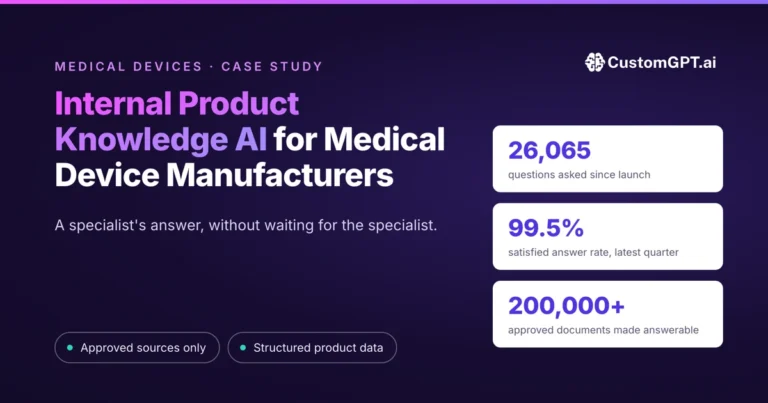
This is already running in production. GEMA, the German rights society with more than 100,000 members, resolved over 248,000 member inquiries at an 88 percent success rate on its own approved knowledge base.
VdW Bayern DigiSol, a housing federation of 500-plus member organizations, handled more than 7,000 regulated housing-law queries with 84 percent positive member feedback. Both results come from the same design: a closed corpus, a citation on every answer, and a refusal when the library does not cover the question.
The default language model is trained to guess rather than admit doubt
Large language models hallucinate because standard training and evaluation reward a confident guess over honest uncertainty. A model that abstains is making a deliberate design choice against the industry default, one documented by the people who build these systems.
OpenAI’s own researchers put it plainly in their September 2025 paper: hallucinations persist because “today’s evals reward guessing over ‘I don’t know'”. Their illustration is a birthday question. A model asked for a specific person’s birthday and forced to answer has a small chance of landing the right date and scoring a point, while replying “I don’t know” scores nothing on an accuracy-only test.
Across millions of such graded examples, the scoreboard teaches the model that a fluent guess beats an admission of doubt. The technical version of the argument sits in the arXiv preprint, and the fix the authors propose is to reward calibrated abstention rather than penalize it.
Read that way, an assistant that says it does not know when your library lacks the answer is behaving the way the researchers argue it should, doing the thing the default training pushes against.
For an association, the birthday example is not a curiosity. It generalizes to every niche question your members ask, because the narrower and more specialized the topic, the less the public training data supports a real answer and the more the model reaches for a plausible fabrication. A question about a specific clause in your code of conduct, a filing deadline in one state, or an eligibility rule for a credential is where guessing is most likely and most damaging.
Calibrated abstention, the fix the OpenAI researchers argue for, means the assistant answers only when it has grounding and otherwise says so. Building that behavior into a member assistant turns the industry’s documented weakness into your governance advantage, because the questions your members care about most are the ones a guessing model gets wrong.
For associations serving regulated professionals, a confident wrong answer becomes a liability
Members who are lawyers, pilots, engineers, or compliance officers act on the answer, and a 2026 wave of state chatbot laws now attaches real exposure to an official assistant that answers wrong. The stakes for an association’s AI sit well above those of consumer chat.
Members treat an answer from the association as authoritative, which is exactly why a fabricated one carries weight. The legal profession is already living the consequence. A public database of court cases with AI-fabricated citations, maintained by a research fellow at HEC Paris, logged more than 1,490 decisions worldwide by mid-2026, up from roughly 200 a year earlier.
In one Oregon case, a federal magistrate judge sanctioned two lawyers $110,000, the largest such penalty handed down by an Oregon federal judge, after they filed 15 fabricated citations and eight invented quotations. Those professionals are your members.
The regulatory floor is hardening in parallel. Nebraska enacted its Conversational AI Safety Act on April 14, 2026, with comprehensive transparency obligations, and a growing set of statutes prohibit chatbots from impersonating licensed professionals such as doctors and lawyers.
An assistant that answers member questions on housing law, aviation standards, or a certification code is operating in that zone, which is why regulated content is the clearest case for a closed corpus and identity-gated, SOC 2 Type 2 access. VdW Bayern DigiSol, the Bavarian housing federation, built its member assistant on this kind of must-be-right regulated content rather than the open web.
“I don’t know” is a named, live behavior, and a context boundary wall enforces it
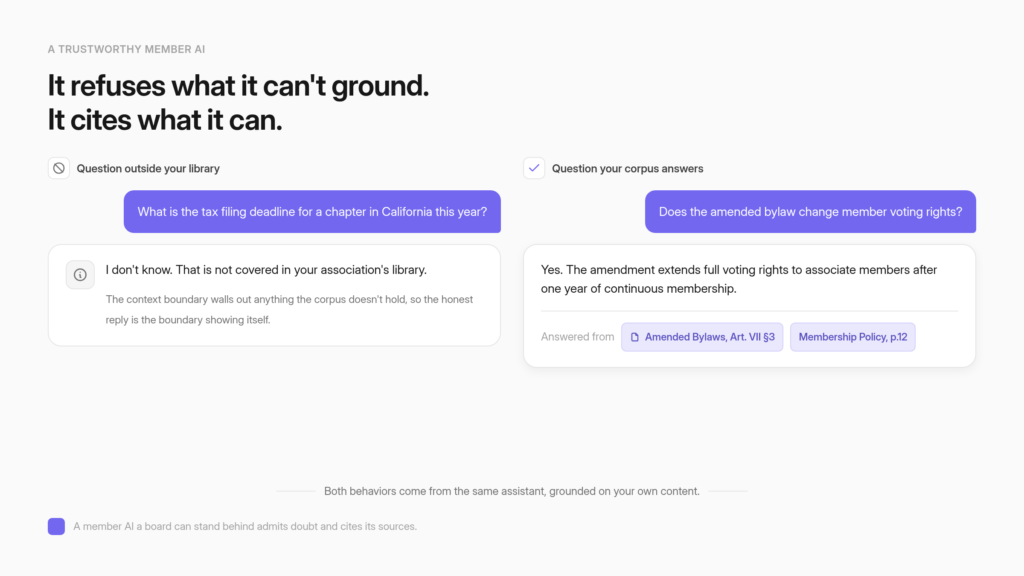
When the assistant lacks a grounded answer, it says so in those words instead of guessing. A context boundary keeps every answer derived only from your approved content and walls out unrelated internet data, so the refusal is enforced by architecture rather than by a hopeful instruction.

The behavior is concrete and named on the product. When the assistant deems that it does not know an answer, it will simply admit it: “I don’t know”, rather than generate a plausible-sounding paragraph. The exact wording of that refusal is something you configure, so it reads in your association’s own voice rather than a canned system line. Enforcing that refusal is a context boundary that confines responses to your business content, so any general or unrelated internet data is walled out.
The platform holds that boundary by default: it generates answers from your uploaded data only and layers proprietary anti-hallucination prompting on top, a configuration its documentation credits with protecting against over 95% of known prompt-injection methods. Contrast that with a general-purpose model, which answers from the broad public web and has no way to tell your bylaws from a Reddit thread.
For an association, the closed corpus is the whole safety mechanism: the assistant can only speak from the standards, syllabi, and member research you loaded, and when a question runs past that edge, the honest reply is the boundary showing itself. This is how a member AI built for member organizations behaves, rather than one adapted from a consumer chatbot.
Consider a member who asks whether a recent bylaw amendment changes their voting rights. An open-web model assembles a reply from generic nonprofit governance material it was trained on, none of which is your bylaws, and presents it with the same confidence it uses for a settled fact.
A closed-corpus assistant either answers from your actual amended bylaws with a citation to the exact section, or it tells the member it does not have that answer and routes them to staff.
Both outcomes protect the member. The outcome a closed corpus removes is the one associations fear most: a confident, specific, wrong answer about your own rules, delivered under your name. The wall is what makes the refusal reliable, because the assistant has no unapproved material to fall back on when your library comes up short.
A closed corpus carries its own honest limit worth naming for the staff who will run it. The assistant is accurate to the content you load, so an out-of-date bylaw or a wrong figure sitting in your own files gets cited faithfully rather than caught. The citation is what contains that risk: it puts the exact source in front of the member and the staff reviewer, so a stale page is visible and fixable instead of buried in confident prose.
Keeping the library current stays the association’s job, and the platform gives staff the controls to do it, so you manage and remove the sources in the knowledge base and pull a stale page before it gets cited again. That curation step is the first line of defense, because a closed corpus faithfully repeats whatever bad input it holds, and the boundary is what makes corpus quality the one accuracy variable you actually control.
Every answer returns its exact sources so a member can check the work
Each response returns the exact sources it used, rendered as clickable inline citations, on by default across every plan. A member checking a certification rule or a compliance deadline clicks straight to the source document instead of trusting a confident paragraph.
The mechanism is a source trail rather than a score. Every time the assistant generates a response from your business content, it also returns the exact sources it used, and those inline citations are now the default for all new CustomGPT.ai projects on every plan, while staying a setting a builder can turn on per agent for anything set up differently. Read a citation as a check-your-work guide back to the origin document, not as a certified accuracy stamp.
The value sits in the link itself: a member who disagrees, or a staff reviewer signing off, can open the cited page and confirm the claim against your own library in seconds. That verifiability is why member-association deployments lean on citation as the trust primitive rather than on the fluency of the prose. An answer a member can trace is an answer a governance committee can defend, and one a skeptical certified professional will actually use.
The clickable source also solves a problem specific to expert members. A certified professional does not want to be told the answer; they want to see the authority behind it so they can judge it themselves. When the assistant links a compliance deadline to the exact page of your regulatory guidance, or a certification requirement to the syllabus section that sets it, the member does the final verification in the way they were trained to.
That turns the assistant from something a skeptical expert distrusts by reflex into a faster path to the primary document they were going to check anyway. The citation is not a decoration on the answer. It is the part that makes the answer usable by the exact members whose questions carry the most risk.
Grounding reduces hallucination sharply but does not eliminate it
Grounding on your own corpus lowers fabrication a lot, and no honest vendor claims zero. Even the strongest 2026 frontier model still invented citations some of the time in third-party testing, so the durable value is a large reduction paired with a citation a human can verify.
The current numbers are sobering and useful. An April 2026 published analysis benchmarking five frontier models across 1,600 citation prompts found citation accuracy still failed 6.8% of the time for the best model, rose to 19.1% for the worst, and averaged 12.4%, with models inventing DOIs, titles, and author names. The same study found retrieval grounding cuts citation hallucination by 75 to 90 percent, while prompting alone cuts 5 to 15 percent.
Grounding is the largest lever available, and it still does not reach zero. The product language matches that honesty rather than overselling it: asked whether AI can stop hallucinating completely, the straight answer is no, you can reduce hallucinations sharply but should not promise perfect accuracy in every edge case.
A support-automation vendor writing about regulated industries in July 2026 framed the corollary well, noting that escalation is itself a hallucination control and “the cheapest way to avoid a wrong answer is to not produce one”. For a governance committee, that disclosed ceiling is the feature, because it is the part a vendor promising perfection would hide.
For the committee that has to approve a member-facing assistant, the disclosed ceiling changes the conversation. A vendor promising perfect accuracy is asking the committee to accept a claim no benchmark supports, which is itself a reason for caution.
A vendor that states the reduction, shows the residual failure rate, and hands over a citation on every answer is giving the committee a control it can actually operate. The board is not buying a promise that the assistant never errs. It is buying a large, measured drop in errors, a boundary that produces an honest refusal instead of a fabrication, and a source trail that lets a human catch what slips through. That combination is what makes the assistant defensible in front of a membership that will notice a wrong answer and remember it.
Builders and admins get a verification workflow to audit answers during rollout and after
Verify Responses is builder and admin tooling. A Claim Verifier extracts each factual claim and cross-references your source documents, a Verified Claims Score reports the ratio, and a Trust Score runs the answer past six virtual stakeholders. Members never see this panel.

The workflow is built for the person accountable for the answer, not the member reading it. Verify Responses runs a Claim Verifier that extracts every factual claim and cross-references it against your source docs, reports a Verified Claims Score as a simple ratio (eight verified out of ten claims reads as 80 percent), and produces a Trust Score by simulating six stakeholders: the end user, security and IT, risk compliance, legal compliance, PR, and executive leadership. Builder mode runs it automatically on every chat, and audit mode lets a staff member re-run it on any past conversation.
It is available on every plan, from Standard through Enterprise. The honest boundary belongs here too. This is admin-side verification your end users never see, scored per answer and viewed in aggregate by your team, not a per-member guarantee stamped on each individual reply. It shifts a wrong answer from something a member catches to something a reviewer catches first.
In practice the two modes cover different moments. Builder mode is the pre-launch and tuning phase, where staff watch the Claim Verifier and Trust Score on live chats and adjust the corpus before the assistant reaches members. Audit mode is the after-the-fact check, where a compliance lead can pull any past conversation and re-run verification when a member disputes an answer or a regulator asks how a claim was produced.
Neither mode changes what the member sees in the moment, which is why it pairs with the closed corpus and the citations rather than replacing them. The member-facing guardrails keep most wrong answers from ever being produced. Verify Responses gives your team the record and the review workflow to catch the rest, and to show their work to a board or an auditor when asked.
Third-party-validated benchmarks put numbers on the accuracy gap
A RAG benchmark of 945 questions across nine datasets, validated by the third-party testing firm Tonic.ai, measured a lower hallucination rate, higher accuracy, and faster responses versus a leading assistant API. Read alongside the 2026 frontier results, the direction of the evidence is consistent.
The figures only mean something with their scope attached. Against OpenAI’s Assistant API V2, across 945 questions spanning nine datasets and validated by the third-party testing firm Tonic.ai, CustomGPT.ai showed a 10 percent lower hallucination rate, 13 percent higher accuracy, and 34 percent faster average responses.
Read that as a directional product claim, and pair it with the April 2026 frontier benchmark for the current picture: grounding pulls citation hallucination down by 75 to 90 percent, and the best ungrounded frontier model still failed 6.8 percent of the time.
Two different studies, run on different systems in different years, point the same way. Retrieval grounding on a trusted corpus is the mechanism that moves the accuracy number, and the residual gap is the reason the citation and the “I don’t know” fallback matter. Numbers set the expectation; the source trail lets a member verify any single answer against it.
Associations have already deployed cited, closed-corpus assistants for regulated member bases
The category is already proven. A 100,000-member rights society and a federation of hundreds of housing organizations have each put their own approved knowledge behind a cited, closed-corpus assistant, with every deployment scoped to its own content and its own measured outcome.
GEMA, the German music-rights society, serves more than 100,000 members and resolved over 248,000 inquiries at an 88 percent query success rate while saving 6,000-plus staff hours a year. In the words of Jonas Walther, Manager Data and AI at GEMA, the deployment “isn’t just a support tool. It’s become a knowledge infrastructure for our organization.” VdW Bayern DigiSol, the Bavarian housing federation representing 500-plus member organizations, handled more than 7,000 queries on regulated housing-law content with 84 percent positive member feedback. Both built on their own corpus, and each metric belongs to that single deployment rather than to a blended average.
The through-line across these deployments is that each association kept its own content as the single source and let the assistant cite back to it, which is what makes the results portable to your organization. GEMA’s rights-registration questions and VdW Bayern’s housing-law queries share almost nothing in subject matter. What they share is the architecture: a closed corpus, a citation on every answer, and a refusal when the library does not cover the question.
An association evaluating this does not have to trust that the pattern works in the abstract. It can look at a rights society and a housing federation that each run it today on regulated content their members act on every day.
The trust requirement for member AI is inverted from consumer chat
A member AI a board can stand behind refuses questions outside your library, cites the answers it does give, and admits its own ceiling. That is the opposite of a consumer model rewarded for always producing a reply, and it is what a regulated membership actually wants.
Members are ready for this when the trust is visible. Higher Logic’s 2025 Association Member Experience Report found 94 percent of members are comfortable with their association using AI for search, personalization, and support, as long as the tools stay transparent and human-centered.
Transparency, in practice, is the citation on every answer and the honest “I don’t know” when the library falls short. The default model guesses because its training rewards guessing; a member assistant flips that incentive by grounding on your corpus, showing its sources, and disclosing the ceiling that grounding cannot erase.
For a membership of lawyers, pilots, engineers, and compliance officers, the assistant that admits doubt is the trustworthy one. To see how the closed corpus, the inline citations, and the “I don’t know” fallback fit an association’s specific member base, book a 15-min discovery call with the CustomGPT.ai team.
You can also start a free trial, load a slice of your own library, and watch where the assistant cites a source, where it refuses, and where it holds the line on the questions your members actually ask.
Frequently asked questions about trustworthy cited AI for members
What does it mean when a member AI says "I don't know"?
It means the assistant found no grounded answer in your approved library and tells the member so, in plain words, instead of writing a confident paragraph that might be wrong. That refusal is a deliberate design choice against the industry norm, because OpenAI’s own research shows most models are trained to reward a guess over an honest admission of doubt. For members who act on the answer, a refusal is safer than a fabrication that sounds right.
What happens when a member asks about something our content does not cover?
The assistant tells the member it does not have that answer and can route them to staff, rather than assembling a reply from unrelated internet data. A context boundary keeps every answer derived only from your approved content, so when a question runs past the edge of your library, the honest refusal is the boundary showing itself. That is the exact moment a general-purpose model would guess and get your own rules wrong.
Why does hallucination matter more for our specialized field than for general questions?
The narrower and more specialized the topic, the less public training data supports a real answer, so a model reaches for a plausible fabrication. A question about one clause in your code of conduct, a filing deadline in a single state, or an eligibility rule for a credential is where a guessing model is most likely to be wrong and most damaging. A closed corpus that answers only from your vetted content, or refuses, fits specialized member bases for that reason.
What is a hallucination, and how often do these models make one up?
A hallucination is a confident, plausible answer a model invents when it lacks real grounding, including fake citations, titles, and author names. It stays common even at the frontier: an April 2026 benchmark of five frontier models found citation accuracy still failed 6.8% of the time for the best model and 12.4% on average. The same study found that grounding an assistant on a trusted corpus cuts citation hallucination by 75 to 90 percent.
Can you promise the AI will never give a member a wrong answer?
No, and treat any vendor who promises that with caution. Grounding an assistant on your own content lowers fabrication a great deal, and no honest provider claims it reaches zero. Asked whether AI can stop hallucinating completely, the straight answer is no: you can reduce hallucinations sharply but should not promise perfect accuracy in every edge case. What you get is a large, measured reduction paired with a citation any member or reviewer can check.
What is the difference between reducing hallucinations and eliminating them?
Reducing means grounding the assistant on your corpus so it fabricates far less and cites what it does say. Eliminating would mean a zero-error guarantee no benchmark supports. Grounding is the largest lever available and still does not reach zero, which is why the citation and the honest refusal both matter. A vendor that discloses the residual failure rate is handing your board a control it can operate, not a promise it has to accept on faith.
How can a member see where an answer came from?
Every answer returns the exact sources behind it, rendered as clickable inline citations a member can open to read the original document. These citations are on by default for new projects on every plan, so a member checking a certification rule or a compliance deadline clicks straight to the source instead of trusting the prose. An answer a member can trace is one a governance committee can defend.
Our members are lawyers and engineers who double-check everything. Will they trust an AI assistant?
Skeptical experts trust a source trail more than fluent prose. A certified professional does not want to be told the answer; they want the authority behind it so they can judge it. When the assistant links a compliance deadline to the exact page of your guidance, the member does the final verification the way they were trained to. Members broadly report readiness for this: a 2025 association report found 94% comfortable with their association using AI when the tools stay transparent.
How do we review or audit what the AI has told our members?
Builders and admins can check answers with Verify Responses, a workflow members never see. A Claim Verifier extracts each factual claim and cross-references your source documents, a Verified Claims Score reports the ratio, and a Trust Score runs the answer past six virtual stakeholders. Builder mode scores live chats before launch, and audit mode lets a compliance lead re-run verification on any past conversation when a member disputes an answer.
Do our members see the accuracy scores or the verification panel?
No. The Claim Verifier, the Verified Claims Score, and the Trust Score are admin and builder tooling viewed by your team, not stamped on each member reply. What a member sees is the answer and its citations. The verification runs behind the scenes so a staff reviewer catches a wrong answer before a member does, and the scores are read in aggregate by your team rather than as a per-member guarantee on any single reply.
Are associations already running a cited AI on regulated member content?
Yes. GEMA, the German music-rights society serving more than 100,000 members, resolved over 248,000 inquiries at an 88% query success rate on its own approved content. Separately, VdW Bayern DigiSol, a Bavarian housing federation of 500-plus organizations, handled more than 7,000 queries on regulated housing-law content with 84% positive member feedback. Each metric belongs to that single deployment rather than to a blended average.
Is trustworthy AI an enterprise-only feature, or is it on our plan?
The trust guardrails are not gated behind a top tier. Inline citations are on by default for new projects on every plan, and the Verify Responses builder and admin tooling is listed on every plan from Standard through Enterprise. A small association staff gets the closed corpus, the citations, and the verification workflow without needing an enterprise contract or a developer team to run it.
Related Resources:
- Enterprise-Grade Member AI Without an Enterprise Team: See how a small staff configures this same refusal behavior without a developer.
- AI for Credit Union Research Libraries: See why declining to guess matters most when the content is regulated financial research.
- How to Connect Member AI to Your AMS: See how identity gating and honest refusal work together to keep the assistant trustworthy.
- AI for Healthcare Credentialing Bodies: See this same refusal behavior applied where a wrong answer means misstating a credentialing requirement.
- AI for State Employer Associations and Their HR Libraries: See why refusing an off-corpus question matters most when the topic is employment law liability.
- AI for Manufacturing and Packaging Trade Associations: See this same trust-through-refusal pattern applied to technical standards and specs.
- Member vs Staff AI Permissions: See how refusal behavior interacts with role-based routing when a person shouldn’t see an answer at all, not just when the library lacks one.