
AI for State Employer Associations and Their HR Libraries
An HR answer is only safe for your member when it is right for their state and current as of a date they can see
A state employer association’s HR resources have to satisfy two conditions before a member can safely act on them. The guidance has to be correct for the member’s state, and it has to be current as of a date the member can see.
Those two conditions fail independently, on different clocks, and an assistant that handles only one of them will confidently hand a Missouri member a California answer or quote a bulletin that a legislature superseded last quarter.
The design that satisfies both is a closed-corpus assistant over the association’s own vetted library. Four behaviors define it:
- Answers only from approved content. Nothing the association has not vetted.
- Carries state and publication date as retrieval metadata. Not prose buried on page four of a PDF.
- Attaches the exact bulletin, template, or survey edition behind every answer, so the member can judge vintage without trusting the paragraph.
- Declines when the library holds nothing current. It routes the member to a hotline advisor instead of reaching for the open web.
That combination is what member AI built for association content libraries has to deliver in this vertical.
One frame belongs up front, not in a footer. The assistant is not legal advice and does not replace the advisors who give it. Employer associations already refer members to outside counsel for legal questions, and an assistant sits below that line, in the same place the document library has always sat.
An employer association sells a jurisdiction-specific answer, delivered four ways
State and regional employer associations exist to keep member companies compliant with changing federal and state employment law. They deliver that through an advisor hotline, a document and template library, training programs, and briefings. The member on the other end is usually a small HR team with no in-house employment counsel.
The national body for these organizations describes the job in its own words. Employer associations, per the Employer Associations of America, help member businesses “stay in compliance with ever-changing federal and state laws” through “answers over the phone, educational forums, newsletters, and training”. That phrase, ever-changing, is the vertical’s own account of its core problem, and it is the reason the library is the hardest part of the benefit to keep honest.
The service shape is unusually generous. AAIM Employers’ Association publishes a 24/7 HR hotline offering members unlimited calls, where “one of AAIM’s qualified HR advisors picks up immediately”. Scale runs large on the membership side too: the California Employers Association, founded in 1937, “serves 20,000+ businesses operating in California” with unlimited phone support, handbook templates, toolkits, and training.
Picture the member who actually calls. A 40-person manufacturer whose HR generalist also runs payroll, fields a question about intermittent leave on a Tuesday afternoon, and has fifteen minutes to resolve it. That person is not going to read a 60-page state summary. They want the answer for their state, today, with something they can forward to their owner.
Associations already know this, which is why keeping policy documents inside a private assistant is a natural extension of what the library was always for.
Members do not know which rules already bind them, so they cannot ask the right question
SHRM’s 2026 research found that 19 of the most populous states have enacted AI laws or regulations covering employer or employment AI use, and that 57% of HR professionals working in those states were not aware of those policies. A member who does not know a rule exists will not search for it.
That finding comes from SHRM’s State of AI in HR 2026 report, which fielded its survey of HR professionals in December 2025 and states that “as of February 2026, 19 of the most populous states have enacted AI laws or regulations that pertain to employer or employment AI usage” while “a surprising 57% of HR professionals who work in those states reported that they are not aware of those policies”. The same research puts adoption at 39% of HR functions currently using AI, with another 7% intending to launch this year.
The retrieval consequence matters more than the headline. A system that only matches the words a member typed cannot surface an obligation the member has never heard of. If half the membership in a covered state does not know a rule applies to them, no amount of search-box quality closes that gap, because nobody is typing the query. What closes it is a corpus curated by jurisdiction, where the assistant answering a question about an automated screening tool can pull the state obligation alongside the federal one because the association tagged it that way. This is why compliance work stalls on retrieval rather than on expertise: the association already wrote the guidance, and the member never found it.
The supply side is moving faster than member awareness. ASAE’s first State of Associations report, published March 23, 2026, reports that AI use is “widespread” at “87.5% for content and 44.3% for data” while “readiness lags, with most organizations citing limited expertise and data privacy concerns”. Associations are deploying. The question is whether the corpus underneath is organized well enough to be worth deploying over.
Employment law changes its own vocabulary, and the library keeps the old words
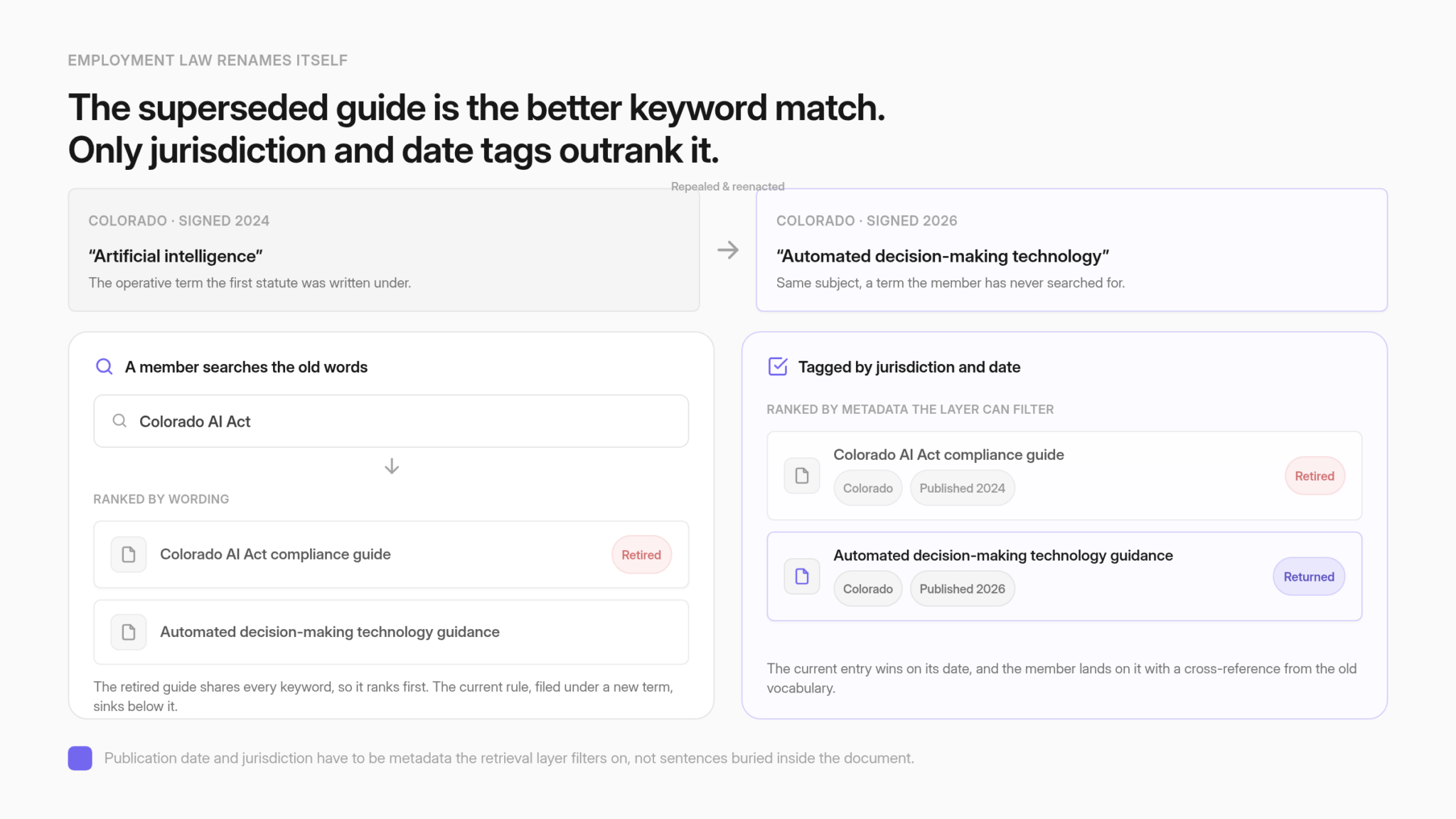
Colorado’s 2024 AI statute was repealed and reenacted in May 2026 under a bill whose operative term is “automated decision-making technology” rather than “artificial intelligence.” Guidance written to the old name still matches a member’s search better than the current rule does.
The record is on the legislature’s own pages, and it runs to three touches in two years. Colorado SB 24-205 was approved by the Governor on May 17, 2024, with obligations set to apply “on and after February 1, 2026.”
A 2025 special-session bill moved that date: SB 25B-004 “extends the effective date of the requirements of Senate Bill 24-205 to June 30, 2026” and was approved by the Governor on August 28, 2025. Then SB 26-189, titled “Automated Decision-Making Technology,” was signed by the Governor on May 14, 2026, and “repeals and reenacts those provisions with new requirements regarding the use of automated decision-making technology in consequential decisions”. The new statute defines that term as a technology that processes personal data and uses computation to generate output used to make, guide, or assist a decision.
An association publishes a “Colorado AI Act compliance guide” in 2025. A member hears about AI hiring rules in 2026 and searches the member portal for “Colorado AI Act.”
The superseded guide shares every keyword in that query. It also sits closer in embedding space, because it was written in the same vocabulary the member is using. Both lexical matching and semantic matching favor the wrong document. The current rule, filed under a term the member has never encountered, ranks below it. Nothing about the retrieval system is broken. It is doing exactly what it was built to do, and the outcome is a fluent, cited, out-of-date answer.
Illinois shows the same problem from the other direction. HB 3773 became Public Act 103-0804 on August 9, 2024, taking effect January 1, 2026, and it amends the Illinois Human Rights Act at 775 ILCS 5/2-101 and 5/2-102 rather than standing up a separate AI statute. A member searching the portal for “Illinois AI Act” is searching for a document that does not exist under that name. The obligation lives inside the state’s civil rights law, which is where the association’s own summary has to file it and cross-reference it.
Publication date and jurisdiction have to be metadata the retrieval layer can see and filter on, not sentences inside the document. Labeling each page by jurisdiction and vintage lets the assistant draw from only the sources a label permits, so it can prefer the current entry over the better-matching stale one, and it can show the member which vintage it used. That is what lets a compliance reviewer trace an answer.
The hotline scales by headcount, and the library scales by retrieval
An unlimited-call advisor hotline is a promise bounded by how many advisors the association employs. The document library carries no such bound, which makes it the part of the member benefit an assistant can widen without adding staff. Repetitive lookup questions move to the library. Judgment calls stay with advisors.
The finance committee sees the two curves clearly enough. Unlimited phone support across thousands of member companies is a fixed-headcount promise stretched across a growing membership.
Every new member makes the ratio worse, and the only lever is hiring. The library has the opposite curve. Once a bulletin exists, the thousandth member reading it costs the same as the first. What has historically capped the library’s value is not its cost to serve but the member’s ability to navigate it, and that cap is a retrieval problem.
An assistant of this kind augments the existing portal and staff by absorbing repetitive “where do I find” questions so the team can spend advisor time on higher-value work. That is the accurate promise for an assistant that answers from your own member resources, and it is a deliberately smaller claim than replacement.
The assistant should hand the member to the hotline whenever the question turns on facts the library cannot see: what this specific employee’s leave history looks like, whether this particular termination carries risk, how a regulator treated a comparable case.
The vertical already models the boundary above that one, since AAIM’s own hotline page tells members that for legal advice, it partners with a law firm specializing in labor law and can offer a reference. Two escalation tiers exist and work. The assistant becomes a third tier below them, and the human review step in an HR workflow stays exactly where it was.
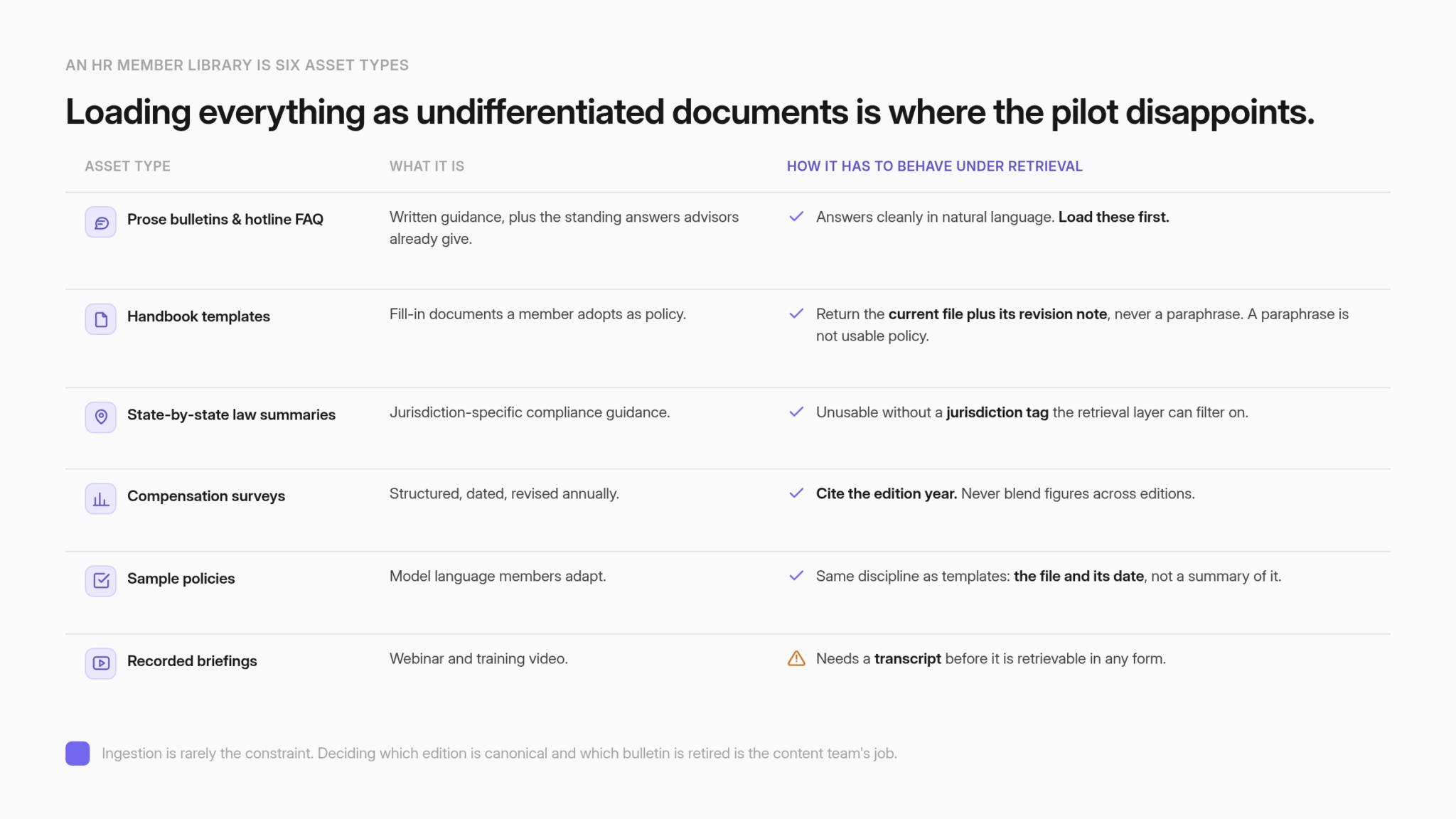
An HR member library is six asset types, and each one behaves differently under retrieval
Hotline precedent, handbook templates, state-by-state law summaries, compensation surveys, sample policies, and recorded briefings do not retrieve alike. Prose guidance answers well in natural language.
A dated survey table and a fill-in template need different handling, and loading everything as undifferentiated documents is where pilots disappoint.
AAIM publishes its hotline coverage as recruiting and staffing, leaves of absence, legislative compliance, benefits, termination, policies, hourly wages, surveys, and payroll. That list is the retrieval taxonomy, because it is what members actually ask about.
Each asset type carries its own requirement.
| Asset type | What it is | How it has to behave under retrieval |
|---|---|---|
| Prose bulletins and hotline FAQ | Written guidance, plus the standing answers advisors already give | Answers cleanly in natural language. Load these first. |
| Handbook templates | Fill-in documents a member adopts as policy | Return the current file plus its revision note. A member who gets a paraphrase has received nothing usable and may believe the paraphrase is the policy. |
| State-by-state law summaries | Jurisdiction-specific compliance guidance | Unusable without a jurisdiction tag the retrieval layer can filter on. |
| Compensation surveys | Structured, dated, revised annually | Cite the edition year. Never blend figures across editions. |
| Sample policies | Model language members adapt | Same discipline as templates: the file and its date, not a summary of it. |
| Recorded briefings | Webinar and training video | Needs a transcript before it is retrievable in any form. |
Compensation surveys show why the edition year has to travel with the answer. The American Society of Employers announced on June 8, 2026 that it had released “Michigan’s Largest Compensation Survey, Showing 3.3% Wage Growth in 2026”. A 2026 figure and a 2025 figure averaged together produce a number that describes no year at all.
Ingestion is rarely the constraint. Support for over 1,400 file formats and syncing from the systems the content team already uses covers what an association actually holds, which tends to be PDFs, Word documents, spreadsheets, and a portal CMS.
Recorded briefings are the one asset that needs a step first, since connecting the video platform that hosts them brings each transcript along so the briefing becomes searchable, and without that transcript the file is stored but its spoken content stays unsearchable. Curation is the constraint. Deciding which survey edition is canonical and which 2025 bulletin is retired is work the content team does in the knowledge base by managing its sources, and no ingestion pipeline does it for them.
A citation with a publication date is what makes a member-facing answer auditable
Every answer should arrive with the specific bulletin, template, or survey edition it came from, and the member should be able to see when that source was published. A paragraph without a dated source is unverifiable, and in a field where the rule changed last quarter, that is the gap between guidance and a guess.
The product mechanism is straightforward. Answers carry numbered references with one-click access to the source text, a citation display turned on per agent, so every answer arrives with the bulletin it came from attached. For an HR member library, the citation carries a second job beyond verification. It exposes vintage. A member who sees the answer came from a bulletin dated March 2025 can make their own judgment about whether to call the hotline before acting, which is a decision they cannot make about an uncited paragraph.
Editorial discipline is the part the software does not do. A corpus holding both the 2025 and the 2026 version of a bulletin will cite both, sometimes in the same answer, and the member is left refereeing.
Three practices prevent that. Date-stamp every bulletin in its title so the vintage travels with the citation. Retire superseded guidance rather than editing it in place, since editing in place destroys the record of what members were told last year. Keep one canonical entry per jurisdiction per topic, and treat any second entry as a bug in the library rather than as extra coverage.
Handled that way, the Colorado situation becomes an operating procedure instead of a hazard.
The 2025 guide comes out of the corpus when the statute is repealed, a new entry goes in under the current term with a cross-reference from the old vocabulary, and a member searching the old words lands on the current rule with a note explaining what changed. This is the same practice that compliance teams already follow when citing the source on every generated answer.
A closed corpus means the assistant declines instead of filling the gap from the open web
When the library has nothing current for a state, the correct behavior is to say so and route the member to an advisor. An assistant that reaches past vetted content to answer will produce a fluent response about the wrong jurisdiction, and that outcome is worse for the member than no answer.
Default behavior in a general model runs toward the most represented jurisdictions in its training data, which means federal framing and large-state rules.
A member in Missouri or Nebraska who asks a bare question about final paycheck timing, without naming their state, gets an answer shaped by whatever dominates the public corpus. It will read as authoritative. Final paycheck deadlines are one of the places state rules diverge, so an answer that is right for the country in general can be wrong for the member in a way that produces a wage claim.
Closed-corpus grounding is the control. The assistant can only speak from the bulletins, templates, and summaries the association loaded, so a question outside that boundary produces a refusal instead of an improvisation.
For an employer association the refusal is the safer product, because a member who hears “the library does not have current Nebraska guidance on this, here is the hotline” behaves correctly, and a member who receives a confident California answer does not. The wording of that decline is itself configurable, so it can point a member to the hotline in the association’s own voice rather than dead-ending on a generic refusal.
Three options usually sit on the table when an association takes this up.
- AMS or portal CMS search. It matches keywords, so it ranks a retired bulletin and a current one by wording instead of by date.
- A general assistant pointed at a folder of uploaded documents. It depends on that folder being complete, and nothing in that setup obliges it to tell a member when the folder is silent.
- A closed-corpus assistant over the vetted library. The one option that can decline and show its source.
The first two cost less, and an association whose members read mostly stable federal guidance may be well served by them. The case for the third gets stronger the more state-specific and fast-moving the library is.
Grounding an assistant on curated content reduces fabrication substantially without eliminating it, and that is the most any vendor in this space can honestly promise. The residual risk is contained by the citation, which puts the source in front of the member and the reviewer, and by guardrails that stop an assistant from filling gaps with material the association never approved.
One state employer association already ships this, and its published disclaimer names the real limit
The American Society of Employers, which describes itself as Michigan’s largest employer association, runs Chester AI, built on Betty AI, restricted to ASE’s own vetted content. Its published disclaimer tells members the assistant might not always reflect the most current policies or interpretations, and points them to official materials or staff.
ASE describes Chester AI as trained on its content library, survey data, course catalog, event calendar, and member-exclusive resources, and states that “Chester only searches ASE’s trusted content and the knowledge it has been trained on. It does not pull information from external websites or search the open internet”. The same page carves out one exception, that Chester “will refer to specific government site pages on a very limited basis,” which
is a reasonable line for a compliance corpus and is worth copying rather than glossing. A working deployment in this exact vertical arrived independently at closed-corpus retrieval, which is a stronger argument for the pattern than any vendor claim.
The disclaimer is the more valuable artifact. ASE publishes that Chester AI “provides responses based on ASE’s vetted resources but might not always reflect the most current policies or interpretations.
Always consult official ASE materials or staff for authoritative information,” alongside a statement that it is not providing legal advice or counsel. That is an association telling its own members, in public, that the vintage axis is a live risk. Any honest treatment of AI in this vertical operates under that same ceiling, and a vendor claiming otherwise is selling something the category cannot deliver.
Access is tiered, not open. Chester AI is available to ASE members and to people exploring membership, and ASE publishes that anyone who is not a member, or is a member but not logged in, is limited in how many questions they can ask, while members have unlimited access. That model turns the assistant into a sampling surface for the paid library, which is a familiar move for any association weighing what to expose publicly and what to keep behind the join page.
Copy the disclaimer practice, not only the architecture. Write your own, put it where members read answers instead of on a terms page nobody opens, and have counsel look at it before launch alongside the disclaimer your hotline already carries. An association that has been telling members for twenty years that the hotline is not legal advice has most of that language written, and the board conversation about liability goes faster when the wording is already in front of them.
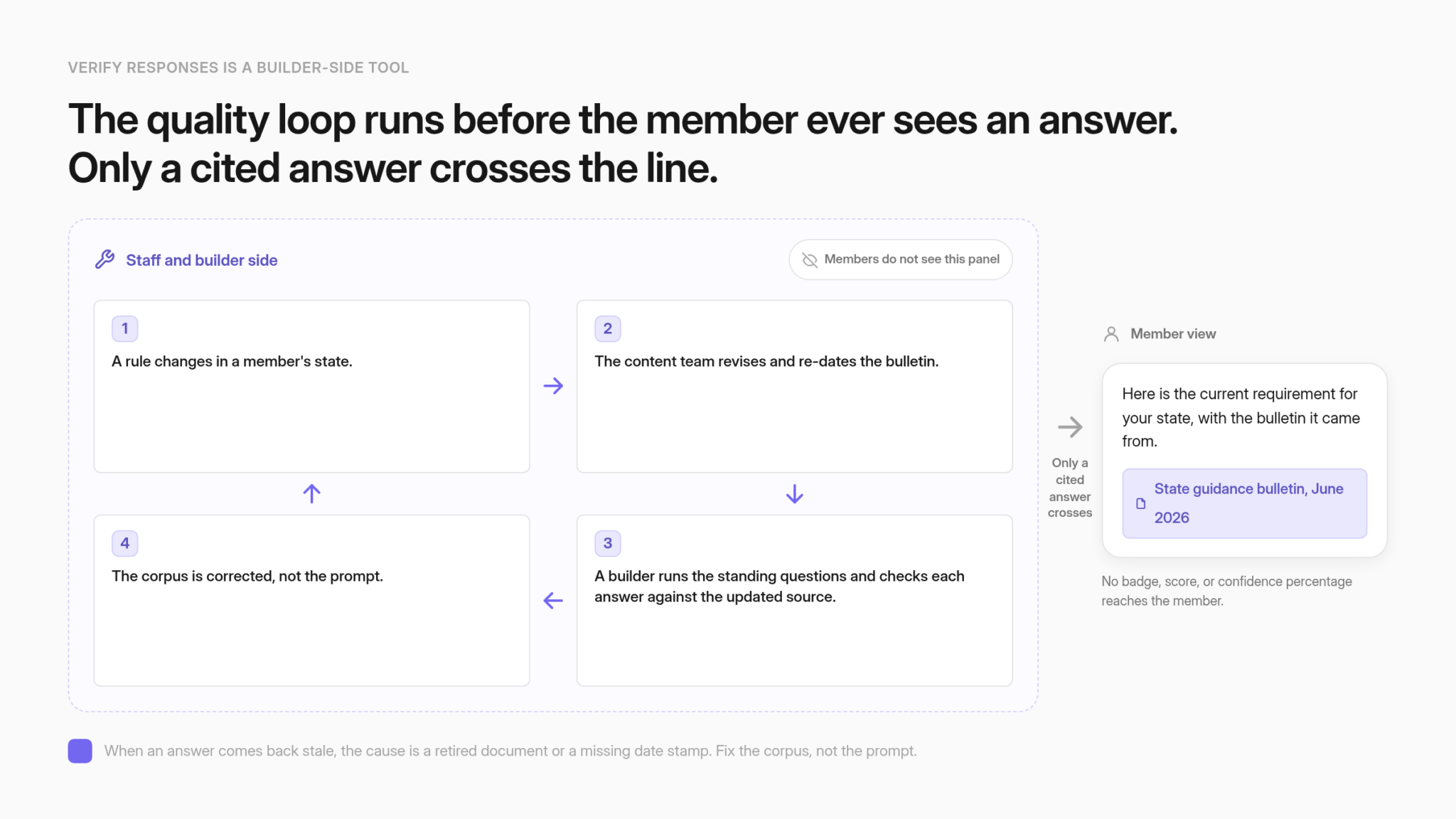
Checking answers against the source bulletin is a staff job, and the tooling is builder-side
Verify Responses checks an agent’s answers for factual accuracy and compliance risk, extracting the factual claims in a response and testing them against the source documents. Per the documentation it is a builder-only tool, available on all plans, and it runs as an agentic action that consumes additional query credits. End users do not see the shield icon or the analysis panel, which makes it a staff quality loop and not a per-answer guarantee.
The boundary is worth restating plainly. No member receives a verification badge, an accuracy score, or a confidence percentage. What the association gets is a way for the content team to fact-check answers during QA before a rollout, run by the people who own the corpus.
The operating practice this vertical needs follows from the Colorado problem. After each revision cycle, the HR content team runs a standing set of questions for the changed jurisdiction, compares each answer against the updated bulletin, and fixes the corpus instead of the prompt. Fixing the corpus is the important half. When an answer comes back stale, the cause is almost always a retired document still sitting in the library or a missing date stamp, and prompt-level patches hide that defect instead of removing it.
Cadence should follow the legislative calendar rather than the content calendar. State sessions cluster, and the weeks after a session closes are when a member library goes quietly out of date. An association that schedules its QA pass to the sessions in the states where its members operate catches drift while it is still cheap. Associations weighing what a deployment actually covers should budget this review time explicitly, because it is recurring staff work and not a launch task.
Member-only guidance stays member-only through the login you already run, and that is an Enterprise control
Compensation survey data, handbook templates, and state-law summaries are usually the paid tier of the member benefit. Gating an assistant’s answers to logged-in members through an existing identity provider is available on the Enterprise plan. A public-facing assistant over ungated content runs on any plan.
This is the claim most often fudged in this category, so here is the published line. Gating member-only guidance behind the login you already run works through your existing identity provider, authenticating members as end users mapped to a role rather than as accounts you provision one by one, and it is an Enterprise control: the published plan comparison draws that line. An association that needs compensation survey answers restricted to paid members is buying Enterprise. An association starting with public compliance explainers and a join-page funnel is not.
What comes on every plan is worth knowing before the security review starts. SOC 2 Type 2, GDPR alignment, 256-bit AES encryption at rest, and Verify Responses are included across tiers, and the platform supports SAML 2.0 access control alongside self-contained agents with no data sharing between agents, with single sign-on set up through a SAML configuration import. That last property matters for an association running a member assistant and a staff assistant on the same account, since internal advisor notes should never surface in a member answer.
Three constraints belong in front of a board now, not during procurement. The data processing agreement is available to Enterprise customers only. Deployment is cloud-only, with no private-cloud or on-premises option, which is a real consideration for associations holding member compensation or payroll data. ISO 42001 is prepared for but not certified, and any claim otherwise should be checked against the security page instead of a sales deck.
The mechanism is proven at federation scale, and the vertical case study does not exist yet
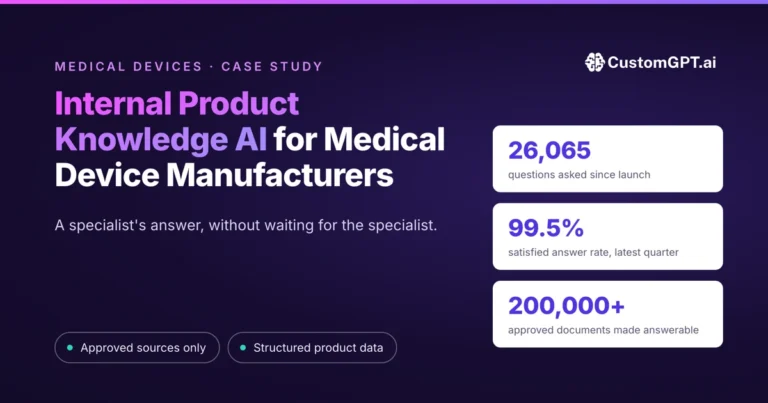
VdW Bayern DigiSol is the digital subsidiary of the association representing more than 500 housing organizations across Bavaria. It deployed a cited assistant over 3,620 internal documents, answered more than 7,000 questions across 2,000 conversations in its first six months, recorded positive feedback on 84% of user interactions, and went live in under 60 days.
The structural parallel runs close. VdW Bayern is a federation whose members are organizations rather than individuals, facing regulatory complexity and staffing shortages, where member organizations lacked the legal or administrative resources to interpret complex frameworks quickly. Its accuracy requirement came from regulatory compliance, and its answers are fully source-backed with citations drawn from all 3,620 documents on every answer. Dr. Korbinian Weisser, Managing Director of VdW Bayern DigiSol GmbH, states on the case study that the platform “made it straightforward to turn our vision for WohWi AI into reality,” and that the assistant “now enables members to make informed decisions faster and with greater confidence.” Label the analogy accurately: this is a German housing federation, not a US employer association. What transfers is the mechanism of a federation serving member organizations that lack in-house legal capacity, answered from a curated corpus with citations attached.
Separately, at a different scale, GEMA is a 100,000-member organization running a public and member-portal assistant that has resolved more than 248,000 queries with an 88% query success rate against a 70% benchmark.
Set those two deployments aside before reading the next set of numbers, because they come from a different kind of source and attach to neither of them. Across membership association customers as a group, the published figures are 95%+ member satisfaction with cited answers and roughly two weeks to a branded pilot, with support deflection listed as reaching up to 93% of repetitive questions. Those are aggregates and ceilings. No individual association’s results can be read out of them, and none of them describe VdW Bayern or GEMA.
There is no published state employer association case study to point at here. The proven deployments are a rights society and a housing federation, and the transferable evidence is the mechanism rather than the vertical. An association evaluating this should treat hotline deflection, member satisfaction with cited answers, and time-to-answer on state-specific questions as numbers it will measure itself, and should discount any vendor presenting a vertical proof point it cannot name.
What to load first, and what stays with your advisors
Start with the jurisdictions where the most member questions land and the content that changes fastest, date-stamp everything loaded, and keep the hotline as the escalation path. The assistant widens the library. Advisors keep judgment, and legal advice keeps coming from counsel.
A two-week pilot has room for four things. The law summaries for the state where the largest share of member companies operate. The handbook template set, with revision notes attached and not stripped. The most recent compensation survey edition, tagged with its year. And the standing hotline FAQ, which is already written in the form members ask questions in. What a two-week pilot does not load is everything, because a corpus assembled by bulk upload contains the retired 2025 bulletins that cause the exact failure this whole design exists to prevent.
Measure the pilot on the questions members ask instead of on volume. Which states show up. Which topics repeat. Which questions the assistant declined, since a decline list is a content roadmap written by the membership. Associations that also want the assistant working on the acquisition side can look at turning member access into non-dues revenue, which is the same corpus pointed at a different audience.
Staffing is the question a 25-person association asks next, and the honest answer is that this lands on people already on the payroll. The HR content team deciding which survey edition is canonical and which 2025 bulletin is retired is doing that curation today, in a spreadsheet or in one person’s head. What changes is that the decision becomes explicit and has to be recorded where the retrieval layer can read it. Budget the recurring QA pass at each revision cycle. Do not budget a new hire.
There are two ways to find out whether your own corpus is ready. Load one state’s law summaries and last year’s handbook templates into a free trial, then ask it the ten questions your hotline hears most. An afternoon of that will tell you more about the state of your library than any vendor call. Or bring the jurisdiction, gating, and content-currency questions to the pilot path associations use and scope it with someone who has run the process before.
Frequently asked questions about AI for state employer association HR resources
Will an AI assistant give our members answers for their state, or default to federal rules?
A general model leans toward federal framing and the largest states, because that is what dominates the public text it learned from. A member in Missouri or Nebraska who asks about final paycheck timing without naming their state gets an answer shaped by that bias, and it will read as authoritative even where state deadlines diverge. A closed-corpus assistant answers only from the bulletins and state summaries your association loaded, with jurisdiction carried as retrieval metadata rather than as a sentence buried inside a PDF. When the library holds nothing current for that state, the correct output is a decline and a route to an advisor.
Our members have employees in several states. How does the assistant know which state's rule to apply?
Tag every document with the jurisdiction it governs, then let the retrieval layer filter on that tag before it ranks anything. A member with staff in three states gets the relevant entry per state instead of one blended paragraph that is accurate nowhere. The hard part is editorial rather than technical: keep one canonical entry per jurisdiction per topic, and treat a second entry on the same topic as a defect in the library rather than as extra coverage.
How do we stop the assistant from quoting a bulletin that a legislature already replaced?
Retire superseded guidance instead of editing it in place, and date-stamp what stays so the vintage travels with the citation. Vocabulary drift is the case that catches libraries. Colorado’s 2024 AI statute was repealed and reenacted in May 2026 under a bill whose operative term is “automated decision-making technology” rather than “artificial intelligence.” A 2025 guide written to the old name still matches a member searching “Colorado AI Act” better than the current rule does, on both keyword and semantic matching. Cross-reference the old vocabulary to the new entry so the member lands on the current rule.
Our members do not know which AI hiring rules already apply to them. Can an assistant close that gap?
Only if the corpus is organized by jurisdiction, because search cannot surface an obligation nobody is typing. SHRM’s State of AI in HR 2026 report, based on a survey of HR professionals fielded in December 2025, found that 19 of the most populous states have enacted AI laws or regulations covering employer or employment AI use, and that “a surprising 57% of HR professionals who work in those states reported that they are not aware of those policies.” When documents are tagged by state, an assistant answering a question about an automated screening tool can pull the state obligation alongside the federal one without being asked.
Does this replace our HR hotline?
No. Repetitive lookup questions move to the library, and judgment calls stay with advisors. The assistant handles “where do I find” and “what does our summary say about this,” which is the volume that scales badly against a fixed advisor headcount. It should hand off whenever the answer turns on facts the library cannot see: one employee’s leave history, the risk in a specific termination, how a regulator treated a comparable case. Associations typically already run two escalation tiers, hotline and outside counsel, and the assistant becomes a third tier below both.
Is an AI answer about employment law considered legal advice?
No, and the interface should say so where members can read it. Employer associations already refer legal questions to counsel, and an assistant sits below that line, in the same place the document library has always sat. Some associations publish that boundary explicitly. The American Society of Employers states of its own member assistant that it “is not providing any legal advice or counsel,” alongside a note that responses might not always reflect the most current policies or interpretations. That is an operator in this vertical naming the ceiling in public.
What should we load first if we want something running in two weeks?
Four things. The law summaries for the state where the largest share of member companies operate. The handbook template set with revision notes attached rather than stripped. The most recent compensation survey edition, tagged with its year. And the standing hotline FAQ, which is already written in the form members ask questions in. Skip the bulk upload of everything, because a corpus assembled that way carries the retired bulletins that cause the exact failure the design is meant to prevent.
Can we keep compensation survey data and handbook templates behind the member login?
Yes, and it is a plan question worth settling early. Gating answers to logged-in members runs through the identity provider you already operate and is an Enterprise control per the published plan comparison. A public-facing assistant over ungated compliance explainers runs on any plan. Some associations run both, using the public assistant as a sampling surface for the paid library and keeping survey data and templates behind the join page.
If a member asks for a handbook template, do they get the document or a paraphrase?
They should get the current file plus its revision note. A member who receives a paraphrase of a template has received nothing they can adopt, and may believe the paraphrase is the policy. Compensation surveys need the same discipline in a different form: cite the edition year rather than blending numbers across editions, since a 2026 figure averaged with a 2025 figure describes no year at all. Prose bulletins answer well in natural language, and structured or fill-in assets do not.
How do we check what the assistant has been telling members?
Verify Responses checks an agent’s answers for factual accuracy and compliance risk, extracting the claims in a response and testing them against the source documents. It runs in the builder interface, behind a shield icon on each response, and the documentation records it as a builder-only tool, available on all plans, that consumes additional query credits as an agentic action. End users do not see the shield icon or the analysis panel, so members never get a score, a badge, or a confidence percentage. Schedule the review to the legislative calendar rather than the content calendar, since the weeks after a state session closes are when a library goes quietly out of date. When an answer comes back stale, fix the corpus rather than the prompt.
Can the assistant still be wrong even when our library is correct?
Yes. Grounding on curated content reduces fabrication substantially without eliminating it, and a vendor promising zero is selling something the category cannot deliver. Two controls contain what remains. The citation puts the dated source in front of the member and the reviewer, so a wrong paragraph is checkable rather than invisible. The decline keeps the assistant from improvising when the library holds nothing current. One governance note belongs with that: conversation analytics can be filtered by user detail, so decide up front whether staff read member conversations individually or only as topic and jurisdiction patterns, and tell members which it is.
Has a state employer association actually deployed this?
There is no published state employer association case study to point at here, and any vendor presenting a vertical proof point it cannot name deserves scrutiny. A public third-party example exists: the American Society of Employers, Michigan’s largest employer association, runs a member assistant restricted to its own vetted content that does not search the open internet. The nearest proven federation deployment is VdW Bayern DigiSol, the digital subsidiary of a Bavarian federation of more than 500 housing organizations, which answered more than 7,000 questions over 3,620 cited documents in its first six months and recorded positive feedback on 84% of user interactions. What transfers is the mechanism rather than the vertical, so treat hotline deflection and time-to-answer on state-specific questions as numbers your association will measure itself.
Related Resources:
- Why Associations Want an AI That Says “I Don’t Know”: See why declining an out-of-corpus question matters most when the answer is employment law.
- Turn Gated Content into a Lead Engine: See the non-member acquisition angle for HR guidance an employer association could open up.
- Verify AI Answers for Associations: See the claim-by-claim audit that matters most when a wrong answer means misstating an employment law obligation.
- Member vs Staff AI Permissions: See how member-only HR guidance stays separated from public content by role.
- How to Connect Member AI to Your AMS: See how AMS/SSO integration gates member-only guidance behind the login members already use.
- Enterprise Security and SSO for Association Member AI: See the broader security posture this article’s identity gating pairs with.
- AI Pricing for Associations: Per-Member, Not Per-Query: See the pricing model that fits unpredictable HR-question volume better than per-query billing.
- Enterprise-Grade Member AI Without an Enterprise Team: See how a small association staff runs this same compliance-sensitive deployment.
- How a Credit Union Research Library Went Searchable: See how a research institute decides what belongs in a member-facing agent versus a staff-only one.