
A US national professional society for pharmacists working in hospitals and health systems runs nine member services AI assistants on a single subscription, each one grounded in one department’s own material.
Between them they cover member support, knowledge discovery across clinical reference content, and internal staff support, over 6,767 documents and 35.2 million words. The busiest month on record carried 1,006 questions, and in three years the society has raised zero support tickets. It shared the deployment with us anonymously.
Nine different questions, and no single place that answers all of them
A hospital pharmacist is checking a drug monograph mid-shift. A resident is working out which residency programs take her specialty and when applications close. A policy staffer needs the society’s published position on a bill before a meeting starts.
These are not variations of one question. They come from different people, draw on different bodies of content, and belong to different departments inside the society. A single assistant trained on everything would answer all three badly.
The society’s problem was never a shortage of content. It was that each department needed its own narrow, accurate answer service, and none of them could justify a project of their own.
One corpus per assistant, which is an accuracy decision
Drug reference material and residency application deadlines have nothing to do with each other. An assistant holding both will blend them at exactly the wrong moment, and for clinical content that is a failure mode worth designing out rather than tuning around.
So each of the nine is scoped to a single body of content and nothing else. The residency agent cannot answer a drug question badly, because it cannot reach the drug content at all. Narrow scope is an accuracy decision before it is a design decision.
The second boundary is what the society reports rather than what it judges. A society can tell you what its own monograph or position statement says. It cannot make a clinical judgment for a pharmacist at a bedside. Restricting retrieval to published material keeps that line structural.
What the nine actually are
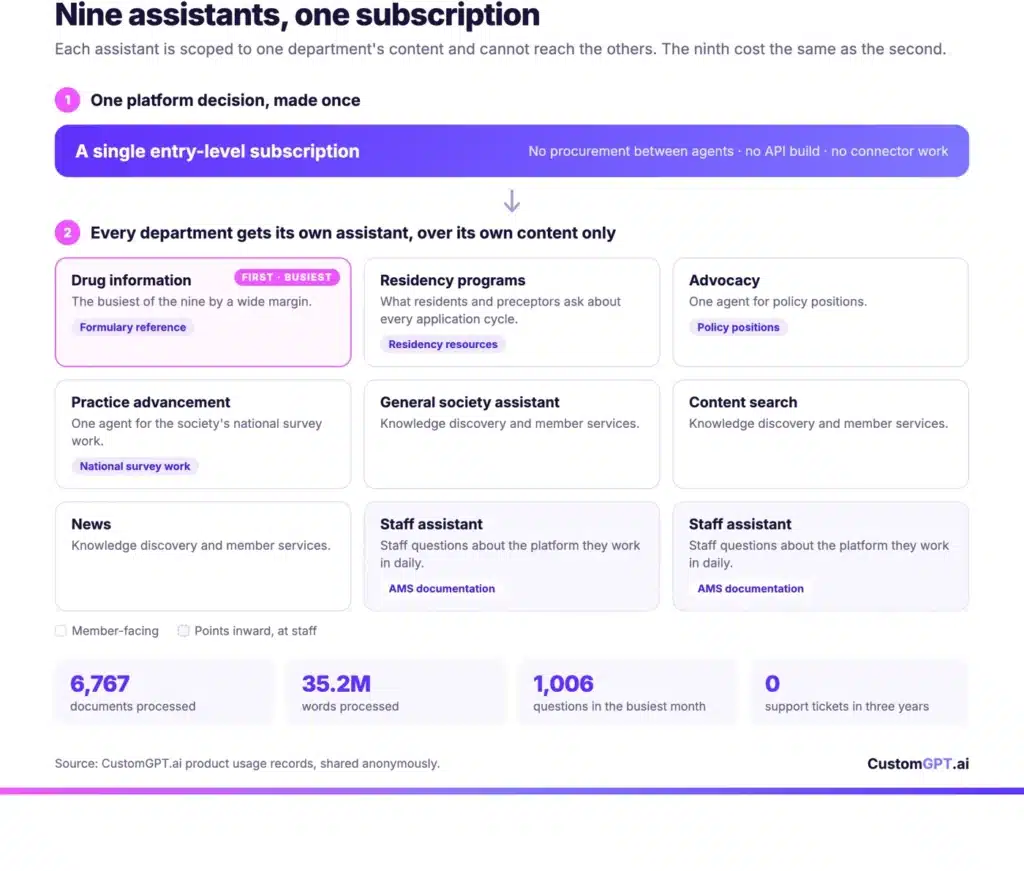
Drug information came first, over the society’s formulary reference, and it remains the busiest of the nine by a wide margin. Residency programs followed, with a dedicated agent for the resources residents and preceptors ask about every application cycle. Advocacy and practice advancement each got their own, one for policy positions and one for the society’s national survey work.
Then a general society assistant, a content search agent and a news agent for knowledge discovery and member services.
The last two are the interesting ones. They sit over the association management system’s own documentation, so staff can answer their own questions about the platform they work in daily instead of asking each other.
The capability that made it possible: the ninth agent cost the same as the second
What stops an organization putting an assistant in front of a second department is rarely the technology. The second one needs a business case, a budget line and somebody to own the procurement, and at that point the idea quietly dies.
Here, a department with a body of content and a recurring question can have an assistant over it, scoped to that content alone, without asking anyone for a new contract. No procurement between agents, no API build, no connector work, no engineering team standing behind any of it.
That is why there are nine and not one. The test of a platform is what the ninth agent costs, not the first.
The estate today
| MEASURE | TO DATE |
| Purpose-built assistants in production | 9 |
| Documents processed | 6,767 |
| Words processed | 35.2M |
| Questions in the busiest month | 1,006 |
| Support tickets raised | 0 |
The number that matters is nine. Most organizations that buy an assistant end up with one, because the second has to be argued for. This society has agents for drug information, residency programs, advocacy, practice advancement, news, member search and events, plus two pointed at internal staff, and none of them required a separate purchase.
Behind them sits real depth. The drug information assistant alone has carried the majority of every question asked across the estate, which is where the corpus weight sits.
Three years, nine agents, zero support tickets. Nobody at the society has had to call us about any of it. All nine run on a single entry-level subscription, which is the point: the platform decision was made once, and every department since has been a configuration rather than a purchase.
How the estate grew
It grew the way these things actually grow, which is one department at a time rather than as a program.
The busiest content went first. The next department saw it working and asked for its own, scoped to its own material rather than folded into the first agent. Depth followed volume, so the heaviest-used agent is where the corpus weight went.
Two of the nine were pointed inward, at staff rather than members. And the small ones got added anyway. An events agent and a news agent carry modest volume and cost nothing extra to run, which is as much the argument for the ninth as it was for the second.
The newest agent is also the most capable, using retrieval, web search and code execution together, built years after the first one and on the same subscription.
What this means for your association
Count the departments, not the use cases.
Narrow beats broad. One assistant over everything is the intuitive design and the wrong one. Scope each to a single body of content and each becomes accurate enough to trust.
Ask what the ninth one costs. Any vendor can stand up your first assistant. The question that decides your three-year outcome is what happens when a second department asks for one.
And there is one move here worth copying directly. Point one inward first. Two of these nine answer staff questions about the society’s own membership platform. Internal agents need no brand review and no legal sign-off, which makes them the fastest way to prove the idea works before anything faces a member.
Read the full case study: How a National Pharmacy Society Gave Nine Departments Their Own Assistant on One Subscription
Figures from CustomGPT.ai product usage records. Shared anonymously at the customer’s request.

Arooj Ejaz is the Marketing Operations Lead at CustomGPT.ai, where she works on content, growth operations, and go-to-market programs for AI agent and chatbot solutions.