

A national professional body for chartered accountants, with more than 40,000 members, put an accounting standards research AI tool on its public website, grounded entirely in its own published guidance, qualification and CPE material.
It answers 81.9% of questions from that corpus, roughly 85% of them arrive through live chat, and questions asked are up 50% year on year. The body is now in its third consecutive term. It shared the deployment with us anonymously.
The answer was published. It was filed in the body’s vocabulary.
A student halfway through the qualification is working out which pathway now applies to her. A practicing member is checking what this CPE cycle requires of him, and whether the course he just booked counts. An employer is verifying a credential before an offer goes out.
None of the three knows the term the body files that answer under. A national body publishes for the record, so its material is organized the way a regulator organizes things rather than the way a member searches. The answer is published, it is correct, and it still generates an email to the team.
That gap between publication and retrieval is what most professional bodies are actually paying for when they staff a member services inbox.
Member and public self-service from a single corpus
The assistant sits in live chat on the open site, with no login between a member of the public and a published answer. Members, students, employers and the general public are all answered from the same published material.
That was a deliberate requirement rather than a convenience. Four audiences arrive at the same website, and building four destinations would have meant four things to maintain and four places for the answer to drift. One corpus, one voice, four audiences.
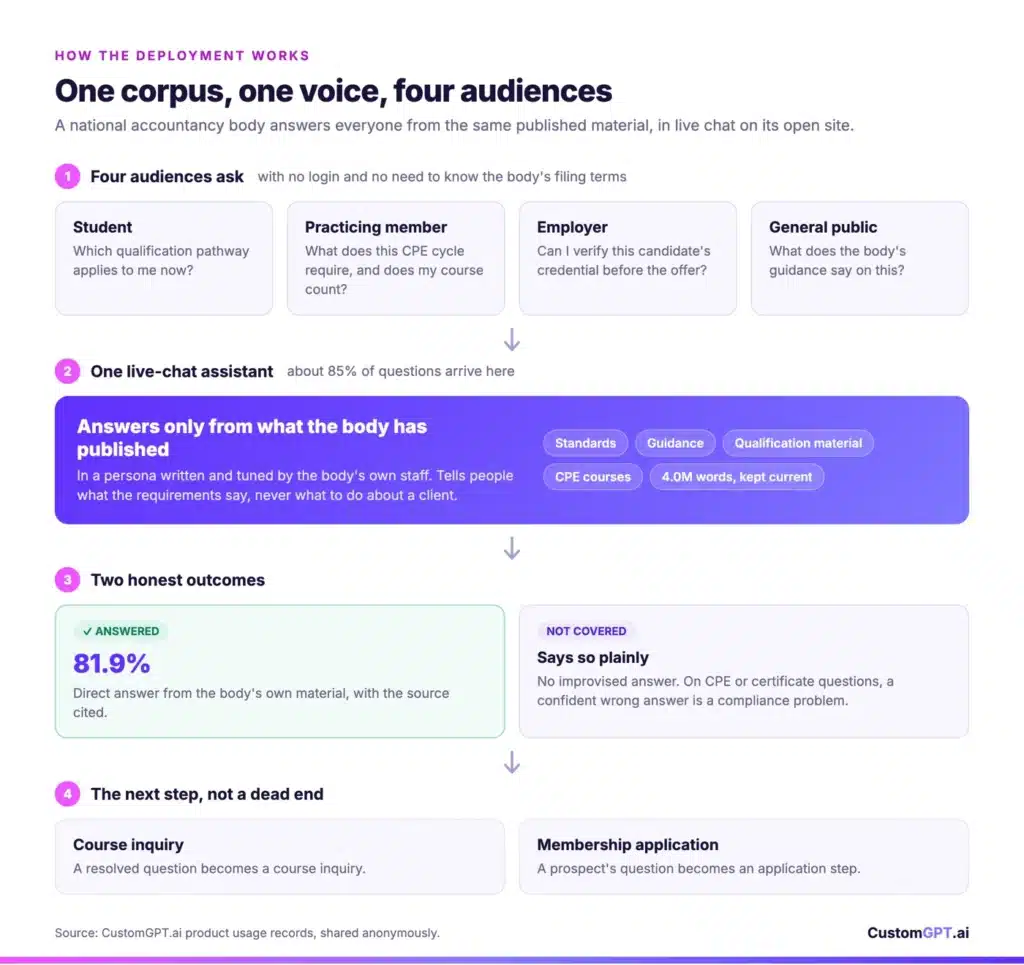
The other half of that decision is what the assistant does after it answers. Most questions arriving on a professional body’s site are one step from a course booking or a membership application, so a resolved question can become a course inquiry or an application step rather than simply ending the exchange.
Professional ethics, accuracy and the advice boundary
The evaluation was run out of IT rather than marketing, with the digital experience team alongside it. That shaped the criteria, because the people judging the assistant were the ones who would carry the consequences of a wrong answer.
The first requirement was grounding. The assistant answers only from what the body has published, and says it does not know rather than improvising. When a question touches CPE obligations or eligibility for a practicing certificate, a confident wrong answer becomes a compliance problem with the member’s name on it.
The second is the line every professional body has to hold. A body can tell you what its requirements say. It cannot tell you what to do about your client. Restricting retrieval to the body’s own published material keeps the assistant on the correct side of that line by construction, rather than by hoping a general model stays there.
The corpus does not sit still either. Standards get revised and courses are re-listed each term, so four million words have to stay indexed and current for the assistant to answer from today’s guidance rather than last term’s.
The capability that decided it: a voice the institution controls
A national body’s authority is partly a matter of language. The register took decades to establish, and handing it to a vendor template means the assistant stops sounding like the institution within a sentence.
So the persona is written inside the product by the body’s own staff, and it has been revised dozens of times since launch. The instructions it carries are the body’s own: lead with the direct answer, cite the source, say plainly when the published material does not cover the question. When the tone needs to change, it changes that afternoon, with no engineering ticket and no vendor in the loop.
The related requirement was that the whole thing had to run without a project team. No integration program, no standing internal headcount, no rebuild at renewal. A small IT function had to own it, revise it and keep it current alongside everything else on its list.
Three years in, and busier than it has ever been
| Measure | To Date |
| Year-on-year growth in questions asked, matched periods | +50% |
| Current weekly volume against its own six-month baseline | +24% |
| Questions answered to date | 7,351 |
| Answer rate | 81.9% |
| Arriving through live chat | 85% |
Set the most recent run of months against the same months a year earlier and questions asked are up 50%, with current weekly volume a quarter above the six-month average.
Most deployments peak in their first weeks and then decay. This one has done the opposite, and nobody campaigned for it. At its busiest stretch a question arrived every day for twelve consecutive weeks.
Behind that sits the number that makes it possible. Four questions in five are answered outright from the body’s own material. Traffic only compounds when the answers hold up.
What a third term actually represents
Two terms are complete and a third is in motion. That is a service the organization now runs on, rather than a renewal argued from a fresh business case each time.
The foundation took the time, and it is done: a live corpus, a voice the body controls, and an audience that has learned to ask. A small IT function owns it outright, with no relaunch, no migration and no second procurement. Which is why there is a third term rather than a fresh evaluation.
What this means for your professional body
Your answer is already published. It just is not findable by anyone who does not already know your filing system.
Grounding is the product. In a regulated profession, answering only from your own published material is what earns permission to deploy at all, and it costs far less answer coverage than most teams expect before they try it.
Placement decides the rest. The best-grounded assistant does nothing behind a link in the footer. Eight in ten questions here arrive through live chat on the open site, in the moment somebody is already stuck.
There is one question worth putting to any vendor you are evaluating. Launch numbers are easy to produce. Ask whether their customers’ volume in year three is above or below where it started.
The student, the member and the employer no longer need the body’s vocabulary to reach the body’s answer.
Read the full case study: How a National Accountancy Body Grew Its Assistant 50% Year on Year
Figures from CustomGPT.ai product usage records. Shared anonymously at the customer’s request.

Arooj Ejaz is the Marketing Operations Lead at CustomGPT.ai, where she works on content, growth operations, and go-to-market programs for AI agent and chatbot solutions.