

A voluntary state bar association of roughly 15,000 lawyers built a comprehensive legal research AI tool over content it already owned: CLE recordings, business-law forms, practice guidance and section newsletters. In its first eight weeks it answered 1,940 member questions, 92.4% of them from association material, with at least one question on every one of the 54 days it had been live. The association shared the deployment with us anonymously.
The library was already built. Nobody could reach it.
A solo practitioner has a client on hold and is hunting the business-law form that lets her close today. A litigator mid-matter wants to check whether opposing counsel is right about which county governs. A member three weeks into their first year does not yet know the association already owns the answer.
All three are after material the association spent years building. None of it needed to be created or bought. It needed to become reachable, and it sat across six content systems that had nothing to do with one another, each with its own search box, none of which searched the others.
That is the shape of the problem at most membership organizations. The archive is the asset, and the search box is what stands between the asset and the renewal.
Comprehensive legal research, restricted to the association’s own content
The evaluation was led by the association’s practice-management director and its director of continuing legal education, with IT and marketing in the room from the start. The criteria were unusually precise, because the person signing off was a practicing business attorney who reads contracts for a living.
Five requirements came out of that room, and the first one shaped everything else: the assistant answers only from the association’s uploaded corpus, and says it does not know rather than improvising. For an audience of lawyers, a confident wrong answer is worse than no answer, so the refusal behavior had to be as reliable as the answers themselves.
The second requirement was harder. Section materials and CLE recordings are paid products, and most tools handle paid content by excluding it. That leaves the assistant weakest in exactly the place the association’s content is strongest. What the association wanted instead was an assistant that could answer from gated material at a level it controlled, then send the member to the page that sells access.
Confidentiality and member-only access
A bar association carries a confidentiality obligation that a publisher does not, and the documentation had to survive review by a risk-averse lawyer.
Nothing uploaded could be used to train a third-party model. No member question or uploaded document could reach a public generative AI service. Access runs through single sign-on at the association’s own identity provider, with membership status deciding who gets in, and the assistant is embedded inside the paywall and signed with JWT so there is no link that skips the gate. Staff and administrators carry different rights through the association’s own directory, and none of those users exists in our system at all. The deployment was validated against SOC 2 by the association’s own auditor.
Three problems that had to be solved before anything could launch
The most valuable material sat behind a member login that no crawler could reach, so an authenticated one was built. The CLE platform had no usable export, so engineering wrote a dedicated connector for it. The video library had no transcripts, so a custom pipeline transcribed and ingested the recordings, including sessions too long to process any other way.
None of that is glamorous, and all of it is the job. Every content estate breaks a platform somewhere. The question worth asking a vendor is whether their engineers will build what your estate turns out to need, or whether the unreachable material simply gets scoped out.
The capability that decided it: citations that respect the paywall
The association wanted its members to get real answers from material it sells. We built a viewer that opens the page an answer came from, highlights the passage, and blurs the rest. The citation leads to the page selling access, which turns search into an upsell rather than a leak.
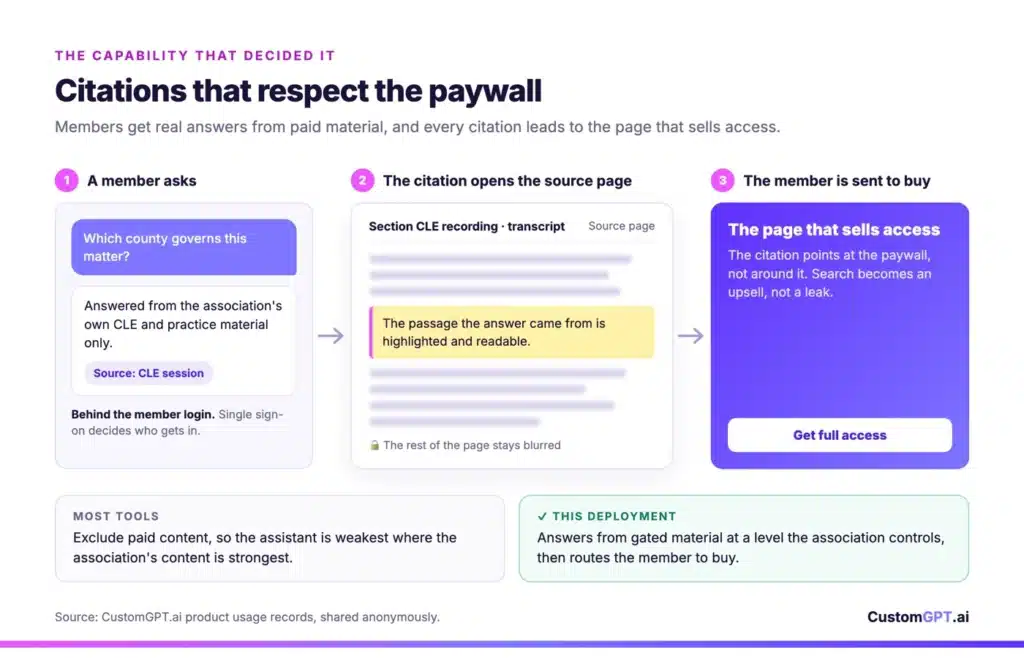
Seventy-two business-law forms were run in front of the executive sponsor before launch. Watching the citations point at the paywall instead of around it was the moment the business case made itself. That viewer is now standard for every enterprise customer.
What the first eight weeks look like
| Measure | First Eight Weeks |
| Member questions answered | 1,940 |
| Peak questions in a single week | 525 |
| Answer rate | 92.4% |
| Arriving through the site widget | 91% |
| Days with member activity | 54 of 54 |
Nine times in ten, the association already had the answer on file. Nine in ten of those questions arrive through the widget embedded in the association’s own site, so the answer meets the member on the page they were already on.
The streak is what makes the rest credible. There has not been a single day since launch without a member question, through weekends, holidays and the quietest weeks of late summer, with no reminder campaign behind it.
One use case the association never planned for showed up in the first few weeks. As its director of continuing legal education put it: “We had one user last week that actually uploaded a pleading, and used the tool to dispute opposing counsel’s view on which county a minor resided in.”
Members invented that themselves. The assistant had stopped being a search box and become something a lawyer reaches for mid-matter.
One contract, as many assistants as the work needs
Nine agents run in production today: a member assistant, a research agent, a CLE agent, an events agent, a referral agent and internal staff tools. Every one of them was added on the same subscription, with no new line item and no fresh negotiation. Smart routing, a document analyst and a public referral agent are next, and the association has already renewed.
What this means for your association
Your next member benefit is probably already written. The material exists, it is approved, and it is sitting behind a search box that was never designed to answer questions.
Two things decide whether surfacing it works. Grounding earns the permission to deploy at all, because an association that cannot guarantee its assistant stays inside its own corpus will not get past its own risk review. And if your library is also your revenue, the citation has to route the member toward the page that sells access rather than around it. That distinction is the whole decision.
The solo practitioner, the litigator and the three-week member no longer need to know which of six systems holds their answer. They ask once, and the association answers in its own words, with the source attached.
Read the full case study: How a State Bar Association Reached a 92.4% Answer Rate and a Member Question Every Day Since Launch
Figures from CustomGPT.ai product usage records. Shared anonymously at the customer’s request.

Arooj Ejaz is the Marketing Operations Lead at CustomGPT.ai, where she works on content, growth operations, and go-to-market programs for AI agent and chatbot solutions.