
How Professional Associations Can Make Standards, Reports, and Training Searchable With AI
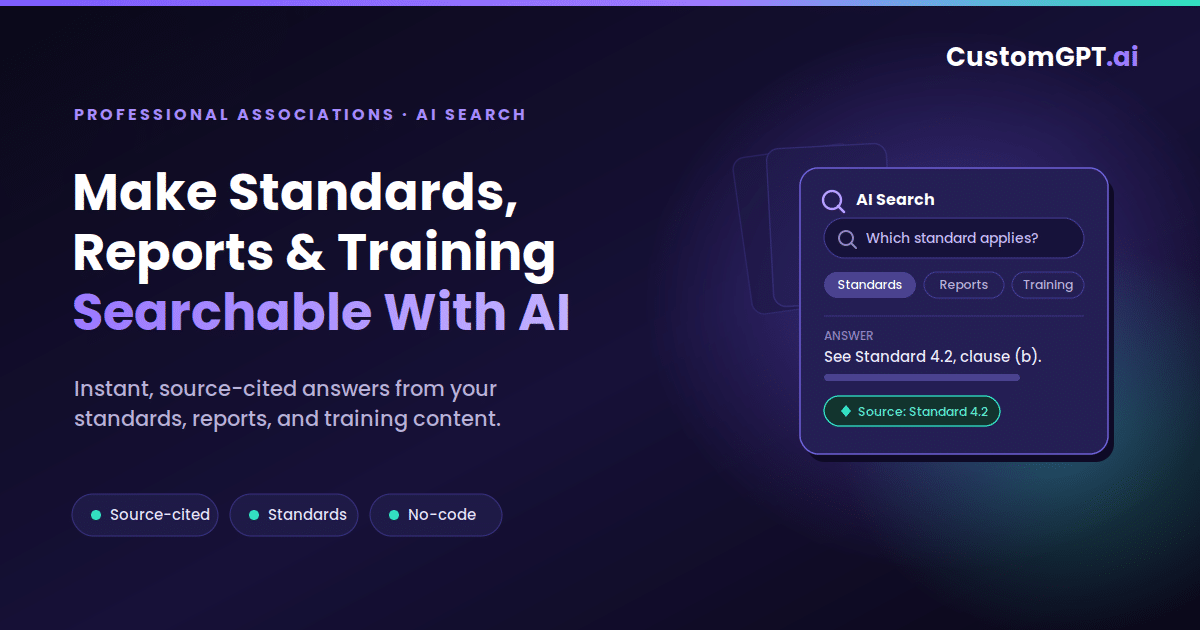
Professional associations can make standards, reports, research, training, certification, and continuing education content searchable with AI by connecting approved association resources to a secure, source-cited AI assistant. Members and staff can then ask natural-language questions and receive direct answers from trusted organizational content instead of searching manually through PDFs, portals, archives, and knowledge bases.
This is what AI search for professional associations delivers, and it matters because the value of an association’s knowledge depends on whether members can use it. When standards, research, and training become instantly answerable, members get more from their membership, certification and continuing education support improves, standards get adopted more consistently, staff spend less time on repeat questions, and engagement and retention rise. The knowledge you already produced starts working harder without anyone creating anything new.
Direct Answer: What Is AI Search for Professional Associations?
AI search for professional associations is a secure, content-grounded search and chat experience that lets members and staff ask questions across approved association content and receive direct, source-cited answers from standards, reports, research, training materials, certification resources, event content, and knowledge base articles.
It differs from normal keyword search in a fundamental way. Keyword search matches words and returns a list of documents to open and read. AI search understands the question, retrieves the relevant passages from your approved content, and returns the answer itself with the source cited. Members stop hunting through results and start getting answers they can verify.
Why Professional Association Content Is Hard to Search
Most associations do not have a content problem. They have a findability problem. The knowledge exists, but it is hard to reach at the moment a member needs it.
The friction shows up in familiar ways. Standards are often long, technical, and hard to interpret, so members struggle to locate the specific clause that applies. Reports and research are spread across years of publications, making it difficult to know what has already been published. Training and certification content lives in different systems, and continuing education material may be locked inside an LMS or scattered across PDFs. Event recordings and transcripts are rarely used again after the event ends.
On top of that, members often do not know which document contains the answer, so they either give up or email staff. Staff then repeatedly answer questions that are already addressed in published content. New members struggle to understand where to start. Traditional search returns links rather than answers, and proprietary knowledge loses much of its value when members cannot easily access it. Association leaders, including through ASAE’s association management resources, consistently tie member value and retention to how easily members can reach that value.
Table 1: Professional Association Content That AI Can Make Searchable
| Content Type | Example | Member Question It Can Answer |
|---|---|---|
| Standards and guidelines | Published technical or professional standards | Which clause applies to my situation? |
| Technical manuals | Implementation and reference manuals | How do I apply this requirement in practice? |
| Industry reports | Annual state-of-the-industry report | What did this year’s report conclude? |
| Research papers | Peer-reviewed or commissioned studies | Has the association published research on this topic? |
| Policy updates | Bylaw changes and regulatory bulletins | What changed in the latest policy update? |
| Certification handbooks | Eligibility and exam requirement guides | What do I need to qualify for certification? |
| Continuing education materials | CE course catalogs and requirements | How many CE credits do I need this cycle? |
| Training modules | Self-paced or instructor-led training content | Which training covers this competency? |
| Event recordings and transcripts | Conference sessions and webinars | What did the keynote say about this trend? |
| Member FAQs | Common membership and benefits questions | What is included in my membership tier? |
| Toolkits and templates | Practitioner toolkits and document templates | Is there a template I can use for this task? |
| Research archives | Historical studies, journals, and proceedings | What has been written about this over the years? |
How AI Search Works for Standards, Reports, and Training
- Upload or connect approved content, including standards, reports, training materials, certification handbooks, and knowledge base articles.
- Organize knowledge by topic, audience, certification, or access level so answers come from the right material for each group.
- Members ask questions in natural language instead of guessing at keywords.
- The AI retrieves relevant passages from your approved content.
- The AI generates a direct answer grounded in what those passages say.
- The answer includes citations to the source material so it can be verified.
- The assistant declines or says “I don’t know” when the content does not support an answer.
- Staff review analytics to improve content and identify gaps over time.
This grounding is powered by retrieval-augmented generation, which retrieves passages from your documents and uses them to compose the answer. Our complete guide to retrieval-augmented generation explains how it works, and IBM’s overview of retrieval-augmented generation describes the same retrieve-then-generate pattern. The important point is that RAG keeps answers grounded in approved association content rather than generic AI training data.
Benefits of AI Search for Professional Associations
1. Members Find Standards and Guidance Faster
AI search helps members find the right standard, clause, guideline, or policy answer without reading an entire document. Instead of scanning a 200-page standard, a member asks a specific question and gets the applicable passage with a citation, which is especially valuable when accuracy carries professional weight.
2. Reports and Research Become Easier to Use
Years of reports and research become answerable when members can ask a question rather than knowing a title or publication date. This turns a deep but underused library into a resource members actually draw on.
3. Training and Certification Support Improves
AI search can answer questions about certification requirements, continuing education, training paths, study resources, and professional development content. Candidates get consistent, sourced answers throughout their journey, which reduces confusion during high-stakes periods.
4. Staff Spend Less Time Answering Repetitive Questions
When members self-serve accurate answers, the volume of routine questions reaching staff drops. This applies the logic of ticket deflection to association support, so the team spends less time repeating published information and more time on complex member needs.
5. New Members Onboard Faster
AI search helps new members understand benefits, resources, standards, and learning paths on demand. New members do not have to know where to look or wait for staff, which shortens time to value and supports first-year retention.
6. Content ROI Increases
Existing standards, reports, and training materials become more valuable when members can actually find and apply them. The investment you already made in creating content pays off every time a member gets an answer from it.
7. Member Engagement and Retention Improve
Easier access to high-value content raises the perceived value of membership. When members can reliably get what they need, they use more of it, and usage is one of the clearest signals of renewal intent.
8. Answers Stay Grounded in Approved Sources
Because answers come only from approved content and cite their sources, members can trust them. For standards, certification, compliance, and professional guidance, source grounding is not optional. It is what makes the tool safe to put in front of members and practitioners.
State bar associations face the same problem with CLE content specifically, see how one bar association made its CLE library and practice manual searchable for members.
9. Associations Get Better Insight Into Member Needs
Analytics reveal what members ask, which resources are hard to find, and where content gaps exist. These signals help teams prioritize new content, improve onboarding, and update materials that generate the most questions.
Table 2: Traditional Association Search vs AI Search for Professional Associations
| Search Experience | Traditional Portal Search | AI Search for Professional Associations |
|---|---|---|
| Search method | Keyword matching | Natural-language questions |
| Output | A list of links to open | A direct answer with the source cited |
| Member effort | High, member reads and interprets | Low, the assistant retrieves and summarizes |
| Standards lookup | Scan long documents manually | The applicable clause is surfaced and cited |
| Report discovery | Requires knowing titles or dates | Findings surface from the full library |
| Training support | Members search across systems | Answers drawn from approved training content |
| Source trust | Depends on finding the right file | Every answer names its approved source |
| Staff workload | Frequent repeat questions | Routine questions resolved automatically |
| Content gap insights | Little visibility | Analytics reveal gaps and demand |
| Member experience | Slower and inconsistent | Fast, consistent, and verifiable |
Best Use Cases for AI Search in Professional Associations
Standards and guideline lookup. Members find the applicable standard or clause with the source cited, without reading the whole document.
Certification requirement Q&A. Candidates get consistent answers on eligibility, exams, and requirements from official handbooks.
Continuing education support. Members confirm CE credit requirements, deadlines, and approved courses on demand.
Training resource discovery. Members locate the right training for a competency without searching multiple systems.
Report and research search. Members surface findings from reports and studies by asking a question. An expert AI assistant trained on your research library is well suited to this.
Policy and regulatory update lookup. Members find what changed in the latest policy or bulletin and see the source.
Event transcript and webinar search. Members query conference and webinar content long after the event, extending its value.
Member onboarding assistant. New members get guided answers about benefits, resources, and where to start.
Staff knowledge assistant. Staff query internal guides and playbooks to answer members faster and more consistently.
Member self-service support. Members resolve common questions instantly. An AI knowledge base chatbot turns your help content into direct answers.
Chapter or regional content search. Chapters get answers grounded in national standards while respecting regional differences.
Toolkits and template discovery. Members find the right toolkit or template for a task by asking rather than browsing.
Historical archive search. Members search journals, proceedings, and back issues by question rather than by title.
Professional development path guidance. Members get help mapping training, certification, and CE into a development path. These use cases apply across professional bodies, institutes, and standards organizations, as described on the AI for associations and AI for membership organizations pages.
Table 3: AI Search Use Cases by Association Team
| Team | Content They Manage | AI Search Value |
|---|---|---|
| Standards team | Standards, guidelines, technical manuals | Members find the right clause with a citation |
| Certification team | Certification handbooks and exam rules | Consistent answers on requirements and eligibility |
| Continuing education team | CE catalogs and credit requirements | Members confirm credits and approved courses |
| Research team | Reports, studies, and data | Findings surface from years of research |
| Policy team | Bylaws, policies, and bulletins | Members see what changed and why it matters |
| Events team | Session recordings and transcripts | Event content stays searchable after the date |
| Membership team | Benefits, renewals, and FAQs | Routine questions resolved instantly |
| Member experience team | Onboarding and resource guides | Faster time to value and higher engagement |
| Support team | Help articles and how-to content | Repetitive tickets resolved automatically |
| Chapters team | National and regional guidance | Consistent answers across a distributed body |
| IT and security team | Access, security, and governance | Documented controls and SOC 2 Type 2 for review |
| Leadership | Strategy and member insight | Analytics on what members ask and need |
Real-World Proof: How CustomGPT.ai Helps Knowledge-Heavy Organizations Make Content Searchable
Professional associations need more than generic AI. They need secure, source-grounded AI that can answer from trusted organizational content. These CustomGPT.ai examples show how knowledge-heavy organizations make large content libraries easier to search, use, and trust.
| Organization | Knowledge Challenge | CustomGPT.ai Result |
|---|---|---|
| GEMA | High-volume member and stakeholder knowledge access | 248,000+ queries, 6,000+ hours saved, 88% success rate, €182K–€211K estimated cost avoidance |
| VdW Bayern DigiSol | Regulated and compliance-heavy guidance | Secure, source-grounded AI for trusted knowledge access |
| MIT ChatMTC | Always-on multilingual education and training access | 90+ languages, 24/7 access, no-code deployment |
| Lehigh University / The Brown and White | Large historical archive search | Decades of archived content made searchable for students, writers, and faculty |
| BQE Software | High-volume help center knowledge automation | 180,000+ questions, 86% AI resolution, 64% AI-automated help center interactions |
GEMA: High-Volume Knowledge Access for Members and Stakeholders
GEMA used CustomGPT.ai to handle large-scale knowledge access and support, resolving more than 248,000 queries, saving over 6,000 working hours, achieving an 88% success rate, and generating an estimated €182K to €211K in cost avoidance. This maps directly to associations with large member bases, recurring questions, and valuable proprietary knowledge that members struggle to navigate.
VdW Bayern DigiSol: Trusted AI for Regulated and Compliance-Heavy Knowledge
VdW Bayern’s DigiSol shows why secure, source-grounded AI matters when answers involve rules, policy, standards, or regulated guidance. Operating in the strictly governed housing sector, it needed answers traceable to approved sources rather than plausible guesses. That requirement applies squarely to professional associations, certification bodies, standards organizations, and institutes.
MIT ChatMTC: 24/7 Multilingual Access to Training and Knowledge
MIT’s ChatMTC provides a strong example for professional education and training access, with support for more than 90 languages, 24/7 availability, and no-code deployment. For associations serving global members or multilingual professional communities, it shows how training and knowledge can be reachable anytime, anywhere.
Lehigh University / The Brown and White: Making Archives and Research Searchable
Lehigh University’s The Brown and White made decades of archived material searchable for students, writers, and faculty. For associations with journals, reports, newsletters, conference proceedings, and historical research libraries, it demonstrates how deep archives can become useful again.
BQE Software: Knowledge Base Automation at Scale
BQE Software used CustomGPT.ai to answer more than 180,000 questions, reach an 86% AI resolution rate, and automate 64% of its help center interactions. For associations, this shows how repetitive member questions about standards, certification, training, and member resources can be resolved automatically at scale.
What to Look For in AI Search for Professional Associations
When evaluating platforms, check for each of the following:
- Source-cited answers so members and staff can verify every response.
- Grounding in approved association content rather than the open web.
- Support for standards, PDFs, reports, training, and knowledge bases, since association content is multi-format.
- Secure handling of member-only content to protect proprietary material.
- Access control planning so public, member, and staff content stay separate.
- No-code setup so association teams can manage it without engineering.
- Website, member portal, or knowledge base deployment so it lives where members search.
- Analytics for member questions and content gaps to guide improvement.
- Honest fallback behavior so the assistant declines when content lacks an answer.
- Easy knowledge updates so answers stay current as standards and policies change.
- Enterprise security, documented on the CustomGPT.ai security and trust page.
- SOC 2 Type 2 certification for procurement and security review, which CustomGPT.ai holds and documents on its SOC 2 Type 2 certification page.
- Case study proof from knowledge-heavy organizations.
Frameworks such as the NIST AI Risk Management Framework and resources from EDUCAUSE on digital transformation and knowledge access are useful references for the governance and adoption side of this decision.
Table 4: AI Search Platform Evaluation Checklist for Professional Associations
| Requirement | Why It Matters for Professional Associations |
|---|---|
| Source citations | Members can verify answers about standards and certification |
| Content grounding | Answers reflect approved content, not the open web |
| Standards support | Long, technical documents become answerable by clause |
| PDF and report support | Handles the document-heavy libraries associations hold |
| Training content support | Certification and CE materials become searchable |
| Access control | Keeps public, member, and staff content separate |
| Security | Protects member-only and proprietary material |
| SOC 2 Type 2 | Clears procurement and security review faster |
| No-code setup | Association teams manage it without engineering |
| Portal deployment | Meets members where they already search |
| Analytics | Reveals member questions and content gaps |
| Fallback behavior | Declines gracefully when content lacks an answer |
Common Mistakes to Avoid
- Using generic AI for standards or certification answers, which invents details your members may act on.
- Letting AI answer from the open web instead of approved content, which leads to inaccurate or outdated guidance.
- Not requiring source citations, so answers cannot be verified.
- Uploading outdated or conflicting standards, which produces confidently wrong answers.
- Ignoring access control, which risks exposing member-only content.
- Launching without real member questions, which hides the queries members actually ask.
- Trying to cover every department on day one, which stalls the rollout.
- Treating AI search as a replacement for content strategy, when it surfaces content rather than creating it.
- Not reviewing analytics, which wastes the insight the assistant generates.
- Not defining fallback rules, so the assistant guesses instead of declining.
- Mixing public and member-only content without governance, which creates exposure and confusion.
How to Launch AI Search for Professional Association Content
- Identify the highest-value content category first, such as standards, certification, or continuing education.
- Collect the top member questions about that content from support channels.
- Audit standards, reports, training, and certification materials you would connect.
- Remove outdated or conflicting documents so answers are reliable.
- Organize content by topic, audience, certification, or access level.
- Upload or connect content to CustomGPT.ai without engineering effort.
- Configure source citations and fallback behavior so answers are verifiable and honest.
- Test with real member and staff questions rather than idealized examples.
- Deploy in the member portal, website, LMS, or knowledge base where members search.
- Review analytics monthly to close content gaps and refine coverage.
- Expand to additional content areas once the first use case works well.
Why CustomGPT.ai Is a Strong Fit for AI Search for Professional Associations
CustomGPT.ai helps professional associations create secure, no-code, source-cited AI search assistants trained on approved association content. Teams can make standards, reports, research, training materials, certification resources, and member-only knowledge searchable without building a custom AI system from scratch.
Specifically, CustomGPT.ai offers no-code AI assistant creation, source-cited answers, grounding in approved association content, support for gated and proprietary content, both AI knowledge base chatbot and expert AI assistant use cases, and deployment across your website, knowledge base, and member portal. It is backed by enterprise security and SOC 2 Type 2 certification, and by proven knowledge-access results from GEMA, VdW Bayern DigiSol, MIT ChatMTC, Lehigh University, and BQE Software.
To evaluate the fit for your organization, review the AI for membership organizations page, the AI for associations resources, the expert AI assistant solution, and the AI knowledge base chatbots page. Check the security and trust and SOC 2 Type 2 certification documentation, see proof in the GEMA, VdW Bayern DigiSol, MIT ChatMTC, Lehigh University, and BQE Software customer stories, browse more on the customer stories page, or start on the CustomGPT.ai platform.
FAQ
What is AI search for professional associations?
AI search for professional associations is a secure, content-grounded search and chat experience that answers questions from approved association content such as standards, reports, research, training, certification resources, and knowledge base articles. Members and staff ask in natural language and receive direct, source-cited answers.
Unlike keyword search, it returns the answer rather than a list of links, and unlike a public AI model, it answers only from your approved content. That combination makes it accurate enough to trust for standards, certification, and professional guidance.
How can AI make standards searchable for professional associations?
AI makes standards searchable by letting members ask a question and receive the applicable clause or guidance with the source cited, instead of reading an entire document. The assistant retrieves the relevant passage from your approved standards and composes a direct answer.
This is valuable because standards are long and technical, and members often need one specific requirement. Because the answer names its source, members can open the standard at the exact place to confirm the detail.
Can AI help members find reports and research?
Yes. AI helps members find reports and research by answering questions across years of publications without requiring members to know a title or date. The assistant surfaces relevant findings from your research library and cites the source.
This turns a deep but underused archive into a resource members actually draw on, which increases the return on the research your association has already funded and published.
Can AI search training and certification content?
Yes. AI can search training and certification content by answering questions about requirements, credits, study materials, and professional development directly from your official resources. Candidates get consistent, sourced answers throughout their journey.
Because answers are grounded and cited, candidates can trust and verify them, which is important when the guidance affects credentials, renewals, or continuing education compliance.
How is AI search different from a member portal search bar?
AI search is different from a portal search bar because it returns a direct answer with a citation, while a search bar returns a list of links for the member to open and read. AI search understands the question and retrieves the relevant passage rather than matching keywords.
The two can work together. Search is useful for browsing, while AI search is better when a member has a specific question and wants an answer. Adding AI search does not require removing the existing search bar.
Should AI answers cite sources from association content?
Yes. AI answers should always cite sources from association content so members and staff can verify them. For standards, certification, and compliance-heavy guidance, traceability to an approved source is often a requirement rather than a preference.
Citations also make it clear when an answer is grounded in your content versus invented, which is the core safety property for any member-facing or practitioner-facing tool.
Can AI search member-only or gated association content?
Yes. AI search can cover member-only and gated content when the organization connects approved private resources to a secure platform and sets access rules. The assistant answers from that material while keeping it protected.
Because the content stays in a secure environment and the assistant only answers from what you approve, member-only reports, standards, and training can power the experience without being exposed publicly.
Is AI search safe for standards and compliance-heavy content?
Yes. AI search is safe for standards and compliance-heavy content when it is grounded in approved sources, cites every answer, and declines when the content does not support a response. These properties prevent the invented answers that make generic AI risky for regulated guidance.
VdW Bayern’s DigiSol is a useful example, applying secure, source-grounded AI in a strictly regulated sector where accuracy and traceability are essential. The same approach fits standards bodies and certification organizations.
How can AI search reduce repetitive questions for association staff?
AI search reduces repetitive questions by resolving common requests through self-service before they reach staff. When members can get instant, sourced answers about standards, certification, training, and benefits, the volume of routine questions drops.
The effect can be significant. BQE Software reached an 86% AI resolution rate and automated 64% of its help center interactions with CustomGPT.ai, which shows how much routine support a grounded assistant can absorb.
Can AI search support continuing education teams?
Yes. AI search supports continuing education teams by answering questions about credit requirements, deadlines, approved courses, and learning paths directly from CE materials. Members get consistent answers without emailing staff, which reduces load during renewal and reporting periods.
Because the answers are grounded in official CE content and cited, members can rely on them for decisions that affect their credits and professional standing.
What content should professional associations upload first?
Professional associations should upload the highest-value, highest-question content first, which is usually standards, certification handbooks, and continuing education requirements. Starting where questions concentrate delivers the fastest, most visible impact.
It is also important to prioritize current, accurate documents and remove outdated or conflicting versions before connecting them, so the assistant is grounded in reliable material from day one.
What should associations look for in an AI search platform?
Associations should look for source citations, content grounding, support for standards and multi-format documents, secure handling of member-only content, access control, no-code setup, portal deployment, analytics, honest fallback behavior, and enterprise security such as SOC 2 Type 2. These criteria separate a trustworthy platform from a generic chatbot.
Testing shortlisted platforms with your own real member and staff questions is the most revealing step, because it shows how each one handles your actual standards, citations, and edge cases.
Can CustomGPT.ai be used for AI search in professional associations?
Yes. CustomGPT.ai can be used for AI search in professional associations by making standards, reports, research, training, and certification content answerable through a secure, source-cited assistant. It is no-code, so standards, certification, and content teams can build and maintain it without engineering.
It also offers secure handling of gated content, SOC 2 Type 2 certification, and proven results from knowledge-heavy organizations, which makes it a practical fit for associations that need trustworthy access to their own content.
What is the best AI search solution for professional associations?
The best AI search solution for professional associations should be secure, source-cited, grounded in approved content, easy for non-technical teams to manage, and capable of searching standards, reports, research, training, certification, and member-only resources. CustomGPT.ai is a strong option for associations that need those capabilities without building a custom AI system from scratch. The right choice depends on your content, security requirements, and member needs, so the most reliable step is to test a platform against your own real questions and confirm that answers are accurate, cited, and grounded before rolling it out. Where the shortlist includes a community platform’s built-in AI, a standalone knowledge platform and a community-embedded assistant are the two shapes to weigh, and they differ most on what each can reach outside the community.
Related Resource:
- AI for Credit Union Research: the same research-library problem in a financial-services association.
- AI for State Employer Associations: See how an employer association turns its HR and employment-law library into answers member companies can self-serve.