
CustomGPT.ai for Competitor Research: How to Enhance Your Business Insights with AI

Staying ahead of your competitors is challenging. However, now with Large Language Models (LLM), GPT, and CustomGPT.ai, we can automate and simplify this process dramatically. In this article, we’ll show you how to effectively use CustomGPT.ai for competitor research, making what was once a complex task much easier.
We will explain some practical examples of using CustomGPT.ai for competitor research through website and social media monitoring.
Let’s first understand what competitive research is and how CustomGPT.ai supports competitive analysis, then we will explore the whole process of using CustomGPT.ai for competitor research. Let’s get started!
Understand the Competitor Research/Analysis
Competitor Research is the process of looking at your competitors to figure out their plans and market strategies. It’s not just about where you stand, it’s about understanding what others in your industry are doing. Why does this matter? Well, it’s not just about knowing your position but also being aware of who else is walking the same path. Through competitor research, you can adjust your business plans and strategy accordingly.
CustomGPT.ai

CustomGPT AI assistant is a one-size-fits-all solution, It is tailored to meet the specific needs of your business. CustomGPT.ai has a user’s user-friendly design, You can create and customize a custom chatbot according to your specific business need, and product sales within just a few minutes. It supports 1400+ different file formats and a website sitemap for chatbot training. It shows that CustomGPT.ai can handle large amounts of data.
Its advanced anti-hallucination technology makes sure that users can get accurate and reliable responses and build their trust. It is suitable for businesses of all sizes.
How to use CustomGPT.ai for Competitor Research?
Let’s see how you can use CustomGPT.ai for competitor research by following five easy steps:
Step 1: Define Your Objectives
First, define your objectives for competitor research. Now make an outline for what insights are you looking for, whether it is about the marketing strategies of your rivals, their product and features, or other aspects. By defining objectives and goals you can be more focused on research by having a detailed plan.
Step 2: Gather Data
After outlining the plan, the second step is to gather data. This step is crucial for making the foundation of competitor research by data collection. For data collection gather information from a competitor’s website, their products, offerings, features, blog posts, pricing packages, and customer reviews. These data sets help you gain valuable insights into your competitors’ business.
A great starting place is:
- Your competitor’s homepage
- Your competitor’s product documentation
- Your competitor’s marketing material (PDFs, PowerPoints, Word Documents, etc)
- Your competitors social media data
Also, to support comparisons between your company and your competition, consider also adding in:
- Your company’s homepage
- Your company’s product documentation
- Your company’s marketing materials
- Your company’s internal content (sales, marketing, positioning, etc)
Step 3: Feed the Data to CustomGPT.ai
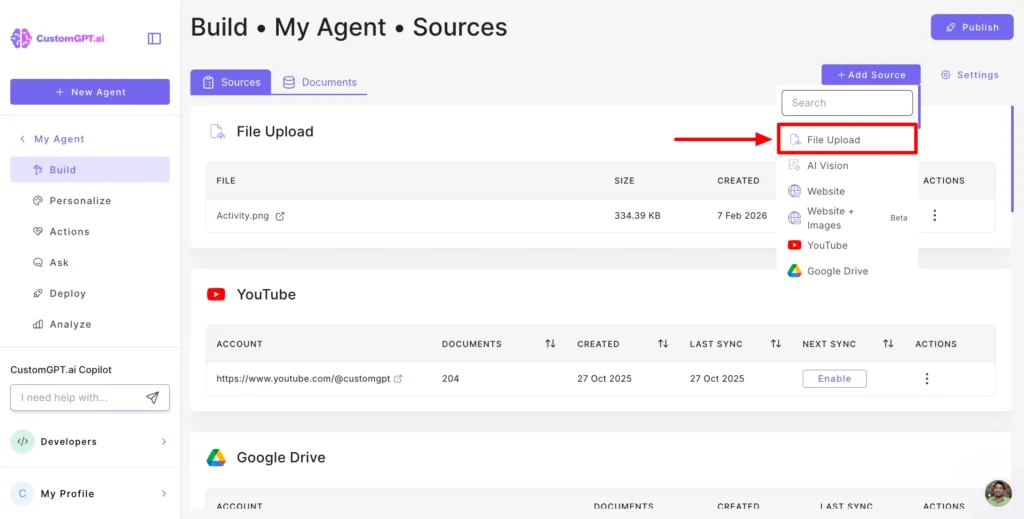
Once you have collected all the valuable information it’s time to integrate these sets of data into CustomGPT.ai. You can train your CustomGPT.ai chatbot model on these data in two ways. Either:
- Upload the Sitemap URL, or
- Upload documents and files into the CustomGPT.ai interface
To do so you need to follow these few simple steps:
- Login to your CustomGPT.ai account.
- Click on the dashboard and Create a New Agent (Your chatbot model). You can also upload the data in the form of documents. CustomGPT.ai supports 1400+ different file formats. Because of this multiple data integration capability of CustomGPT.ai, it can handle large amounts of data easily and efficiently.

- Go to the settings of your chatbot and click on Data.
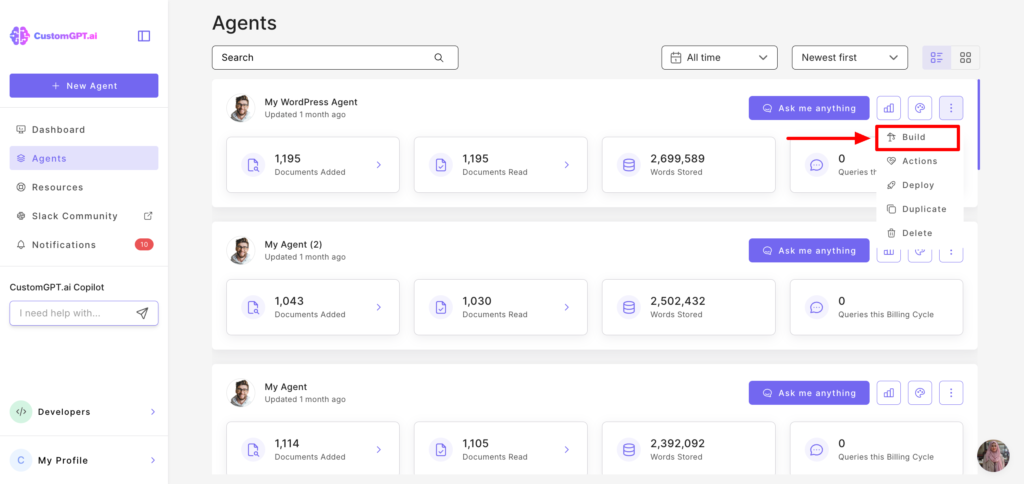
- Now you can upload sitemap and documents here.
Step 4: Ask Question & Analyze the Output
After feeding data to CustomGPT.ai in the last step, your chatbot is ready to provide you with detailed comprehensive information about your competitor’s strategy, products, features, and almost everything about their website.
Here are 10 questions to get you started:
- Product Features Comparison: “What are the key differences in product features between [our company]’s product and [our competitor]’s product?”
- Pricing Strategies: “How does [our company]’s pricing model compare to [our competitor]’s pricing strategies?”
- Customer Feedback Trends: “What are the most common complaints or praises customers have for [our competitor]’s products?”
- Marketing Tactics: “What marketing strategies are [our competitors] using that seem to be most effective?”
- Innovation Trends: “What new technologies or innovations are [our competitors] investing in currently?”
- Sales Channels Analysis: “Which sales channels are most effectively used by [our competitors]?”
- Customer Service Practices: “How do [our competitor]’s customer service practices differ from [our company]?”
- Brand Perception: “What is the general public’s perception of our brand versus our competitors?”
- SWOT Analysis: “Can you perform a SWOT (Strengths, Weaknesses, Opportunities, Threats) analysis for [competitor’s name]?”
- Regulatory Compliance: “How are our competitors handling regulatory compliance in different regions compared to us?”
Be mindful to ask questions that can be answered by the data you provided. If you need more data, then find it, and add it!
Based on these responses generated by CustomGPT.ai, you can get a detailed analysis by revealing trends, patterns, and sentiments within the collected data. These insights provide you the competitive strategies behind effective competitive intelligence.
Step 5: Take Action
Now after processing all the competitor’s data, it’s time to take action. It is not about understanding your competitors it’s about outsmarting them. Use the information provided by CustomGPT.ai and create your business strategy accordingly. By this, you can position your business for a competitive edge by adjusting marketing approaches or refining product offerings.
Pulling it all Together
To sum up, we’ve explored how CustomGPT.ai can revolutionize competitor research by simplifying data gathering and analysis. This powerful tool helps in comparing product features, understanding pricing strategies, and gaining insights into market trends.
By collecting and analyzing competitor data, CustomGPT.ai enables businesses to make informed decisions and stay ahead. In our next post, we’ll dive into how CustomGPT.ai can be applied specifically to social media analysis, providing a deeper understanding of competitive dynamics in the digital space. Stay tuned for more insights on leveraging CustomGPT.ai for comprehensive social media competitive research.
Frequently Asked Questions
How can AI speed up competitor research for a small team?
AI speeds competitor research by turning scattered sources into one searchable workspace. Instead of reopening websites, PDFs, product docs, and social posts one by one, you can ask direct questions about features, messaging, reviews, or pricing and get answers from the material you uploaded. Bill French described the performance impact this way: “They’ve officially cracked the sub-second barrier, a breakthrough that fundamentally changes the user experience from merely ‘interactive’ to ‘instantaneous’.”
What data should you include in an AI competitor analysis knowledge base?
Start with the source types listed in the use case: a competitor’s homepage, product documentation, marketing materials such as PDFs or PowerPoints, pricing packages, customer reviews, and social media data. Add your own homepage and product documentation too so you can compare claims side by side. MIT’s ChatMTC shows why multi-source organization matters: it made entrepreneurial knowledge available 24/7 across 90+ languages with zero reported hallucinations.
Can AI keep track of competitor website and social changes on an ongoing basis?
Yes, if you keep refreshing the underlying sources. The use case specifically highlights website and social media monitoring, and the platform supports ingesting websites, URLs, documents, audio, and video. In practice, ongoing monitoring works best when you regularly reload updated public content so answers reflect the latest material you collected rather than a one-time snapshot.
How do you stop an AI competitor research tool from hallucinating or mixing up brands?
Use a retrieval-based setup that answers only from uploaded sources and shows citations. The provided benchmark says CustomGPT.ai outperformed OpenAI in RAG accuracy, and the product includes anti-hallucination with citation support. To reduce brand mix-ups, keep each competitor’s website, documents, reviews, and social content in separate source groups, and keep your own company material separate for comparison.
Is setup hard if you want one AI workspace for several competitors?
Setup can stay lightweight if you start small. The use case says you can create a chatbot in minutes, train it from a website sitemap, and load many file types. A practical rollout is to begin with one competitor, test the questions your team actually asks, and then add more source groups once the answers stay clean. Stephanie Warlick summed up the knowledge-centralization benefit this way: “Check out CustomGPT.ai where you can dump all your knowledge to automate proposals, customer inquiries and the knowledge base that exists in your head so your team can execute without you.”
What kinds of competitor questions can an AI knowledge base answer?
It is best for grounded questions that depend on exact source content. Examples include: what features a competitor highlights, how its messaging has changed, what pricing packages or reviews mention specific objections, and how your own product documentation compares. The recommended inputs include competitor websites, product documentation, marketing material, pricing packages, customer reviews, social media data, and your own materials, so answers can stay tied to collected evidence.
Related Resources
If you’re refining your competitor research process, these resources add useful context around workflows, analysis, and knowledge management.
- AI Content Brief Workflow — See how an AI-assisted briefing process can help turn competitor insights into clearer, more strategic content planning.
- Enterprise Knowledge Search — Explore how CustomGPT.ai helps teams search across large internal knowledge bases to surface fast, reliable answers at scale.
- How CustomGPT.ai Works — Get a practical overview of how the platform ingests content, connects knowledge, and delivers accurate AI responses.
- Market Analysis GPTs — Learn how CustomGPT.ai can be configured for market analysis tasks, including tracking trends, positioning, and competitive signals.
- Custom Knowledge Management — This guide explains how CustomGPT.ai supports structured, searchable knowledge management for teams working with complex information.