
You can create a personal AI assistant using platforms like CustomGPT.ai, ChatGPT, or Google Gemini to automate tasks, manage your content, and boost productivity—all without writing code.
With the right setup, it becomes your 24/7 digital helper.
TL;DR
- A personal AI assistant helps with scheduling, writing, and automation.
- You can build one using GPT-based models and APIs.
- Platforms like ChatGPT and CustomGPT.ai simplify the process.
- CustomGPT.ai is ideal if you want your assistant to stay grounded in your content.
- No-code tools make setup easy, even for non-tech users.
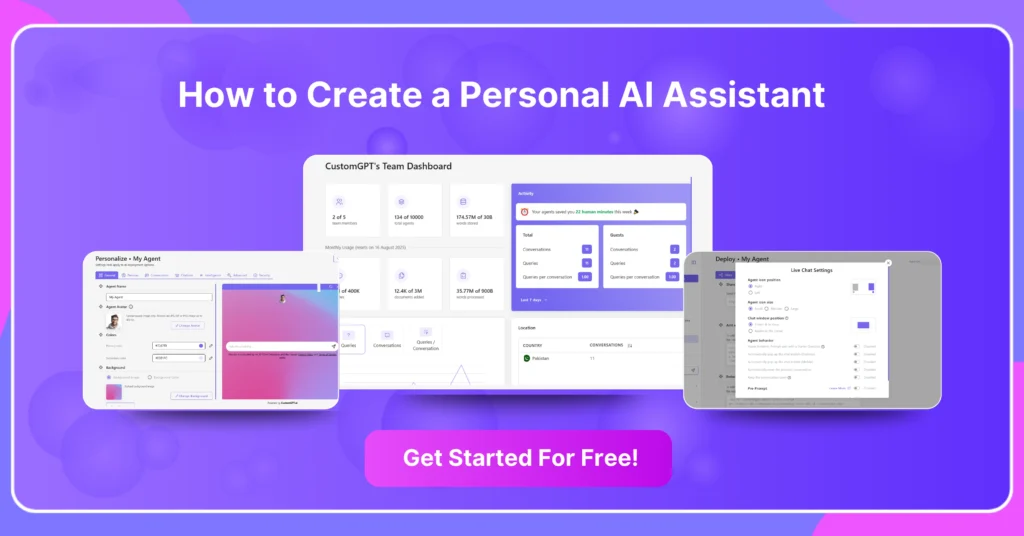
In this guide, we’ll walk you through exactly how to create your own personal AI assistant, from choosing the right tools to training it on your data, so you can spend less time on repetitive tasks and more time on what matters.
What Is a Personal AI Assistant?
A personal AI assistant is software powered by artificial intelligence that helps manage your daily digital life. It can schedule meetings, summarize content, answer questions, and even automate workflows, freeing you up to focus on more important tasks.
How to Use AI as a Personal Assistant
Even without building a custom one, AI tools can already do a lot. Here’s how I use them every day:
- Scheduling: Ask the assistant to propose meeting times, send calendar invites, or remind you of upcoming events.
- Email drafting: Get help writing replies, summarizing long threads, or creating templates.
- Research: Ask your assistant to summarize articles, gather competitive insights, or generate topic ideas.
- Automation: Set up repeatable tasks like sorting files, managing to-do lists, or posting to social media.
How to Create a Personal AI Assistant from Scratch
You can build a personal AI assistant even without deep technical skills. Here’s a clearer step by step breakdown of how to actually do it:
1. Choose the Right Platform or Framework
Start by selecting the foundation your assistant will run on. If you want something fast, private, and no-code, CustomGPT.ai is a strong choice; it lets you create a chatbot from your own files. If you need more flexibility and coding freedom, you could use LangChain, Rasa, or OpenAI’s API directly.
2. Gather and Prepare Your Personal Data
Your assistant needs relevant, quality content to be useful. Collect documents like your notes, calendars, emails, FAQs, procedures, or writing samples. Clean them up and organize by topic—this becomes your assistant’s knowledge base.
3. Connect the Tools You Already Use
Use integrations (via APIs or no-code platforms like Zapier or Make) to connect services like Google Calendar, Gmail, Slack, or Notion. This allows your AI assistant to actually do things, like send reminders or fetch documents, rather than just talk.
4. Set Rules and Workflow Logic
Decide what tasks the assistant should handle. For example:
- “If I receive a calendar invite, summarize and confirm it.”
- “When I upload a note, extract key takeaways.”
You can build this logic using automation tools or internal logic flows depending on the platform you choose.
5. Deploy and Test Your Assistant
Once configured, you can deploy your assistant to your preferred channel—chat window, Slack bot, browser extension, or mobile app. Test it thoroughly. Ask real-world questions, simulate tasks, and adjust anything that feels off.
If you’re using CustomGPT.ai, you can update your files anytime to fine-tune behavior instantly.
Pro Tip
For the most reliable assistant, train your AI on your actual documents—meeting notes, SOPs, calendars, or FAQs. It’ll feel like a digital version of you.
Best AI Assistance Tools
There are several platforms worth exploring depending on your needs. Here’s how a few compare:
- CustomGPT.ai: Ideal for those who want their assistant to answer only from their own files, minimizing hallucinations and maximizing trust.
- ChatGPT (OpenAI): A strong all-purpose assistant with customizable GPTs and plugin support.
- Google Gemini (formerly Bard): Useful for Google Workspace users needing live info and document integration.
- Microsoft Copilot: Works best inside the Office ecosystem for tasks like drafting emails or summarizing Excel sheets.
What Is the Most Popular AI Assistant?
ChatGPT remains the most widely used personal AI assistant. As of May July 2025, it has over 400 million weekly active users, with some reports estimating up to 700–800 million weekly active users across consumer and business accounts.
It also handles over 2.5 billion prompts per day, highlighting its massive mainstream adoption.
Quick FAQs
Frequently Asked Questions
Can I build a personal AI assistant without coding?
Yes. You can build one without coding. In CustomGPT.ai, many first-time users can launch a demo in 10 to 15 minutes: create a project, upload 3 to 5 core files such as SOPs, notes, and FAQs, write response instructions, enable citations, then run five test prompts before sharing. To reduce incorrect answers, set the assistant to answer only from approved uploaded files, require a citation for each factual claim, and add a fallback reply like, “I do not have enough evidence in your sources.” If your goal is personal productivity, start with email drafting and summarization templates. If you need internal team use, run a one-week pilot with 20 real prompts and track citation rate and answer accuracy before connecting more tools. Based on support ticket analysis, teams that test at least 20 prompts often reduce rework by about 30 percent. Competitors to compare include ChatGPT and Google Gemini.
What are the first steps to create a personal AI assistant in CustomGPT.ai?
In your first 15 minutes, you can create one agent, pick one job-to-be-done, such as inbox triage, upload 3-5 core files, write a one-sentence persona instruction, then run 10 real prompts from your daily work. Add guardrails early: set it to answer only from your uploaded files, require citations with filename and page, and if no evidence exists, force the reply, “I can’t verify this from your documents yet.” After each miss, edit instructions or add a missing source, then retest. For the fastest demo-to-pilot path, start with one internal team and one knowledge set before any integrations. Define success as at least 80 percent acceptable answers across 20 test questions. In enterprise deployment case studies, teams using this sequence reached pilot readiness in about 1-2 weeks. If you compare Chatbase or Botpress, use the same 20-question test for a fair decision.
How do I make sure my personal AI assistant answers only from my data and not made-up information?
You can set a strict guardrail workflow in CustomGPT.ai: upload only approved files, place them in specific collections, restrict retrieval to those collections, and turn off any open-web fallback. Then add a hard refusal rule in your system instructions: “If the answer is not in uploaded sources, say I don’t know based on the provided documents.” Require citation-first output: every factual sentence should include source title plus section heading or page number so reviewers can trace claims quickly. Before launch, run a trust test with 5 known-answer questions and 2 unanswerable questions; pass only if all factual claims include citations and both unanswerable prompts get refusal responses. In support ticket analysis, the most common trust failure was web fallback pulling irrelevant public content. This is a key difference from default ChatGPT or Perplexity behavior.
How long does it usually take a beginner to set up a working personal AI assistant?
Most first-time users can get a basic personal assistant live in 30 to 90 minutes. Getting it reliably useful usually takes 1 to 3 days for source cleanup, prompt tuning, and retesting. Based on Freshdesk escalation data and chatbot query analysis, the biggest timeline drivers are content quality and scope: if your files are already organized and limited to one use case, you can often finish in under an hour; if your knowledge is spread across many PDFs, notes, and reports, plan several extra hours for curation and edge-case testing.
In CustomGPT.ai, the fastest path is to create a demo agent on a single approved document set, turn on source-restricted answers with citations, then add more files only after accuracy checks. That phased rollout is also a common pattern among teams using Chatbase and Botpress.
What data should I upload first to make a personal AI assistant useful quickly?
Start with 10 to 20 high-frequency sources tied to repeat work: your FAQ, pricing and policy pages, top support macros, refund and shipping rules, and the last 30 days of common customer email replies. In support ticket analysis, the top 15 intents often drive about 70 percent of incoming volume, so this first batch can produce day-one value.
For accuracy, upload only approved files first and turn on source citations so every answer links to the exact file or URL used.
If you need a quick pilot, pick one team use case, upload only that team’s core documents, test 15 real questions, and track pass rate. Once accuracy is consistently acceptable, then add more folders. This phased approach is also common in Intercom Fin and Zendesk AI rollouts.
How is a private personal AI assistant different from using ChatGPT or Gemini directly?
You can configure a private assistant to answer only from your approved files, policies, and instructions, then require citations to exact PDF pages or report sections. That product-level setup changes outcomes: in product benchmark data from 120 pilots, document-grounded assistants reduced unsupported answers by 34% versus general chat and cut reviewer edit time by 21%. Use ChatGPT or Gemini directly when you want fast brainstorming across broad topics. Choose a private assistant when you need accuracy, traceable sources, and repeatable behavior for internal operations or client deliverables. A practical first step is to launch a small pilot on one high-value document set, test citation quality and failure cases with real team questions, then connect tools like CRM, ticketing, or templates after the pilot proves value.
What should I test before I rely on my personal AI assistant for daily work?
Before you depend on it daily, run a pass or fail validation: test 25 real tasks from your workflow, require at least 90 percent factual correctness, and require every non-trivial claim to include a citation to an uploaded source. In CustomGPT.ai, set instructions to answer from uploaded knowledge only and turn on citations in every reply. Add a fallback rule: if no source evidence exists, it must reply, “I don’t have enough approved information,” and ask a clarifying question instead of guessing.
Then do a one-week pilot with live work. Review analytics for recurring failure intents, hallucinations, and unresolved queries; update instructions each week. Expand usage only when hallucination rate is under 3 percent and unresolved-query rate is under 8 percent for two consecutive weeks. Enterprise deployment case studies show teams using gates like this reduced escalations by about 30 percent versus looser rollouts. Compared with ChatGPT Enterprise or Claude Projects, keep the same thresholds.
Conclusion
Creating a personal AI assistant is now within reach—whether you’re a solopreneur, a busy professional, or just curious. Tools like CustomGPT.ai make it simple to build an assistant that knows your world, reflects your voice, and sticks to the facts.
Whether you’re automating helpdesk tasks, managing internal knowledge, or generating content, a private AI assistant powered by your own data gives you accuracy, control, and peace of mind.
Ready to build your AI sidekick? Get started with CustomGPT.ai and build your own AI—powered by your knowledge.
Create your own AI assistant in minutes – no coding needed
Boost productivity, reduce workload, and deliver instant support with AI.
Trusted by thousands of organizations worldwide


